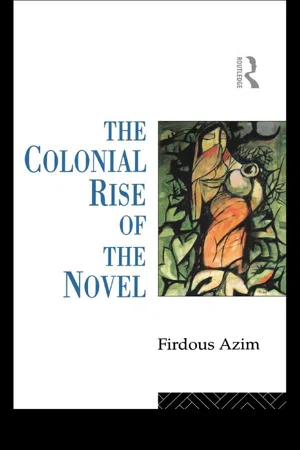
In this challening book, Firdous Azim, provides a feminist critique of orthodox accounts of the `rise of the novel' and exposes the underlying orientalist assumptions of the early English novel. Whereas previous studies have emphasized the universality of the coherent and consistent subject which found expression in the novels of the eighteenth century, Azim demonstrtes how certain categories: women and people of colour, were silenced and excluded. The Colonial Rise of the Novel makes an important and provocative contribution to post-colonial and feminist criticism. It will be essential reading for all teachers and students of English literature, women's studies, and post-colonial criticism.
- 264 pages
- English
- ePUB (mobile friendly)
- Available on iOS & Android
eBook - ePub
The Colonial Rise of the Novel
About this book
Information
1
THE SUBJECT/S OF THE NOVEL
This chapter will map out the main features in the encounter between the English text and the Third World post-colonial subject. Both positions in this encounter are problematic and complex—be it that of the Third World subject as s/he tries to decipher meaning through the master(’s) text, or that of the text, and the ways in which it is formulated as a central term in this meeting. The reason I have used the novel as the example of the master’s text is to highlight the complexities of this encounter. The novel, as a genre, has a difficult existence—at one level it has been given very reluctant status as literature, and was not even included in the Oxbridge literature syllabus until the 1930s (Lovell, 1987, Consuming Fiction, p. 12). The history of the novel traces the moment of its birth to the seventeenth and eighteenth centuries, and identifies the central narrating subject as its main formal property. The status of this central narrating subject acquires significance when allied to the contemporary linguistic and philosophical task that was an attempt to define the subject as homogeneous and consistent, and to delineate the constituents of the citizen-subjects brought into being by the Western Enlightenment discourse. Moreover, the novel has historically been linked to women, and feminist literary criticism has used this preponderance of women within the genre to bring into focus the status of other marginalised subjectivities in literary discourse. The novel, as the discourse of the master, occupies a somewhat anomalous position—its history is one of struggle with and against that master, while it also seeks to be recognised by it and to emerge with full status into the field of English, as both literary and pedagogical text. The history of the novel can either be read as a narrative of growth, or the focus can be kept on the dichotomies and contradictions within the genre, and the tensions of its positioning within literature. A juxtaposition of the novel with the Other subject/student of literature demonstrates the many layers that pertain to cultural encounters, and to the recounting of those encounters. So let us spend this first chapter looking at the postcolonial subject facing the English text, and, while completely eschewing the notion of a binary opposition, analyse the ways in which both terms in this encounter are structured.
THE COLONIAL SUBJECT
Examination of the post-colonial subject is best approached by way of Homi Bhabha’s introduction to Fanon’s Black Skin, White Masks (1986). What is most valuable about this analysis is the recognition of the split in the colonial world and the way that this split is seen to apply to both the coloniser and the colonised. Positions of dominance and domination are not easily compartmentalised, and echo each other. The fear/desire oscillation draws both subjects into a mirror-image. The notion of mimicry is manifested in the covert positioning of the colonised subject, who, while seeking to reproduce, subverts imperial power. Bhabha’s reading of Fanon highlights the intervention of colonialism in the formation of the subject. Psychoanalysis sees the human subject as formed in a dialectical relationship to the site of an imaginary Other (the Lacanian mirror-image). This site is now seen to be provided by the Other subject of colonialism—the Black or the native. However, the image of the Black man refracts and interrupts, rather than providing easily identifiable positions:
The Black presence ruins the representative narrative presence of Western personhood: its past tethered to treacherous stereotypes of primitivism and degeneracy… (Bhabha, 1986, Foreword to Fanon, Black Skin, White Masks,
p. xii)
The white man encounters his image as Other in confrontation with his Black double, to which he would like to ascribe a notion of primitiveness, origin or savagery. This easy identification is belied, as the Black man reflects not the Other but the ambivalence of the mirror-image: ‘The image is at once a metaphoric substitution, an illusion of presence and by that same token a metonymy, a sign of its absence and loss’ (Bhabha, 1986a, p. xviii). The image in the colonial mirror recreates the Black man as a twinning, a mimic or a double, and it is within this process of reflection that the identities of both coloniser and colonised are formed. Bhabha insists that colonial mimicry does not perform the task of a faithful reconstruction; instead it works as a refraction, and transforms the colonial situation, throwing back an unfamiliar, and even unrecognisable image into the colonial mirror.
The birth of the nations of the post-colonial world and the subsequent task of the building of the Third World nation—the struggle for liberation and the growth of nationalism within once-colonised countries—has to take into cognisance the relation between these movements and the colonial power. The struggle for national independence is often read—too easily—as a struggle for liberation from the colonial yoke, ignor ing the links and continuities with the colonial power. Similarly, the search for national identity often seeks expression in pre-colonial forms, ignoring the way that colonial identities and history have been irrevocably affected by the colonial experience. Romilla Thapar has said regarding our knowledge of Indian history that
A major contradiction in our understanding of the entire Indian past is that this understanding is derived from the interpretation of Indian history made in the last two hundred years.
(Thapar, 1966, A History of India, vol. 1, p. 3)
That is, during and after the period of British rule. Knowledge of our past has been filtered through the imperialist prism, and any historical re-creation has to keep this process in mind.
The subject of English in the Indian subcontinent has a special historical significance, as it was first introduced as an academic subject for the education of Indians. This history is traced in detail in Gauri Viswanathan’s pioneering work Masks of Conquest (1990). The significance of this historical fact needs to be reiterated. English as an academic discipline arose out of a need for the colonial power to define its own identity, and this definition was guided by and kept the colonial subject/terrain/task constantly in view. Bhabha’s mimetic relationship—the mirror-image—is in operation here: it is in confrontation/encounter with its colonised subject that the colonising power defines the terrain against which it would like to be identified. Macaulay, advocating the importance of English to the task of colonial governance, emphasised that it represented ‘the best part of the English nation’. English, according to Macaulay’s famous 1835 minute, was to serve a twofold purpose: British civil servants in India, schooled in the ‘best part of the English nation’, would successfully impress the natives with the glories of their colonial masters, and, at the same time, the introduction of English as a subject for Indians would create colonial subjects able to carry on some of the administrative and governing tasks of the British Empire. The Western-educated native was to act as a ‘conduit’ for the British.
Gauri Viswanathan’s very important study highlights the split in the colonial situation:
The split between the material and discursive practices of colonialism is nowhere sharper than in the progressive rarefaction of the rapacious, exploitative, and ruthless actor of history into the reflexive subject of literature.
(Viswanathan, 1987, ‘The Beginnings of English Literary Study in British India’, OLR, p. 23)
This split divides the coloniser into dichotomous roles—as a carrier of culture and as a rapacious governor of colonial territory. The debates around colonial education agreed on one point: English education was to function as a buttress, filling in the gaps in the edifice of British power. The educational project, in all its aspects—in its Anglicist or Orientalist phase, in the debates between a secular and missionary/religious education—was concerned with the building of this buttress. English literature as a subject for academia was born in this context.
The imperial purpose that English served has been seen in other studies of the history of English as well. Baldick (1983) stresses the role of English as a ‘civilising subject’, both within England and in the colonies. Literary criticism had always performed an ideological task. The ‘rise of English’ is traced from the latter half of the nineteenth century by Terry Eagleton (1983). English literature (within England) was introduced to bring hitherto socially marginalised sections into the fold of tertiary education, and was first institutionalised as a subject in Working Men’s and Women’s Colleges, i.e., it had been relegated in the higher education system to that section of the population who were deprived of Latin and Greek (a classical) education. Arnold’s proposal to establish poetry/ literature as a substitute for religion is a sufficient indication of the ideological task English was meant to serve.
English, both for the colonisers and the colonised, was designed to give an impression of English cultural superiority. The designing of English as a subject in the curriculum always had to keep the colonial mir ror image in direct view. The history of the introduction of English into the curriculum points significantly towards the place of culture in the process of political and economic domination.
In the Indian context, despite the inbuilt power hierarchies within the encounter, the situation can also be seen as a meeting of cultures, a cultural encounter within the colonial terrain. In the Indian subcontinent the establishment of English education had to take account of existing indigenous educational systems. The debate between the amalgamation or rejection of existing Indian pedagogy and culture divides the history of British rule into Orientalist and Anglicist camps or phases. English education was introduced as a secularised pedagogical practice, the government being opposed to the task of religious conversion favoured by the missionaries (the debate between the missionaries and the government educational institutions is recorded in detail by Viswanathan). The secular nature of British education in India split the colonial terrain further along lines of secular (colonial) or religious (native) education. Religion remained part of the indigenous terrain, whereas the public modern colonised world was to be faced armed with the intellectual tools imparted by the colonial masters.
Indian acceptance of British education was guided by the attractions of the job market. Significantly, a religious education was kept out of the official educational curriculum, and the Western address to the Indian subject was through the discourse of the eighteenth-century Enlightenment. A separation of religion from official education and the relegation of Indian thought to the religious sphere served as an ideal means to bring to the forefront concepts of rationalism, equality and humanism, which were then equated solely with the Western Enlightenment tradition. In this context, the teachings of Tom Paine became more potent than the Bible could have been, and the glories of the West shone with greater brilliance when compared with the atavism and darkness that was seen to accrue to indigenous forms of learning.
*
The experimentation with English in India as a pedagogical subject provides an example of the status of culture in the establishment of political and economic domination. It is a colonial encounter of a different kind, where the position of both subject and student is in the process of construction. British pedagogical practice was not introduced into virgin soil, but had to consider existing cultural and educational practices. The native response to this was to devise ways through which the benefit of Western learning and science could be made commensurate to native/ Indian beliefs and systems of learning. Gauri Viswanathan’s book has traced in great detail the coloniser’s strategies, designed to keep political power intact. The other side of the story (which is yet to be told) is how the native educated elite devised ways in which it could benefit from Western learning and science, while keeping native/Indian identities intact. The best illustration of this can perhaps be found within the histories of the two famous Calcutta colleges—the Hindu college and the Sanskrit college— and the ways that both Bengali and English were emerging in the early part of the nineteenth century in Bengal to further and spread the ‘light’ of Western education in the region.1
THE TEXT: ORIGINS OF THE NOVEL
Examinations of the origins of the English novel take us back to the eighteenth century and can be linked to the philosophical and ideological debates around the status of the human individual and its relationship with language. The notion of a beginning echoes the search for origins that lies at the heart of the eighteenth-century discourse on human subjectivity and the rise of human civilisation. My examination of the ‘origins’ of the English novel will be linked in with the European colonial project, and the ideological and political implications of the dissemination of the novel as literature and its function in the creation of the colonial terrain.
Novel criticism, which can be seen to have originated with Watt’s influential The Rise of the Novel (1957), squarely traces the origins of the form to the rise in capitalist practices. Watt’s largely sociological and economic analysis concentrates on factors such as the growing rate of literacy, the shift in the writing profession from the institution of patronage to that of publishing houses, the proliferation of bookshops and circulating libraries. Watt’s note on the growing leisure of women, and their entry into the market as consumers of fiction, has a significance for the feminist reader. Watt’s thesis is interesting in that it draws in the contemporary philosophical discourse on human subjectivity and its relation to language in the delineation of the development of the novel. One of the hallmarks of the novel—the creation of individual characters, marked off by a name, or the narrative of the ‘life’ or ‘adventures’ of this character—is part of the discourse around the creation of the individual human subject undertaken within contemporary philosophical disquisitions. John Locke’s Essay Concerning Human Understanding (1690), describing the growth and development of a coherent human subject and the relationship between that subject and language, is the most well-known contemporary piece of philosophical writing.
Let us look briefly at Locke’s essay, as the notion of subjectivity developed within that treatise has important links with other subjectivities or other states of subjectivity that need to be annihilated in order to reach the position of unity that was envisaged as the ideal. Locke sees the child as gathering a use of language in its progress towards human subjectivity. Through memory, association and consent, human societies and the individuals placed within them, assign significance to words. The child, placed within this signifying system, learns a use of language, and finds its place within the system. While this consistent brick-by-brick building process is described, the Essay nonetheless is forced to encounter gaps and failures in the process. Locke feels constrained to include a chapter entitled the ‘Abuse of Words’, where the properties of wit and eloquence are discussed. The deceptive properties of language are highlighted, where the user deliberately manipulates words so that their meaning is no longer easily decipherable, and the perfect correspondence between language and meaning belied. Significantly, the deceptive properties of wit and eloquence are equated in Locke’s Essay with the ‘fair sex’. Similarly, Locke’s image of a consistent growth of subjectivity is mar red as the human consciousness under production itself records lapses in this process of growth, exemplified in states such as madness or drunkenness. Locke’s philosophical search is aimed towards the creation of a system of ideal correspondence, but is constantly balked by gaps and fissures which it is forced to encounter, both in the concept of a consistent subjectivity and in the linguistic system in which this subject is seen to be placed.
Locke has emphasised psychological processes, such as memory and reflection, in the gradual building up of the storehouse of knowledge in the human mind:
The Senses at first let in particular Ideas, and furnish the yet empty Cabinet: and the Mind by degrees growing familiar with some of them they are lodged in the Memory…
(Locke, 1961, vol. 1, pp. 15–16)
This stress on the function of memory brings into focus the concept of representation. Other philosophers, for example Diderot in D’Alembert’s Dream (1769), link the subject together by memory. Memory functions as a trace or the representation of the object, rather than the object itself. Diderot’s treatise takes the human subject away from a purely sensational existence to a consideration of human consciousness, which operates by recreating or representing images of sensory data. A simple equation between sensory perception and data and human perception is broken down, and the question of the relation between the subject and representational and signifying systems begins to be debated.
Fiction, theatre, representation—these are the words used to describe the human subject (in the works of Locke, Diderot, Hume and Hobbes, to name the most prominent thinkers of the period). Language, in eighteenth-century linguistic speculation, was seen as a perfect system of representation, issuing from the coherent and unified subject, which this system presupposed. But, when we look at the progress of linguistics in that era, we see that gaps emerged within this conception, and that representational form, ‘objective’ reality and subjectivity could never come together as an ideal whole.
The political ramifications of this project are visible when the concept of development of language is used as a measure of human civilisation. Again, the search for the origins of human civilisation is based on a notion of development from animal or pre-linguistic...
Table of contents
- COVER PAGE
- TITLE PAGE
- COPYRIGHT PAGE
- ACKNOWLEDGEMENTS
- LIST OF ABBREVIATIONS
- INTRODUCTION
- 1. THE SUBJECT/S OF THE NOVEL
- 2. SLAVERY AND SEXUALITY IN OROONOKO
- 3. DANGEROUS IDENTITY: THE MANY DISGUISES OF ROXANA
- 4. CHARLOTTE BRONTË/CURRER BELL: SEXUALITY, THE TEXT AND THE WOMAN NOVELIST
- 5. THE BRONTË CHILDREN AT PLAY
- 6. THE POLITICS OF LANGUAGE IN THE PROFESSOR
- 7. REREADING FEMINISM’S TEXTS: JANE EYRE AND SHIRLEY
- LANGUAGE, SUBJECTIVITY AND LITERATURE: AN AFTERWORD
- NOTES
- BIBLIOGRAPHY
Trusted by 375,005 students
Access to over 1.5 million titles for a fair monthly price.
Study more efficiently using our study tools.
Frequently asked questions
Yes, you can cancel anytime from the Subscription tab in your account settings on the Perlego website. Your subscription will stay active until the end of your current billing period. Learn how to cancel your subscription
No, books cannot be downloaded as external files, such as PDFs, for use outside of Perlego. However, you can download books within the Perlego app for offline reading on mobile or tablet. Learn how to download books offline
Perlego offers two plans: Essential and Complete
- Essential is ideal for learners and professionals who enjoy exploring a wide range of subjects. Access the Essential Library with 800,000+ trusted titles and best-sellers across business, personal growth, and the humanities. Includes unlimited reading time and Standard Read Aloud voice.
- Complete: Perfect for advanced learners and researchers needing full, unrestricted access. Unlock 1.5M+ books across hundreds of subjects, including academic and specialized titles. The Complete Plan also includes advanced features like Premium Read Aloud and Research Assistant.
We are an online textbook subscription service, where you can get access to an entire online library for less than the price of a single book per month. With over 1.5 million books across 990+ topics, we’ve got you covered! Learn about our mission
Look out for the read-aloud symbol on your next book to see if you can listen to it. The read-aloud tool reads text aloud for you, highlighting the text as it is being read. You can pause it, speed it up and slow it down. Learn more about Read Aloud
Yes! You can use the Perlego app on both iOS and Android devices to read anytime, anywhere — even offline. Perfect for commutes or when you’re on the go.
Please note we cannot support devices running on iOS 13 and Android 7 or earlier. Learn more about using the app
Please note we cannot support devices running on iOS 13 and Android 7 or earlier. Learn more about using the app
Yes, you can access The Colonial Rise of the Novel by Firdous Azim in PDF and/or ePUB format, as well as other popular books in Literature & Feminist Literary Criticism. We have over 1.5 million books available in our catalogue for you to explore.