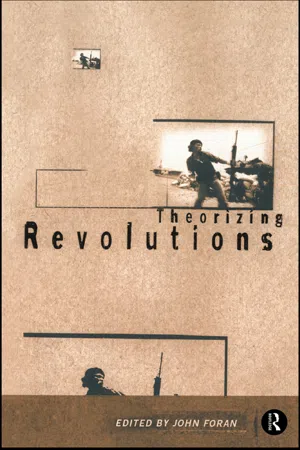
In Theorizing Revolutions, some of the most exciting thinkers in the study of revolutions today look critically at the many theoretical frameworks through which revolutions can be understood and apply them to specific revolutionary cases.
The theoretical approaches considered in this way include state-centred perspectives, structural theory, world-system analysis, elite models, demographic theories and feminism and the revolutions covered range in time from the French Revolution to Eastern Europe in 1989 and in place from Russia to Vietnam and Nicaragua.
- 320 pages
- English
- ePUB (mobile friendly)
- Available on iOS & Android
eBook - ePub
Theorizing Revolutions
About this book
Information
Part I
THE FRONTIERS OF STRUCTURES
1
STATE-CENTERED APPROACHES TO SOCIAL REVOLUTIONS
Strengths and limitations of a theoretical tradition
Jeff Goodwin
I argue in this chapter that state-centered theoretical approaches comprise some of the most powerful analytic tools that are currently available to analysts of social revolutions. By contrast, fashionable post-structuralist conceptions of power simply beg too many fundamental questions. Certain types of cultural analyses, as we shall see, as well as the recent turn to “civil society,” are somewhat more useful. But state-centered approaches are even more helpful for resolving the key puzzles that are distinctive to the study of social revolutions.1 (Throughout, I refer to state-centered approaches in the plural, because—as I shall detail—there is no single statist perspective or argument, but several overlapping ones.) Of course, state-centered analysis, like any theoretical tradition, has its blindspots and limitations, which I shall also address. Fortunately, these limitations point the way toward a more powerful synthetic perspective on revolutions and collective action.
What is the statist theoretical tradition all about? All of the state-centered approaches that I shall review emphasize or “center” a particular set of causal mechanisms—namely, those processes whereby states (foreign as well as domestic) shape, enable, or constrain economic, associational, cultural, and even social-psychological phenomena. State-centered theorists argue that these mechanisms are, for certain purposes, more powerful or causally important than (or at least complementary to) a range of alternative causal processes—for example, those emphasizing social class, civil society, culture, or social psychology. Statist perspectives, then, are intentionally one-sided.
And yet partly because of this one-sidedness, state-centered approaches are exceptionally valuable for understanding social revolutions. This follows, at least in part, from the fact that revolutions themselves are unusually state-centered phenomena. As Charles Tilly notes, “whatever else they involve, revolutions include forcible transfers of power over states, and therefore any useful account of revolutions must concern, among other things, how states and uses of force vary in time, space and social setting.”2
I should note at the outset that I do not write as an unbiased observer. My own empirical investigations into insurgencies and social revolutions have been resolutely state-centered.3 I must obviously believe, then, that statist approaches to social revolutions are especially powerful! At the same time, I shall try to clarify the various limitations of this perspective.4 After discussing the considerable strengths of state-centered approaches to social revolutions, accordingly, I shall review the main weaknesses of statist analysis and suggest some of the theoretical resources that are available for redressing them.5 I also examine how certain strengths and limitations of state-centered approaches are exemplified in a case study of the Cuban Revolution.
Before discussing the analytic strengths of state-centered approaches to social revolutions, let me begin by distinguishing the distinctive forms of state-centered analysis. Understanding the variety of statist perspectives is important for appreciating both the strengths and limitations of this theoretical tradition.
FOUR TYPES OF STATE-CENTERED ANALYSIS
A good deal of confusion has resulted from the failure of proponents and critics alike to distinguish among—or even to note the existence of—four distinctive versions of statist analysis, namely, the state-autonomy, state-capacity, politicalopportunity, and state-constructionist approaches. Because individual states exist within an international state system, furthermore, each of these approaches has geopolitical as well as domestic dimensions.
The state-autonomy perspective, with which the others are most often conflated, emphasizes the variable autonomy of state officials or “state managers” from the dominant social class, civil society more generally, or other states.6 According to this perspective—which derives from Max Weber’s political sociology—politicians, bureaucrats, and military officers may develop identities, interests, ideologies, and (ultimately) lines of action that are very different from those of organized groups in civil society or the officials of other states; they may not be usefully conceptualized, accordingly, as representatives of powerful capitalists, interest groups, the “popular will,” or foreign potentates. In fact, the interests of state officials in accumulating resources (through taxes, for example) and mobilizing the population (for war against other states, for example) may sometimes conflict with the interests of powerful social groups (including the dominant class), not to mention external actors. Overt conflicts between state officials, on the one hand, and economic elites or mobilized groups, on the other, are typically adduced as evidence for this perspective.
A second statist approach—which may also be traced to Weber—emphasizes the actual material and organizational capacity (or lack thereof) of state officials to implement successfully their political agenda, even in the face of opposition from powerful actors in civil society or from other states. This perspective focuses on variations in states’ fiscal resources, military power, and organizational reach (or “penetration”) into civil society—what Michael Mann has termed the “infrastructural power” of states.7 Key determinants of such variations include the organizational or bureaucratic rationality of state institutions as well as the extent to which states confront threats from other states that require war preparation. (Some states also receive large infusions of resources from other states; a state’s position in the international state system, in other words, may strongly shape its capacities.)8 While this second, statecapacity approach is typically utilized alongside the state-autonomy perspective, the two are analytically distinct; state officials, after all, may have very different aims than economic elites or other states and yet lack the capacity actually to implement their preferred policies. State autonomy, in other words, does not necessarily imply state capacity, or vice versa.
A third state-centered approach emphasizes how the apparent responsiveness or permeability of states or “polities” influences the ability of mobilized social groups to act collectively or substantively influence state policies.9 More specifically, “political opportunities” (which mobilized groups themselves usually attempt to create or manipulate) are deemed necessary—in addition to (for example) grievances and organization—for people to act collectively or to shape the agenda of state officials.10 At the very least, according to this politicalopportunity perspective, the state must either lack the means (infrastructurally speaking) or simply be unwilling to violently suppress such groups; it also helps if these groups can find powerful allies within a divided state or polity.11 And geopolitics is again important here. Some social groups, for example, may form alliances with, and receive significant resources from, foreign states; and international wars and imperial over-extension have often produced political crises that have created unprecedented opportunities for political mobilization.12
There exists, finally, what Theda Skocpol calls a “Tocquevillian” approach, which emphasizes how states shape the very identities, social ties, ideas, and even emotions of actors in civil society.13 To my mind, this is perhaps the most interesting statist approach of all, yet it is often elided in discussions of statecentered theory or else conflated with the political-opportunity perspective. I propose that we label this approach the state-constructionist perspective,14 because it examines the ways in which states help to construct or constitute various aspects of civil society that are (falsely) conceptualized as wholly exterior to states.15 In other words, the focus here—as against a political-opportunity approach—is not so much on whether a state or polity provides incentives or opportunities to act for already existing networks of like-minded people; rather, state constructionism emphasizes how the actions of foreign as well as domestic states help to make cognitively plausible and morally justifiable certain sorts of collective grievances, emotions, identities, ideologies, and associational activities (but not others) in the first place.16
ANALYTIC STRENGTHS OF STATE-CENTERED APPROACHES TO REVOLUTIONS
How are these various theoretical approaches useful for understanding social revolutions in particular? In what follows, I emphasize how statist approaches help to resolve a series of key problems that are distinctive to the study of social revolutions.
The centrality of state power and state breakdowns
To begin with, consider this puzzle: Why is social revolution, unlike many other forms of social conflict, a peculiarly “modern” phenomenon? Why, in other words, have social revolutions occurred with considerable frequency during the nineteenth and twentieth centuries, yet seem not to have occurred at all before the seventeenth? This puzzle concerns the “conditions of existence” of revolutions—that is, the background conditions (which have widely existed, evidently, for only the past century or two) that are necessary for social revolutions to occur. A state-centered perspective offers a compelling solution to this puzzle: the international state system itself. In other words, no states, no revolutions. This basic proposition, frequently reiterated by Charles Tilly, is usually overlooked by analysts of revolutions; it is taken for granted by virtually all scholars of revolutions, including Marxists, culturalists, and state-centered analysts themselves.
From a state-centered approach, in other words, it is much more than a convention or a mere matter of convenience that scholars write books and articles about, for example, the “French,” “Russian,” and “Cuban” revolutions. In fact (as a state-capacity approach would suggest), prior to the emergence of consolidated national states,17 social revolutions as we now understand them—whether as radically transformative processes, a distinctive political repertoire, or a moral ideal—were simply impossible. Until the modern era, that is, there existed no institution with sufficient infrastructural power to remake extensive social arrangements in fundamental ways; the consolidated national state, however, made it possible to do—and to think of doing—just that. (Revolutionaries themselves, in fact, have often consolidated states precisely in order to remake societies.) Thus, while social conflict may be as old as humanity itself, the reality and ideal of radically transforming a “society,” “nation,” or “people”—the economic, political, and cultural arrangements of a large population—are coeval with the modern state system as it originated in Europe and was then transported and emulated around the globe.
This analysis immediately suggests a solution to another puzzle: Why are revolutionary movements, unlike other types of social movements, concerned with “seizing” or “smashing” state power? If the preceding analysis is correct, those who would radically transform modern societies must obviously concern themselves with the state. (If they do not, the state will certainly concern itself with them!) In other words, because the state enforces (through violence if necessary) the most fundamental “rules” of a society (whether these are codified as laws or not) by virtue of its control of the principal means of coercion, any radical recasting of these rules requires access to, and indeed a fundamental reorganization of, state power itself. Because of their actual and potential infrastructural power, in other words, states are necessarily the target (although not the only target) of revolutionary movements.
This view of revolutions, I should note, is shared by state-centered and Marxist analysts alike, even though the latter are otherwise keen to emphasize how class struggles are supposedly the driving force behind them. “The basic question of every revolution,” wrote Lenin, “is that of state power.”18 The task of revolutionaries, in his view, was not simply to change laws or to replace government officials, but rather to change the structural characteristics of the state—to create “an entirely different kind of power” with which society as a whole could then be recast.19 Perry Anderson similarly notes that
one of the basic axioms of historical materialism [is] that secular struggle between classes is ultimately resolved at the political—not at the economic or cultural—level of society. In other words, it is the construction and destruction of States which seal the basic shifts in the relations of production, so long as classes subsist.20
It follows that successful revolutionary movements must, at the very least, secure or “seize” state power. And this implies, by definition, that the old state must collapse; for if it persists in the face of a revolutionary challenge, then the revolutionaries have obviously failed to attain the sort of power that they need in order to change society as a whole in a more or less radical fashion.21
We now possess the solution to yet another conundrum: Why must the state break down, collapse, or capitulate for a revolution, unlike many other forms of social pro-test, to succeed? That state breakdowns create the sort of political opportunities necessary for full-fledged revolutionary change is perhaps the bestknown idea to emerge from statist analyses of revolution; it is a point that is central, for example, to Theda Skocpol’s influential state-centered study, States and Social Revolutions.22 In fact, Skocpol not only utilizes a politicalopportunity approach in order to explain why transformative, class-based revolts from below could occur in France, Russia, and China, but also employs a stateautonomy perspective in order to explain the political crises that created such opportunities in the first place. Indeed, one of the more interesting claims of Skocpol’s study is that the political crises that made revolutions possible in France, Russia, and China were not brought about by revolutionaries; rather, conflicts between dominant classes and autonomous state officials—conflicts, Skocpol emphasizes, that were produced or exacerbated by geopolitical competition—directly or indirectly brought about such crises, thereby opening up opportunities that rebellious lower classes and self-conscious revolutionaries seized, sometimes years later.
By illuminating the origins of, and the political opportunities created by, these sorts of state crises and breakdowns, state-centered approaches help to resolve yet another classic puzzle: Why do social revolutions occur when and where they do? It has become virtually obligatory for scholars to note that people are not often rebellious in the poorest of societies or during the hardest of times; and even where and when people are rebellious, and strong revolutionary movements form, they may not always be able to seize state power—unless, that is, they are able to exploit the political opportunities opened up by state breakdowns.
The limited utility of post-structuralist conceptions of power, at least for the analysis of revolutions, should now be apparent.23 In fact, any view of power as “decenter...
Table of contents
- COVER PAGE
- TITLE PAGE
- COPYRIGHT PAGE
- FIGURES AND TABLES
- CONTRIBUTORS
- AGKNOWLEDGEMENTS
- INTRODUCTION
- Part I: THE FRONTIERS OF STRUCTURES
- Part II: RE-CENTERING CULTURE AND AGENCY
- BIBLIOGRAPHY
Trusted by 375,005 students
Access to over 1.5 million titles for a fair monthly price.
Study more efficiently using our study tools.
Frequently asked questions
Yes, you can cancel anytime from the Subscription tab in your account settings on the Perlego website. Your subscription will stay active until the end of your current billing period. Learn how to cancel your subscription
No, books cannot be downloaded as external files, such as PDFs, for use outside of Perlego. However, you can download books within the Perlego app for offline reading on mobile or tablet. Learn how to download books offline
Perlego offers two plans: Essential and Complete
- Essential is ideal for learners and professionals who enjoy exploring a wide range of subjects. Access the Essential Library with 800,000+ trusted titles and best-sellers across business, personal growth, and the humanities. Includes unlimited reading time and Standard Read Aloud voice.
- Complete: Perfect for advanced learners and researchers needing full, unrestricted access. Unlock 1.5M+ books across hundreds of subjects, including academic and specialized titles. The Complete Plan also includes advanced features like Premium Read Aloud and Research Assistant.
We are an online textbook subscription service, where you can get access to an entire online library for less than the price of a single book per month. With over 1.5 million books across 990+ topics, we’ve got you covered! Learn about our mission
Look out for the read-aloud symbol on your next book to see if you can listen to it. The read-aloud tool reads text aloud for you, highlighting the text as it is being read. You can pause it, speed it up and slow it down. Learn more about Read Aloud
Yes! You can use the Perlego app on both iOS and Android devices to read anytime, anywhere — even offline. Perfect for commutes or when you’re on the go.
Please note we cannot support devices running on iOS 13 and Android 7 or earlier. Learn more about using the app
Please note we cannot support devices running on iOS 13 and Android 7 or earlier. Learn more about using the app
Yes, you can access Theorizing Revolutions by John Foran in PDF and/or ePUB format, as well as other popular books in Politics & International Relations & World History. We have over 1.5 million books available in our catalogue for you to explore.