- 256 pages
- English
- ePUB (mobile friendly)
- Available on iOS & Android
eBook - ePub
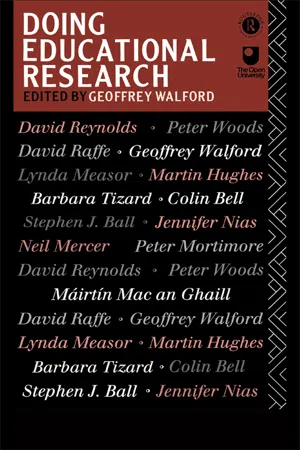
Doing Educational Research
About this book
Thirteen major educationalists offer semi-autobiographical accounts of their own influential research work, focusing on the practical and personal realities of the research process. Authors such as Barbara Tizard and Martin Hughes, Stephen J. Ball, David Reynolds and Peter Mortimore discuss their approaches to aspects of research from conception and funding of the project to information gathering and analysis, writing up and publishing.
Information
1
REFLEXIVE ACCOUNTS OF DOING EDUCATIONAL RESEARCH
Geoffrey Walford
There are many introductory books on social and educational research methods. Some of the most well known of these textbooks, such as those by Moser and Kalton (1982), Cohen and Manion (1980) and Hoinville et al. (1978) are widely used on undergraduate and postgraduate courses in universities and colleges and have been reprinted many times to serve successive cohorts of students. These books, and others like them, present research largely as an unproblematic process concerned with sampling, questionnaire design, interview procedures, response rates, observation schedules, and so on. They present an idealized conception of how social and educational research is designed and executed, where research is carefully planned in advance, predetermined methods and procedures followed, and ‘results’ are the inevitable conclusion. In essence, such books take what they perceive to be the methods used in the natural sciences as their model, and seek to present social and educational research as being equally ‘scientific’ in its methods.
In practice, however, it is now widely recognized that the careful, objective, step-by-step model of the research process is actually a fraud and that, within natural science as well as within social science, the standard way in which research methods are taught and real research is often written up for publication perpetuates what is in fact a myth of objectivity (Medawar, 1963). The reality is very different. There are now several autobiographical accounts by scientists themselves and academic studies by sociologists of science that show that natural science research is frequently not carefully planned in advance and conducted according to set procedures, but often centres around compromises, short-cuts, hunches, and serendipitous occurrences.
One of the earliest and most well known of these autobiographical accounts on natural science research is that by Nobel Prize winner James Watson (1968), who helped unravel the helical structure of DNA. His revelations of the lucky turns of events, the guesswork, the rivalries between researchers and personal involvement and compromise gave a totally different view of how natural science research is conducted from that given in methods textbooks. The personal and social nature of science research (and of writing about that process) is underlined by the somewhat conflicting account of the same research given much more recently by Watson’s co-Nobel Prize winner, Francis Crick (1989). Various sociologists of science have also looked in detail at the process by which scientific knowledge is constructed. The ethnographic study of the everyday world of the scientific laboratory by Latour and Woolgar (1979), for example, shows clearly how scientific ‘facts’ are not ‘discovered’, but are the result of an extended process of social construction.
Yet, while it is increasingly recognized that the individual researcher in natural science does not behave as an objective automaton, social and educational research has traditionally tried to justify its own research procedures by making them as ‘scientific’ and ‘objective’ as possible, and by aping what have been perceived to be the methods of the natural sciences. Most social science and educational research methods textbooks have abstracted the researcher from the process of research in the same way as have natural science textbooks. The social dimension of research is omitted and the process is presented as a cold analytic practice where any novice researcher can follow set recipes and obtain predetermined results. It is little wonder that when the novice researcher finds unforeseen difficulties, conflicts and ambiguities in doing research he or she will tend to see these as personal deficiencies arising from insufficient preparation, knowledge or experience. It is the belief of the contributors to this present book that the idealized models of research presented in traditional textbooks are a necessary part of understanding about research, but that they do not prepare novice researchers for the political and social realities of actual research practice. They need to be supplemented by rather different accounts of the research process in action.
The limitations of traditional research methods textbooks have gradually been recognized over the last decade or more, and therehas grown a range of ‘alternative’ books for students and practitioners, which aim to present more realistic accounts of the particular research practices that led to specific research reports. In these books the researchers themselves have written semi-autobiographic reflexive accounts of the process of doing research, in the hope that others will benefit from this sharing of practical experience. Sociologists, and in particular those engaged in more qualitative research, have tended to be the most forthcoming in their accounts, and Whyte’s (1955) appendix to his ethnographically based Street Corner Society is widely regarded as a classic of the genre. Within Britain, the most widely known and used collection of such accounts are those edited by Colin Bell and Howard Newby (1977), Colin Bell and Helen Roberts (1984) and Helen Roberts (1981). All of these collections, in their different ways, give accounts of the ‘backstage’ research activities and unveil some of the idiosyncrasies of person and circumstances which are seen as being at the heart of the research process. Although some of the contributors to these volumes deal with quantitative research, the majority of cases discussed are qualitative in their nature and thus, perhaps, lend themselves more easily to this type of self-analysis of methodology. Anthropologists have written similar accounts of their fieldwork for some time (see, for example, Wax, 1971). In contrast, it is noticeable that psychologists have been more reluctant than sociologists to move away from the security of their natural science research model, and there are no similar collections of reflexive accounts on key psychological works.
Few of the articles in these general collections on sociological research methods were concerned with sociology of education. Indeed, the only article on education intended for inclusion in Bell and Newby (1977) was not published due to possible libel action, and a modified version only appeared much later (Punch, 1986). Nevertheless, there have now been several collections which present the practical, political and personal side of educational research. In Britain, the first of these was the collection edited by Marten Shipman (1976), who managed to persuade six authors of highly respected research reports to write about the origins, organization and implementation of their projects, including the personal and professional problems that they had to overcome. He was unusually fortunate in being able to include authors of longitudinal quantitative research as well as detailed case studies and qualitative work. As with all such collections, the authorsresponded with differing degrees of candour, but some of the accounts were eye-openers to students trained only in the ‘scientific’ method.
During the mid-1980s there was an outpouring of four books edited by Robert Burgess which gathered together similar revelatory autobiographical accounts by educational researchers. The most important of these was The Research Process in Educational Settings (Burgess, 1984) which presented ten first-person accounts of research experience in ethnographic or case study work. The book has since become an Open University Set Book and is widely used in other universities and colleges. Burgess produced three more rather similar collections in 1985 (Burgess, 1985a-c), which discussed strategies and tactics for research, and examined methods of investigation in relation to theories, problems, processes and procedures. The relationship between research and policy and practice was also given prominence. These four collections by Burgess contain many valuable accounts, but they have the drawback of only being concerned with qualitative research, and omit consideration of quantitative research. A critical reader might gain the impression that the ‘flexibility’ of method and the effect of the personal on the way in which research is conducted is a feature only of qualitative methods, and that the ‘harder’ quantitative methods escape from these problems.
That this is not correct was shown by some of the chapters in the recent collection by Walford (1987) on Doing Sociology of Education which did include contributions from quantitative as well as qualitative researchers. However, the fact that the majority of the chapters in that book were still written by qualitative researchers is an indication of the difficulty of persuading more quantitative researchers of the utility of such accounts. The present book can be seen as a sequel to that earlier volume.
The rise of evaluation work within educational research has brought its own literature on methodology. This has mainly consisted of ‘how to do evaluation’ books and articles, but there have also been several reflexive accounts of the evaluation process. An early collection was that of David Smetherham (1981) which included sensitive accounts on a diverse range of evaluation studies. This was followed by Clem Adelman’s (1984) The Politics and Ethics of Evaluation which brought ethical questions to the fore. More general ethical issues have also been addressed in a recent collection of essays edited by Burgess (1989).
The present book seeks to place itself in what it is hoped will become a tradition of books which explore the practical and social aspects of doing research in education. The contributors to this volume have been asked to write reflexive autobiographical accounts about aspects of the major research projects with which they have been involved. The majority of the chapters examine particular segments of the process of a research project that led to a major book—often one which has had a significant impact on our understanding of education. In doing so, it is hoped that readers will be better able to assess the validity, reliability and generalizability of that particular research, but it is also hoped that these discussions of specific research projects will help students and others involved in conducting and reading research to understand the research process more fully. The chapters have different emphases. Some give the ‘true stories’ of a well-known research project, others elaborate the day-to-day trials and tribulations of research, while yet others are concerned with the process of publication of findings and the reactions of others to these reports. However, all of the chapters aim to share some of the challenges and embarrassments, the pains and triumphs, the ambiguities and satisfactions of trying to discover what is unknown.
With all such accounts, there is always some self-censorship. Some of this will be done to avoid harm to others or because there might be a threat of libel action, but the majority is likely to be the result of the reluctance on the part of the researchers to reveal quite all that occurred. In all the collections published there is, for example, a complete lack of comment on any sexual relationships that may have been a part of the research process, yet it is difficult to believe that these have been entirely absent. Perhaps the best that anyone can expect is that the second worst thing that happened will be discussed. Thus, these accounts do not pretend to present the truth about research or even about the research methods used in the particular studies discussed, but they do give a further perspective on the ways in which research is conducted. It is hoped that these accounts of doing educational research will help the reader to reflect critically on research methodology, and may provide a source of comfort to students and fellow professional researchers setting out on their own research projects.
THE CHAPTERS
The chapters in this collection include discussion of a wide variety of educational research. The range is from large-scale quantitative surveys to qualitative case studies of just a few pupils. It includes discussion of work on school effectiveness, learning theory, pupil experiences, teachers’ careers and life histories, micropolitics, racism, and policy implementation. One of the chapters describes a longitudinal interview study, another a psychological investigation, another some teacher-researcher work and yet another an intensive period of participant observation. There is also diversity in the aspect of the research process which the authors choose to discuss, so that some deal with the problems of research access, others with the collection of data, the data analysis, the process of writing up for publication, and the public reaction to the research following publication. Yet, within this diversity, there are great similarities in the pragmatic and down-to-earth ways in which researchers set about their tasks. The real world in which they work, is one of constraint and compromise. Individuals and groups try as best they can to grapple with the innumerable problems that confront them, working within practical, personal, financial and time constraints to produce reports which are as sound and propitious as possible.
The first account, by Barbara Tizard and Martin Hughes in Chapter 2, is concerned with language and communication with young children. Their book, Young Children Learning (1984) has now become a classic, and has been the subject of considerable debate, for it questions commonly held assumptions about the ways in which children learn at home and in school. The book discusses the findings of a study of the conversations of thirty four-year-old girls (half middle and half working class) at home with their mothers, and at nursery school with the staff. At home, all of the children took part in conversations with their mothers that increased their knowledge of the world and stretched them intellectually. They found that, in all, there was four times as much adult-child talk at home as at school, and that children on average asked twenty-six questions an hour at home compared to two an hour at school. Most interestingly, the difference was particularly pronounced for the working-class children who, at school, appeared subdued, unassertive and immature. Tizard and Hughes argued that the myth of working-class language deprivation arose from the assumption that children who appeared inarticulate at school were the same athome. But, far from compensating for these perceived inadequacies at home, the staff lowered their expectations of these children, asking them less intellectually demanding questions. The authors suggested that the kind of dialogue used by teachers actually made the child more confused and inhibited and did not help her to think and learn as much as the informal conversations taking place at home. The taped conversations with nursery staff showed with horrifying clarity how difficult the deliberate process of aiding intellectual growth can be.
However, the authors stressed that they did not wish to see nursery schools disappear: they emphasized that children have a wide variety of needs, some of which cannot be met at home. But they did wish to raise questions about why it was that working-class children were so socially insecure at nursery school that they appeared to be linguistically deprived, and thus started on the downward spiral towards underachievement.
In Chapter 2, Tizard and Hughes discuss the origins of their research project and the methods they used, describing the various decisions made about sample size, the concentration on girls only, selection of the sample, recording method, and interviews of parents and nursery staff. They then describe the process by which they analysed the data and wrote up the research for publication. They also discuss how they tried to ensure that their potentially controversial results were given a fair hearing by the press, but show that misinterpretation was widespread by teachers and by other academics. They discuss some of the academic criticism in detail.
Chapter 3 by Neil Mercer is also concerned with language and communication but in a rather different way. It discusses research on the teaching-learning process that he conducted with Derek Edwards and published in the book Common Knowledge (1987). The research is based on a series of video-recorded school lessons with a group of eight- to ten-year-old children. Their analysis of the data leads them to question traditional individualistic psychologies that have underpinned much of present-day educational theory and practice. They argue that even the most ‘child centred’ education is a process of cognitive socialization under teacher control where ‘common knowledge’ or shared understandings are created between teacher and pupils. They show the presenting, receiving, sharing, controlling, negotiating, understanding and misunderstanding of knowledge in the classroom to be an intrinsically social communicative process which can be revealed only through a closeanalysis of joint activity and classroom talk. They show how classroom communications take place against a background of implicit understandings, some of which are never made explicit to the pupils, while there develops during the lessons a context of assumed common knowledge about what has been said, done or understood.
In the chapter here, Neil Mercer takes the reader through the research process which led to the book. He describes the problem that the research was designed to investigate, the way in which the research was planned and the data collection methods used. He points to some of the p...
Table of contents
- COVER PAGE
- TITLE PAGE
- COPYRIGHT PAGE
- NOTES ON CONTRIBUTORS
- 1 REFLEXIVE ACCOUNTS OF DOING EDUCATIONAL RESEARCH
- 2 REFLECTIONS ON YOUNG CHILDREN LEARNING
- 3 RESEARCHING COMMON KNOWLEDGE
- 4 BREAKTHROUGHS AND BLOCKAGES IN ETHNOGRAPHIC RESEARCH
- 5 RESEARCHING THE CITY TECHNOLOGY COLLEGE, KINGSHURST
- 6 YOUNG, GIFTED AND BLACK
- 7 WORKING TOGETHER? RESEARCH, POLICY AND PRACTICE
- 8 PRIMARY TEACHERS TALKING
- 9 POWER, CONFLICT, MICROPOLITICS AND ALL THAT!
- 10 DOING EDUCATIONAL RESEARCH IN TRELIW
- 11 THE FRONT PAGE OR YESTERDAY’S NEWS
Trusted by 375,005 students
Access to over 1.5 million titles for a fair monthly price.
Study more efficiently using our study tools.
Frequently asked questions
Yes, you can cancel anytime from the Subscription tab in your account settings on the Perlego website. Your subscription will stay active until the end of your current billing period. Learn how to cancel your subscription
No, books cannot be downloaded as external files, such as PDFs, for use outside of Perlego. However, you can download books within the Perlego app for offline reading on mobile or tablet. Learn how to download books offline
Perlego offers two plans: Essential and Complete
- Essential is ideal for learners and professionals who enjoy exploring a wide range of subjects. Access the Essential Library with 800,000+ trusted titles and best-sellers across business, personal growth, and the humanities. Includes unlimited reading time and Standard Read Aloud voice.
- Complete: Perfect for advanced learners and researchers needing full, unrestricted access. Unlock 1.5M+ books across hundreds of subjects, including academic and specialized titles. The Complete Plan also includes advanced features like Premium Read Aloud and Research Assistant.
We are an online textbook subscription service, where you can get access to an entire online library for less than the price of a single book per month. With over 1.5 million books across 990+ topics, we’ve got you covered! Learn about our mission
Look out for the read-aloud symbol on your next book to see if you can listen to it. The read-aloud tool reads text aloud for you, highlighting the text as it is being read. You can pause it, speed it up and slow it down. Learn more about Read Aloud
Yes! You can use the Perlego app on both iOS and Android devices to read anytime, anywhere — even offline. Perfect for commutes or when you’re on the go.
Please note we cannot support devices running on iOS 13 and Android 7 or earlier. Learn more about using the app
Please note we cannot support devices running on iOS 13 and Android 7 or earlier. Learn more about using the app
Yes, you can access Doing Educational Research by Geoffrey Walford in PDF and/or ePUB format, as well as other popular books in Education & Education General. We have over 1.5 million books available in our catalogue for you to explore.