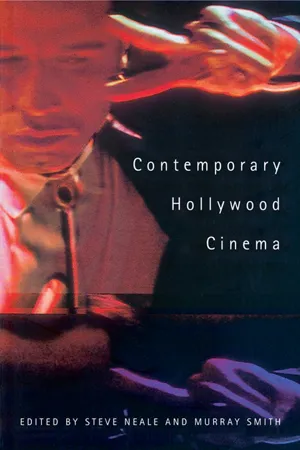
A comprehensive overview of the film industry in Hollywood today, Contemporary Hollywood Cinema brings together leading international cinema scholars to explore the technology, institutions, film makers and movies of contemporary American film making.
- 360 pages
- English
- ePUB (mobile friendly)
- Available on iOS & Android
eBook - ePub
Contemporary Hollywood Cinema
About this book
Information
Hollywood historiography
Chapter 1
Theses on the philosophy of
Hollywood history
Murray Smith
At one time, the main tools necessary for picture-making were a megaphone, a strong cranking arm, and a plot. Only the last has resisted change.
(Weegee and Mel Harris, Naked Hollywood)
There have been, I know, a lot of new Hollywoods ...
(Jon Lewis, Whom God Wishes to Destroy: Francis Coppola and the New Hollywood)
Since the 1960s, there has been a proliferation of terms designating more-or-less fundamental shifts in the nature — and thus the appropriate periodization — of Hollywood cinema: the New Hollywood, the New New Hollywood, post-classicism, and more indirectly, post-Fordism and postmodernism. And before these terms came into currency, critics had already noted what they saw as significant shifts in the nature of American filmmaking through terms which have since fallen out of use — Manny Farber's 'New Movie', for example, or the 'maximized' cinema posited by Lawrence Alloway to encompass the period 1946—64. Many of the contributors to this volume assume, argue or imply that the classical Hollywood cinema of the studio era has been partly transformed or wholly superseded.
The watchwords in virtually all analyses of 'classical Hollywood cinema' are stability and regulation, features which can either be prized for the way in which they enabled a great popular art, or decried for the constraints they imposed upon filmmakers. But just what is said to have been regulated in such a way that a high degree of stability was ensured varies considerably. First, and most obviously, classicism may refer to certain narrative and aesthetic features (the stability of a system of genres, or of continuity principles, for example); or, it may refer to the studio system as a mode of production. Moving out from the films themselves in another direction,' classicism' may be said to describe a certain kind of spectatorship, one characterized by a high degree of 'homogenization' or psychic regulation.1
Although the notion of a 'classical' American cinema had been in circulation for decades, the concept became a focus of theoretical attention in journals such as Monogram and Screen in the 1970s, and was given far greater substance by David Bordwell, Janet Staiger and Kristin Thompson in their landmark 1985 work The Classical Hollywood Cinema (CHC).2 Influenced by both Andre Bazin3 and — less obviously but perhaps just as significantly — Jan Mukařovský, Bordwell, Staiger and Thompson use the phrase 'classical Hollywood cinema' to refer to a mode of film practice (an aesthetic of 'decorum, proportion, formal harmony' (CHC, p. 4)) supporting and supported by a mode of film production (the studio system).4 'The label "classicism" serves well', the authors argue, 'because it swiftly conveys distinct aesthetic qualities (elegance, unity, rule-governed craftsmanship) and historical functions (Hollywood's role as the world's mainstream film style)' (CHC, p. 4). 'Classical', then, connotes not only particular aesthetic cjualities, but the historical role of Hollywood filmmaking as a template for filmmaking worldwide: classical films are classical in the sense that they are definitive.
Following Mukařovský, Bordwell, Staiger and Thompson separate several dimensions of form: they write of material, technical, aesthetic and socio-ethical-political ('practical') norms. Each of these can be said to have been highly regulated in the studio era (many material and technical norms, for example, were regulated and stabilized by co-operation among the majors, while many practical norms were regulated by the Production Code). The emphasis of The Classical Hollywood Cinema is very clearly and explicitly placed on technical and aesthetic norms, though to that statement we need to add two qualifications. First, material and 'practical' norms are considered, though only to the extent that these impinge upon technical and aesthetic norms (the norm of the union of a heterosexual couple is examined as an instance of Hollywood's interest in narrative closure, for example). Second, there is an important principle of interdependence in operation: not only between the mode of production and mode of film practice, but also, implicitly at least, among the various norms. One might argue, for example, that the technical norms of narrative closure and shot/reverse-shot editing are interdependent with the aesthetic norms of 'unity' and 'harmony'. This extends into a kind of holistic principle (also evident in Bazin): the idea that the regulated stability of each of the formal norms, along with the ordered nature of the mode of production, generates a greater overall level of stability than the sum of each of these levels. There is, to recall Bazin's metaphor, an overall 'equilibrium profile' which arises from the stability achieved in each of the institutional and formal dimensions.
Where Bordwell, Staiger and Thompson argue that the classical style has 'persisted' since 1960 (the date at which the detail of their study ends) in spite of the shift to package production, and the later process of conglomeration,5 other authors have argued that the classical aesthetic gradually dissipated with the breakdown of the studio system (and, for some authors, the wider emergence of postmodernity). Indeed, for almost as long as Hollywood has been conceptualized as a 'classical' cinema, there have been claims regarding the end of the classical period. Probably the first such claim was implicitly made by Bazin, who suggested that the classicism of 1930s Hollywood began to give way to a 'baroque' cinema in the 1940s, a cinema of greater self-consciousness and stylization, in the form of, for example, 'superwesterns' like Duel in the Sun (1946), High Noon (1952), and Shane (1953). In 1952 Manny Farber lambasted the 'new mannerist flicker', which seemed more concerned with thematic seriousness and stylistic ostentatiousness than with the traditional Hollywood virtue of entertaining storytelling.6 In 1971 we find one of the earliest uses of the phrase 'post-classical', which explicitly takes its cue from Bazin. Contemplating Bazin's characterization of American cinema in the late 1930s as a cinema of 'classical perfection', Lawrence Alloway noted 'it follows that the later developments must be post-classical. Extending the morphology of styles implicit in Bazin's formula, the movies I grew up with [in the 1940s and 1950s] were baroque, Hellenistic, overblown, late. 7 In an argument that in some ways prefigures an aspect of the study by Bordwell, Staiger and Thompson, Alloway rejects this thesis, claiming instead that Hollywood films of the 1940s and 1950s intensified or 'maximized' the themes and formal possibilities established in the 1930s, rather than overthrowing them.
There are essentially two ways of understanding the thesis that the classical mode of practice persisted beyond the breakdown of studio system. The first, and more circumspect, argument involves the claim that one or more aspects of the system described above persists: classical narrative structure, for example, but not the practical norms with which it was associated in the 1930s and 1940s. This is a view which stresses the multi-faceted nature of Hollywood and accepts that change may well be uneven, occurring at different rates and at different moments across these facets.8 The second, and much stronger, claim is that it is not merely isolated elements of the system that persist, but that the equilibrium obtaining among and across the various levels — that supervening feature which adds greatly to the sense of stability in the system as a whole — has also persisted. This stronger claim is much more difficult to defend, though it is not clear that anyone, including Bordwell, Staiger and Thompson, wishes to make it: they admit, for example, 'that the force of the classical norm was reduced somewhat' (CHC, p. 10) after 1960, even if many formally classical films continued to be made; and more recently, Thompson has argued that certain technical and aesthetic norms associated with classical filmmaking have persisted, not that the broader overall stability has endured.9
The question of the existence of a distinctive post-classical cinema — like the question of the existence of a classical cinema — is, then, one with both empirical and conceptual dimensions. Nothing approaching the scale and rigour of The Classical Hollywood Cinema has been undertaken on the empirical aspect of this question, and this volume cannot claim to make more than a very modest contribution towards it. What I want to focus on here, however, are the conceptual aspects of the issue — aspects which, it should be underlined, are never eradicated by empirical work, no matter how thorough. If there is no agreement at this point on whether there is a post-classical cinema, or on which features of such a cinema are the features which mark it off from a preceding classical cinema, we can at least sketch out what sorts of criteria would be important in answering these questions. Hollywood, as a total institution, is a multi-faceted creature: which of its facets are of most significance in understanding its evolution? Are the most important criteria those of changes in technology, narrative form, or the use of style? Should changes in the mode of production of films, or changes in their marketing, distribution and exhibition have greater priority? Is the positing of an 'epochal' transition only warranted by a global assessment in which all of these factors play a role and undergo change? In what remains of this essay, I want to explore these questions — questions about the assumptions and criteria present in arguments concerning classicism and post-classicism. I will do this through an examination of two arguments - or rather, one argument, and a second family of arguments — in favour of the idea that the classicism of the studio era has given way to something new. The first argument roots itself very much in the nature of industrial organization, while the second family of arguments stresses the interdependence of the aesthetics of Hollywood films with their mode of production.
Vertical disintegration and post-Fordism
The equilibrium profile of classicism — its high level of stability — will only be disrupted, Bazin argued, by a 'geological movement', as a result of which 'a new pattern' will be 'dug across the plain'.10 Bazin's metaphor provides a way into the argument that the most significant development in the post-war Hollywood system is the shift away from the Fordist principles around which it had been organized during the studio era. For the proponents of the 'post-Fordist thesis', the Paramount decrees of 1948 constitute a seismic 'movement' which fundamentally alters the 'pattern' of Hollywood.
Although the concept of post-Fordism is relatively obscure within film studies, it has a direct bearing on debates regarding the shift to package production. The notion of post-Fordism was coined by sociologists studying shifts in the nature of capitalist production, particularly after the Second World War when in many industries the strategies of Fordist mass-production (economies of scale through standardization and a detailed division of labour) were revised as a result of changes in market conditions. In a series of articles, Michael Storper and Susan Christopherson have used the development of the US film industry after 1948 as a case study of post-Fordism. As they apply the concept to post-war Hollywood, post-Fordism involves a shift from a largely undifferentiated mass market served by a limited array of standardized, mass-produced commodities, to that of a more heterogeneous range of specific markets to which more specialized products can be profitably sold. The 'initial shock' of the Paramount decrees, which forced the major studios to sell off their exhibition arms, dramatically raised 'the level of uncertainty [and] instability' in the market for film, Storper argues.11 Loss of control over exhibition encouraged the trends (already underway) towards fewer but more expensive films, and 'independent' package production. The details of this process of vertical disintegration are relatively well-known within film studies. Storper's analysis does, however, draw our attention to a number of less wellunderstood features of the post-war industry. The rise of package production leads to a growth in the number of independent film companies — both independent production companies (small production companies without a corporate relationship with a distribution company12), as well as specialist firms serving various aspects of preproduction, production and postproduction (talent agencies, special effects houses, catering firms, etc.). These specialist firms then adapt the products and services they offer to the needs of a variety of clients, a process Storper refers to as product variety (as distinct from product differentiation), ...
Table of contents
- Cover Page
- Half Title page
- Title Page
- Copyright Page
- Contents
- List of illustrations and permissions
- Notes on Contributors
- Acknowledgements
- Introduction
- Part 1 Hollywood historiography
- Part 2 Economics, industry and institutions
- Part 3 Aesthetics and Technology
- Part 4 Audience, address and ideology
- Select bibliography
- Index
Trusted by 375,005 students
Access to over 1.5 million titles for a fair monthly price.
Study more efficiently using our study tools.
Frequently asked questions
Yes, you can cancel anytime from the Subscription tab in your account settings on the Perlego website. Your subscription will stay active until the end of your current billing period. Learn how to cancel your subscription
No, books cannot be downloaded as external files, such as PDFs, for use outside of Perlego. However, you can download books within the Perlego app for offline reading on mobile or tablet. Learn how to download books offline
Perlego offers two plans: Essential and Complete
- Essential is ideal for learners and professionals who enjoy exploring a wide range of subjects. Access the Essential Library with 800,000+ trusted titles and best-sellers across business, personal growth, and the humanities. Includes unlimited reading time and Standard Read Aloud voice.
- Complete: Perfect for advanced learners and researchers needing full, unrestricted access. Unlock 1.5M+ books across hundreds of subjects, including academic and specialized titles. The Complete Plan also includes advanced features like Premium Read Aloud and Research Assistant.
We are an online textbook subscription service, where you can get access to an entire online library for less than the price of a single book per month. With over 1.5 million books across 990+ topics, we’ve got you covered! Learn about our mission
Look out for the read-aloud symbol on your next book to see if you can listen to it. The read-aloud tool reads text aloud for you, highlighting the text as it is being read. You can pause it, speed it up and slow it down. Learn more about Read Aloud
Yes! You can use the Perlego app on both iOS and Android devices to read anytime, anywhere — even offline. Perfect for commutes or when you’re on the go.
Please note we cannot support devices running on iOS 13 and Android 7 or earlier. Learn more about using the app
Please note we cannot support devices running on iOS 13 and Android 7 or earlier. Learn more about using the app
Yes, you can access Contemporary Hollywood Cinema by STEVE NEALE,Murray Smith in PDF and/or ePUB format, as well as other popular books in Media & Performing Arts & Film History & Criticism. We have over 1.5 million books available in our catalogue for you to explore.