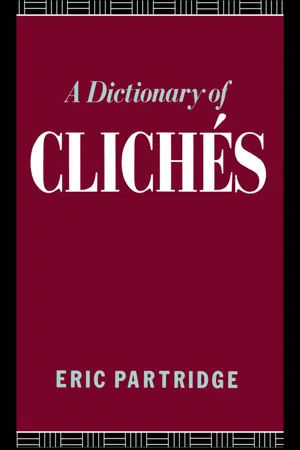
This work is full of things better left unsaid: hackneyed phrases, idioms battered into senselessness, infuriating Gallicisms, once-familiar quotations and tags from the ancient classics. It makes a formidable list, amplified as it is with definitions, sources, and indications of the clichés, venerability in every case.
; esp., in sackcloth and ashes, abjectly penitent or, now only occasionally, grief-stricken: late C. 18–20. Biblically, clothes of sackcloth and ashes sprinkled on the head conventionally and ritualistically betokened penitence or lamentation: as, e.g,, in Matthew, xi. 21, ‘They would have repented long ago in sackcloth and ashes’:
‘they would long ago have changed the inner man—the soul—in sacking and ashes’.
sacred edifice, a or the
. A (or the) church: C. 19–20. John Gloag crystallizes its ‘clichéness’ in his distinguished novel, Sacred Edifice, 1937.
*‘sadder and a wiser man, a.’
Mid C. 19–20. Coleridge, The Rime of the Ancient Mariner, 1797, Part 7.
sadly at fault, to be (esp., to have been)
, much at fault; very much in the wrong: late C. 19–20.
sæva indignatio
. A severe and fierce indignation, befitting a satirist: literary: C. 19–20. Often applied to Juvenal and Dryden.
*safe and sound
. Safe: from ca. 1870. Properly, safe and uninjured.
[safety first
. In the corner formed where three provinces meet: those of official formulas, catchphrases, and clichés. It is rapidly becoming predominantly the third.]
sail near the wind, to
To keep only just inside the law; to be almost beyond the pale; to do shady things that aren’t illegal: from ca. 1880. Nautical.
sail the seven seas, to
. See seven seas.
sailor’s yarn, a
An improbable or exaggerated story: late C. 19–20.—Cf. the almost obsolete a travellers tale.
salad days
; esp., in one’s. In one’s youth; inexperienced and very, very green: 1606, Shakespeare, Antony and Cleopatra, ‘My salad days,|When I was green in judgement’; but it did not become a cliché until ca. 1840 or 1850.
*salt of the earth, the
. Mid C. 19–20. ‘In recent trivial use’, says the O.E.D. in 1914, ‘the powerful, the aristocratic, the wealthy’; but, from 1920 at latest, the prevailing sense, surely, has been that of ‘the staunch and true, the essentially good, generous, humane and kindly’. In Matthew, v. 12–13, Christ, addressing those persecuted and/or reviled because of their loyalty to His cause, says, ‘Rejoice, and be exceeding glad: for great is your reward in heaven… Ye are the salt of the earth’:
that which gives life its savour and preserves civilization.
sanctity of the home, the
. The inviolability of the home (‘an Englishman’s home is his castle’): C. 20. D.C. Murray, 1888, ‘We have grown quite accustomed nowadays to the invasion of what used to be called the sanctity of private life’ (O.E.D.).
sanctum sanctorum
. A person’s study or ‘den’, where he is—or should be—free from intrusion: from ca. 1880: journalistic. Lit., holy of holies.
[sans cérémonie
(without ceremoniousness or ceremony) and sans gêne (free-and-easy; casual): not quite clichés. But guard against them!]
saunter to and fro, to
. To stroll about carelessly or idly: mid C. 19–20.
save (another’s, or one’s own) good name, to
. To preserve one’s or another’s honour or credit: mid C. 19–20.
saving for a rainy day
. Putting money by against old age, illness, unemployment, crisis: mid C. 19–20. An old proverb runs, keep some till more come.
saving grace, a or one’s
. A redeeming quality or feature: late C. 19–20. From the theological grace that delivers a person from sin and/or hell-fire.
*say ‘boh !’ to a goose, not to
. ‘That quiet fellow wouldn’t say “Boh” to a goose,’ is too timid to open his mouth. A proverbial saying (recorded, in Apperson, for 1588): from ca. 1880, a cliché.
say nay, to
esp., there is no one to say or who dares to say (e.g., him) nay, to deny, withstand, forbid or prohibit (him): from ca. 1870.;
say the least
. See to say the least…
scales of Justice, the
. Justice with its scales that weigh the good and the ill; Justice: C. 19–20.
scantily attired (or clad)
. Wearing few clothes (and those, rather less than opaque): mid C. 19–20; late C. 19–20. Dickens, 1840, has the former.
Scarlet Woman, the
. The Church of Rome: pejorative-religious (odium theologicum…), much commoner among Nonconformists than among Church of Englanders: from ca. 1870 (Southey, 1816). Of Scarlet Lady, Whore, Woman, only the third has survived; cf. Joseph Hocking’s anti-Roman novel, The Scarlet Woman, 1899, and his return-to-the-charge, The Woman of Babylon, 1906. See Revelation, xvii. 1 (‘the great whore’), 4 (‘the woman…arrayed in purple and scarlet colour’), 5 (‘Babylon the Great, the Mother of Harlots’).
scathing sarcasm; scathingly sarcastic
. Withering, or sharp and damaging, sarcasm; cuttingly or searingly sarcastic: late C. 19– 20.
scotch—not kill—a snake, to
. To render only temporarily harmless something that is, or is regarded as, dangerous: C. 19–20. From Theobald’s proposed emendation, ‘We have scotch’d the snake, not kill’d it’: Macbeth, III, ii, 13.
scrap of paper, a
esp., a mere scrap… A political pact: from mid August 1914. Used by von Bethmann- Hollweg, the German Chancellor: noted by Sir Edward Goschen, to whom it was ...
Table of contents
COVER PAGE
TITLE PAGE
COPYRIGHT PAGE
PREFACE TO THE 5TH EDITION
PREFACE
INTRODUCTION
A DICTIONARY OF CLICHÉS
A
B
C
D
E
F
G
H
I
J
K
L
M
N
O
P
Q
R
S
T
U
V
W
Y
Trusted by 375,005 students
Access to over 1.5 million titles for a fair monthly price.
Study more efficiently using our study tools.
Frequently asked questions
Yes, you can cancel anytime from the Subscription tab in your account settings on the Perlego website. Your subscription will stay active until the end of your current billing period. Learn how to cancel your subscription
No, books cannot be downloaded as external files, such as PDFs, for use outside of Perlego. However, you can download books within the Perlego app for offline reading on mobile or tablet. Learn how to download books offline
Perlego offers two plans: Essential and Complete
Essential is ideal for learners and professionals who enjoy exploring a wide range of subjects. Access the Essential Library with 800,000+ trusted titles and best-sellers across business, personal growth, and the humanities. Includes unlimited reading time and Standard Read Aloud voice.
Complete: Perfect for advanced learners and researchers needing full, unrestricted access. Unlock 1.5M+ books across hundreds of subjects, including academic and specialized titles. The Complete Plan also includes advanced features like Premium Read Aloud and Research Assistant.
Both plans are available with monthly, semester, or annual billing cycles.
We are an online textbook subscription service, where you can get access to an entire online library for less than the price of a single book per month. With over 1.5 million books across 990+ topics, we’ve got you covered! Learn about our mission
Look out for the read-aloud symbol on your next book to see if you can listen to it. The read-aloud tool reads text aloud for you, highlighting the text as it is being read. You can pause it, speed it up and slow it down. Learn more about Read Aloud
Yes! You can use the Perlego app on both iOS and Android devices to read anytime, anywhere — even offline. Perfect for commutes or when you’re on the go. Please note we cannot support devices running on iOS 13 and Android 7 or earlier. Learn more about using the app
Yes, you can access A Dictionary of Cliches by Eric Partridge in PDF and/or ePUB format, as well as other popular books in Languages & Linguistics & Languages. We have over 1.5 million books available in our catalogue for you to explore.