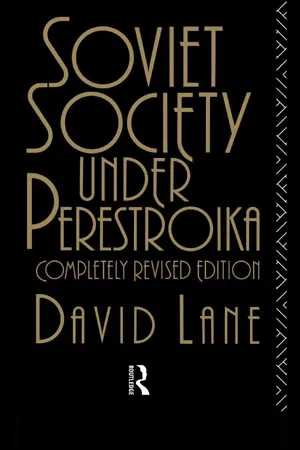
This is an up-to-the-minute revised edition of a text which, since its publication in 1990, has been extremely influential. The great changes of the past 18 months have entailed a comprehensive updating of the book. This edition takes account of new developments that include the independence of the Baltic states and the treaty which sparked 1991's attempted coup.
- 464 pages
- English
- ePUB (mobile friendly)
- Available on iOS & Android
eBook - ePub
Soviet Society Under Perestroika
About this book
Information
Chapter 1
CHANGING CONCEPTIONS OF SOVIET SOCIETY
Since its foundation the Soviet Union has been considered by most people in the West to be a major adversary to our conceptions of a democratic state and society. Following the temporary alliance between the Allies during the Second World War, Western governments have regarded the Soviet Union and the Warsaw Pact countries as pursuing policies inimical to the interests of Western states. The West has not only regarded their foreign policies as hostile, but also has viewed their internal political and social organization as illegitimate. Such political conflict in the international sphere has created an environment in which the social and political systems of the major adversaries have been stereotyped in the popular imagination. The image of Soviet society in the eyes of people outside the USSR has been one of an illegitimate totalitarian society in which individual rights have been sacrificed to meet the needs of an all-powerful totalitarian state. George Orwell’s novels Animal Farm and 1984, have been powerful symbolic representations of the fate of the masses in socialist states.
This book will subject such popular conceptions to critical scrutiny. Under the leadership of Gorbachev a new turn has taken place in Soviet policies. Many of the old ways of doing things have been questioned; radical attempts for reform (perestroika) have been made. In the pages that follow, the impact of the reforms on the structure of Soviet society will be analyzed. Following a discussion of the reform strategy of Gorbachev, its economic and political implications, we shall consider the relationships between the major social groups (classes and nationalities), forms of social welfare and control (education and the family) and the processes of social change (the mass media and the rise of independent groups). By analyzing the social context in which Soviet politics takes place—the ways that politics constrains the social system and vice versa—we shall understand better the changes and challenges the USSR faces.
In the first instance I shall outline some of the assumptions that people have, or the expectations they entertain, about the nature of communist (or as I define them, state socialist) societies. Moreover, one cannot study data in an ideological vacuum; one’s perceptions are influenced by assumptions taken from one’s own society, its history and values. These preconceptions affect the ways that we interpret foreign societies, especially in the context of international competition. We may define two worldviews of the USSR that were current in the West before the advent of perestroika: the benign and the malevolent.
THE IMAGE OF THE SOVIET UNION: BENIGN
The polarity of antagonism between East and West as outlined above is an oversimplification, and the image of the Soviet Union as destructive of human rights is one-sided. The Russian Revolution and the Soviet system that emerged from it have been, and are, greeted with acclaim by many in the West. Rather than mere hostility, there has always been ambivalence to the Soviet Union in the West.
Many socialists and liberally minded people in the West saw the Russian Revolution as ushering in a new society that represented an alternative in advance of capitalism. Born in the genocide of the trenches of the First World War and followed by the poverty of the Great Depression of the 1920s, the revolution was regarded as the beginning of a new world order that would put an end to the uncertainty of the market, the irrationality of competition that gives rise, on the one side, to a system of inequality and poverty, and on the other, riches and domination. In the West communism has not only appealed to the underdogs—who would have most to gain materially from systemic change—but also to the idealists and intellectuals who regard socialism as a form of society superior to capitalism and who condemn the class-ridden rapacious Western imperialist powers. The imagery of such thinkers is symbolized not by the malevolent utopia of George Orwell but by the benevolent one of Aldous Huxley’s Brave New world.
Supporters of communism have in mind a society based on conscious human control. To meet human needs, the spontaneity and uncertainty of market competitive relations in superseded by planning, while production of commodities for profit is replaced by the administrative allocation of goods and services. Marx’s assumption that under socialism the labor process would not be determined by exchange but “in accordance with a definite social plan” has been widely accepted by critics of capitalism. Competition is to be replaced by cooperation in a classless society. Equality (social, economic, and political) is a watchword of a socialist society in which the pathologies of capitalism—greed, exploitation, and domination—would wither away. These assumptions concerning what socialism ought to be have been conflated into a stereotype of what the USSR became.
The reality of the Soviet Union, moreover, has always belied its claims to rationality, order, benevolence, planning, and equality. Nevertheless, “progressive” writers who have supported the Soviet Union have adopted the mantle of apologists. The Soviet Union, they claim, inherited an economic and political base that did not provide the necessary conditions for a planned and equal society. Tsarist Russia was one of the poorest countries in Europe and its political culture was not initially conducive to political participation. Perhaps more important, these writers assert that the presence of a hostile world environment in the form of predatory capitalist states has caused the malformations of the socialist states. Soviet socialism was born imperfect, and it would remain flawed as long as the contradictions of capitalism continue in the West.
This position, in turn, has legitimated practices that in themselves were foreign to the structure of socialism—a strong state with a large military and a secret police, institutional forms of inequality, and internal pathologies, such as crime, exploitation, and prejudice.
Despite such imperfections in the USSR, its supporters claim it had superior institutional arrangements: the supremacy of plan over market, the priority of collective over private interest, and the absence of conflicting social classes. The achievements of the socialist order, they contend, include constant economic growth, full employment, comprehensive welfare, and relative social equality.
THE IMAGE OF THE SOVIET UNION: MALEVOLENT
With the exception of certain periods during the Second World War, the weight of Western opinion has been opposed to this charitable view of Soviet society. Ideologically, Western opponents have deplored the destruction of individual human liberty. Freedom is held to be an integral value of democracy and the Western way of life because it promotes the development of the human will and spirit. Freedom, from this standpoint, is the absence of constraint, freedom allows the internal striving of the individual to flourish to fulfill human needs. Individuals, it is contended, have inalienable rights, which are manifested in the ownership of property and in the unconstrained formation of ideas, beliefs, associations and groups, and in the sanctity of the family. Only individuals have interests and their unfettered expression leads to human emancipation and progress. Such were the values of the French and American revolutions. The interaction of individual rights is furthered through the market in the economy and the parliamentary or representative state in politics. Both institutions create an environment in which individual freedom is promoted whilst the minimum constraints of freedom necessary to enhance collective welfare are secured.
This worldview gives rise to a perspective on socialist states that is quite apart from that held by “progressives.” The essence of state socialism, opponents point out, is replacing self-motivation and individual interest by a collectivist state. Such a state is external to the individual and acts as a constraint on the person. Socialist society as such is inimical to freedom, human liberation, and progress in general because freedom is sacrificed for equality. The individual has no rights. Whereas the state in liberal democracies promotes minimal interference with the activity of the individual, the Soviet state espouses complete control: because planning is a collective effort that requires the subjugation of the market and individual enterprise, the state invades the privacy of civil society.
The institutions of state socialism, then, deprive the individual of rights: ownership of property is denied, a free market is replaced by government regulation, individual associations are limited to what the state thinks fit, and political parties and trade unions, which would express individual interests, are suppressed. People are isolated and become actors in a “mass society”—they are unable to express their spontaneity and humanity through spontaneous interaction with other people. Instead of the state expressing individuals’ interests, associations perform the state’s interest.
Totalitarianism is the concept that sums up Western democratic opposition to the sociopolitical order of state socialism. Contrasted to pluralistic Western societies, totalitarian societies allow no autonomous associations or institutions and those that are authorized are state managed. The essence of the totalitarian approach is the absence of any distinction between the state and civil society. The state reaches down into the very pores of society.
The description of totalitarianism is best known by the six-point definition concocted by the American writers C.J.Friedrich and Z.K.Brzezinski in 1956: an official ideology, a single mass party, a system of terroristic police, a monopoly of control of mass communication, a monopoly of all means of armed combat, and the control and direction of the economy. Collective control is assured because a single dominant political party has a monopoly on political power. The party’s values are derived from an all-embracing ideology—Marxism-Leninism—that concentrates all activities on the achievement of a “utopian” society, communism. Only modern technology, it is claimed, gives the possibility for such ubiquitous forms of control.
Moreover, the activity of the totalitarian state is malevolent: it exploits the individual while the political elite pursues its own interest and dominates the masses. Such domination is secured not only by coercion— through the apparatus of the political police—but also by manipulation— through the ideology that is secured by a monopoly on the means of mass communication. The planning of the economy entails the bureaucratic coordination of all kinds of activities—education, wages, social insurance, and welfare—and thus not only does the state suppress the spontaneity of individuals and groups but it also does not meet consumer demands. State socialist societies are, according to this viewpoint, modern forms of tyranny that differ from those of the past by the extent of political control and, paradoxically perhaps, by virtue of the willingness of the masses actively to support the system.
It is my own view that neither of the above stereotyped positions captures the reality of the contemporary Soviet Union, though both say something important about the nature of the modern world. The totalitarian model never comes to grips with the fact that under Stalin and until relatively recently the Soviet Union was largely a rural society and thus the “technologically” conditioned means of control must be doubted. Traditional mores and ways of doing things are in practice very resistant to change. It must be conceded, however, that the Soviet state under Stalin and his successors did have and still has a wide range of activities under its control—much more so than in the pluralistic West. Under Gorbachev, however, this has been changing. The totalitarian model is static: it does not allow for significant change in society that would arise from the social structure, that is, from groups or interests. There has been a tendency to dismiss any developments (economic, political, social) as not “really” or “in essence” changing anything; and the process of change and political transformation which led to the coup of August 1991 has been overlooked.
Analysis of the Soviet Union must be made in an historical perspective and one must be aware of its changing ideology and structure, its leading personalities and ambitions, as well as the changing world systems in which it operates. By analogy, the United States and Britain have had transformed world roles in the twentieth century. Their internal social structures and political processes have evolved from Roosevelt to Reagan and from Lloyd George to Thatcher. So, too, one must recognize that the Soviet Union under Stalin, Khrushchev, Brezhnev, Gorbachev and Eltsin is distinctive. The USSR must be conceptualized as a changing and developing society. The grand sweep of political ideology whether it be totalitarian or communist does not grasp the reality of social transformation under state socialism.
FROM KHRUSHCHEV TO GORBACHEV: THE CHANGING NATURE OF SOVIET POLITICS
It must be emphasized from the outset that the Soviet Union under Gorbachev has undergone radical changes that make many of the characteristics of earlier periods obsolete. The policies ushered in by Gorbachev (like the short-lived ones of Dubcek in Czechoslovakia, twenty years earlier) have cast in doubt the validity of the antinomy between capitalism and communism and the associated competing organizing principles of planning and market, private and public, individual and collective. A look at the political, economic, and ideological developments between the leadership of Khrushchev and that of Gorbachev will provide a foundation for understanding the changing nature of the goals of Soviet communism. Two major watersheds in recent Soviet history may be distinguished: Khrushchev’s Program of the CPSU (Communist Party of the Soviet Union) and its revised version brought out under Gorbachev. For important dates in recent Soviet history see Figure 1.1.
| 1953 | Death of Stalin. |
| 1956 | Twentieth Congress of the Communist Party of the Soviet Union (CPSU): Khrushchev exposes Stalin's excesses. |
| 1961 | New Program of the CPSU adopted at the Twenty-second Party Congress. |
| 1964 | Brezhnev and Kosygin come to power. |
| 1982 | Andropov comes to power. |
| 1984 | Chernenko comes to power. |
| 1985 | Gorbachev comes to power. |
| 1986 | Twenty-seventh Congress of the CPSU. Program of the CPSU revised. |
| 1988 | Nineteenth Conference of the Communist Party of the Soviet Union. |
| 1989 | USSR Congress of People's Deputies elected. |
| 1990 | Party plenum relinquishes monopoly of power by CPSU. |
| 1990 | Non-communist governments elected in some republics. |
| 1990 | Presidential power declared. |
| 1991 | Referendum on Union Treaty. |
| 1991 | Attempted coup fails, Eltsin asserts authority. |
| 1991 | Union of Soviet Socialist Republics disintegrates, new Union of Sovereign States created. |
| 1991 | Baltic states recognized as independent. |
| 1991 | Communist Party of Soviet Union destatized and banned in some republics; Gorbachev resigns as General Secretary. |
Figure 1.1 Some Important Dates in Recent Soviet History
The Program of the CPSU adopted at the Twenty-second Party Congress on 18 October 1961, reflected the optimism and confidence of the political leadership under Khrushchev. The Program asserted that the world socialist system would triumph given the cumulative “crisis of world capitalism.” It was proclaimed that within twenty years the Soviet economy would catch up with the standard of living of the United States. This goal would be ensured by the advantages of state ownership, central planning, and Communist Party leadership based on Leninist principles. The 1961 Program marked, in its own words, the beginning of a period of “full-scale communist construction.”
Almost a quarter of a century later on 25 February 1986, Gorbachev presided over another version of the Party Program at the Twenty-seventh Party Congress. This time the tone was more cautious. In his introductory remarks, after praising previous Soviet achievements, he said, “the leadership considers its duty to tell the Party and the people honestly and frankly about the deficiencies in our political and practical activities and the unfavorable tendencies in the economy and the social and moral sphere.” The claims of the revised Party Program of 1986 are more modest. There are no references to the attainment of communism. If a fundamentalist regards Khrushchev as wanting to dig a grave for capitalism, Gorbachev may be said to have been doing the same for the traditional Soviet concept of communism. Ideologically, the Party’s Revised Program made no reference to the attainment of communism, to the expansion of collective forms of welfare outside the price system, nor did it refer to the withering away of the state.
The problems of socialist construction became the center of the Party’s attention. As Gorbachev emphasized in January 1987...
Table of contents
- COVER PAGE
- TITLE PAGE
- COPYRIGHT PAGE
- LIST OF TABLES
- LIST OF FIGURES
- PREFACE
- CHAPTER 1: CHANGING CONCEPTIONS OF SOVIET SOCIETY
- PART ONE: THE POLITICAL AND ECONOMIC FRAMEWORK
- PART TWO: SOCIAL CLASSES AND GROUPS
- PART THREE: SOCIAL CONTROL
- PART FOUR: CONCLUSIONS
- APPENDIX: THE CONSTITUTION (FUNDAMENTAL LAW) OF THE USSR, 1977. (AS AMENDED TO DECEMBER 1990)
- ABOUT THE AUTHOR
Trusted by 375,005 students
Access to over 1.5 million titles for a fair monthly price.
Study more efficiently using our study tools.
Frequently asked questions
Yes, you can cancel anytime from the Subscription tab in your account settings on the Perlego website. Your subscription will stay active until the end of your current billing period. Learn how to cancel your subscription
No, books cannot be downloaded as external files, such as PDFs, for use outside of Perlego. However, you can download books within the Perlego app for offline reading on mobile or tablet. Learn how to download books offline
Perlego offers two plans: Essential and Complete
- Essential is ideal for learners and professionals who enjoy exploring a wide range of subjects. Access the Essential Library with 800,000+ trusted titles and best-sellers across business, personal growth, and the humanities. Includes unlimited reading time and Standard Read Aloud voice.
- Complete: Perfect for advanced learners and researchers needing full, unrestricted access. Unlock 1.5M+ books across hundreds of subjects, including academic and specialized titles. The Complete Plan also includes advanced features like Premium Read Aloud and Research Assistant.
We are an online textbook subscription service, where you can get access to an entire online library for less than the price of a single book per month. With over 1.5 million books across 990+ topics, we’ve got you covered! Learn about our mission
Look out for the read-aloud symbol on your next book to see if you can listen to it. The read-aloud tool reads text aloud for you, highlighting the text as it is being read. You can pause it, speed it up and slow it down. Learn more about Read Aloud
Yes! You can use the Perlego app on both iOS and Android devices to read anytime, anywhere — even offline. Perfect for commutes or when you’re on the go.
Please note we cannot support devices running on iOS 13 and Android 7 or earlier. Learn more about using the app
Please note we cannot support devices running on iOS 13 and Android 7 or earlier. Learn more about using the app
Yes, you can access Soviet Society Under Perestroika by David Lane in PDF and/or ePUB format, as well as other popular books in Politics & International Relations & Politics. We have over 1.5 million books available in our catalogue for you to explore.