- 272 pages
- English
- ePUB (mobile friendly)
- Available on iOS & Android
eBook - ePub
Technology as Symptom and Dream
About this book
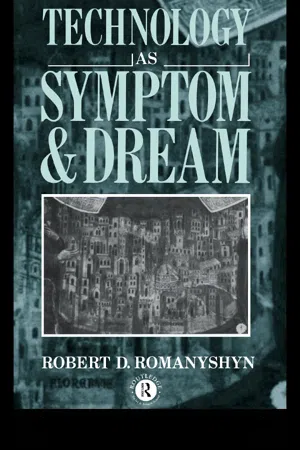
The development of linear perspective in the 15th century represented a radical transformation in the European's sense of the world, the body and the self. Robert Romanyshyn's latest book examines the claim that the development of linear perspective vision was and is indispensable to the emergence of our technological world. It does so by telling the story of how an artistic technique has become a cultural habit of mind.
Information
Chapter one
Lift-off: we are all astronauts
I
Abandoning the body
Naked exposure, stripped of clothes and skin, two electric bodies exchange a kiss. Sparks do fly, as we have always known, but here it is no mere metaphor. The kiss inflames and stirs electric circuitry into life. Touching, holding, pressing, kissing radiates, leaps beyond its boundaries, jumps the gap between two beings and fuses them as one. Meltdown at the core!
Here, at the moment of lift-off, the reader is invited to look again at Figure IV. A sun is in the background. It radiates its energy and between it and the kiss a web is generated. These electric bodies, these bodies of fusion and radiation, belong to the stars. They are bodies of atomic children, cosmic creatures.
When we previously considered this painting by Alex Grey, I indicated that its appearance in Esquire magazine was accompanied by a quote from the artist. ‘The inside,’ he said, ‘tells me about the outside.’ Now in reply to these words I want to say No and Yes. No, because the image itself goes further. It says more. It says the inside is the outside. All is energy and energy is all. Body melts into cosmos. And Yes, because the last four hundred years of the history of the body have been a history of this telling, of an opening of the inside to tell us about the outside. We can appreciate the significance of the latter reply when we know that the appearance of this painting in Esquire magazine was accompanied not only by the artist’s words, but also by a photo. In that photo there is the artist and behind him the figure of a skeleton. That skeleton behind the artist who speaks these words about the inside and the outside is a witness to these last four hundred years of history. The two who kiss are not alone. They are observed.
Vesalius, whom we shall meet again later, is a witness. In 1543 he created modern anatomy. Before Vesalius the non-living body was a dead body. Dead bodies are buried with rituals of remembrance. After Vesalius the dead body became a corpse. Corpses are designed to be opened for inspection. They are invented so that the inside can be instructive about the outside. The English physician William Harvey, whom we shall also meet again, is there too. The corpse lies still on the dissecting table. It does not move. Harvey resurrects this corpse. In 1628 he reanimates it by making the heart into a pump. A crude machine in comparison with those electric bodies, but their ancestor nonetheless. The skeleton in the background is a reminder of this lineage. Something of the corpse haunts these cosmic creatures, these electric bodies which belong to the stars.
A
The corpse and the cosmonaut
The corpse is present in the figure of the Little Cosmonaut (Figure II). But it is hidden, or better, it has been transformed, re-dressed in the guise of its technical functions. The pumping heart is there and so much more. The eye of optics, the lungs of respiration define this body, a chiasm of physics and physiology. It is the medical body as an artist’s dream:
All the natural activities—of hearing, breathing, speaking, and making gestures—are…replaced by technical functions. The body has no contact with the surrounding atmosphere; it is protected by impenetrable suits. Van Hoeydonck gave us twentieth-century man as this man created himself: an almost inhuman abstraction, further removed from nature than at any other moment in history.1
Activity has become function: inspiration and expiration as respiration; communion as ingestion, digestion, elimination. The body is a technical matter, a problem to be solved. I know this body. We all know it. But it is known at a distance from life, from the body in its living situations. Vision may be a matter of what meets the eyeball, but seeing never is. The awesome power of the rising space shuttle is a sight which can take one’s breath away. But that is a different matter from respiration.
An invented body! A created body! A manufactured body! And perhaps above all else a body without context, isolated from its surrounding atmosphere, a visible body, a spectacle. The inside has truly become the outside when all bodily activities have been rendered visible as technical functions. Like Le Centre Pompidou in Paris, that building with exposed interior, with its pipes and ducts, beams and girders on the outside, this body is exposed for inspection. A spectacle for observation, a specimen: nothing secret, nothing hidden, nothing shamed. Can the Little Cosmonaut blush? Can the astronautic body escape the gaze of an observing eye? The corpse, lying on the dissecting table, is pure spectacle. It is the body exposed in its isolation to the full light of objective consciousness: a blinding, antiseptic whiteness; a body of purity. So too is the body etherized on the surgeon’s table, the medical body, the body as object of the medical gaze. Are we all astronauts? We are in so far as we all share this reality of the objective body, the body as technical function. Baby Fae was given a baboon’s heart and it hardly made a difference. A pump was exchanged and her mother said, ‘There are a lot of sentimental ways of talking about the heart. The soul of the human is in the brain.’2
The location, of course, is not the issue. The eclipse of the difference between the heart as a pump and the human heart, between technical function and human activity, is the issue. Do you think that if for one of those two electric bodies the kiss is a bitter disappointment his/her broken heart can be fixed? It is easier to repair a broken pump than it is to heal a broken metaphor, especially when we have forgotten the difference. Without the difference, a heart cannot be broken out of love, or if it can it really does not matter. Without the difference, the broken human heart has become only a metaphor, while the pump that can be broken can be exchanged.
B
Homo sapiens astronauticus
The body of the Little Cosmonaut is a spectacular body. It is a spectacle, a body of pure visibility, and a spectacular wonder in the sense that it is the same for all. It is an anonymous body, a democratic body, an empty shell. It is the body from which a self has taken flight and in this respect all of us truly are astronauts, perpetually ‘in orbit’ as Walker Percy says and perhaps also as he says ‘lost in the cosmos’.3
A shell! Enshelled according to the artist! And it is true. One can see it. The Little Cosmonaut is enshelled in his/her space suit. Has a metamorphosis occurred? Has the invention, creation, and manufacture of the spectacular specimen body become a reincarnation? Is this body even to be viewed perhaps as a new stage in evolution, ‘homo sapiens astronauticus’, space man, cosmic woman, a universal creature?
If so, it is a very curious stage in evolution, because the body of the Little Cosmonaut amusingly resembles a kind of hard-shelled bug. The inside which has become an outside is like an exoskeleton. Is the cosmonautic body then a creature which reverses the actual movement of evolution, from the shell on the outside protecting the soft interior of the creature as is the case, for example, with crustaceans like crabs and lobsters, to the skeleton as support on the inside?
A reversal, perhaps, but no mere repetition of an earlier stage. On the contrary, the astronautic body is more a new twist in the spiral of evolution. It is the body turned inside out, re-dressed in terms of technical functions on the way to being discarded. It is a first step, perhaps, on a path toward ‘exosomatic evolution’,4 a temporary bridge which initially joins us and machine, and wires us to (as) a computer. As a first step the shell is an external womb and the astronaut in suit and ship a foetus. The closing scenes of 2001: A Space Odyssey vividly portray this image, as the astronaut David Bowman, floating in an amniotic bubble, is reincarnated as a foetus against the background of earth. A rebirth of humanity is being imagined here, a rebirth in space, but whether it is apart from earth or still in its shadows remains a mystery. In either case, however, from cybernetics to cyborgs, a new bionic woman and a six million dollar man loom on the horizon—and a new offspring, the boy Daryl in the film of the same name: D.A.R.Y.L.: Data Analyzing Robot Youth Lifeform!
Either as shell or embryo, the astronautic body becomes a temporary body on a path which ultimately leads to the abandonment of the body. In the generative fantasies of Timothy Leary, ‘We are all neurogenetic robots’5 programmed to leave the earth and destined by our genes to shed this skeletal husk of the human body. From the vantage point of the Little Cosmonaut the human body of flesh and bone, blood and muscle has been a necessary but only temporary expediency. Man, says the Nobel geneticist Herman J.Muller, is ‘a giant robot created by DNA to make more DNA’.6 In this vision, the body which belongs to the earth, which is tied to the earth by the natal bond of gravity, the body which each one of us is, is secondary. It is the genetic code which is primary and which is primarily human. We need to pause for a moment to imagine our reaction to this news. Is it a sudden, sharp sense of alienation from one’s own body? Does this news make one feel like an agent of some alien force? Or is the other side a more appealing possibility? Is there some comfort in feeling guided by some higher wisdom, by a kind of universal intelligence coded as DNA?
Whatever one’s reaction, no less an authority than Francis Crick, who with James Watson decoded the structure of DNA, gives the fantasy of DNA-programmed departure another twist. He speculates in his recent book Life Itself7 that the stuff of DNA could have originally come only from the stars. If that be so, then the message coded in our genes is to journey in search of home. The astronautic body, then, is destined to depart. It is a body made by DNA to engineer its departure, the invention of DNA which will allow it to return to its home in the sky. Evolution with a cosmic purpose, blueprinted as the genetic code, and all of us under the same injunction: Little Cosmonaut as E.T.—‘Phone home!’
C
The shadow of the alien
Crick’s speculation, however, has a shadow side. If the astronautic body is DNA’s way of redesigning the body to depart earth in search of its original home in the stars, then the earth is not our home. We are, then, in a very fundamental sense, aliens with respect to earth.
Film portrays the mythology of an age. It is a shared myth, a cultural daydream, and as such it is in film that we obtain perhaps the best images of our alien status. In films like E.T., Alien, Aliens, Close Encounters, The Thing, 2001, Invasion of the Body Snatchers, and the Star Wars series we encounter through the alien figure reflections of who we imagine we once were or will be. The alien is us, and in the context of Crick’s proposition regarding the extra-terrestrial origins of life on earth, the alien creature is psychologically an image of an ancestor. In the guise of the alien creature we encounter our imagined heritage. For astronautic man/woman on the journey home, the alien figure wears the face of mother and father, the symptomatic face of our dreams of disincarnation.
But even without Crick’s hypothesis, the alien still mirrors our own imagined face. Even if the earth is originally our home and the astronaut in departing is obeying another destiny coded in the genes, as Leary, for example, suggests, the alien is an encounter with an imagined future, with what we imagine we will be. As heritage and destiny, then, ‘homo astronauticus’ encounters himself/ herself in the guise of the alien, and what is most significant in this encounter is the ambivalent character of our technological dreams of departure from earth and abandonment of the body.
The aliens of Close Encounters, for example, are decidedly different from those we meet in films like Invasion of the Body Snatchers or The Thing. In the former the alien is a figure of salvation; in the latter a figure of destruction. Such films, as expressions of our cultural daydreams, enact for us our optimistic hopes for, and pessimistic fears of, technology. Perhaps nowhere else is the ambivalent character of our daydreams more visible than in Japanese science fiction films. The only people on the face of the earth to have suffered the unforgettable fire of atomic war, the Japanese often instill in one and the same alien figure the dread and the hope of technology. A creature like Godzilla, for example, which is spawned by nuclear technology, is destructive and protective at the same time. In so many of these films, humanity looks to this creature for deliverance from some threatening evil, even while this creature itself is something which is feared. Moreover, the attribution of quasi-human qualities and emotions to Godzilla, while amusing and even silly, nevertheless strikes a deep chord in the human soul. It is an effort, I believe, to humanize and hence to tame the dread of technology’s monstrous face. It is an effort to scale down the monstrous proportions of technology to human terms.
From the inside which tells about the outside (the corpse), through an inside which has become the outside (the two kissing figures), to a body either discarded as shell or temporarily used as embyro (Little Cosmonaut), the telos of technology’s dream to refashion the body is toward abandonment of the body, toward disincarnation. This dream is, however, inseparable from the dream of departing earth. Disincarnation is a moment of departure. We can deepen our appreciation of the dream of technology, therefore, by attending to this moment.
II
Departing earth
The images in Figure I and III mirror two prominent possibilities of our time. Indeed, they are the primary images of our age. The space shuttle at lift-off rises against the pull of earth’s gravity, and in that powered ascent the earth grows smaller and farther away. In this image and event we have unmistakeable testimony that our technological power over nature is, and always has been, a matter of obtaining distance from it. The departure of the shuttle from earth is only the latest, and perhaps most dramatic, enactment of that distance, for distance belongs to technological knowledge as much as nearness belongs to intimate knowledge, to what might be called a knowledge of the heart. To know one’s own body as a technical function, to know that the heart is, for example, a pump, requires a measure of distance neither obtainable nor suitable in the context of daily life. Although one may know one’s body and heart in this fashion, they are known in this way only on the condition that one withdraws from them, that one places between oneself and the passion of one’s heart, which in thirsting for knowledge of the other whom one loves necessarily draws near to that other, a distance which is not a matter of measure but of attitude.
Joseph Weizenbaum, one of the early pioneers of computer technology, portrays this dream of technology as distance in his work. Describing the role played by a group of American scientists in advising the Defense Department during the Vietnam war, Weizenbaum writes:
These men were able to give the counsel they gave because they were operating at an enormous psychological distance from the people who would be maimed and killed by the weapons systems that would result from the ideas they communicated to their sponsors. The lesson, therefore, is that the scientist and technologist must, by acts o...
Table of contents
- Cover Page
- Title Page
- Copyright Page
- Figures
- Acknowledgements
- Prologue Address to the Reader
- Chapter One: Lift-Off: We Are All Astronauts
- Chapter Two: The Window and the Camera
- Chapter Three: Self As Spectator
- Chapter Four: Body As Specimen
- Chapter Five: The Abandoned Body and Its Shadows
- Chapter Six: World As Spectacle
- Chapter Seven: Re-Entry: Paths of Return
- Notes
- Bibliography
Trusted by 375,005 students
Access to over 1.5 million titles for a fair monthly price.
Study more efficiently using our study tools.
Frequently asked questions
Yes, you can cancel anytime from the Subscription tab in your account settings on the Perlego website. Your subscription will stay active until the end of your current billing period. Learn how to cancel your subscription
No, books cannot be downloaded as external files, such as PDFs, for use outside of Perlego. However, you can download books within the Perlego app for offline reading on mobile or tablet. Learn how to download books offline
Perlego offers two plans: Essential and Complete
- Essential is ideal for learners and professionals who enjoy exploring a wide range of subjects. Access the Essential Library with 800,000+ trusted titles and best-sellers across business, personal growth, and the humanities. Includes unlimited reading time and Standard Read Aloud voice.
- Complete: Perfect for advanced learners and researchers needing full, unrestricted access. Unlock 1.5M+ books across hundreds of subjects, including academic and specialized titles. The Complete Plan also includes advanced features like Premium Read Aloud and Research Assistant.
We are an online textbook subscription service, where you can get access to an entire online library for less than the price of a single book per month. With over 1.5 million books across 990+ topics, we’ve got you covered! Learn about our mission
Look out for the read-aloud symbol on your next book to see if you can listen to it. The read-aloud tool reads text aloud for you, highlighting the text as it is being read. You can pause it, speed it up and slow it down. Learn more about Read Aloud
Yes! You can use the Perlego app on both iOS and Android devices to read anytime, anywhere — even offline. Perfect for commutes or when you’re on the go.
Please note we cannot support devices running on iOS 13 and Android 7 or earlier. Learn more about using the app
Please note we cannot support devices running on iOS 13 and Android 7 or earlier. Learn more about using the app
Yes, you can access Technology as Symptom and Dream by Robert Romanyshyn in PDF and/or ePUB format, as well as other popular books in Art & Art Theory & Criticism. We have over 1.5 million books available in our catalogue for you to explore.