Reading McDowell: On Mind and World brings together an exceptional list of contributors to analyse and discuss McDowell's challenging and influential book, one of the most influential contributions to contemporary philosophy in recent years. In it McDowell discusses issues in epistemology, philosophy of mind and ethics as well as surveying the broader remit of philosophy. Reading McDowell clarifies some of these themes and provides further material for debate across philosophy of mind, ethics, philosophy of language and epistemology.
The internationally renowned contributors include: Richard Bernstein, Gregory McCulloch, Hilary Putnam, Charles Taylor, Crispin Wright, Jay Bernstein, Rudiger, Bubner, Robert Pippin, Charles Lamour, Axel Honneth, Barry Stround, Robert Brandom and Michael Williams. In conclusion, John McDowell responds to all the contributions.
This critical contribution to analytic philosophy is likely to shape philosophical debate for years to come. It will be of interest to professional philosophers, as well as students of contemporary epistemology, philosophy of mind and ethics.
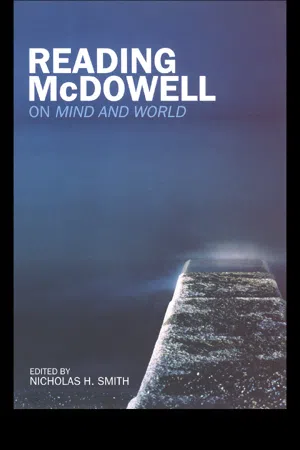
- 328 pages
- English
- ePUB (mobile friendly)
- Available on iOS & Android
eBook - ePub
About this book
Information
Part I
PHILOSOPHY AFTER KANT
1
McDOWELL’S DOMESTICATED HEGELIANISM
Richard J.Bernstein
It is central to absolute idealism to reject the idea that the conceptual realm has an outer boundary, and we have arrived at a point from which we could start to domesticate the rhetoric of that philosophy. Consider, for instance, this remark of Hegel’s: “In thinking, I am free, because I am not in an other” This expresses exactly the image I have been using, in which the conceptual is unbounded; there is nothing outside it. The point is the same as the point of that remark of Wittgenstein’s: “We—and our meaning—do not stop anywhere short of the fact.”
(Mind and World, p.44)
I suspect that many of John McDowell’s “analytic,” and former Oxford, colleagues thought it was some sort of a joke when McDowell announced in the Preface to Mind and World “that I would like to conceive this work…as a prolegomenon to a reading of [Hegel’s Phenomenology of Spirit].”1 Hegel is a philosopher that few “analytic” philosophers have taken seriously (or even read)—a philosopher who is typically held up for ridicule, as someone who epitomizes the intellectual vices that “analytic” philosophy has sought to overcome. Or as McDowell himself more judiciously phrases it, Hegel is “someone we take almost no notice of, in the philosophical tradition I was brought up in” (p.111). McDowell’s reference to Hegel is no joke. I want to show how profoundly McDowell has been influenced by a line of thinking that is Hegelian, and that McDowell’s domesticated Hegelianism provides an essential clue for grasping the overall strategy and direction of his thinking. One of the many attractive features of McDowell’s thought is that he shows just how outdated and provincial the so-called “analytic-continental split” is for philosophy today. There is good and bad philosophical thinking, and many of today’s most creative thinkers—like McDowell (and his colleague, Robert Brandom)—pay no attention to this artificial split; they incorporate ideas from what we have erroneously labeled two different traditions.2 One looks forward to the day (in the not too distant future) when we glance back upon the ideological “culture wars” between “analytic”’ and “continental” philosophers with amusement, wondering how these sometimes fruitless heated debates could be taken so seriously.
When I speak of McDowell’s “domesticated Hegelianism,” I mean something quite specific.3 I am referring to his creative appropriation of a pattern of thinking that is exhibited in Hegel (at his best). Although such a line of thinking can be found in Hegel, its philosophic significance and justification are independent of its origin. And the reason why I use the adjective “domesticated” is because it is quite clear that McDowell also rejects large portions of Hegel that may strike some as “wild.” McDowell is fond of using a variety of epithets to describe his philosophic orientation. We shall see that McDowell’s “prolegomenon to a reading of the Phenomenology” is also a “minimal empiricism” or a “naturalized platonism”— epithets that would certainly upset and even shock many “straight” Hegelians. McDowell’s explicit references to Hegel are few and scattered (although they are always crucial and revealing). He does not begin with reflecting on Hegel or commenting on his writings. Rather, McDowell begins where, it may be said, Hegel himself began—by reflecting on the achievements and limitations of Kant. McDowell uses the twentieth-century Kantian Wilfrid Sellars as a guide for his reading of Kant.4
Let me begin by giving a sketch of how I plan to approach McDowell. Kant’s great philosophic achievement was his rich and textured articulation and probing of a number of interrelated philosophic distinctions: understanding and sensibility; concepts and intuitions; spontaneity and receptivity; phenomena and noumena; understanding (Verstand) and reason (Vernunft); appearance and the “thing-in-itself”; freedom and natural necessity. These (and other closely related distinctions) contributed to a radically new understanding of the nature and limits of knowledge and rationality. In this sense, Kant himself brought about a revolution in philosophy which was as dramatic and as consequential as Copernicus’s revolution in astronomy. But the great achievement of Kant has also been the source for deep perplexities and philosophic anxieties. Why? Because Kant, at times, seems to reify these distinctions, to make them into rigid dichotomies that leave us with all sorts of aporiai. Virtually every philosopher since Kant, who has taken his achievement seriously, has sought to return to his provocative distinctions and dichotomies in order to modify, abandon or rethink them. The greatest of these was Hegel himself.5 Indeed, there is a master strategy at work in Hegel. Viewed from one perspective, no other thinker of his stature sought to take Kant so seriously and “complete” his project.6 But viewed from another perspective, no other thinker has been such a penetrating and sharp critic of Kant. These claims are compatible because Hegel does not abandon the Kantian distinctions, but rather seeks to show that when we think them through, we discover they are not rigid, fixed epistemological and/or metaphysical dichotomies. Rather, they turn out to be dynamic, changing, fluid distinctions which are to be comprehended within a larger whole or context. Thus Hegel’s thinking and working through the Kantian distinctions leads to the rejection of all rigid distinctions and dichotomies (including perhaps the most fundamental distinction between the finite and the infinite). Using a Hegelian turn of phrase, the Kantian distinctions turn out to be distinctions which are no distinctions. Or stated in another way, Hegel seeks to draw out what he takes to be the “truth” (Wahrheit) implicit in the Kantian distinctions—a truth that turns out frequently to be the very opposite of what Kant presumably intended. We will see that this is just the strategy that McDowell himself develops in regard to the Kantian distinctions of understanding and sensibility, spontaneity and receptivity, concepts and intuitions, appearance and reality. This very strategy warrants McDowell’s rejection of any vestiges of the “Myth of the Given,” and enables him to argue there is no “outer boundary” to the conceptual realm; we are not (epistemologically or metaphysically) cut off from the world or reality as it exists “in itself.” The essential relation that we, as thinking and knowing beings, have to the world is one of openness to the world with no fixed boundaries. There are not only causal constraints on what we can know, but also rational constraints. But let us now turn to the details of how this story unfolds.
Taking his cue from Sellars, McDowell sets himself against all varieties of the Myth of the Given. In the opening paragraph of “Empiricism and the Philosophy of Mind,” Sellars makes the point that there is an innocent non-controversial sense of the “given” where the term is used to refer “merely to what is observed as being observed” and not inferred. This common variety sense of the “given” is not what is philosophically interesting or controversial. But Sellars also points out that “the phrase ‘the given’ as a piece of professional-epistemological shoptalk carries a substantial theoretical commitment.”7 The basic idea of givenness in this technical sense is closely associated with what Hegel calls immediacy. Although givenness has taken on many different forms in the history of philosophy, the Given is presumably not “contaminated” by any mediation, any form of inference. The Given is something that can be either directly known or known by acquaintance; it is an immediate intuition or a self-authenticating epistemic episode. This unmediated Given serves as a foundation for the edifice of knowledge. And this is why we might look upon Kant as initiating the modern critique of the “Myth of the Given”—a critique that is epitomized in Kant’s remark “intuitions without concepts are blind.” Now it is important to realize why the Myth of the Given does not seem to be a myth but rather some sort of basic truth, and why it is so attractive and seductive. To use a term that McDowell favors, there has been a pervasive philosophic “anxiety” that unless there is something Given, unless there is something that grounds knowledge in the way in which the Given presumably does, then the very possibility of empirical knowledge is threatened. We seem to be left with a bad free-floating conceptual realm that has not been tied down to the real world.
Kant’s remark about intuitions and concepts is intimately related to his distinction between spontaneity and receptivity. As McDowell diagnoses our contemporary philosophic situation, there is a back and forth movement—a seesaw between two unacceptable extremes. He thinks that there is a “danger of falling into an interminable oscillation”—an oscillation between some version of the Myth of the Given where we deceive ourselves into thinking that empirical knowledge is grounded and epistemically justified by a Given that is not already conceptualized and some sort of frictionless coherentism (a position which he sometimes associates with Davidson). But McDowell thinks that we can dismount from this seesaw and that it is Kant (and Sellars) who begin to show us how this is to be done:
The original Kantian thought was that empirical knowledge results from a co-operation between receptivity and spontaneity. (Here “spontaneity” can be simply a label for the involvement of conceptual capacities.) We can dismount from the seesaw if we can achieve a firm grip on this thought: receptivity does not make an even notionally separable contribution to the co-operation.
(p.9)
We will soon see just how consequential this claim is for McDowell, but first we have to understand it. For everything depends on how we understand this “cooperation between receptivity and spontaneity.”8 We will set off on the wrong track if we think that receptivity can be sharply distinguished from spontaneity in such a manner that it is the source for non-conceptual “data,” and that this receptivity is only conceptualized when spontaneity comes into play. This will lead us straight to the Myth of the Given. It is bad philosophy and bad Kant. Rather, we must grasp that conceptual capacities are “always already” drawn on in receptivity. In short, it is a fiction—a seductive misleading fiction—to think that there is some sort of “pure” receptivity that is free from all involvement of conceptual capacities. McDowell announces this theme early in his first lecture: he returns to it over and over again, explicating, amplifying, and defending it. He tells us:
The relevant conceptual capacities are drawn on in receptivity…. It is not that they are exercised on an extra-conceptual deliverance of receptivity. We should understand what Kant calls “intuition”— experiential intake—not as a bare getting of an extra-conceptual Given, but as a kind of occurrence or state that already has conceptual content. In experience one takes in, for instance sees, that things are thus and so. That is the sort of thing one can also, for instance, judge.
(p.9)
McDowell restates and amplifies this theme at the beginning of his second lecture:
In my first lecture I talked about a tendency to oscillate between a pair of unsatisfying positions: on the one side a coherentism that threatens to disconnect thought from reality, and on the other side a vain appeal to the Given, in the sense of bare presences that are supposed to constitute the ultimate grounds of empirical judgements. I suggested that in order to escape the oscillation, we need to recognize that experiences themselves are states or occurrences that inextricably combine receptivity and spontaneity. We must not suppose that spontaneity first figures only in judgements in which we put a construction on experiences, with experiences conceived as deliverances of receptivity to whose constitution spontaneity makes no contribution. Experiences are indeed receptivity in operation; so they can satisfy the need for an external control on our freedom in empirical thinking. But conceptual capacities, capacities that belong to spontaneity, are already at work in experiences themselves, not just in judgements based on them; so experiences can intelligibly stand in rational relations to our exercises of the freedom that is implicit in the idea of spontaneity.
(p.24)
This is precisely the reading that Hegel gives to the Kantian distinctions of intuitions and concepts, receptivity and spontaneity. McDowell’s statement of the relation of receptivity to spontaneity helps us to understand what Hegel means when he speaks of a distinction that is no distinction. Experience (Hegel’s Erfahrung) is of such a character that it is “always already” constituted by conceptual capacities. There is no receptivity where spontaneity is not already at work.
But if this is what McDowell himself maintains, then one may wonder if he has really shown us how to dismount from the oscillating seesaw that he so trenchantly describes. If there is no escape from the Conceptual, then what is the difference that makes a difference between what McDowell is affirming and the type of coherentism that he objects to in Davidson? Put in another way, has not McDowell backed himself into a form of (linguistic) idealism in which he has failed to explain how empirical knowledge is tied down to an independent reality which is “outside” and “beyond” the Conceptual?
McDowell is perfectly aware that this is the sort of objection that will be raised against him. And it is in meeting (or rather undermining and defusing) this objection that we find some of his most subtle, perceptive, and original thinking. McDowell, like Wittgenstein, thinks that there is a picture here that holds us captive. It is a picture whereby we imagine that there must be something (a world of brute reality) that is “outside” and “exterior” to what is Conceptual. Unless we find some way to connect this brute reality with the exercise of our conceptual capacities, then (presumably) there is the danger of undermining not only the possibility of any empirical knowledge, but any knowledge whatsoever. For how can a conceptual realm that is not “tied down” to an external independent reality yield any knowledge of this reality? This is the picture that needs to be deconstructed, that needs to be undermined by a type of Wittgensteinian therapy. McDowell carries out this therapy by showing us that the very idea of thinking that there is something “inside” the conceptual sphere and something “outside” it (that ties the conceptual sphere down) is a thoroughly confused and incoherent idea. We need to grasp and appreciate “The Unboundedness of the Conceptual”9 McDowell’s point, stated in a way that brings him into direct confrontation with Davidson (and many others), is that we do need to account for rational constraints on thinking and judging; it is not sufficient “to make do with nothing but causal constraints.” Furthermore, we can affirm that there are rational constraints without falling back into the Myth of the Given. This sounds like a stunning trick. And we might well wonder how McDowell is going to pull it off. Let me first state what McDowell is affirming, and then unpack his meaning. McDowell writes:
In the conception I am recommending, the need for external constraint is met by the fact that experiences are receptivity in operation. But that does not disqualify experiences from playing a role in justification, as the counterpart thought in the Myth of the Given does, because the claim is that experiences themselves are already equipped with conceptual content. This joint involvement of receptivity and spontaneity allo...
Table of contents
- Cover Page
- Title Page
- Copyright Page
- Contributors
- Acknowledgements
- Introduction
- Part I: Philosophy After Kant
- Part II: Epistemology
- Part III: Philosophy of Mind
- Part IV: Toward Ethics
- Part V: Responses
Trusted by 375,005 students
Access to over 1.5 million titles for a fair monthly price.
Study more efficiently using our study tools.
Frequently asked questions
Yes, you can cancel anytime from the Subscription tab in your account settings on the Perlego website. Your subscription will stay active until the end of your current billing period. Learn how to cancel your subscription
No, books cannot be downloaded as external files, such as PDFs, for use outside of Perlego. However, you can download books within the Perlego app for offline reading on mobile or tablet. Learn how to download books offline
Perlego offers two plans: Essential and Complete
- Essential is ideal for learners and professionals who enjoy exploring a wide range of subjects. Access the Essential Library with 800,000+ trusted titles and best-sellers across business, personal growth, and the humanities. Includes unlimited reading time and Standard Read Aloud voice.
- Complete: Perfect for advanced learners and researchers needing full, unrestricted access. Unlock 1.5M+ books across hundreds of subjects, including academic and specialized titles. The Complete Plan also includes advanced features like Premium Read Aloud and Research Assistant.
We are an online textbook subscription service, where you can get access to an entire online library for less than the price of a single book per month. With over 1.5 million books across 990+ topics, we’ve got you covered! Learn about our mission
Look out for the read-aloud symbol on your next book to see if you can listen to it. The read-aloud tool reads text aloud for you, highlighting the text as it is being read. You can pause it, speed it up and slow it down. Learn more about Read Aloud
Yes! You can use the Perlego app on both iOS and Android devices to read anytime, anywhere — even offline. Perfect for commutes or when you’re on the go.
Please note we cannot support devices running on iOS 13 and Android 7 or earlier. Learn more about using the app
Please note we cannot support devices running on iOS 13 and Android 7 or earlier. Learn more about using the app
Yes, you can access Reading McDowell by Nicholas Smith in PDF and/or ePUB format, as well as other popular books in Philosophy & Epistemology in Philosophy. We have over 1.5 million books available in our catalogue for you to explore.