- 192 pages
- English
- ePUB (mobile friendly)
- Available on iOS & Android
eBook - ePub
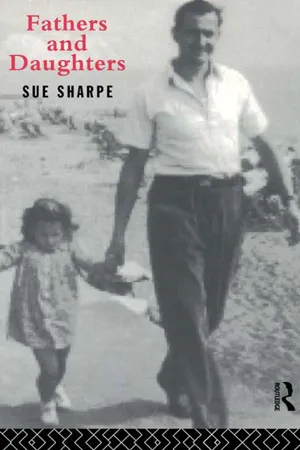
Fathers and Daughters
About this book
Fathers and Daughters explores the complex nature of this subject using the voices and experiences of both fathers and daughters. Sue Sharpe provides an examination of the important processes operating within the relationship such as those affecting gender roles, achievement, teenage sexuality, women's relationships with men and ageing. It is an original and captivating treatment of a strangely neglected subject. Sue Sharpe is a free-lance writer and researcher based in London.
Information
Chapter 1
Little girls
‘As she grew older I can recall feelings which I suppose I still hold, of protection, possibly over-protection, towards “my little girl”; rushing to hold her hand and steady her if she looked as if she might fall, for example. Whether I would act the same if she was a boy I don't know. I've always tried to avoid “gender stereotyping”, but subconsciously I don't think I expect her to be as physical or as sporty, nor do I push her to be so.’
Patrick
‘I remember my dad buying me cars and things deliberately because I was a girl; probably if I was a boy he'd have bought me dolls and things!’
Sophie
‘He's never made a difference between the girls and the boys of the family. The boys used to take turns at doing the dishes, in fact they were better at it … but I don't think he would have expected us to do the wallpapering or anything, whereas I probably would have made a better job than my brothers. He would say, “I need the boys for that”’.
Jean
The prospect of having a baby affects men in a variety of ways. Some are overjoyed; others are doubtful and nervous about their capacity for this role; and some give it little serious thought until it happens. Over the past few decades the traditional image and reality of being a father has, to some extent, been modified. Expectations have been created in which housework and childcare potentially are shared between men and women in the family, and there is an assumption that people have become more open about sexuality and the process of giving birth.
Men who became fathers several decades ago often had quite different expectations and experiences from those of young fathers today. David, for instance, is a journalist in his mid-sixties who has several grown-up children as a result of three marriages. He is typical of many fathers who have found themselves having children simply as an extension of marriage, because this was the next and appropriate thing to do:
‘I became a father when I was twenty-five. I had an idea of being a father — you got married and so you would be a father, but if it were left to me, like many men, I think I would have put off having children until I was about forty. I think most men have a picture of being a father of a seven or eight-year-old boy to take out fishing or to football matches, whether they ever do that, it's a kind of myth. But babies — men want children but they don't want babies!’
Whatever feelings men have beforehand, having a child significantly changes the course of their lives. Peter is a building maintenance worker, a single parent in his late thirties, who has shared the responsibility for his fourteen-year-old daughter Melanie all her life, and especially since his relationship with her mother broke down when she was a few years old. His early experience was shared living in communal housing with his partner and daughter but now he lives on his own and his daughter joins him every alternate week. Recalling the time leading up to her birth, he said:
‘I didn't think about it very much, but I felt very excited about it. I didn't really see or perceive what it meant, you only have short-term vision when you're twentyfour. In reality it means you're going to have care and control and emotional involvement for the rest of your life.’
Some fathers are extremely dubious about parenthood, questioning the sort of world they may be bringing children into. One of these I spoke to is Richard, whose early life as a technical representative had been transformed in his forties through getting a place to study history at university. He and his wife and daughter Sophie lived together in a remote part of the west country until Sophie went recently to college. Richard's experiences were also tempered by his earlier experience of childcare:
‘I was very taken aback and very anxious when Pam became pregnant. We had in fact brought up my brother's boy for about five years. He proved to be a very difficult child and it was totally unrewarding; there was never any feedback at all.’
Whatever the initial feelings, these can all change when the baby is born, and men are confronted with this small but very real person, as Richard had found: ‘When Sophie arrived the qualms did disappear and the angst slowly melted away.’
One thing men cannot do is give birth, and many are thankful to be missing this momentous but often very painful experience. In earlier years it was not the custom for fathers to be present at the birth of their children. It was discouraged by doctors and other hospital staff because men got in the way, their presence was unhygienic, they might faint at the sight of blood and at that time many men and women assumed it was inappropriate. In my parents' generation, the prospective father was hustled out and expected to wait in another room, or was called at work at some time afterwards with the message: ‘You've just had a baby girl/boy’. My own father was hard at work at the office when he received the call from the nursing home that my older brother had been born. He was so excited that he fell off his bike on the way home.
Although today it is quite common practice for men to be present at the birth of their children, Richard remembers the day nineteen years ago his wife had Sophie: ‘I wasn't actually there when Sophie was born, although I saw her quite early on. But to be truthful, it hadn't really occurred to me to actually be present at the birth.’ In contrast, Malcolm, a freelance writer, had very much wanted to attend the birth of his daughter Anna, thirteen years ago, but had not anticipated taking an active part in it. However, because another mother was giving birth at the same time as his wife Claire, this caused a sudden shortage of nursing staff: ‘I was like the assistant midwife, very much involved and really delighted. The fact that I was actually taking part was really exciting because it meant that it was our child and not just Claire's, because I'd been there. And when I saw Anna I felt fantastic.’
Obviously, having children can radically affect men's lives, both practically and emotionally, and the amount of participation that a father feels in the actual birth process can intensify his feelings of involvement. This in itself may not affect the later relationship between father and daughter, but it can add to the amount of personal investment in fathering that a man is already bringing to this role in his life.
For Tony, who works as an electricity board officer and lives with his wife and two teenage children in the north of England, it was a very significant moment in his life when his son Martin was born eighteen years ago, as he describes:
‘I was there at the birth and I recognised then that my life had changed. We'd been married a couple of years before Martin came along — he was planned — and the emotion was enormous. In those first seconds when he was born, his life — or was it my life — flashed through my mind. Complete identity, change of direction. I was no longer a single man with a wife. I was responsible for somebody, for their life. It just changed and I knew it did. Fantastic. Laura was also planned, but having experienced Martin being born and all the emotion, then when Laura was born I didn't have the same experience. I didn't have that same identity, because as a man I didn't know what being a girl meant. I knew what being a boy meant, I'd been through it. I looked at her and I thought, that's nice, very nice, but it wasn't until she got to nine months that she had a character, and certainly by the time she was twelve months. But I couldn't get that kind of identity until that age.’
Having Laura was clearly different for Tony from having Martin in terms of his shared identification with the ‘masculine’ future in store for his son. While women have a shared identification with their daughters, some researchers contend that mothers tend to treat babies and young children of both sexes more similarly than fathers do.1 Men appear to place a sense of being ‘other’ on their daughters more than mothers do on their sons. In his study of one hundred first-time fathers, Brian Jackson noticed that, although it is impossible to measure, the way fathers held sons and daughters at birth was different. He suggests that mothers hold more closely to both sexes, but that fathers tended to hold daughters more protectively close, while a male baby was held more at a distance and was gazed at more intensely.2
It seemed quite hard for men to put into words the nature of the different feelings they may have towards their sons and their daughters. Sean is a lecturer in his forties who is the father of a teenage son, two young daughters and a baby boy, in three separate relationships. He attempts to express what it feels like for him:
‘I feel differently towards them in a very gut way. I don't think I love daughters or sons more than the other, but I have different feelings about them. I have no idea where that comes from, but daughter-ness is different from son-ness to me. I'm attracted by the femininity of daughters, wherever that comes from, whereas sons seem to offer a slightly different shared life with me. I'd play football with my daughters but I wouldn't look to them to be footballers, whereas I did a lot of training with my eldest son … while I say that, I'm aware my daughter is particularly athletic and that's something I'd like to develop. Even though I'm describing a different gut feeling towards them it wouldn't stop me giving her the same amount of time and attention on that. But the basic flush of emotion is slightly different towards her — I do find it a bit difficult to describe, the precise timbre of it.’
In looking at the ways that girls develop feminine identity and personality, it was suggested by Nancy Chodorow3 that there is a kind of shared identification (or ‘double identification’) in which mothers identify with their daughters, having been daughters/girls themselves, and their daughters identify with their mothers through being of the same sex and often being involved more with their mothers and with other women in general. This may also occur with boys and their fathers, as Tony and Sean have described above, with their sons, although in the reverse direction. Some boys may find it less easy to identify with their fathers if they are not around in their lives very much, and consequently for young boys, their representation of masculinity may be partly formed by a rejection of femininity and anything seen as feminine. Fathers, like Tony and Sean, are therefore finding it difficult to identify with their daughters, as compared with their sons, because of their perceived differentness and the different future they anticipate for their daughters. There is already a psychological distance between them, created by this feeling of ‘otherness’.
Some parents have definite ideas about whether they want a son or a daughter. It used to be thought more important to have at least one son in order to carry on the family line, and also to fulfil a romantic image of father and son sharing masculine activities together, playing or watching sport, or engaging in craft skills like carpentry. Having a son for purposes of inheritance or economic provider is not such a salient concern for many fathers in this country today, at least not in traditional English culture. In other cultures, such as Asian, having sons has much more significance. Asian women's lower status is reflected in the relatively negative attitudes towards having daughters, reinforced by the greater cost incurred, since it is a girl's family that has to provide a dowry for each daughter on marriage. In postwar Britain, the middle-class ideal was to have one child of each sex, and advertisements portrayed a happy family as two smiling parents holding hands with their young son and daughter. Many men today would like to have a son but if they have one or several daughters instead, this is not usually a problem. Some even prefer it that way, like Raymond, for example, a self-employed businessman who is now in his late sixties. From a traditional Jewish family, he and his wife had two children, both girls, now grown up with children of their own. He says: ‘I always prefer girls. I thought they were less trouble I suppose, and because boys are a little bit mischevious and I haven't got a lot of patience.’ The idea that girls are easier to manage is a legacy from the traditional feminine stereotype and is not substantiated in general practice. Although I heard more young daughters described as being ‘no trouble at all’ compared to sons, a lot of other parents described many of the problems they have trying to communicate with, or control the behaviour of their teenage daughters.
Some men specifically profess to prefer women to men in general, and for them, the obvious choice is to hope to have a daughter. Several of the fathers quoted above took this view, like Richard for instance:
‘I was very pleased I had a daughter, and also there's the underlying thing that in general I do, with a few exceptions, find women much more interesting than men. I've never been one of the boys.’
Malcolm is another who is happy to have had a daughter, and for him, females are definitely better:
‘I just wanted a child with all four limbs in place, but I must confess I was delighted when it was a girl. I think girls are nicer than boys. I honestly don't know why, I just do like girls better than boys and women better than men.’
David, now an elderly grandfather, was not at all worried when he had four daughters before having a son:
‘I didn't mind not having a son and having a lot of daughters. I can honestly say I had no interest in that aspect at all. I love women. I like their feeling how they won't stand bullshit and nonsense. And they're not bullying, they're more easily turned into a jolly, laughing mood. It's much harder to do that with boys.’
I am perhaps tempted to agree with men who profess to think women better than men, and that women are generally better company, more sympathetic and usually more intelligent than men, but I find this attitude in men sometimes a little suspect. Why do men who so much prefer women's company to men's often have few male friends? It may be illuminating to look back to their own family and childhood and to their relationships with their mothers or sisters. While some men's liking for female company is genuine, I believe for others it can mask an underlying misogyny and a desire to constantly prove they can exert power and control over women. They use women as confidantes because women understand feelings and are more emotionally empathetic; talking to them is less exposing and threatening, and it can also serve to enhance their ego. For fathers who use their children as extensions of themselves, girls may serve a similar decorative role. Being seen with an attractive teenage daughter may help to prop up her middleaged father's self-image, and detract from his own declining sexual attractiveness and his conflict with the ageing process.
Men's primary role has traditionally been seen as going out to work while women's role has been to stay at home and look after the home and family. Such a rigid division may seem old-fashioned to many young people growing up today, but it is not so long ago that this over-simplification of real life was taken for granted (at least amongst large sections of the middle-class population) and it has not totally changed. It did ring true in describing the situation for many fathers whose daughters were born just after the Second World War, such as Raymond (quoted above) and his daughter Margaret, now in her thirties with children of her own. Raymond describes how he had little involvement in the care of his two daughters:
‘I did nothing at all in the domestic field. I used to go up to London about seven in the morning and I rarely got back before half past eight at night; they were always in bed. One of the things I regret is not having a more active part in their young days. I probably didn't play with them as much as most fathers as I had my own business, I very often worked weekends as well. There were never any problems, they always took to me very well. I would take them places, but very rarely on my own, we would go as a family.’
Men's involvement in childcare and children's activities in general were not seen as crucial to the child's ‘healthy’ development, and in the 1950s and 1960s, for example, researchers on maternal deprivation neglected any possible significance of the father in family life and on children's bonding processes.4
Fathers from Raymond's generation tended to come home from work in the evening in time to play with their children for a short while, maybe even give them a bath, perhaps read them a story or put them to bed. There were of course exceptions, but this was what happened in the majority of families where fathers had employment and it is not so different from many families today. Margaret recalls her memories of Raymond from about thirty years ago when she was a small girl:
‘My dad used to work in London so he used to commute. He had kippers for breakfast. I remember hoping he hadn't time to finish his kippers properly before he went for his train so I could finish them. If he got back in the evenings before I went to bed it was very special, his coming home was absolutely a big deal.’
Fathers took more of a recreational role with the children, as many still do today, which reinforces the different style of relationship that fathers and mothers often have wth their children. Tony, quoted earlier, has a fifteen-year-old daughter Laura, who recalls the fun she and her brother enjoyed out with her father, while her mother was doing things at home:
‘My father's always been playful and jokey. He used to play with us for ages, it was really nice. It used to be Sundays. Mum would be cooking the dinner so me, my dad, and Martin would go up to the hills. It would be brilliant, we'd come back covered in muck. And he used to excel himself on holidays, he'd never stop making a fool of himself, and he'd always be laughing and throwing us around, really good fun.’
Fathers also took a more authoritarian role in which, although they were often absent at work for most of the day, they were given ultimate power over discipline and authority within the family, and held up as a threat to misbehaving children (‘Wait until your father gets home!’). Fathers in this role become ‘special’ through their relative absence from day to day activities and trivialities. This contributes to the sense in which fathers and their love and support are not taken for granted in the same way as that of mothers.
Since the late 1960s, increasing li...
Table of contents
- Cover
- Half Title
- Male orders
- Full Title
- Copyright
- Contents
- Dedication
- Acknowledgements
- Introduction
- 1 Little girls
- 2 Approval and achievement
- 3 Dominance and violence
- 4 Sexuality
- 5 Other men in her life
- 6 Ways of fathering
- 7 Ageing: the roles reverse
- 8 Concluding thoughts
- Glossary of daughters and fathers
- Notes
- Bibliography
- Index
Trusted by 375,005 students
Access to over 1.5 million titles for a fair monthly price.
Study more efficiently using our study tools.
Frequently asked questions
Yes, you can cancel anytime from the Subscription tab in your account settings on the Perlego website. Your subscription will stay active until the end of your current billing period. Learn how to cancel your subscription
No, books cannot be downloaded as external files, such as PDFs, for use outside of Perlego. However, you can download books within the Perlego app for offline reading on mobile or tablet. Learn how to download books offline
Perlego offers two plans: Essential and Complete
- Essential is ideal for learners and professionals who enjoy exploring a wide range of subjects. Access the Essential Library with 800,000+ trusted titles and best-sellers across business, personal growth, and the humanities. Includes unlimited reading time and Standard Read Aloud voice.
- Complete: Perfect for advanced learners and researchers needing full, unrestricted access. Unlock 1.5M+ books across hundreds of subjects, including academic and specialized titles. The Complete Plan also includes advanced features like Premium Read Aloud and Research Assistant.
We are an online textbook subscription service, where you can get access to an entire online library for less than the price of a single book per month. With over 1.5 million books across 990+ topics, we’ve got you covered! Learn about our mission
Look out for the read-aloud symbol on your next book to see if you can listen to it. The read-aloud tool reads text aloud for you, highlighting the text as it is being read. You can pause it, speed it up and slow it down. Learn more about Read Aloud
Yes! You can use the Perlego app on both iOS and Android devices to read anytime, anywhere — even offline. Perfect for commutes or when you’re on the go.
Please note we cannot support devices running on iOS 13 and Android 7 or earlier. Learn more about using the app
Please note we cannot support devices running on iOS 13 and Android 7 or earlier. Learn more about using the app
Yes, you can access Fathers and Daughters by Sue Sharpe in PDF and/or ePUB format, as well as other popular books in Social Sciences & Sociology. We have over 1.5 million books available in our catalogue for you to explore.