Time in Antiquity offers a detailed survey of the science of time and its measurement in the Greek and Roman worlds, including Babylon and Egypt where many of the first advances were made. Robert Hannah focuses on the physical aspects of time measurement, locating the means of measurement, and the astronomers who developed these mechanisms, within their scientific context for the first time. This is a unique contribution to the understanding of the ancient world and its thinking, and is of interest to classicists, historians of the ancient world and of science, philosophers, and anthropologists.
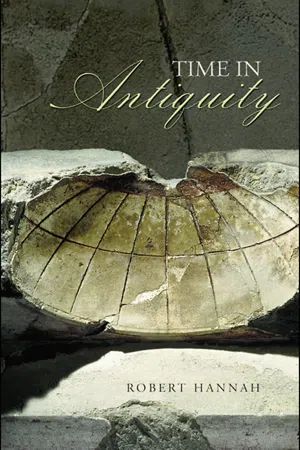
- 210 pages
- English
- ePUB (mobile friendly)
- Available on iOS & Android
eBook - ePub
Time in Antiquity
1
TIME IN ANTIQUITY
An introduction
Hell, some wit in antiquity once suggested, was made by God for those who asked what he was doing before he made Heaven and Earth. The quip is retailed by Augustine of Hippo (Confessions 11.12.14), in an uncharacteristically light moment in a serious disquisition about time. The point of the joke, he tells us, is that before the Creation, time did not exist, so there is no point in asking about any ‘before’. Modern cosmologists face a similar problem when dealing with questions about what happened before the ‘Big Bang’, which currently holds sway as the best theory for the beginning of the universe. Before this event there could be no time, nor space, so the question, ‘What happened before?’, is just as meaningless now as it was in Augustine’s day.1
Yet time fascinates us. According to the 11th revised edition of the Concise Oxford English Dictionary, the word ‘time’ is the most common noun in the English language. How it stands in other languages I do not know, but it may not be too different. And it does not stop there: other time-related words are high in the popularity stakes in English, with ‘year’ ranked third, ‘day’ fifth, and ‘week’ seventeenth.2
Occasionally such popular fascination with the parts of time bubbles up from antiquity too. One poor individual, who died at the hands of robbers, seemingly along with his seven foster-children, was buried by his widow with this epitaph:
To Iulius Timotheus, who lived more or less 28 years, a man of most innocent life, deceived by robbers with his seven foster-children, Otacilia Narsica [dedicated this] to her dearest husband.
(CIL 6.20307; ILS 85053)
The phrase ‘more or less’ is expressed simply as P M in the inscription, that is, plus minus in Latin. ‘Plus or minus’ has become part of our everyday language to express an approximation. What the epitaph demonstrates is a desire for precision—otherwise, why bother saying it?—but an inadequate means of measuring it.
A lawyer in Dalmatia, on the other hand, had his age noted on his tombstone down to the very hour: ‘47 years, 9 months, 7 days, in the fifth hour of the night’ (CIL 3.2127A; ILS 7774).4 This, however, is unusual. As we shall see in the course of this book, the measurement of time underwent a slow evolution, whose stages still remain unclear, and whose results are usually not very precise by our modern, artificial standards.
We live in a curious age. Despite our knowing the mechanics of the cosmos so well now in contrast to past ages, we persist in saying that the sun ‘rises’ and ‘sets’, even though the sun does no such thing. Yet we also define a ‘second’ now as ‘the duration of 9,192,631,770 periods of the radiation corresponding to the transition between the two hyperfine levels of the ground state of the caesium 133 atom’.5 There was a time, not long ago, when a ‘second’ was simply (we thought!) one 86,400th of a day, because there were 86,400 seconds in a day (24 hours=1,440 minutes=86,400 seconds), and that day was governed by the sun.
The apparent movement of the sun around the Earth once defined time for us. The ordinary civil day comprises the interval between one noon and the next, between successive moments when the sun is at its highest in the sky. But it became clear to scientists that this apparent movement of the sun—or more accurately, the spin of the Earth, which produces the illusion of the sun’s movement—is not uniform, but is both slowing down and erratic. The frictional tidal effects of the moon on the Earth’s oceans cause it to slow down, and it is erratic because of the displacement of the North and South Poles by a few metres from one year to the next. There are seasonal fluctuations also, which are due to the varying distribution of air and water across the surface of the Earth, and which cause the Earth to slow down in spring and to speed up in winter.
Modern scientific theory and practice, however, demand uniform time to very minute levels of precision. So the measurement of the civil day, and hence of its components, is inaccurate for science. Averaging out the days to produce a ‘mean solar day’ allows us to smooth out some of the wrinkles inherent in measuring time by the rotation of the Earth, but not to the degree of precision now required. In an effort to provide greater standardisation, from 1956 the ‘mean solar second’ was anchored artificially to the value it had had in 1900. This continued to prove unsatisfactory, and so from 1967 it was agreed that we should cut the conceptual umbilical cord to the rotation of the Earth, and measure time according to another system entirely—the natural vibrations of the caesium atom, which occur in the invisible, microwave part of the radio spectrum. Atomic clocks, based on this premise, have no face nor hands. Even those ancient ‘clocks’, the Greek and Roman sundials, which measured time through the hours of sunlight, were characterised as having a relationship to the human face: a witticism from the Roman imperial period had it that ‘If you put your nose facing the sun and open your mouth wide, you’ll show all the passers-by the time of day’ (Palatine Anthology 11.418). We have lost the human ‘face’ of time, but retain its language.6
In chapter 2 we shall return to the natural world, seeking the means by which the heavenly bodies—the sun, moon and stars—were used to help mark time for ancient Greek and Roman societies. The cycles of these luminaries can provide in themselves sufficient regularity to help people develop time-schedules or almanacs, and ultimately calendars. But I want also to put ourselves back into the physical place of Greeks and Romans and to view these same celestial bodies against the natural landscape of hills and plains, which provided a backdrop for marking special times of the year.
I have devoted the third chapter to a study of the time-schedules, calendars and cycles of antiquity. These mark moments of time, rather than measure its passage. I have structured my study around the most complex geared instrument from antiquity, the Antikythera Mechanism. This incorporates a number of the calendars and cycles of antiquity into a single ingenious, wind-up mechanism, which could predict the positions of the sun and moon, and certainly two and probably all five of the planets known to Classical antiquity. The Mechanism has been known for over a century, but it has taken some of the most sophisticated technology of modern times, such as the CT scanner, to reveal to us just how complex it is. We are familiar with this form of high-end X-ray scanning in medicine, but the research group examining the instrument have taken advantage of the facts that the Antikythera Mechanism is not a living creature which can be harmed by too much radiation, and that it cannot move of its own accord but sits perfectly still, and so they have bombarded it with far more X-rays than any organism could withstand and have at last seen through the centuries of marine decay and encrustation that it suffered in the sea off the coast of Antikythera. I must express here my gratitude to Tony Freeth, the leader of the Antikythera Mechanism Research Group, for allowing me access to the group’s material and their findings before formal publication. We still do not have all the answers to the puzzles that it presents, and we may never have, but we are a considerable distance along the road towards knowing, which is all science can sometimes ever seek. To Michael Wright, who has developed over many years a full-scale working model of the same Mechanism, I owe another debt of gratitude for making the instrument come alive, and for showing something of the spirit of engineering enquiry that must have characterised the original maker. I hope he can incorporate some of the latest findings and give us further cause to wonder at the capacity of the ancient mind to magic the cosmos into a shoebox!
In the following chapters (4–6), while demonstrating the forms of various ‘time machines’ devised in antiquity, notably sundials and water clocks, I want also to emphasise along the way the human facet of timekeeping and time-measurement, by burrowing into the literature of the period to see what it says, here and there, about time and its effects. I want also to see what we can derive from the instruments themselves about contemporary perceptions and conceptions of time. Few people wrote about time per se outside the schools of philosophy, and it is not the philosophers’ thoughts that I am wishing to place in centre-stage in this book, but rather the perceptions of the ‘ordinary’ people, who lived and worked with these instruments devised by others. We shall see also how these people reacted to these increasingly common, and even dominating, instruments, whose growing complexity demonstrates the emerging technological sophistication of the Classical world. Yet we shall see also how simple and very human some methods of telling the time were, such as the use of one’s own shadow, and how human, in another sense, the very makers of these inherently complex instruments sometimes were, in not having much of a clue about the underlying theory and getting it wrong, so that they produced, for instance, sundials which could tell the hours of the day very well but which failed miserably when it came to pointing out the time of year. Designing the dials was one thing, it seems; giving the template to an artisan to manufacture (literally, by hand) a finished product and still expect accuracy, was sometimes another. That this accuracy, or its lack, was not simply a function of size we shall see in the few examples of miniature, portable sundials, which could tell the time with remarkable precision.
The final chapter provides a case study of the Pantheon in Rome, in which I float an idea about how this famous building from antiquity could be used to tell the time, and why it might do so. Here I am consciously book-ending chapter 2’s emphasis on the natural landscape with the built environment, showing how both could be used as aids to mark special times.
What I do not investigate in any depth in this book is the philosophy of time as seen by thinkers from Plato and Aristotle to Proklos and Augustine. They receive occasional attention, but as it is the instruments of time that are my natural focus, and as this book sits in a series on the Sciences of Antiquity, I have chosen to focus on investigating the practical science underlying the design of these instruments, and the social impact that they had. The sociology of ancient time has taken a while to develop. This book makes an effort to increase our awareness of it.7
2
COSMIC TIME
Those who live in sight of clear horizons to the east or west and with few sources of artificial light are likely still to have something of the same sense of time derived from observing the heavens as the ancient world took for granted. Sunrise and sunset mark the major part of the working day, as well as signalling geographical direction to east and west. Noon is generally when the sun rides highest in the sky (barring the summer months, when many countries shift to some form of ‘daylight saving’ and turn their clocks forward an hour). We still talk of ‘sunrise’ and ‘sunset’, even though we know that these are illusions caused by the rotation of the earth beneath our feet and are not the result of the movement of the sun. In that sense, we are still children of the ancient world.
In the semi-rural situation in which I live in New Zealand, I can see clearly the part of the western horizon where the sun will set throughout the year (Figure 2.1). At one extreme, in midwinter, when days are shortest and nights longest, sunset occurs over a distant hill to the northwest. At the other extreme, in midsummer, when days are longest and nights shortest, the sun sets in the southwest over a fairly flat horizon.
The sun appears to move along the 70° arc between these two points on the horizon every six months, never venturing beyond it, but seeming to stand still for a few days at the midwinter and midsummer points before turning back on itself along the horizon. The situation in the east at dawn is the same, with an arc of 70° also marking out the sun’s annual course between northeast and southeast along that horizon.
For those in the northern hemisphere, of course, the northern and southern limits of the sun’s course represent the opposite seasons from those that I have described here for New Zealand: in midsummer the sun reaches its northernmost extreme along the horizon, while in midwinter, it reaches its southernmost points.
We can illustrate this with a view of the midsummer/midwinter arc in Athens, Greece (Figure 2.2). This time, let us take the sunrise phenomena. I have deliberately chosen a standpoint on the Pnyx, the ancient political assembly area of Athens to the west of the Akropolis—the reason will become clear soon. Looking to the east, we would find the midsummer sunrise appearing in the vicinity of the peak of Mount Lykabettos, a prominent conical hill in the northeast. Six months later in midwinter, sunrise occurs over the long, high brow of Mount Hymettos in the southeast. The arc this time is about 60°.

Figure 2.1 Limits of sunset between midsummer and midwinter Dunedin, New Zealand (latitude 45°52′S).
Source: Image derived from GoogleEarth, August 2007.
Source: Image derived from GoogleEarth, August 2007.
These midsummer and midwinter points are called the solstices, from the Latin sol (‘sun’) and sistere (‘to stand’), because the sun seems to stand still for a few days before shifting its rising and setting points back along the horizon. This term essentially describes the situation as we see it from earth, rather than what actually happens in the solar system. This geocentric perspective matches antiquity’s usual view of the cosmos, and it persists in our vocabulary, despite our knowing that it is the earth that moves around the sun and not vice versa, simply because it captures perfectly what our senses tell us is happening.
Through the course of the seasons, then, we see the sun apparently shifting north or south along the eastern or western horizons. In the northern hemisphere, we see the sun in midsummer rising and setting at its most northerly points on the horizon. As the season shifts to autumn and winter, the sun’s rising or setting point on the horizon shifts also, moving further and further south, until in midwinter it reaches its most southerly point. Then the sun returns back along the track that it has measured out on the horizon, back to the summer point. The full course, one way, takes six months; together with the return journey we have a solar year.

Figure 2.2 Limits of sunrise between midsummer and midwinter Athens, Greece (latitude 37°58′N).
Source: Image derived from GoogleEarth, June 2008.
Source: Image derived from GoogleEarth, June 2008.
The mid-point between the two extremes occurs three months after midsummer or midwinter, and therefore in spring and autumn. At these points the sun rises directly in the east and sets directly in the west, and day and night are (more or less) equal. From this latter characteristic these midpoints of the sun’s course are called the equinoxes, the words deriving from the Latin aequinox (‘equal night’). Unlike the apparent standstill at the solstice periods, the equinoxes witness a rapid shift by the sun from one day to the next, so that the equinoctial points are not easy to situate with precision in either space or time.
I have tried to describe these annual phenomena in such a way as to bring out their topographical and temporal significance: the places and time at the extremes when day or night is longest, and the place and times in between when they are equal. We may surmise that other points in place and time exist elsewhere between the two extremes when the balance between day and night is different, that—like the mid-point—they occur twice each year, and that whatever balance of day and night exists on one side of the mid-point is both matched by a twin on the other side, and mirrored by its inverse at some other points. Locally for me at 46°S, midsummer day is about 15 hours 45 minutes long, while the night is 8 hours 15 minutes. Midwinter day, on the other hand, reverses these values, giving a day length of 8 hours 15 minutes, and a night-time of 15 hours 45 minutes. In between, the spring equinox provides some 12 hours 10 minutes of daylight, and 11 hours 50 minutes of night, while the autumn equinox provides about 12 hours 7 minutes of daylight, and 11 hours 53 minutes of night. In between these dates, 11 May has 9 hours of daytime, and 15 hours of night-time. This balance is matched around 1 August, on the other side of the winter solstice, while it is inverted on 5 November, as we approach the summer solstice, and on 5 February, on the other side of the summer solstice, as we leave summer.
We have ...
Table of contents
- Cover Page
- Title Page
- Copyright Page
- List of figures
- Abbreviations
- Acknowledgements
- 1 Time in antiquity: an introduction
- 2 Cosmic time
- 3 Marking time
- 4 Telling time
- 5 Measuring time
- 6 Conceptions of time
- 7 Epilogue
- Notes
- References
Trusted by 375,005 students
Access to over 1.5 million titles for a fair monthly price.
Study more efficiently using our study tools.
Frequently asked questions
Yes, you can cancel anytime from the Subscription tab in your account settings on the Perlego website. Your subscription will stay active until the end of your current billing period. Learn how to cancel your subscription
No, books cannot be downloaded as external files, such as PDFs, for use outside of Perlego. However, you can download books within the Perlego app for offline reading on mobile or tablet. Learn how to download books offline
Perlego offers two plans: Essential and Complete
- Essential is ideal for learners and professionals who enjoy exploring a wide range of subjects. Access the Essential Library with 800,000+ trusted titles and best-sellers across business, personal growth, and the humanities. Includes unlimited reading time and Standard Read Aloud voice.
- Complete: Perfect for advanced learners and researchers needing full, unrestricted access. Unlock 1.5M+ books across hundreds of subjects, including academic and specialized titles. The Complete Plan also includes advanced features like Premium Read Aloud and Research Assistant.
We are an online textbook subscription service, where you can get access to an entire online library for less than the price of a single book per month. With over 1.5 million books across 990+ topics, we’ve got you covered! Learn about our mission
Look out for the read-aloud symbol on your next book to see if you can listen to it. The read-aloud tool reads text aloud for you, highlighting the text as it is being read. You can pause it, speed it up and slow it down. Learn more about Read Aloud
Yes! You can use the Perlego app on both iOS and Android devices to read anytime, anywhere — even offline. Perfect for commutes or when you’re on the go.
Please note we cannot support devices running on iOS 13 and Android 7 or earlier. Learn more about using the app
Please note we cannot support devices running on iOS 13 and Android 7 or earlier. Learn more about using the app
Yes, you can access Time in Antiquity by Robert Hannah in PDF and/or ePUB format, as well as other popular books in History & Ancient History. We have over 1.5 million books available in our catalogue for you to explore.