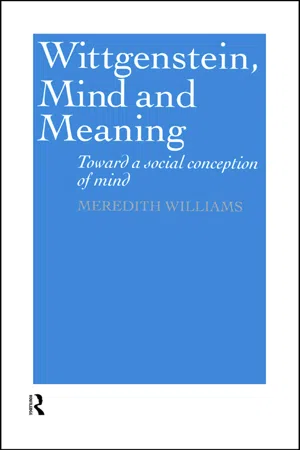
Wittgenstein, Mind and Meaning offers a provocative re-reading of Wittgenstein's later writings on language and mind, and explores the tensions between Wittgenstein's ideas and contemporary cognitivist conceptions of the mental. This book addresses both Wittgenstein's later works as well as contemporary issues in philosophy of mind. It provides fresh insight into the later Wittgenstein and raises vital questions about the foundations of cognitivism and its wider implications for psychology and cognitive science.
- 336 pages
- English
- ePUB (mobile friendly)
- Available on iOS & Android
eBook - ePub
About this book
Trusted by 375,005 students
Access to over 1.5 million titles for a fair monthly price.
Study more efficiently using our study tools.
Information
Topic
PhilosophySubtopic
Language in PhilosophyPart I
Against the philosophic tradition
1 Wittgenstein on representations, privileged objects, and private languages
In this chapter, I shall investigate Wittgenstein’s private language argument, that is, the argument to be found in Philosophical Investigations §243–315. Roughly, this argument is intended to show that a language knowable to one person and only that person is impossible; in other words, a “language” which another person cannot understand isn’t a language. Given the prolonged debate sparked by these passages, one must have good reason to bring it up again. I have: Wittgenstein’s attack on private languages has regularly been misinterpreted. Moreover, it has been misinterpreted in a way that draws attention away from the real force of his arguments and so undercuts the philosophical significance of these passages.
What is the private language hypothesis, and what is its importance? According to this hypothesis, the meanings of the terms of the private language are the very sensory experiences to which they refer. These experiences are private to the subject in that he alone is directly aware of them. As classically expressed, the premise is that we have knowledge by acquaintance of our sensory experiences. As the private experiences are the meanings of the words of the language, a fortiori the language itself is private. Such a hypothesis, if successfully defended, promises to solve two important philosophical problems: It explains the connection between language and reality–there is a class of expressions that are special in that their meanings are given immediately in experience and not in further verbal definition. More generally, these experiences constitute the basic semantic units in which all discursive meaning is rooted. I shall refer to this solution as the thesis of semantic autonomy.1 This hypothesis also provides a solution to the problem of knowledge. For the same reason that sensory experience seems such an appropriate candidate for the ultimate source of all meaning, so it seems appropriate as the ultimate foundation for all knowledge. It is the alleged character of sensory experience, as that which is immediately and directly knowable, that makes it the prime candidate for both the ultimate semantic and epistemic unit. This I shall refer to as the thesis of non-propositional knowledge (or knowledge by acquaintance).
However, the idea that sensory experiences are supposed to constitute the meanings of the terms of a private language needs explicating, for on the face of it, it is difficult to understand how a red flash, tickle, or pain could be a meaning. A clearer way to express this is to say that the sensory experience is directly correlated with a term. Making this correlation generate a rule of meaning actually masks two assumptions which explicate how we are to understand such peculiar rules: (1) the Naming Assumption: to fix meaning, ostensive baptism of a sensory experience must occur; and (2) the Consistency Assumption: in subsequent use, the objects referred to by the term in question must be of the same kind as the object originally baptized.
Wittgenstein’s attack on the possibility of a private language focuses on the legitimacy of such rules of meaning. The upshot of his challenge is that this empiricist solution to the problem of relating language to reality and to the problem of knowledge cannot succeed. The mind, Wittgenstein argues, is not the privileged source of either meaning or knowledge. Roughly, Wittgenstein’s strategy is a three-stage affair: an attack on the traditional role that ostensive definition is alleged to play in language acquisition, an attack on the idea that representation requires the existence of special privileged objects, and an attack on the attempt to substitute “reference” for “meaning” as the link between the world and ourselves. If Wittgenstein is correct, reference is no better a philosophical tool for solving the problem of our epistemic relation to the world than was meaning. Both founder on a misconception of representation and knowledge.
These are ambitious aims, with far-ranging implications for theory of language, the character of sensory experience, and the structure of knowledge. Meanings aren’t “in the head”; sensory experience isn’t transparent and simply “given” to the subject; knowledge isn’t grounded in sensory experience. These large philosophical claims aren’t established by the private language argument alone as an argument separable from the rest of the Investigations. As I shall show, the private language argument draws on some of the general arguments concerning the nature of language that are developed much earlier in the Investigations. Thus, the rubric “private language argument” is something of a misnomer. Yet the standard interpretation of these passages in the Investigations treats the private language argument as a relatively self-contained argument, fit to join the canon of other great philosophical arguments such as the Ontological Argument or Zeno’s Paradoxes. As I shall now argue, the private language argument treated in this way loses its philosophical persuasiveness and becomes embroiled in a debate that leads us away from the important issues and into a blind alley.
1 A blind alley: the Consistency Assumption
Norman Malcolm’s early interpretation of the private language argument gives clear expression to the idea that private language fails because it only gives seeming rules for consistent usage (cf. Malcolm 1966). The fundamental error of this interpretation lies in casting Wittgenstein’s argument against the Consistency Assumption. Not only is this an incorrect interpretation, it cannot demonstrate the inadequacy of a private language. The standard empiricist approach to the question of private languages is to claim that the subject can ostensively define his primitive terms and proceed to use them in accordance with the private rule, “I shall call this same thing ‘S’ whenever it occurs.” Both the empiricist and his critic agree that a term cannot be a means of representation unless it can be consistently used. The critic charges that it is impossible to determine whether a private term is being used consistently. The best way to characterize this charge against the empiricist is to let the critic–in this case Malcolm–speak for himself:
Now how is it to be decided whether I have used the word consistently? What will be the difference between my having used it consistently and its seeming to me that I have? Or has this distinction vanished? “Whatever is going to seem right to me is right. And that only means that here we can’t talk about ‘right’” (258). If the distinction between “correct” and “seems correct” has disappeared, then so has the concept correct. It follows that the “rules” of my private language are only impressions of rules (259). My impression that I follow a rule does not confirm that I follow the rule, unless there can be something that will prove my impression correct. And the something cannot be another impression—for this would be “as if someone were to buy several copies of the morning paper to assure himself that what it said was true” (265). The proof that I am following a rule must appeal to something independent of my impression that I am.
(Malcolm 1966: p. 68)
Malcolm’s argument is intended to show that the Consistency Assumption can be satisfied only if there is some independent check on the application of the rule in question–independent, that is, of the subject’s say-so. And that is precisely what the private-language user, ex hypothesi, cannot have: He can only check his seeming to follow a rule correctly by another seeming.
But, in this case, the difference between a word’s seeming to be correctly applied and its being correctly applied collapses.2 With this collapse goes the possibility of determining whether the private “rule” is used consistently.
The well-known empiricist answer is to argue that the subject’s memory provides an adequate check on the correct, hence consistent, application of a private term. Against this, Malcolm argues that one must be able to distinguish genuine memory from ostensible memory, and if the is/seems distinction collapses at this level, it likewise collapses at the lower level. If such a distinction cannot be drawn, then (citing Wittgenstein for support) “whatever is going to seem right to me is right. And that only means that here we can’t talk about ‘right’” (PI §258). The rejoinder of the empiricist is to claim that this objection brings into question the reliability of memory itself, a move which equally undercuts his opponent’s position since the general reliability of memory must be presupposed whether the checks in question are the subject’s own memory or public checks.
A common response to this defense is to argue that the issue is not the reliability of memory but whether uncheckable checks are checks at all. In other words, the critic raises the question, can the subject’s memory, which cannot be checked, serve as a check on his application of rules in his private language?3
In the end, this line of argument against memory as an adequate check fails. It fails because, first, it raises the threat of scepticism concerning the reliability of memory. A public language has no greater safeguard against this kind of scepticism than a private language.4 Second, the position taken concerning “uncheckable checks,” namely that these are not genuine checks, makes a stronger demand on the empiricist than many would require of their own position. Many critics of the empiricist agree that, in any justificatory context, the quest for reasons must eventually come to an end. They do not insist that every reason or justification–to be a genuine reason–must itself be susceptible to some independent check. Within any given inquiry there will be assumptions which confer reasonableness on some other belief within that inquiry, but which cannot themselves be justified within that context. This is the bedrock of justification–we finally come to reasonless reasons. The point here is that the critic of the empiricist does not impose such rigid strictures on what is acceptable or justificatory on himself and thus should not object to the empiricist’s appeal to uncheckable checks.
This line of debate leads up a blind alley–it diverts attention from the real force of Wittgenstein’s arguments without really damaging the empiricist’s position.5 By concentrating on the Consistency Assumption, philosophers have implicitly conceded the more important Naming Assumption. Yet it is primarily against the Naming Assumption that Wittgenstein directs his attack.
2 Ostensive definition: the Naming Assumption
Wittgenstein’s actual strategy is to argue that the Consistency Assumption cannot be satisfied because it is contentless–not because it appeals to uncheckable checks.
In accordance with the Naming Assumption, the empiricist maintains that it is possible for the subject to individuate a particular mental entity–sensation or impression–concentrate his attention on it, and label it. It is then merely a matter of correctly applying the same expression whenever a qualitatively similar entity is present to the subject’s consciousness. The empiricist thinks that an act of “private ostensive definition” can fix meaning and set a standard for correct use in the future. The meaning of a symbol is given by that sensation or impression with which it is associated by the subject.
Earlier I separated two strands in this empiricist program, viz. the existence of non-propositional knowledge and the independence of the private terms. These theses are mutually supporting and crucially bound up with the notion of acts of ostension as fundamental to concept formation. Non-propositional knowledge (or knowledge by acquaintance) is that knowledge we acquire of mental states just in virtue of having them. Nothing is known about them; rather they are directly known themselves. They are the basic epistemic units and the basic semantic units, for they provide the meanings of primitive terms. This guarantees the independence of these terms. They need not be embedded in a larger linguistic practice in order to be meaningful; no other knowledge or grasp of concepts is required for the acquisition of these expressions. It may be discovered that certain logical relationships hold between these terms (such as, nothing can be red and green in the same place and at the same time), but knowledge of these relationships is irrelevant to grasping the full meaning of a term. For the full meaning is given in an act of pure ostension. Thus, the plausibility of these two theses (non-propositional knowledge and semantic autonomy) is bound up with the plausibility of the claim that ostension is fundamental to concept formation and acquisition.
The argument of PI §259–61 where this issue is taken up has frequently been misconstrued by commentators as attacking the Consistency Assumption in the ways discussed in section 1. The real point of Wittgenstein’s argument is to demonstrate that the notion of consistently applying an expression of a private language is contentless.
According to the empiricist, the rule for reapplication is generated by the act of private baptism, an act which can be accomplished wholly independently of any knowledge or concept other than the awareness of the particular sensory experience to be labeled. The crucial part of Wittgenstein’s argument against this has already been established earlier in the Investigations in the attack on the appeal to ostensive definition as basic to determining meaning (PI §28–38). What he intends to show in his critique of private languages is that private ostensive definition as a means for generating a language is as much a myth as is public ostensive definition. That is, Wittgenstein offers a general critique of ostensive definition which he then applies explicitly to private ostension.6
This pattern is wholly in keeping with his general strategy for dealing with philosophical problems. The same theses can arise and seem to find support from various sources; this fact requires that any philosophical problem be approached from different perspectives if it is finally to be laid to rest. So in the present case, although the notion that ostensive definition is fundamental to concept formation and language acquisition has already been shown to be mistaken, we are tempted to believe that it must work for our private sensations. Sensations seem to have features which make ostensive definition especially appropriate. Wittgenstein intends to show that this is mere illusion.
Naming and pointing or inwardly concentrating one’s attention are sophisticated acts that can only be successful within a context in which much else is known. When one says “He gave a name to his sensation” one forgets that a great deal of stage setting in the language is presupposed if the mere act of naming is to make sense (PI §257). I shall not review the familiar arguments that Wittgenstein brings against ostension beyond reiterating their conclusion: the use of ostension presupposes linguistic competence and so cannot be the source of that competence.
Having reminded us of the difficulties with ostension and thus already undermined the claim for the autonomy of private terms, Wittgenstein addresses the problem of a private language directly. He shows that the possibility of a private rule for correct application of an expression is an illusion by showing that a private rule is empty. It is empty just because no standard for subsequent namings has been set at the outset, and thus no sense can be made of the claim to continue to use the expression correctly–this is true even if our memory is infallible. Wittgenstein gives this argument in PI §258, a passage which has often been construed as denying that we could tell when a private rule has been correctly applied:
A definition surely serves to establish the meaning of a sign.—Well, that is done precisely by the concentration of my attention; for in this way I impress on myself the connexion between the sign and the sensation.–But “I impress it on myself” can only mean: this process brings it about that I remember the connexion right in the future. But in the present case I have no criterion of correctness (my emphasis).
(PI 258)
In other words, an act of ostension can neither give meaning to a sign nor generate a standard for reapplication. Without such a criterion or standard, the notion of getting the connexion right is empty. The Naming Assumption degenerates into idle ceremony.
As one can now see, this argument has nothing to do with the reliability of memory or the need for independent checks. Even more significantly, these grounds for rejecting a private language have nothing to do with the privacy of the language per se. He is showing that private ostension is no exception to his general critique of ostension.
The strength of Wittgenstein’s critique of ostensive definition lies not only in the criticisms he makes but also in his explanation of why ostension appears to be such a plausible mechanism for acquiring language. In the interest of giving such an explanation, he distinguishes between ostensive definition and ostensive teaching (PI §6). As has been stated, far from providing the basic mechanism for fixing meaning and generating a language, ostensive definition doesn’t play this role, so how is the acquisition to language to be explained? Wittgenstein suggests that the role traditionally attributed to ostensive definition is actually played by ostensive teaching:
An important part of the training [in the master of language] will consist in the teacher’s pointing to the objects, directing the child’s attention to them, and at the same time uttering a word….(…I say that it will form an important part of the training, because it is so with human beings; not because it could not be imagined otherwise.) This ostensive teaching of words can be said to establish an association between the word and the thing.
(PI §6)
In other words, ostensive teaching is a causal process which brings about an association between an object and a sign. Animals as well as human beings are susceptible to this kind of teaching. The result of this teaching (or conditioning) is the ability to parrot, but it does not (in itself) effect an understanding of the sign. For this, ostensive teaching must be coupled with a training in the use of the sign. And the use of a sign is determined by the practice or custom in which the sign is embedded. Thus, ostensive teaching, which helps effect understanding, also presupposes a public language, though the child does not know it. The success of ostensive definition, on the other hand, does require individual mastery of a language: “One has already to know (or be able to do) something in order to be capable of asking a thing’s name” (PI §30). Thus, both ostensive definition and ostensive training presuppose communal practices and customs, thou...
Table of contents
- Cover Page
- Title Page
- Copyright Page
- Preface
- Acknowledgments
- List of abbreviations
- Introduction
- Part I: Against the philosophic tradition
- Part II: A new direction
- Notes
- Bibliography
Frequently asked questions
Yes, you can cancel anytime from the Subscription tab in your account settings on the Perlego website. Your subscription will stay active until the end of your current billing period. Learn how to cancel your subscription
No, books cannot be downloaded as external files, such as PDFs, for use outside of Perlego. However, you can download books within the Perlego app for offline reading on mobile or tablet. Learn how to download books offline
Perlego offers two plans: Essential and Complete
- Essential is ideal for learners and professionals who enjoy exploring a wide range of subjects. Access the Essential Library with 800,000+ trusted titles and best-sellers across business, personal growth, and the humanities. Includes unlimited reading time and Standard Read Aloud voice.
- Complete: Perfect for advanced learners and researchers needing full, unrestricted access. Unlock 1.5M+ books across hundreds of subjects, including academic and specialized titles. The Complete Plan also includes advanced features like Premium Read Aloud and Research Assistant.
We are an online textbook subscription service, where you can get access to an entire online library for less than the price of a single book per month. With over 1.5 million books across 990+ topics, we’ve got you covered! Learn about our mission
Look out for the read-aloud symbol on your next book to see if you can listen to it. The read-aloud tool reads text aloud for you, highlighting the text as it is being read. You can pause it, speed it up and slow it down. Learn more about Read Aloud
Yes! You can use the Perlego app on both iOS and Android devices to read anytime, anywhere — even offline. Perfect for commutes or when you’re on the go.
Please note we cannot support devices running on iOS 13 and Android 7 or earlier. Learn more about using the app
Please note we cannot support devices running on iOS 13 and Android 7 or earlier. Learn more about using the app
Yes, you can access Wittgenstein, Mind and Meaning by Meredith Williams in PDF and/or ePUB format, as well as other popular books in Philosophy & Language in Philosophy. We have over 1.5 million books available in our catalogue for you to explore.