- 244 pages
- English
- ePUB (mobile friendly)
- Available on iOS & Android
eBook - ePub
About this book
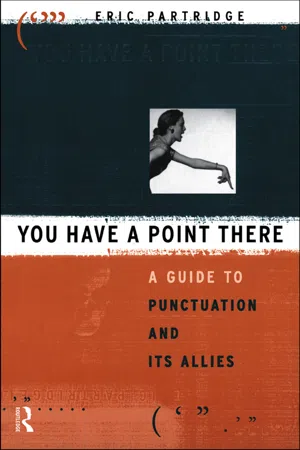
This standard work on punctuation has long been judged the foremost study of the subject. It reveals punctuation to be both an indispensable craft and an invaluable art - a friend, not an enemy.
Trusted by 375,005 students
Access to over 1.5 million titles for a fair monthly price.
Study more efficiently using our study tools.
Information
BOOK I
PUNCTUATION
Chapter 1
INTRODUCTORY
§ 1:
A Few Opinions
ALL THE parts of Syntaxe have already beene declared. There resteth one generall affection of the whole, disposed thorow every member thereof, as the bloud is thorow the body; and consisteth in the breathing, when we pronounce any Sentence; For, whereas our breath is by nature so short, that we cannot continue without a stay to speake long together; it was thought necessarie, as well for the speakers ease, as for the plainer deliverance of the things spoken, to invent this meanes, whereby men, pausing a pretty while, the whole speech might never the worse be understood.
The English Grammar made by Ben Jonson,
written ca. 1617, published in 1640
POINTS, serving for the better Understanding of Words, are either Primary, or Secundary.
Primary Points, which shew their Tone, Sound and Pauses, are eight: four simple and more common; Period, [.] Colon, [:] Semicolon, [ ;] Comma, [,] and four mixt and less frequent…….…. The mixt Points, are Erotesis [?] Ecphonesis; [!] Parenthesis, () Parathesis: [ ] which have always some simple Point, exprest or understood, in them…….….….….….….….….….….
Secundary Points, now shewing Tone, Sound, or Pause, are four: Apostrophus, [’] Eclipsis, [—] or [–—] Dieresis, [. .] and Hyphen, [-] or [].
CHARLES BUTLER, The English Grammar, 1633
Great care ought to be had in writing, for the due observing of points: for, the neglect thereof will pervert the sence.
RICHARD HODGES, The English Primrose, 1644
Pointing is the disposal of speech into certain members for more articulate and distinct reading and circumstantiating of writs and papers. It rests wholly and solely on concordance, and necessitates a knowledge of grammar.
ROBERT MONTEITH, The True and Genuine Art of Pointing, 1704
I know, there are some Persons who affect to despise it, and treat this whole Subject with the utmost Contempt, as a Trifle far below their Notice, and a Formality unworthy of their Regard: They do not hold it difficult, but despicable; and neglect it, as being above it.
Yet many learned Men have been highly sensible of its Use; and some ingenious and elegant Writers have condescended to point their Works with Care; and very eminent Scholars have not disdained to teach the Method of doing it with Propriety.
JAMES BURROW, An Essay on the Use of Pointing, 1771
The pauses which mark the sense, and for this reason are denominated sentential, are the same in verse as in prose. They are marked by the usual stops, a comma, a semicolon, a colon, or a period, as the sense requires.
NOAH WEBSTER, Dissertations on the English Language, 1789
Punctuation is the art of dividing a written composition into sentences, or parts of sentences, by points or stops, for the purpose of marking the different pauses which the sense, and an accurate pronunciation require.
LINDLEY MURRAY, English Grammar, 1794
The sense, or meaning, of the words is very much dependent upon the points which are used along with the words.
WILLIAM COBBETT, A Grammar of the English Language, 1819
It has already been frequently shown by writers on the subject that our punctuation-marks do not indicate the most suitable places for pauses in reading aloud; the voice of an intelligent reader ignores some of the textual pointing and introduces breaks at places other than those where there are points. The pointing of matter ‘to be sung or said’ is, in fact, a subject apart. With regard to constructional pointing it may be urged that in reality it rests on sense and meaning, since grammar is the analysis of the forms in which rational expression is made. We think, however, that all the complexities and divergences and confusions of grammatical pointing arose just because it was not in constant and direct touch with meaning.
A PRACTICAL PRINTER, A Manual of Punctuation, 1859
Of all the subjects which engage the attention of the compositor, none proves a greater stumbling-block, or is so much a matter of uncertainty and doubt, especially to the mere tyro, as the Art of Punctuation. This arises partly from the necessarily somewhat inexact nature of the art itself, but far more from ignorance of the principles on which its rules ought to be founded, and the illogical construction of the sentences with which the printer has sometimes to deal.
HENRY BEADNELL (some forty years a Printer’s Reader), Spelling and Punctuation, 1880
Modern printers make an effort to be guided by logic or grammar alone; it is impossible for them to succeed entirely; but any one who will look at an Elizabethan book with the original stopping will see how far they have moved: the old stopping was frankly to guide the voice in reading aloud, while the modern is mainly to guide the mind in seeing through the grammatical construction.
A perfect system of punctuation, then, that would be exact and uniform, would require separate rhetorical and logical notations… Such a system is not to be desired.
H.W. & F.G.FOWLER, The King’s English, 1906
When punctuation was first employed, it was in the role of the handmaid of prose; later the handmaid was transformed by the pedants into a harsh-faced chaperone, pervertedly ingenious in the contriving of stiff regulations and starched rules of decorum; now, happily, she is content to act as an auxiliary to the writer and as a guide to the reader.
HAROLD HERD, Everybody’s Guide to Punctuation, 1925
HAROLD HERD, Everybody’s Guide to Punctuation, 1925
Intellectually, stops matter a great deal. If you are getting your commas, semi-colons, and full stops wrong, it means that you are not getting your thoughts right, and your mind is muddled.
WILLIAM TEMPLE, Archbishop of York, as reported in The Observer, 23 October 1938
We ought to deplore the growing tendency to use only full stops and commas. Punctuation is an invaluable aid to clear writing, and I suggest that far too little importance is attached to it by many journalists.
FRANK WHITAKER, in an address to the Institute of Journalists: reproduced in The J.I.J, January 1939
Mr Partridge’s account of punctuation shows by its wealth of possible effects that punctuation can be made a part of the art of writing—instead of the simple, almost mechanical routine that American schools recommend.
W.CABELL GREET, in his gloss at ‘Punctuation’ in Usage and Abusage, American edition, 1942
We indicate time by means of stops known as punctuation marks. These marks also help to make the sense clear, to show the expression, and to avoid confusion in reading.
L.A.G.STRONG, An Informal English Grammar, 1943
§ 2:
Clearing the Deck
A thoughtful reading of § I will have shown that already in the 17th Century the principal points were being used. It will not have shown that they arose late in the 16th Century and that we owe them to the ingenuity of Aldus Manutius, the distinguished Italian printer (Aldo Manuzio: 1450–1515) whose ‘Aldine’ Press operated at Venice.
Before him, punctuation had been virtually confined to the period or full stop and, in several countries, to the question mark. Before that, punctuation was unknown. But, as we are not concerned with the history of the subject, I refer the curious to T.F. and M.F.A. Husband’s Punctuation, 1905, or to the briefer, yet adequate, treatment in Reginald Skelton’s Modern English Punctuation,revised edition, 1949.
As § 1 shows, there have been two systems of punctuation: the rhetorical or dramatic or elocutionary, seen at its height in Elizabethan and Jacobean plays, but after the 17th Century very rarely used; and the grammatical or constructional or logical, which has always predominated in prose and has predominated in verse since ca. 1660. On the subject of dramatic punctuation, the standard work is Percy Simpson’s Shakespearean Punctuation, 1911.
But to insist upon the dichotomy dramatic-grammatical would be both pedantic and inept. For much of the time, as is inevitable, the two coincide: a speaker tends to pause wherever either logic or grammar makes a pause; and even the most ‘logical’ or ‘grammatical’ of punctuators tends, when he is writing dialogue, to point what is clearly an elocutionary or dramatic pause, as in ‘He speaks often of freedom. But, he takes good care to avoid going to prison for the cause of freedom’, where the comma represents a dramatic pause. (In dialogue, however, the sensible way to indicate that pause would be to italicize ‘But’, not to punctuate it with a comma.)
The elocutionary element occurs again in the second of these two sentences: ‘He intended to finish the task, but then he fell ill’ and ‘He fell ill; but then, he was always falling ill’ and ‘He fell ill, but then he was always falling ill’. In the first sentence, then means ‘at that point of time’; in the third, then means ‘at, or during, that period’; in the second, however, then has no temporal meaning. ‘He fell ill; but then, he was always falling ill’ could have been written ‘…; but he was always falling ill’. With then, the sentence is much more colloquial and idiomatic; here, then is hardly less interjectional than alas is in ‘He fell ill; but alas! he was always falling ill’. However elocutionary then may be, the comma is demanded by logic: the omission of this comma would not only create ambiguity, it would positively falsify the intended meaning.
In short, English—or, if you prefer, British and American—punctuation is predominantly constructional or grammatical or logical, yet it has what is in some ways a non-logical, non-grammatical element, necessitated by the part played in speech by intonation and pause and in writing (or printing) by emphasis.
Even that modification slightly exaggerates the importance of logic and the power of grammar. In punctuation, grammar represents parliament, or whatever the elected body happens to be called: logic represents King or President: but the greatest power of all is vested in the people or, rather, in the more intelligent people—in good sense rather than in mere commonsense. Commonsense can and often does produce a humdrum, barely adequate, wholly unimaginative punctuation: good sense (another name for wisdom) can and sometimes does produce a punctuation that is much superior to the barely adequate.
One could write a monograph upon the psychological principles of punctuation. That monograph would form an exercise in psychology and occupy an ...
Table of contents
- COVER PAGE
- TITLE PAGE
- COPYRIGHT PAGE
- FOREWORD
- BOOK I: PUNCTUATION
- BOOK II: ALLIES AND ACCESSORIES
- BOOK III: ORCHESTRATION
- BOOK IV: AMERICAN PRACTICE
- APPENDIX I: A FEW NOTES ON OTHER WORKS
- APPENDIX II: A BRIEF LIST OF ACCENTS
Frequently asked questions
Yes, you can cancel anytime from the Subscription tab in your account settings on the Perlego website. Your subscription will stay active until the end of your current billing period. Learn how to cancel your subscription
No, books cannot be downloaded as external files, such as PDFs, for use outside of Perlego. However, you can download books within the Perlego app for offline reading on mobile or tablet. Learn how to download books offline
We are an online textbook subscription service, where you can get access to an entire online library for less than the price of a single book per month. With over 1.5 million books across 990+ topics, we’ve got you covered! Learn about our mission
Look out for the read-aloud symbol on your next book to see if you can listen to it. The read-aloud tool reads text aloud for you, highlighting the text as it is being read. You can pause it, speed it up and slow it down. Learn more about Read Aloud
Yes! You can use the Perlego app on both iOS and Android devices to read anytime, anywhere — even offline. Perfect for commutes or when you’re on the go.
Please note we cannot support devices running on iOS 13 and Android 7 or earlier. Learn more about using the app
Please note we cannot support devices running on iOS 13 and Android 7 or earlier. Learn more about using the app
Yes, you can access You Have a Point There by Eric Partridge in PDF and/or ePUB format, as well as other popular books in Languages & Linguistics & Languages. We have over 1.5 million books available in our catalogue for you to explore.