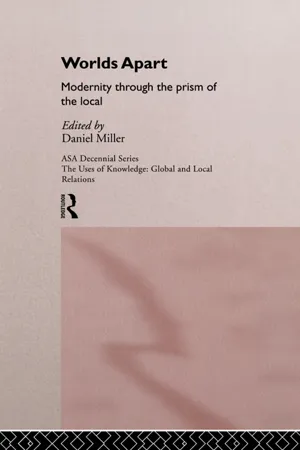
Worlds Apart is concerned with one of the new futures of anthropology, namely the advances in technologies which r eate an imagination of new global and local forms. It also analyses studies of the consumption of these forms and attempts to go beyond the assumptions that consumption either localises or fails to effect global forms and images.
Several of the chapters are written by anthropologists who have specialised in material culture studies and who examine the new forms, especially television and mass commodities, as well as some new uses of older forms, such as the body. The book also considers the ways in which people are increasingly not the primary creators of these images but have become secondary consumers.
- 288 pages
- English
- ePUB (mobile friendly)
- Available on iOS & Android
eBook - ePub
Worlds Apart: Modernity Through the Prism of the Local
About this book
Information
1 Introduction
Anthropology, modernity and consumption1
MODERNITY AS CONSUMPTION
The larger framework to the study of anthropology has always been a concern with modern life as an experience of rupture. While the general public continues to perceive anthropology as primarily a discipline which utilises fieldwork in order to identify and characterise a condition opposed to modernity, this has never been a true representation of the actual range of anthropological concerns. Although at times marginal there has always been present a disciplinary interest in describing and understanding the abstractions and reflexivity of modern life. Today, what might once have been peripheral has now become so ubiquitous as to be almost typical of contemporary anthropological work. This development need not, however, be seen as simply a change in focus or interest, since it must also reflect the culmination of a shift in the consciousness of the peoples we study who almost all now view themselves in direct relation to an explicit image of modern life.
With respect to the specific term ‘consumption’, anthropologists such as Appadurai (1986), Bourdieu (1984) and Douglas (Douglas and Isherwood 1978) have played a conspicuous role in the expansion of this concept from its parochial roots in economics. From economics the term retains as a primary connotation a debate about the role of goods and services. Although there are papers in this book that share this more defined concern, my use of the term in the Introduction will be rather different. In addressing the idea of consumption I want to evoke something more abstract, potentially a philosophical rather than an economic debate. While in economics to be a consumer is to have choice, my emphasis is on quite another aspect. I use the term consumer in opposition to the aesthetic ideal of a creative producer. I want to reflect on a condition in which very little of what we possess is made by us in the first instance. Therefore to be a consumer is to possess consciousness that one is living through objects and images not of one’s own creation. It is this which makes the term symptomatic of what some at least have seen as the core meaning of the term modernity (Habermas 1987: 1–44). This sense of consumption as a secondary relationship takes on particular importance within an ideology which espouses not only the aesthetic ideal of authenticity through creation, but its more mundane philosophical counterpart of a notion of natural ownership through labour. Within such a dominant ideology the condition of consumption is always a potential state of rupture. Consumption then may not be about choice, but rather the sense that we have no choice but to attempt to overcome the experience of rupture using those very same goods and images which create for many the sense of modernity as rupture.
I concede immediately that this is only one perspective. Few of the following chapters make particular use of this term. They have their own keywords such as ‘authenticity’ and ‘identity’ and their own perspectives, but I do feel we share what is now a common concern in the discipline to address issues of reflexivity, rupture and distance. These were the topics introduced by Marilyn Strathern as the overall theme of the Decennial conference of which this book is one product. My point of departure is the suggestion that the condition of consumption represents, at the very least, one possible idiom for these larger problems of modernity.
A simplifying dualism may assist in drawing out emergent foci of concern. This may be posed between what could be called a priori and a posteriori cultural diversity. Anthropologists have generally had as their subject the observation of differences between peoples. The degree to which it was merely an assumption that these differences originated out of their diverse historical circumstance has been particularly challenged by the Comaroffs (Comaroff and Comaroff 1992: 3–48). Through both the study of the sheer complexity of pre-colonial inter-cultural contacts (e.g. Thomas 1991) and the study of the impact of colonial regimes (e.g. Wolf 1982), it is now recognised that we cannot treat the cultural world as though it were a series of isolated historical trajectories leading to current diversity.
Nevertheless there has remained a sense that even if these ‘roots’ were thoroughly entangled, the key source of difference remains historical. So, for example, when anthropologists turn their attention to the differential reception and development of capitalism (e.g. Sahlins 1988) the dominant issue is the impact of the prior regional differences upon the subsequent development of this new institution. These ‘locals’ are held to retain authentic differences at least until they become victims of mass consumption as the latest version of post-colonial influences. Mass consumption goods often come to stand for the new superordinate point of identity that subsumes and suppresses cultural difference and creates drastic global homogenisation. It is as though after anthropologists have documented the resilience of local resistance and the ability to ‘tame’ imported ideas and traditions, these might finally fall exhausted before the onslaught of imported goods.
By contrast, there is another source of difference, which might be called a posteriori difference, that is more rarely acknowledged or theorised. This is the sense of quite unprecedented diversity created by the differential consumption of what had once been thought to be global and homogenising institutions. Examples might include the increasingly differentiated forms of modernity, of bureaucracy, of media worlds and of capitalism. It is commonly our relation to these massive institutions which gives us our identity as consumers. The idea of a posteriori diversity allows for the possibility of more radical rupture under conditions of modernity, but does not assume that homogenisation follows. Rather it seeks out new forms of difference, some regional, but increasingly based on social distinctions which may not be easily identified with space. It treats these, not as continuity, or even syncretism with prior traditions, but as quite novel forms, which arise through the contemporary exploration of new possibilities given by the experience of these new institutions.
I am certainly not claiming this is an unprecedented issue. The regional responses to the universalist claims of religion, creating new unpredictable local movements which are not merely continuous with earlier cults, are among the many examples which should have given the lie to the notion of some pure a priori source of difference. There is, however, a danger in the interpretive framework through which these are judged. The problem arises from our willingness to view the bending of forms to local trajectories as creating difference which is respected – that is, granted authenticity. Indeed, anthropologists tend to ‘cheer’ from the sidelines any sign that the ‘local’ has fragmented and shifted some larger form to meet its own projects of value. The discipline identifies with this David in its struggle with some monstrous global Goliath. In contrast, however, a posteriori diversity may be condemned precisely because it has no ‘roots’. The critique of postmodernism which seems to equate such ‘depthlessness’ with other pejorative terms such as ‘superficiality’ has been popular within anthropology perhaps because it appeals to this conservatism which protects diversity with patina attached but may denigrate the ‘nouveaux’ or ‘parvenu’ locals of the contemporary world, especially when attached to ‘inauthentic’ social fractions such as the lower-middle classes of the developed world, or the middle classes of the developing world. With a posteriori diversity the myth of the a priori ‘original difference’ falls away, but there is a danger that a belief in pure authenticity will be replaced by a myth of pure inauthenticity.
Obviously cultural forms do not arise out of the ether, but there may be an argument that, for example, the emergence of a new variety of ‘public sphere’ through the development of television chat-shows does not necessarily arise out of the historical trajectory documented by Habermas (1991). This would not make it any less important in considering the kind of public sphere which can exist and should be considered in debates about the comparative nature of the public sphere today (e.g. Livingstone and Lunt 1994).
This is the common thread which runs through the chapters of this book. They all deal with social groups who are no longer best understood as self-constructed within the terms of some customary value system. Rather they are constructing themselves through appropriating or rejecting contexts in which they find themselves – or, as the papers reveal, usually through more complex dialectics of identitification. Peoples do not choose for themselves as their ‘starting points’ the legacy of West African colonialism (Barber and Waterman, Rowlands, Warnier), a collapsed communism (Humphrey), a status as minorities in their own lands (Friedman, Kapferer, Morphy). They may not choose domains such as beauty contests (Wilk), or television programmes (Abu-Lughod, Das) upon which they have to constitute themselves as different. For these reasons it may be best to consider them as the consumers rather than creators of their conditions of culture. Nevertheless in all cases the authors trace negotiations, creative appropriations and the production of strategies which develop the possibilities given by these historical conditions. In some cases these do appear to demonstrate continuities with previous projects of value and struggles over power. In other cases there is the emergence of unprecedented forms of identity which appear as explicit encounters with novel aspects of modernity.
There have been several recent discussions as to whether it is possible to use the term ‘modernity’ without suggesting a stigma of primitivism, and whether it characterises unprecedented conditions (e.g. Giddens 1991, Lash and Friedman 1992, Miller 1994). But most of the papers in this volume are concerned with the more straightforwardly unprecedented resources provided by the industrial, scientific and most especially the communications revolutions which provide new technologies of objectification. We are responding to the forms of knowledge and doubt that arise with media such as television and the internet, which allow people to reflect on themselves in the light of almost instantaneous knowledge about global events and local consequences.
People are often suspicious of culture defined as a process of consumption, seeing it as somehow less authentic or worthy given its comparative transience and lack of roots. There is still too often a denigration of these novel sources of difference as merely a new superficiality, a pretension to difference in as much as this is granted us by global institutions such as capitalism. By contrast, the following chapters accept the challenge of these new forms of reflexivity and suggest that the social beings who live within complex and diverse worlds, may, as the subjects of ethnography (as Friedman argues), be neither more complex nor less profound. We cannot presume to know how something will be experienced. A novel practice may become an instrument of reflexivity and rupture, but equally it may sink back into the unreflective practical taxonomies of everyday material culture.
Faced with these new technologies of objectification the primary aim of ethnographic study should remain an evocation of ordinary human commensurability. The anthropological task is often to show just how ordinary and mundane Mongolian breakdancing or gatherer-hunters watching soap opera may have become in everyday experience. The mundane requires empathetic understanding, just as much as the traditional anthropological concern to make extraordinary that which has become taken for granted. That is to show how what we took to be the mundane may be the idiom for core cosmological and moral debates in society.
An anthropology which demonstrates how the consumption of global forms is located in ordinary commensurability also creates an equality between the peoples of the world. The rituals of British capitalism are no more nor less bizarre than Nigerian capitalism, world music is evolving in the Balkans as much as in Brazil. Furthermore, as Rowlands, and Barber and Waterman, point out, the supposed characteristics of modernity may be derived from many regional trajectories, Chinese and West African or at least other than a supposed generic Westernisation.
MODERNITY AND CONSUMPTION AS HISTORICAL MOMENTS
The chapters in this book are without exception ethnographically based. The emphasis is upon the detailed elucidation of specific case studies. Though they take note of more general and comparative materials none of them consists primarily of a sustained theoretical discussion. Yet anthropology has been one of the most constant contributors to the development of major theoretical debates in the social sciences. By now it may be conceded that this is because of and not despite its unusual mixture of relativism and a qualitative version of non-naturalistic empiricism. In this Introduction therefore I am concerned to draw out the wider implications of what in themselves are very particular and focused case studies. I will supplement these comments with data from my own research in Trinidad. The first paper by Rowlands is typical of the anthropological prism that breaks modernity apart in its attention to the specific nuances of the local. In this case through examining first historically and then ethnographically how the interpenetration of a sense of being modern and being traditional is mapped onto a shifting hierarchy and competing claims to legitimation in Cameroon. Yet this relativism is precisely what allows the paper to stand for a much more general concern to document the transition in the world that warrants a change in the discipline’s perception of its subject of study. By revealing that there are African roads to modernity Rowlands is able to document the particular manner in which a dialectic of being both traditional and modern (which is common throughout the contemporary world) takes the form of a very specific and nuanced relationship of partial resolutions and subsumptions, both in the lives of individuals and through contrasts between regional groups. It is the insistence upon difference, what he calls ‘the instability of temporalities’ that makes this safe ground from which to theorise generalities about modernity.
The importance of Rowlands’s contribution may be made more evident by its contrast with Trinidad. Rowlands demonstrates the manner by which the growing confrontation with the contradictions of modernity is best understood through the specific history of the region. In Trinidad, as with the Caribbean more generally, although many of the peoples came from West Africa, their history was punctured by a much more radical rupture in the form of the extreme de-humanisation of slavery. This historical experience is then overlaid by that of many other immigrant groups. Here then there is no easy recourse to tradition or roots and the road to modernity is that much more direct. In Trinidad the result is quite distinct from Cameroon and establishes the importance of relativism in this ‘consumption’ of history. While for Cameroon the core distinction is one of the sense of being modern, which is able to interpenetrate (often without contradiction) the sense of tradition, in Trinidad (Miller 1994) it is the event that is held as contradiction and threat to the sense of the long term. Thus in the latter case an orientation toward plans and strategies for future success goes together with a concern for building respect for the past and the previous generations. Both orientations are contrasted with a radical refusal of either by those absorbed with events as transient states. Because this is completely different from the sense of temporality described by Rowlands it establishes the validity of his point that although a dialectic of modernity and tradition is found in many regions, it cannot be taken for granted and must be related back to the specific experience of history in that locality.
There are several issues in common between Rowlands’s and Humphrey’s chapter. Both emphasise the ways in which increasingly self-conscious developments of cultural identity evolve out of the desire to retain local visions of what may be ascribed to as global futures. Both contributors (as also several of the later contributors) here, as in their previous work, emphasise the role of material culture. This perspective comes into its own given the increasing need to consider the consequences of the new forms of objectification, whether in shopping or household furnishings. Rowlands, in particular, articulates these with an older Cameroonian trajectory of more literal embodiments through his analysis of the ‘bio-politics’ by which property and possessions are hierarchically objectified in the potency of persons. This act of taming of the new signs of success is precisely what seems to be no longer an option in contemporary Moscow. These chapters also demonstrate the importance of ethnographic contributions to the process of commodification. This process is easily over-generalised, but localised studies reveal striking contrasts. Working in an area close to Rowlands, Geschiere (1992) has recently noted the surprise of outsiders that it is often intimate and domestic relations which here are easily commoditised although elsewhere these are regarded as bastions against commodification, while aspects of the economy which in Europe were were commoditised early on, may be resistant to such changes in West Africa.
Finally both chapters show the importance of the term ‘consumption’ as linking questions concerned with the symbolic potential of goods with the more general secondary relationship peoples increasingly take to the forms through which they have to live. In both cases this is represented as a ‘burden of history’. Muscovites may be struggling with some version of capitalism or the market, but it is likely to be a good while before they see this as ‘their’ capitalism. Rather, as with colonialism in Cameroon, these changes highlight the sense that one is consuming in the more abstract sense of dealing with forces which have come from outside and that one does not have the experience or knowledge to properly harness them to one’s own historical project. Indeed they are not even able to stabilise the present around some specific ‘other’ group who can b...
Table of contents
- Cover
- Title
- Copyright
- Contents
- List of illustrations
- List of contributors
- Series editor’s Preface
- Foreword
- 1. Introduction: Anthropology, modernity and consumption1
- 2. Inconsistent temporalities in a nation-space
- 3. Creating a culture of disillusionment: Consumption in Moscow, a chronicle of changing times
- 4. Bureaucratic erasure: Identity, resistance and violence – Aborigines and a discourse of autonomy in a North Queensland town
- 5. Around a plantation: the ethnography of business in Cameroon
- 6. Learning to be local in Belize: global systems of common difference
- 7. Global complexity and the simplicity of everyday life
- 8. On soap opera: what kind of anthropological object is it?
- 9. The objects of soap opera: Egyptian television and the cultural politics of modernity
- 10. Aboriginal art in a global context
- 11. Traversing the global and the local: fújì music and praise poetry in the production of contemporary Yorùbá popular culture
- Name index
- Subject index
Trusted by 375,005 students
Access to over 1.5 million titles for a fair monthly price.
Study more efficiently using our study tools.
Frequently asked questions
Yes, you can cancel anytime from the Subscription tab in your account settings on the Perlego website. Your subscription will stay active until the end of your current billing period. Learn how to cancel your subscription
No, books cannot be downloaded as external files, such as PDFs, for use outside of Perlego. However, you can download books within the Perlego app for offline reading on mobile or tablet. Learn how to download books offline
Perlego offers two plans: Essential and Complete
- Essential is ideal for learners and professionals who enjoy exploring a wide range of subjects. Access the Essential Library with 800,000+ trusted titles and best-sellers across business, personal growth, and the humanities. Includes unlimited reading time and Standard Read Aloud voice.
- Complete: Perfect for advanced learners and researchers needing full, unrestricted access. Unlock 1.5M+ books across hundreds of subjects, including academic and specialized titles. The Complete Plan also includes advanced features like Premium Read Aloud and Research Assistant.
We are an online textbook subscription service, where you can get access to an entire online library for less than the price of a single book per month. With over 1.5 million books across 990+ topics, we’ve got you covered! Learn about our mission
Look out for the read-aloud symbol on your next book to see if you can listen to it. The read-aloud tool reads text aloud for you, highlighting the text as it is being read. You can pause it, speed it up and slow it down. Learn more about Read Aloud
Yes! You can use the Perlego app on both iOS and Android devices to read anytime, anywhere — even offline. Perfect for commutes or when you’re on the go.
Please note we cannot support devices running on iOS 13 and Android 7 or earlier. Learn more about using the app
Please note we cannot support devices running on iOS 13 and Android 7 or earlier. Learn more about using the app
Yes, you can access Worlds Apart: Modernity Through the Prism of the Local by Daniel Miller in PDF and/or ePUB format, as well as other popular books in Social Sciences & Anthropology. We have over 1.5 million books available in our catalogue for you to explore.