- 272 pages
- English
- ePUB (mobile friendly)
- Available on iOS & Android
eBook - ePub
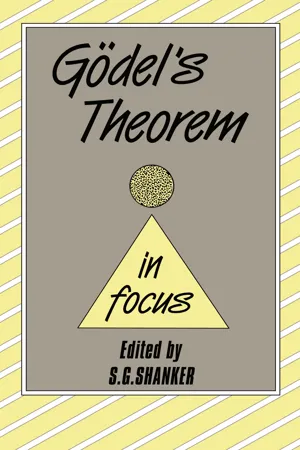
Godel's Theorem in Focus
About this book
A layman's guide to the mechanics of Gödel's proof together with a lucid discussion of the issues which it raises. Includes an essay discussing the significance of Gödel's work in the light of Wittgenstein's criticisms.
Information
Index
MathematicsVIII
Wittgenstein’s Remarks on the Significance of Gödel’s Theorem1
1. Wittgenstein’s Heresy
Few attempts have been made to question the significance of Gödel’s first incompleteness theorem. The fact that Wittgenstein appears to have pursued such a course has been a minor source of irritation to those mathematical logicians who look to his works for the ‘sparkles of intelligence’ they have found elsewhere in his writings; and a matter of acute embarrassment for Wittgenstein’s critics who find themselves unable to explain what at best appears to be an uncharacteristically casual digression. Wittgenstein’s argument suffers from several inescapable defects, not least of which is its opacity. It is clear that Wittgenstein was disturbed by what he saw as the philosophical consequences of Gödel’s theorem; yet nowhere in his Nachlass is there a detailed critique of Gödel’s proof to be found. As a result Wittgenstein’s enigmatic objections in Remarks on the Foundations of Mathematics often appear completely unwarranted, even bizarre. To make matters worse, at one point Wittgenstein confessed that his task as he perceived it ‘is not to talk about (e.g.) Gödel’s proof, but to by-pass it’ (RFM2 VII §19). But how could any philosopher of mathematics seriously propose to bypass ‘one of the most important advances in logic in modem times’?3 Is it any wonder that such an apparently cavalier attitude towards one of the landmarks of mathematical logic should have met with such widespread condemnation? But perhaps these reactions are over-hasty, if not misconstrued. For whether or not Wittgenstein’s criticisms hit their mark — forcing us, as Wittgenstein intended, to reassess our attitude to Gödel’s theorem — is obviously a matter which we cannot hope to address until we have established the philosophical basis for Wittgenstein’s arguments. And that is a task which takes us deep into the conceptual foundations of Gödel’s thought.
Throughout the encomiums to Gödel’s incompleteness theorem we find an unremitting attempt to convey some of the sublime quality of Gödel’s proof. Not content with describing it as ‘the most brilliant, most difficult, and most stunning sequence of reasoning in modem logic’,4 Nagel and Newman go a step further: it is nothing less than an ‘amazing intellectual symphony’.5 Perhaps, then, the philosophical appreciation of Gödel’s theorem belongs as much to the philosophy of art as of mathematics? It is a question which should not be peremptorily dismissed; for mathematics may have one foot in the door of the sciences, but it bears asking where the other one rests. The ‘Queen of the Sciences’, like Bagehot’s constitutional monarch, operates on a different level from the Parliament of Science. Hence the adjectives used to describe an important mathematical proof are fundamentally and necessarily different from those employed to characterize a successful scientific theory. It is certainly no idle whim that the term ‘mystery’ should so prefigure in discussions of scientific advances, whereas the incompleteness theorem should repeatedly be described as an ‘intellectual symphony’. As vague as the latter metaphor might at first appear it is, in fact, one of the most revealing comments that could be made about the nature of Gödel’s theorem, albeit for reasons other than are generally intended. For it points, not only to the profound aesthetic satisfaction which one experiences when working through Gödel’s proof, but also to the very obstacles that must be confronted when trying to assess its overall significance.
Douglas Hofstadter, to mention but one example, has structured an imposing tome around this dimension of Gödel’s proof, constantly striving to elucidate not just the mathematical but more importantly, the trans-mathematical significance of Gödel’s theorem with analogies drawn from music and art.6 But where Hofstadter’s thesis encounters its greatest difficulty is precisely in the endeavour to describe the philosophical import of each. Does Bach’s Musical Offering have any philosophical significance? Certainly it has a musical, but does it have a higher — perhaps a ‘meta-musical’ — meaning? So too, Gödei’s theorem has unquestionable mathematical significance, but the question we must ask ourselves at the outset of any extra-mathematical evaluation is whether it is problematic to speak of the philosophical — or even the meta-mathematical — significance of Gödel’s theorem.
Understandably, mathematicians have always been eager to review what they regard as their crowning achievements. But it can be a distressing sight to witness their suffering as they step outside the parameters of their proofs and venture into the hostile territories of philosophy. Such is the price that must be paid, however, for pursuing a field that hovers uncertainly between the sciences and the arts. What this tension illustrates is, perhaps, simply the limitations of prose for the elucidation of pure mathematical results. But herein also lies a matter of pressing importance to the vast number of mathematicians who populate our universities. For perhaps the greatest danger facing modern mathematicians is their sheer number: it has now reached the point where it is physically quite impossible to keep track of all the theorems published in any given week, let alone during the span of a year.7 It is a disturbing thought that there might be monumental discoveries that have already been published, only to be consigned to the oblivion of the multitude of mathematical journals; or even worse, that will not even be given a reading by inundated editors. But if this seems a somewhat unrealistic danger, how much more worrying must it be for an aspiring young mathematician who is eager to attain some prominence in his career in these circumstances. Sadly for him, we are running out of Hilbert’s Problems (and thus, vacancies in the so-called ‘Honours Class’ of mathematics). Clearly we are witnessing a massive institutional upheaval here as elsewhere; in the meantime, the prudent mathematical prodigy will choose his topics with great care. For he must try to settle on those problems where a success is most likely to gain notice. But how does one judge in advance how much distinction a proof might acquire?
It would help if, to begin with, he had a clearer idea of what contributes to the significance of an important mathematical theorem. To understand this he might begin by turning to Hilbert’s ‘Mathematical Problems’, for this question is closely connected to the issue that Hilbert confronted when he pondered his Paris lecture in 1900. It is easy to see why Hilbert’s paper fired the imagination of a generation of mathematicians; here, for the first time, was a serious inquiry into the ‘general criteria which mark a good mathematical problem’.8 The characteristics which Hilbert seized upon seem straightforward enough: a good problem should be clear, difficult but not inaccessible, and — in a curious relapse into platonist imagery — ‘It should be to us a guide post on the mazy paths to hidden truths.’9 Still, it might be questioned whether the influence of Hilbert’s answer has been wholly salutary. For as a result of the fact that his attention was focused on responding to duBois-Reymond,10 Hilbert ultimately created a distorted and in some ways damaging picture of mathematical significance. Hilbert’s primary motive was to establish that there was no problem, however intractable it might at first appear, which could not be resolved if only the right point of view from which to attack it could be discovered. He thus chose his problems largely because they had resisted all attempts at a solution; not because of any intrinsic merit discernible in the problems themselves. And he did so for the very good reason that, as he himself remarked, ‘It is difficult and often impossible to judge the value of a problem correctly in advance; for the final award depends upon the gain which science obtains from the problem.’11 In other words, the significance of a mathematical theorem does not simply consist in providing the answer to a question which had hitherto eluded mathematicians. Or to put this another way, Hilbert’s ‘universal problem-status’ may be a necessary (although even this is highly debatable) but it is not a sufficient condition for mathematical significance.
To see this we might consider a well-known example such as ‘Do four 7s occur in the expansion of π?’ Until fairly recently this was thought by many (philosophically minded) mathematicians to be an important unsolvable problem. The answer was, in fact, contained in a paper published by Daniel Shanks and John W. Wrench, Jr. in 1962, which simply consisted of a print-out of the expansion of π up to 5,000 decimals.12 It is surely no wonder that this achievement has been passed over in relative silence. As we shall see below, the significance of a theorem — no matter how long the problem in question might have remained unsolved — depends more than anything else on the manner in which the theorem is established; for it is this which determines ‘the gain which science obtains from the problem’. But here too lurk complications similar to those which ensnared Hardy when he sought to articulate the value of pure mathematics.
A large part of A Mathematician’s Apology is devoted to the vexing question of the usefulness of mathematics. The basic problem with Hardy’s argument is that it proceeds from an orthodox utilitarian premise which Hardy labours throughout the text to overcome. He equated value with utility from the outset, but clearly the value of pure mathematics must lie in some other domain. For ‘The “real” mathematics of “real” mathematicians, the mathematics of Fermat and Euler and Gauss and Abel and Riemann, is almost wholly “useless” (and this is as true of “applied” as of “pure” mathematics). It is not possible to justify the life of any genuine professional mathematician on the ground of the “utility” of his work.’13 The ultimate solution which Hardy pursued was simply to repudiate the utilitarian premise which had inspired all of these difficulties in the first place: pure mathematics can only be ‘justified as art if it can be justified at all’.14 But then, what exactly does that mean: that mathematics (and art) can at best be justified in terms of some intangible spiritual benefit? Or is it rather a reflection of the fact that it is entirely misplaced to introduce the concept of justification here?
Obviously, we cannot speak of the mathematical significance of a theorem in the same way that a political theorist debates the implications of a social or ethical decision. Yet neither can we compare it to the discovery of a scientific law. In his attempt to come to terms with this problem Whitehead argued:
The notion of the importance of pattern is as old as civilization. Every art is founded on the study of pattern. The cohesion of social systems depends on the maintenance of patterns of behaviour, and advances in civilization depend on the fortunate modification of such behaviour patterns. Thus the infusion of patterns into natural occurrences and the stability of such patterns, and the modification of such patterns is the necessary condition for the realization of the Good. Mathematics is the most powerful technique for the understanding of pattern, and for the analysis of the relation of patterns. … Having regard to the immensity of its subject matter, mathematics, even modem mathematics is a science in its babyhood.15
This may be a subtle effort to circumvent the problem, but the solution we are searching for cannot be that there is no genuine difference between science and art and hence no problem in placing mathematics in both camps. On logical grounds alone it is manifest that e.g. the propositions of fiction or the drawings of art are toto caelo different from the hypotheses of science or the theorems of topology. More to the point, perhaps, is the fact that the supposition that mathematics shares with the sciences the search for patterns in nature is a throwback to the metaphysical picture of the Laws of Nature which flourished during the Quattrocento. The real difference here is that where science searches for patterns, mathematics constructs them. And where the test for the significance of a scientific law is strictly empirical, there are no mathematical predictions or explanations whereby we can determine the import of a theorem.
The matter remains no less murky, however, when we turn to the realm of pure art for illumination. In an abstract domain such as music we can distinguish between two different types of pivotal work. If we ask about the significance of the Prague Symphony it is clear that the answer hinges on the manner in which Mozart carried classical Viennese style to a new plateau. For his intention was no longer purely pyrotechnic; rather, he created polyphonic unity from an extraordinary number of subjects, thereby rendering a work of unparalleled thematic richness in the genre. But the criteria we have in mind when describing a piece like Beethoven’s Eroica as a revolutionary work (both in spirit and in design) are categorially different. Here we find an entirely new species of symphony: one that assaults the listener through the tempestuous emotions aroused, the dissonances, and the cycles of res...
Table of contents
- Cover
- Half Title
- Title Page
- Copyright
- Contents
- Preface
- Acknowledgements
- I. John W. Dawson, Jr.: Kurt Gödel in Sharper Focus
- II. Kurt Gödel: On Formally Undecidable Propositions of Principia Mathematica and Related Systems I (1931)
- III. Stephen C. Kleene: The Work of Kurt Gödel
- IV. John W. Dawson, Jr.: The Reception of Gödel’s Incompleteness Theorems
- V. Solomon Feferman: Kurt Gödel: Conviction and Caution
- VI. Michael D. Resnik: On the Philosophical Significance of Consistency Proofs
- VII. Michael Detlefsen: On Interpreting Gödel’s Second Theorem
- VIII. S.G. Shanker: Wittgenstein’s Remarks on the Significance of Gödel’s Theorem
- Index
Trusted by 375,005 students
Access to over 1.5 million titles for a fair monthly price.
Study more efficiently using our study tools.
Frequently asked questions
Yes, you can cancel anytime from the Subscription tab in your account settings on the Perlego website. Your subscription will stay active until the end of your current billing period. Learn how to cancel your subscription
No, books cannot be downloaded as external files, such as PDFs, for use outside of Perlego. However, you can download books within the Perlego app for offline reading on mobile or tablet. Learn how to download books offline
Perlego offers two plans: Essential and Complete
- Essential is ideal for learners and professionals who enjoy exploring a wide range of subjects. Access the Essential Library with 800,000+ trusted titles and best-sellers across business, personal growth, and the humanities. Includes unlimited reading time and Standard Read Aloud voice.
- Complete: Perfect for advanced learners and researchers needing full, unrestricted access. Unlock 1.5M+ books across hundreds of subjects, including academic and specialized titles. The Complete Plan also includes advanced features like Premium Read Aloud and Research Assistant.
We are an online textbook subscription service, where you can get access to an entire online library for less than the price of a single book per month. With over 1.5 million books across 990+ topics, we’ve got you covered! Learn about our mission
Look out for the read-aloud symbol on your next book to see if you can listen to it. The read-aloud tool reads text aloud for you, highlighting the text as it is being read. You can pause it, speed it up and slow it down. Learn more about Read Aloud
Yes! You can use the Perlego app on both iOS and Android devices to read anytime, anywhere — even offline. Perfect for commutes or when you’re on the go.
Please note we cannot support devices running on iOS 13 and Android 7 or earlier. Learn more about using the app
Please note we cannot support devices running on iOS 13 and Android 7 or earlier. Learn more about using the app
Yes, you can access Godel's Theorem in Focus by S.G. Shanker in PDF and/or ePUB format, as well as other popular books in Mathematics & History & Philosophy of Mathematics. We have over 1.5 million books available in our catalogue for you to explore.