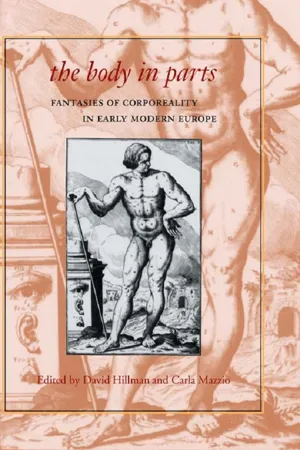
eBook - ePub
The Body in Parts
Fantasies of Corporeality in Early Modern Europe
- 376 pages
- English
- ePUB (mobile friendly)
- Available on iOS & Android
eBook - ePub
The Body in Parts
Fantasies of Corporeality in Early Modern Europe
About this book
An examination of how the body--its organs, limbs, and viscera--were represented in the literature and culture of early modern Europe. This provocative volume demonstrates, the symbolism of body parts challenge our assumptions about "the body" as a fundamental Renaissance image of self, society, and nation.
Information

1. “Multi-layered flap anatomy with mobile shutters and detachable internal organs,” from Johann Remmelin's Catoptrum Microcosmicum (Augsburg, 1619).
1
Introduction
Individual Parts

DAVID HILLMAN AND CARLA MAZZIO
Members. Begin There.... Imagine the body as a body full of thinking members.—Pascal, Pensées
Parts of the body are scattered throughout the literary and cultural texts of sixteenth- and seventeenth-century Europe. The proliferation of social and symbolic practices of “piecing out” the body in the early modern period (be it by punitive dismemberment, pictorial isolation, poetic emblazoning, mythic spargamos, satirical biting, scientific categorizing, or medical anatomizing) has generated a significant body of recent criticism about the logic of fragmentation.1 Indeed, the very title of this book may seem to invoke the spectre of violence and disintegration: the Foucauldian episteme of ruptured social and symbolic fields, or the Lacanian corps morcelé, the psychic “body in bits and pieces.” But the body in parts is not always the body in pieces. While the essays below examine the ways in which social and psychic conditions of fragmentation were encoded in practices of bodily partitioning, they also examine, collectively, the body that is “in” parts, that is constituted by a multiplicity of individuated organs. The extent to which aspects of culture were imagined to reside in, on, and about individual parts of the body is the subject of this volume.
“The subject of both kinds of Anatomy as well Historicall as Scientificall is a Part,” writes Helkiah Crooke in his great compendium of anatomical knowledge, Microcosmographia: A Description of the Body of Man (London, 1616). Inverting Crooke's syntax, we would like to argue that it is equally accurate to say that the part, in the “Historicall” and “Scientificall” texts of the period, is a subject, both in the sense that it is increasingly marked and elaborated upon in a range of visual and textual spaces, and in the sense that it is frequently imagined to take on attributes of agency and subjectivity.2 The ontological status of the part is revealed again and again in the essays here to be in endless flux between the positions of subject and object: as vehicles of culture and symbolization, as organs with eerily individuated agencies, as objects of libidinal cathexes, as instruments of sentient experience, as imagined loci of self-knowledge and self-alienation. What is imagined here is indeed, as Pascal vividly put it, “a body full of thinking members.”3
The relations between bodily and cognitive systems of organization are in many ways most powerfully encoded by the symbolics of any given part, where the tensions between the metaphoric and the metonymic, between the floating and the firmly contextualized, or more generally between conditions of autonomy and dependence are powerfully articulated. As Elizabeth Grosz writes, “human bodies have the wonderful ability, while striving for integration and cohesion, organic and psychic wholeness, to also provide for and indeed produce fragmentations, fracturings, dislocations that orient bodies and body parts toward other bodies and body parts.”4 Because corporeal parts have individuated functions, locations, and differentiated relations to the body as a whole, they can become concentrated sites where meaning is invested and often apparently stabilized. But while the invocation of a specific body part may generate the illusion of a narrowed sphere of reference, it is in fact precisely this specificity that creates, in the corporeal fragment, a remarkable density of implication. As Jean Starobinski writes in his “Short History of Bodily Sensation”: “I believe that the most fruitful generalizations are those arising from fairly precise studies of limited topics.”5
The body has become an object of such extensive critical scrutiny in recent years that, in the words of Caroline Walker Bynum, it has become “no topic or, perhaps, almost all topics.”6 The elevation of the fragment to a position of central significance is, indeed, very much a topical matter in contemporary culture; the rejection of all forms of totality, including the corporeal, is one of the defining characteristics of postmodernism. But what the essays collected here reveal is that early modems, no less than postmoderns, were deeply interested in the corporeal “topic”; for long before “topical” came to mean “of current interest, contemporary,” the term (from the Greek topos, place) meant “of or applied to an isolated part of the body”; and it is suggestive that the first use of the word in this sense is recorded by the Oxford English Dictionary as dating to 1608. Moreover, the earliest English meaning of the term (the one closest to its Greek root)—“of or belonging to a particular location or place” (1588, according to the OED)—may remind us that the spatially imagined body was perhaps the most common vehicle for the making of social and cosmic metaphors in early modern Europe.7
It would be a mistake to underestimate the important role of corporeal partitioning in medieval life and thought: religious relics, venerated body parts of saints, zodiac figures (with each sign of the zodiac corresponding to parts of the body), the scandalously circulating organs of the fabliaux, and accounts of phantom limbs all marked the body as a charged site of fragmentation.8 Indeed, Carolyn Bynum has theorized about the gradually increasing interest in body parts as objects of veneration in the religious life of medieval Europe.9 But, as the very title of Bynum's recent book—Fragmentation and Redemption—might suggest, the medieval Christian understanding of the relation between corporeal fragmentation and wholeness tends to adhere to the Pauline view that “as the body is one, and hath many members, and all the members of that one body, being many, are one body: so also is Christ”;10 thus Erasmus could use almost exactly these words at the beginning of the sixteenth century in his discussion of the nature of bodily multiplicity.11 By the end of the century, however, such a profession of confidence in the ultimate unity of religious and social systems modeled on bodily organization was no longer viable.
The transformations undergone by European culture and society during this period have been characterized variously as “the ultimate desertion of the universal for the particular,”12 or the end of the “age of resemblance” and the beginning of modernity's “analytico-referential discourse.”13 It is not difficult to list elements that contributed to (and were given impetus by) this pervasive sense of fragmentation: the “more atomistic and individualistic” society associated with the advent of print technology and the end of feudalism;14 the schisms in the church; the Copernican revolution, which shook notions of microcosmic-macrocosmic correspondence and symmetry; or the rise of anatomy and its corresponding “culture of dissection.”15 These “impulse[s] to … distinction and individuation”16 put increasing stress on the possibility of the recuperation of part into whole. The negotiation between parts and wholes thus became an especially vexed issue in the somatic structures of early modern Europe. The rhetorical trope in which these relations are configured (and disfigured) is synecdoche, a term that signifies the way in which a part is “taken for” a whole. Insofar as parts were imagined as dominant vehicles for the articulation of culture, the early modern period could be conceptualized as an age of synecdoche.17 What we would like to emphasize here, however, is precisely the way in which the impossibility of fully integrating parts into wholes brought about a privileging of the body part as such.
Thus, for example, the anatomist's dismemberment of the body has been characterized by several critics recently as being in the service of the creation of “a new, more comprehensive order,” a unified “body of knowledge”;18 but what often goes unnoticed is the elaborate attention given and significance attributed to the body part in and of itself. Similarly, the Renaissance artist's detailed anatomical study of the body, muscle by muscle and limb by limb, ostensibly enables the creation of the finished masterpiece; but Leonardo's, or Michelangelo's, or Dürer's gorgeous portraits of individual organs of the body stand as finished works of art in their own right, and attest to the lavish attention each gave to the isolated part; as Leonardo wrote of his anatomical drawings, “You will become acquainted with every part and every whole by means of a demonstration of each part.”19 So too the Petrarchan poet's emblazoning of the beloved's body, while creating a new aesthetic whole—a sestina, an entire sonnet-sequence, the Rime sparse— foregrounds the individual body part so radically that it undermines, as Nancy Vickers will tell us here, “the descriptive mode itself.” Or again, when John Donne describes the internal strife in his own body in the Devotions Upon Emergent Occasions, these countervailing impulses lie on the surface of his text: “Why dost thou melt me, scatter me?” he asks, lamenting the fact that “Man consists of more pieces, more parts, than the world.”20 And though his urgent desire to “recompact the scatter'd body”21 always returns him to a vision of wholeness and unity—“Pray unto the Lord, and hee will make thee whole”22—his extraordinary meditations on particular body parts (heart, bowels, hand, eye)23 speak to the energy generated by (and devoted to) individual organs.24 All of these instances attest to the emergence in early modern culture of what may be called a new aesthetic of the part, which is to say an aesthetic that did not demand or rely upon the reintegration of the part into a predetermined whole.25
The Burckhardtian notion of the Renaissance as a period marked by the rise o...
Table of contents
- Cover Page
- Half Title page
- Title Page
- Copyright Page
- Contents
- List of Illustrations
- Acknowledgements
- 1. Introduction: Individual Parts
- I. Subjecting the Part
- II. Sexing the Part
- III. Divining the Part
- IV. Parting Words
- Contributors
- Index
Trusted by 375,005 students
Access to over 1.5 million titles for a fair monthly price.
Study more efficiently using our study tools.
Frequently asked questions
Yes, you can cancel anytime from the Subscription tab in your account settings on the Perlego website. Your subscription will stay active until the end of your current billing period. Learn how to cancel your subscription
No, books cannot be downloaded as external files, such as PDFs, for use outside of Perlego. However, you can download books within the Perlego app for offline reading on mobile or tablet. Learn how to download books offline
We are an online textbook subscription service, where you can get access to an entire online library for less than the price of a single book per month. With over 1.5 million books across 990+ topics, we’ve got you covered! Learn about our mission
Look out for the read-aloud symbol on your next book to see if you can listen to it. The read-aloud tool reads text aloud for you, highlighting the text as it is being read. You can pause it, speed it up and slow it down. Learn more about Read Aloud
Yes! You can use the Perlego app on both iOS and Android devices to read anytime, anywhere — even offline. Perfect for commutes or when you’re on the go.
Please note we cannot support devices running on iOS 13 and Android 7 or earlier. Learn more about using the app
Please note we cannot support devices running on iOS 13 and Android 7 or earlier. Learn more about using the app
Yes, you can access The Body in Parts by David Hillman, Carla Mazzio, David Hillman,Carla Mazzio in PDF and/or ePUB format, as well as other popular books in Literature & European Renaissance History. We have over 1.5 million books available in our catalogue for you to explore.