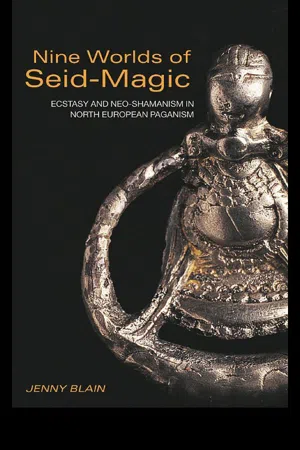
This accessible study of Northern European shamanistic practice, or seidr, explores the way in which the ancient Norse belief systems evoked in the Icelandic Sagas and Eddas have been rediscovered and reinvented by groups in Europe and North America. The book examines the phenomenon of altered consciousness and the interactions of seid-workers or shamanic practitioners with their spirit worlds. Written by a follower of seidr, it investigates new communities involved in a postmodern quest for spiritual meaning.
eBook - ePub
Nine Worlds of Seid-Magic
Ecstasy and Neo-Shamanism in North European Paganism
- 208 pages
- English
- ePUB (mobile friendly)
- Available on iOS & Android
eBook - ePub
About this book
Information
Chapter 1
Introducing shamanism,
seiðr and self
On a day at the end of April 1999, I journeyed by plane from Nova Scotia to Boston, Massachusetts, on my way further west to Illinois. In Boston I had to perform a particular ritual of transition, challenge and answer, one familiar to many people in today’s Western world: going through customs. Why was I entering the United States? asked the official, and I replied, ‘I’m an anthropologist. One of the people I’m studying is getting married. I’m going to dance at her wedding!’.
He laughed and waved me on. I walked, musing on the meanings of the words I’d said, for myself and for the recipient. On the plane I’d been scribbling notes for a paper I had to write, and a future research proposal, and thinking about George Marcus’ discussions of ‘multi-sited ethnography’ (Marcus 1998). Now here was I, caught in a maze of meanings, on my way to a wedding, and it was Walpurgisnacht: Beltane Eve, May Eve.
Some years before, I had met Winifred. She was the first seiðworker – she prefers the term 'spae-woman', one who sees what is to come – that I ever saw in action, and I’d greatly enjoyed the discussions, in person or email, with her since, as we struggled to work out the disputed territory of seiðr, sets of shamanistic practice of pre-Christian Northern Europe. She had talked of her friendship with another Heathen, and then the wedding invitation had arrived and I made the long trip from Nova Scotia to, indeed, dance at the wedding. But neither the ‘wedding’ nor the ‘dancing’ were likely to be quite as the customs officer envisaged. The wedding – indeed an exchange of marriage vows – was part of a weekend celebration of spring, with rituals and a maypole, and the dancing I had in mind would be that very night, before rather than after the exchange of vows. There would be drumming, and guests were encouraged to dance around the bonfire, to – in the words of Winifred’s invitation – ‘leap, spring and bound’, in honour of the festival: and if they so chose, to dance to honour their animal spirits, taking on the movements of the animal, in a sense becoming the animal, strengthening spiritual links between the worlds, between human-kind and animal-kind, masked or unmasked, veiled or unveiled, drawing on and adding to the energies of the night and the fire.
Winifred and others like her live between worlds – both the everyday and shamanic worlds, here the Nine Worlds on the tree Yggdrasill. Even within the ‘everyday’ worlds of people, they meet a range of discursive constructions from the rationalism of (much) scientific/discourse to the rationalist tolerance of ‘liberal’ mainstream religion or agnosticism, and from the human-privileging, God-centred discourse of (much) Christian fundamentalism to the Earth-centred focus of (some) Aboriginal groups and the ‘Earth is the Goddess’ approach of (some) goddess spirituality. Winifred, and others like her, are emphatically part of Western, society, with its tensions and contradictions. She is therefore making her way, living her life, within sets of relations and modes of consciousness that link her to all these groups and more, at work, in community endeavours, in attempting to create alliances that further her goals and those of the Earth that she is, personally, sworn to protect.
Less than a month later, I described the incident of the customs officer, at a conference on folklore with the topic of ‘Going Native’ (Blain 2000). Ethnography is changing and the ‘insider’s’ view is no longer debarred. I was exploring ways to express my experiences, linking the communities of shamanists and seiðworkers, and academics. Two months later I was in Britain, talking with neo-shamanic practitioners there about seiðr and debating theories of what was ‘shamanism’. So many understandings, so many relationships – and I saw myself within the web of practitioners, connected to all by strands of Wyrd, fate, history or social construction, positioned in such a way that I could write about these experiences for a wider audience. The result is before you now.
This book presents an ethnographic exploration of Northern European shamanistic practice called seiðr, within a framework of recent theorising of shamanisms and neo-shamanism. Its purposes are those of advancing thinking on neo-shamanisms and their increasing relevance within social relations of post-modernity; broadening knowledge of seiðr while examining the present-day construction of this specific ‘neo-shamanism’; and dispelling misconceptions about neo-shamanisms in general (e.g. that they are ‘all the same’) and seiðr and Northern European ‘reconstructed-indigenous’ religious practices in particular. Additionally, the book examines the use of experiential anthropology in understanding and theorising phenomena of altered consciousness and the interactions of seidworker or ‘shaman’ with their spirit worlds.
This therefore is an ethnography of seiðr, as it is presently being rediscovered, even ‘reinvented’, by groups in Europe and North America. As such, the book not only describes seiðr, its construction and ‘performance’ – a term disputed within practice and theory – and its sources, but engages with debates within and about ethnography and experiential anthropology.
Focusing chiefly on ‘oracular’ or divinatory seiðr reconstructed from instances in the Icelandic sagas, I locate seiðr as ecstatic practice within specific cultural contexts: Northern Europe of 1,000 years ago, though with roots deep in the past, and the Western Earth-religions revival of the present day. I examine the extent to which seiðr can be said to be either ‘shamanistic’, or ‘shamanic’, understanding the latter term to imply community sanction and structuring of ecstatic/magical practice (Blain and Wallis 2000). My work here is aligned, therefore, with new research within anthropology and religious studies that understands shamanisms, whether ‘traditional’, ‘neo-’ or ‘urban’, as historically and culturally specific, at once transforming and themselves in process of transformation, within contexts which are economic, socio-political and spiritual.
In chapter 2 I introduce seiðr, within a framework of North European ‘Heathenry’, and some of the debates surrounding it. Chapter 3 is an exploration of the (re-)construction of oracular, ‘high-seat’ or divinatory seiðr, the rituals most likely to be met with by observers. Chapter 4 explores issues of trance states, ‘shamanisms’ and ‘the spirits’. Chapter 5 is an experiential narrative of my introduction to, and exploration of, these relationships. In chapters 6 and 7, questions of ambiguity, ambivalence, gender, sexuality and the ‘otherness’ of seiðworkers – then and now – are explored, and the final chapter examines some challenges and questions of magic, neo-shamanisms, rationality, and the location of myself as ethnographer.
Within Western ‘post-modern’ society an increasing number of people are turning to construct their own spiritual relationships with the earth, other people, and those with whom we share the earth: plants, animals, and various spirit-beings found in the mythologies of the world. For many, this goes hand-in-hand with a search for ‘roots’, authenticity, a quest for meaning that seekers do not find in the hustle and pressures of their fragmented everyday lives. If as Bauman (1997) has suggested ‘post-modern society’ is about ‘choice’, one of the most obvious examples lies in this quest for located spiritual meaning.
There are several ways in which this quest has become manifest: religions, traditions or ‘paths’ often confused by researchers, but distinct in the discourse of their followers. The ‘new age’ (not dealt with in this book) focuses, in the main, on self-development, while borrowing from a number of spiritual traditions including Christianity, Hinduism, Buddhism and various indigenous practices from around the world. Numerous ‘neo-paganisms’ look to a remembered, or invented, past, often romanticised, although an increasing number of today’s Western Pagans emphasise their deliberate construction of religion for today. A third strand is ‘neo-shamanism’, also romanticised, which draws heavily on constructions of ‘indigenous’ or ‘traditional’ (world-wide) shamanic practice in the Western literature from the eighteenth century onwards. seiðr can be envisaged as a point of intersection of these second and third strands.
These ways of relating spiritually to the world have been too often dismissed by anthropology, sociology or religious studies as irrelevant, either small-scale manifestations of dissatisfaction, or even adolescent rebellion, teenagers’ attempts to distance themselves from ‘establishment’ of church, state and parents. However, viewed from an approach that sees wealth in diversity, and contestation as creation of meaning, they become part of the patchwork of post-modernity, processes of dynamic construction of present-day Western society. Followers of these new/old religious traditions may be computer programmers, cleaners or clerks, graduates of seminary education, bartenders or barristers, accountants, archaeologists, teachers, students or systems managers, or even anthropologists – engaging with social life in many ways, and attempting to blend their spiritual practices with everyday life.
My interest in writing this book lies in the intersection of reconstructed European pre-Christian religion with ‘shamanisms’ described from elsewhere, indeed in the overlap or interweaving of the second and thirds strand of spiritual thought described above: ‘reconstructed’ Paganism, and neo-shamanism. Many descriptions of neo-shamanisms are available, the most familiar of which is probably Michael Harner’s (1980) The Way of the Shaman, which has become a basic ‘text’ for many practitioners. (For other accounts see e.g. Wallis, forthcoming, a.) Constructions of ‘Celtic Shamanism’ and ‘Norse Shamanism’, as magical practice for today, are increasingly appearing within pagan communities in Europe and North America. A number of popular books and magazine articles dealing with ‘Celtic Shamanism’ (e.g. J. Matthews 1991; C. Matthews 1995; Cowan 1995) have whetted appetites for more, and while ‘Norse Shamanism’ or ‘Saxon Shamanism’ – either of which might conceivably be called seiðr – have received less attention, these too are now attracting notice, particularly through the world wide web and through Jan Fries’ book Seidways (Fries 1996).
Groundwork was laid by Brian Bates’ novel The Way of Wyrd (Bates 1983), which deals with some of the Old English healing ‘charms’ within the context of a shaman training an assistant, and his later non-fiction account The Wisdom of the Wyrd (1996) which gives as background for shamanistic practice (and for the derivation of his novel) both Old Norse and Old English material.
This leads therefore to the ‘North European Paganism’ of the subtitle (a term which its practitioners are rather unlikely to use, but which may make some sense to academics). Under various names, this can be regarded today as a set of linked religious and spiritual ‘traditions’ that are being derived by their practitioners from various source texts and archaeological finds. Notably, these sources are the Eddas and sagas – the great mediaeval literature of North Europe, much of it written in Iceland, popularised/romanticised during the nineteenth century and subsequently as ‘Norse Mythology’, and most familiar to English-speaking readers in the form of children’s stories. The Eddas and sagas have been fruitful fields of study for scholars of mediaeval literature, anthropology, history, religious studies, and folklore. They are also assiduously scanned (together with Old English texts and other pieces which might give clues to pre-Christian spirituality) by practitioners. These latter have a number of names for themselves and what they do: Ásatrú is the name used in Iceland (see Strmiska 2000) and common in North America: other Scandinavian formations of this term – literally ‘faith in the gods’, coined as part of the nineteenth century romantic movement – include Åsatro, Åsatrú, Asatro. The adoption of this term in Iceland was for present-day political reasons, and many practitioners, there and elsewhere, prefer the terms forn siðr or forn sed, simply ‘the old way’. However, the term preferred by many practitioners in Britain, gaining popularity in North America and used by people elsewhere as a descriptor, is simply ‘Heathen’ (heiðinn, hedensk), initially used by those who followed the ‘new’ religion of Christianity to describe the followers of the ‘old ways’, later becoming a term of abuse, now being reclaimed by those who have read the mediaeval literature, and those who refer to the ‘people of the heath’ (Thompson 1998; Cope 1998) – suitably for those who would follow the spirits of the land, wherever they may be.
So, here, I explore the construction and experience of today’s seiðr, as shamanistic practice derived from accounts in the Icelandic sagas. seiðr has a basis within reconstructionist Northern European spiritual communities, and shamanistic groups who adopt methods and principles derived from shamanisms elsewhere and from core-shamanism (Harner 1980). For an ethnographer of post-modern society it is a rich field of study. Its construction is somewhat problematic, with terms and practices disputed in past and present, and gendered political aspects of its implementation that rapidly become apparent where discourses of seiðr and seiðworkers conflict with discourses hegemonic in Western societies. In particular, there are issues around gender and sexuality, and practitioners use the terms of the past within today’s narrative constructions, to recreate or subvert hegemonic practice and to shape new meanings for themselves and directions for their communities. As culturally specific shamanistic, possibly shamanic, practice, seiðr positions its practitioners within the cosmology of the North and North-West of Europe – the Well of Wyrd and the great tree Yggdrasill – as seekers move within the Nine Worlds in quest of knowledge from deities and ancestors.
I write as an anthropologist and as a practitioner. I follow the strands of seiðr practice from present to past, across an ocean and through the Nine Worlds of Norse, Northern, or more generally, ‘Heathen’ cosmology. In this, what I produce here is a multi-sited ethnography (Marcus 1998), as I explore processes of seiðr, from practitioner to practitioner, community to community, time to time; from spatially located ritual practice and my ethnographer’s taped interviews to worldwide email-discussion lists, and through my own, as well as others’, experiences. I write, then, in quest of my own knowledges, situated by my relation to the practices I discuss: like a seer or shaman, and indeed at time as a seer, I go out into a world of many levels that is only partly known, and return with experiences to share. My journey has taken me into possible, disputed, past understandings of being and consciousness, linguistics and comparative religion, mediaeval literature and archaeology, queer theory and understandings of ‘self ’ and ‘meaning’ that slip away, change even as they are examined, as the vision changes when the seeress tries to probe further. On many levels, therefore, this is a work of experiential anthropology (Goulet 1994): observation is not enough to understand relations between seiðworkers and the spirit world. My own experiences form part of what I analyse, and inevitably position me within the layers of meaning that are constructed within the seiðr seance and within the communities of those who engage with it. Insights within this book have been developed in dialogue with many beings. As practitioner and as writer, I engage with worlds and meanings, exploring ways to relate these within the discourses of academia and everyday writing, and by stepping outside these into the language of poetry and imagery. I deal here with current debates within academia and anthropology, on disputed ‘realities’, metaphor and representation, ethnographic theory and methods, ‘shamanism’ as a Western construction of assumed primordial, primaeval, and ‘primitive’ religion versus ‘shamanisms’ as creative, contested political and spiritual invention, as well as the multiple realities of the seiðworkers.
So, like the shaman, I journey out and back, within the cultural contexts of the discourses of academia and those of seiðworkers, and I am transformed by the experience.
Chapter 2
The saying of the Norns
The Welling of Wyrd
They sit, three raised above all others in the room, hands joined: Urðr, who knows all past, and who has direction of this ritual; Werðende who holds the strands that make the present, and tells their weaving; centrally Skuld, obligation, asking: ‘do you understand me?’ Before them stands Jordsvin, the guide for this spae-working, who asks ‘is there one here who has a question for the Norns?’ And one after another, we step forth.
We have come here by means of a journey beginning in the barn at Martha’s Orchard, which serves for the great hall of our feasting and assembly at Trothmoot,1 June 1997. We have seen the three women move to the high seats, we have heard the song which, in this spae-working, attunes our consciousnesses to the cosmology of the North, the high clear voice of Werðende, the present, the now, singing:
Make plain the path to where we are
A horn calls clear from o’er the mountain
The gods do gladden from afar
And mist rises on the meadow ...
The hounds and eight-legged horse we hear
A horn calls clear from o’er the mountain
The heart beats quick as Yggr draws near
And mist rises on the meadow ...
Diana has called for guardianship to Norðri, Suðri, Austri, Vestri, the dwarves of the quarters: for inspiration, assistance and blessing to those of the Elder Kin who do this work, Freyja and Óðinn. Then she has called for energy and guiding on the power animals, the spirit guides or guardians of the three seeresses to come to them, dancing and drumming before she became Urðr in the high seat, and we have descended to the great plain of Miðgarð, to the tree Yggdrasill itself, and beneath its roots to the place where Wyrd, ‘weird’, fate, wells before us and the Norns sit, waiting. I realise, with shock, that quite how we came here I do not know: at some point the familiar meditation became unfamiliar, and so I have travelled here by unknown roads. The air is charged with potential, with waiting, with anticipation and with magic. Now, led by Jordsvin, we sing the song which gives the seeresses access to knowle...
Table of contents
- Cover Page
- Title Page
- Copyright Page
- Dedication
- Preface
- Acknowledgements
- Chapter 1: Introducing Shamanism, Seiðr and Self
- Chapter 2: The Saying of the Norns
- Chapter 3: The Greenland Seeress: Seiðr As Shamanistic Practice
- Chapter 4: Approaching the Spirits
- Chapter 5: The Journey In the Mound
- Chapter 6: Re-Evaluating the Witch-Queen
- Chapter 7: Ergi Seiðmen, Queer Transformations?
- Chapter 8: The Dance of the Ancestors
- Notes
- Bibliography
Trusted by 375,005 students
Access to over 1.5 million titles for a fair monthly price.
Study more efficiently using our study tools.
Frequently asked questions
Yes, you can cancel anytime from the Subscription tab in your account settings on the Perlego website. Your subscription will stay active until the end of your current billing period. Learn how to cancel your subscription
No, books cannot be downloaded as external files, such as PDFs, for use outside of Perlego. However, you can download books within the Perlego app for offline reading on mobile or tablet. Learn how to download books offline
Perlego offers two plans: Essential and Complete
- Essential is ideal for learners and professionals who enjoy exploring a wide range of subjects. Access the Essential Library with 800,000+ trusted titles and best-sellers across business, personal growth, and the humanities. Includes unlimited reading time and Standard Read Aloud voice.
- Complete: Perfect for advanced learners and researchers needing full, unrestricted access. Unlock 1.5M+ books across hundreds of subjects, including academic and specialized titles. The Complete Plan also includes advanced features like Premium Read Aloud and Research Assistant.
We are an online textbook subscription service, where you can get access to an entire online library for less than the price of a single book per month. With over 1.5 million books across 990+ topics, we’ve got you covered! Learn about our mission
Look out for the read-aloud symbol on your next book to see if you can listen to it. The read-aloud tool reads text aloud for you, highlighting the text as it is being read. You can pause it, speed it up and slow it down. Learn more about Read Aloud
Yes! You can use the Perlego app on both iOS and Android devices to read anytime, anywhere — even offline. Perfect for commutes or when you’re on the go.
Please note we cannot support devices running on iOS 13 and Android 7 or earlier. Learn more about using the app
Please note we cannot support devices running on iOS 13 and Android 7 or earlier. Learn more about using the app
Yes, you can access Nine Worlds of Seid-Magic by Jenny Blain in PDF and/or ePUB format, as well as other popular books in Theology & Religion & Religion. We have over 1.5 million books available in our catalogue for you to explore.