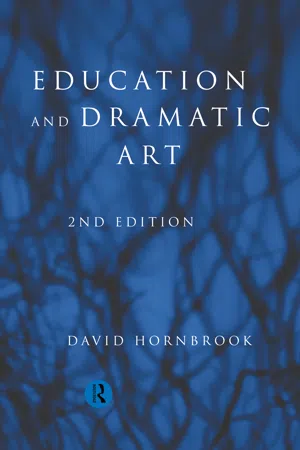
To this day, Education and Dramatic Art remains the only fully worked critique of drama education in schools. Provocative and iconoclastic, this new edition brings the argument up-to-date and locates the author's proposals for a curriculum based on the making, performing and appraisal of dramas securely in the evolving culture of schools.
The first section of the book traces the origins and fortunes of drama in schools in the context of changing political times and argues that by neglecting the customs and practices of the theatre, drama-in-education has often kept from the students it professes to empower, the very knowledge and understanding necessary for them to take command of their subject.
Part two examines the developmental and pedagogic claims of drama-in-education. Theories of knowledge and meaning and assumptions about schools drama's power to establish a moral and social agenda, are all called to account.
Finally, Education and Dramatic Art proposes a multiculturally-based, theoretical structure for the teaching of drama which pulls the theatre and the classroom together and offers teachers the foundation for a broad and balanced drama curriculum with its own distinctive body of knowledge and skills.
- 192 pages
- English
- ePUB (mobile friendly)
- Available on iOS & Android
eBook - ePub
Education and Dramatic Art
About this book
Information
PART I: DRAMA-IN-EDUCATION: TELLING THE STORY
1: THE PLOT: The rise of drama-in-education
NOBLE SAVAGES IN AN ENGLISH ARCADIA
Theory, and the challenge it implicitly presents to empiricism and ‘common-sense’, is viewed, like ideology, with some suspicion by groups traditionally disposed to favour practical ways of doing things. For fifty years or so there has been a small but eloquent faction in English education which has committed itself to the practical way with some single-mindedness. Believing in the power of make-believe to awaken empathy and understanding in young people, its members have dedicated themselves to the use of drama as an educative instrument. The discourse associated with this distinctive alliance of drama and pedagogy has come to be known as drama-in-education.
Modesty of ambition has not marked the advertising of drama-in-education’s portfolio; in 1995, a prominent advocate described one of its techniques as ‘the best possible form of education’,1 and there was a time when some enthusiasts really believed that drama-in-education was so significant that it would one day assume a place at the core of the school curriculum. History, as we shall see, has not dealt kindly with these pretensions. Nevertheless, close observation of exemplar lessons followed by affirmative analysis has helped to sustain believers’ faith in the transforming power of their methods and confirm them in their conviction that the processes of drama-in-education are radically enlightening. Meanwhile, although debates about the relative merits of this or that form of empirical verification have multiplied, the theories that lie behind the classroom practices and the claims made for them have remained obscure.
In fact, the distinctive discourse of drama-in-education may be traced to a series of inter-connected assumptions associated with the progressive education movement. This movement, in turn, has its origins in the revolutionary spirit of late eighteenth-century Romanticism, so that in Jean Jacques Rousseau’s model of precivilised man (sic), his noble savage imbued with natural goodness whose infallible guide was his feelings, can be recognised the ghostly prototype of the paradigmatic student of drama-in-education. It is worth noting, in the light of the unfolding argument, that Rousseau’s noble savage in a significant sense epitomised the ideal family man of the bourgeois imagination: a responsible and considerate husband and father inspired with a natural kindliness and possessed of all natural wisdom – a point which has not escaped feminist critics.2
The autonomy of consciousness advocated by Rousseau, with its extension into a universality of moral feeling where the source of moral rectitude is seen to reside, not in the hands of the gods and their earthly representatives, but in the authentic examination of our ‘true and uncorrupted conscience’, lies at the heart of the challenge that was to be offered to conventional ethics by Romanticism. This view of human nature is, of course, in marked contrast both to that of the traditional Christian account of original sin and to that of the seventeenth-century English philosopher Thomas Hobbes, whose argument for a strong state was based on his belief that, in nature, our lives would be ‘solitary, poor, nasty, brutish and short’. It is from Hobbes’ individualism (through Adam Smith) rather than from Rousseau’s that modern economic orthodoxy derives, an opposition that will be shown to have had no small influence on the moral and political imperatives of our study.
The Romantic idea of a subjective morality accessible through an awareness of our true feelings has permeated thinking about school drama. It has long been supposed that students engaged in the spontaneous improvisation and role-playing of the drama lesson can lose themselves just sufficiently for their ‘deeply felt’, and by implication, genuine, morality to reveal itself. While ‘in the unreality of the classroom’, wrote one practitioner in the 1980s, students ‘may adopt an intellectual posture of accepting the notion of shades of opinion, what surfaces in drama is their real feelings’.3 Romanticism and drama-in-education both share a commitment to a private world of sensation where cognitive endeavour may be safely confined to knowledge about what one truly feels.
Rousseau also had strong views about drama. His polemic against Jean Le Rond d’Alembert,4 who had suggested that the city of Geneva might improve its amenities by building a theatre, reveals not so much a puritanical dislike of pleasure but, rather, a perception of theatre art as leading to the falsification of the self. To be sure, the cramped, odorous playhouses of eighteenth-century France can hardly have been places of moral or spiritual self-enhancement. For Rousseau, committed as he was to the authentic voice of conscience, the actor on the stage deliberately distanced himself (sic) from the universality of moral feeling, thus diminishing his own authenticity by ‘counterfeiting himself’, by ‘putting on another character than his own’. He proposed instead the replacement of those ‘exclusive entertainments which close up a small number of people in melancholy fashion in a gloomy cavern’, with open-air festivities of communal participation. ‘Let the spectators become an entertainment to themselves; make them actors themselves; do it so that each one sees and loves himself in the others.’5 Again, we will see clearly reflected in drama-in-education Rousseau’s deep-seated suspicion of the entire apparatus of theatrical illusion as well as his enthusiasm for the home-made authenticity of participatory drama.
While it might fairly be said that real feelings and personal values have no more a place on the stages of Shaftesbury Avenue or the South Bank than they did on those of eighteenth-century Paris, we should be careful of making too easy a distinction between the ‘false’ world of the theatre and the ‘genuine’ world of human interaction. Also, although we often speak confidently of our real feelings, it is not altogether clear how we can reliably make a distinction between the feelings we have, such as we may intelligibly say of some that they are true and of others that they are false. And who is to mediate between your morality and mine when our ‘true and uncorrupted consciences’ lead us to different conclusions? As an inheritor of these paradoxes, drama-in-education has had some difficulty disentangling itself from the deep contradictions of its Romantic legacy, as the following chapters will show.
If not in its playhouses, historically England did provide more fertile and stable ground for the seeding of these particular products of Romantic naturalism than the turbulent politics of nineteenth-century France. Without the home-grown images of political despotism that inspired the liberationist visions of their European counterparts, English Romantic artists turned instead to attack the economic despotism of the Industrial Revolution which they saw as callous and philistine. The expanding working-class ghettos of the new cities were the antithesis of naturalism, their inhabitants as far from ideals of simple pastoral nobility that it was possible to imagine. Against the bleak, dehumanising town-scapes of industry the English Romantics fielded, not a class-based politics of revolution, but the sensibility of the radical individual. Human liberation was to come about not as a result of class struggle, but through love, creation and self-expression. There was to be a revolution of feeling, a new self-awareness, leading to a nobler, more progressive, humanism.
Established to further this aesthetic, the first English progressive schools were patronised by members of a prosperous and comfortable new social class who, in their revulsion with the industrial squalor brought about by their forebears’ indiscriminate wealth-making, sought to insulate their children from its less attractive consequences. Schools like Abbotsholme (1889) and Bedales (1893) provided idyllic pastoral environments, far removed from the material and moral pollution of Blake’s ‘chartered streets’,6 where the sons and daughters of the rentiers could happily indulge in pre-industrial pursuits. The education they received eschewed the institutionalised brutalities and regimentation of the traditional English public school, and fostered instead the cultivation of individual sensibility. Progressive school teachers aimed to liberate the spirit of their students, allowing them access to the uncorrupted conscience of Rousseau’s moral and aesthetic universe. In this respect they saw themselves as educational facilitators rather than teachers in the conventional sense, offering opportunities for the growth of learning in place of the imposition of knowledge.
It is here that the radical spirit of drama-in-education has its source. Its apologists have traditionally been the champions of a humane, child-centred individualism in education, believing, sometimes passionately, in the liberating powers of selfknowledge. Most would probably still consider themselves to be ‘progressive’, in the widest sense of that word, favourably comparing their digressive practices with what they see as the narrow, conformist pedagogy of other areas of the curriculum. True Romantics, they are likely to entertain a deep suspicion of society’s institutions and of hierarchies of all kinds, regarding themselves as the allies of their students rather than their instructors.
ART AND THE PLAY OF LIFE
There were, of course, no theatres in Arcadia. Virgil’s young shepherds and poets were in as little danger of being corrupted by the ‘intemperate madness’ that Rousseau perceived in Aristotelian catharsis as were the boys and girls of Abbotsholme and Bedales. Although theatre as an institution was disapproved of, art itself, defined by Romanticism as pre-eminently the expression of an inner creative process, had by the end of the nineteenth century assumed a predominant place in the education of the liberated consciousness. Indeed, the idea that personal autonomy is fostered by art is fundamental to all progressive education. Children put paint on paper or make shapes out of clay with no avowed intention of ever becoming painters or potters, but because the very practice of art is seen as a way of nurturing a child’s imagination and creativity.
The experiments of the Austrian art teacher Franz Cizek, who opened free classes for children at the School of Applied Art in Vienna in 1898, provide a pertinent example of the way in which these new ideas about art in education began to take shape. Young people came to his studio to paint and draw as the mood took them. Cizek, always encouraging, made a point of never interfering or attempting to correct their drawings; from time to time he would randomly select work for display. An archetypal early progressivist, Cizek aimed through his classes to awaken the unconscious art which he believed lay in everybody. The colourful walls of today’s primary and infant classrooms are evidence of his continuing influence.
Drama’s eventual guarantee of a place in this aesthetic owed no more to conventional theatre practice than Cizek’s art classes did to the academies. Rather, there was an understanding among early progressivists that the innocent makebelieve of children’s play was a form of highly beneficial ‘natural’ education in itself. In 1911, Harriet Finlay-Johnson described how she had transformed this simple ideal into practice in her village school in Sussex. ‘Why not continue the principle of the Kindergarten game in the school for older scholars?’7 she wrote in The Dramatic Method of Teaching.
am I quite wrong when I say that childhood should be a time for merely absorbing big stores of sunshine for possible future dark times? And what do I mean by sunshine but just the things for which Nature implanted (in the best and highest part of us) an innate desire – the joy of knowing the beauties of the living world around us and in probing its mysteries.8
It was Cambridge schoolmaster Henry Caldwell Cook, however, who, by fusing play (‘the only work worth doing’) with the idea of the player on the stage, became the first to describe a comprehensive programme for what we now might recognise as drama-in-education. Because he considered that ‘acting out’ motivated his boys to a more profound understanding of dramatic literature than could be achieved by formal teaching, Caldwell Cook encouraged the performance of plays, both in the classroom and later in what must have been the first purpose-built drama room, which he called ‘The Mummery’. Groups of boys were also encouraged to write material of their own for performance.
The Play Way, published in 1917, its heady progressivism expressed in the author’s idiosyncratic Boys’ Own Paper style, completely reflects the reformist spirit of ideas about art and education abroad at this time.9 Caldwell Cook’s ideal school, his ‘Play School’ of the future, was characteristically to be situated in the country away from the detrimental influences of city life, and governed by a kind of Athenian assembly of all its members. Singing, Drawing, Acting and the writing of Poetry, would dominate the timetable alongside crafts like Carpentry, Weaving, Printing, Bookbinding and Gardening. Discipline was to be founded on mutual trust and understanding, based on the observance of ‘right conduct’:
We must let ourselves live fully, by doing thoroughly those things we have a natural desire to do; the sole restrictions being that we so order the course of our life as not to impair those energies by which we live, nor hinder other men so long as they seem also to be living well. Right and wrong in the play of life are not different from the right and wrong of the playing field.10
By superimposing the morality of English team games onto the free spirit of Romanticism, Caldwell Cook was unwittingly rehearsing the ethical conundrum which we have already visited and which continues to haunt drama-in-education. At what point does our right to do ‘those things we have a natural desire to do’ give way to the demands of ‘right conduct’? In a world where the values of the public school playing field are by no means universally accepted, who is to adjudicate?
It was the advent of psychoanalysis, and in particular the attention given by post- Freudians to the developmental significance of children’s play, that finally legitimated a form of drama within the ‘inner-world’ concept of creativity favoured by educational progressivists. By the time Harriet Finlay-Johnson was preaching ‘the gospel of happiness in childhood’,11 Karl Groos had already identified play as practice for adult life,12 and it was not long before a succession of post-Freudian psychologists were elevating the play of young children to a dominating position in theories of early learning. The plausibly scientific recognition of play, with its ‘naturalness’ and intrinsic ‘let’s pretend’ element, as a route to intuitive wisdom, enabled the teleological gap between self-authentication and acting to be convincingly bridged. Now the fantasies of an innocent child, acted out in the playground or street, could be represented as a real drama, rich both in creativity and learning. Through the offices of psychology, drama had been transformed from the frivolous diversion described by Rousseau to an essential ingredient of a child’s balanced development. By the 1930s, this perception had even reached the corridors of England’s Board of Education.
Drama both of the less and more formal kinds, for which children, owing to their happy lack of self-consciousness, display such remarkable gifts, offers further good opportunities of developing that power of expression in movement which, if the psychologists are right, is so closely correlated with the development of perception and feeling.13
By the outbreak of the Second World War all the guiding principles of drama-ineducation were in circulation. Endorsed by the child psychologists and psychotherapists of the 1930s and 1940s, drama was now...
Table of contents
- COVER PAGE
- TITLE PAGE
- COPYRIGHT PAGE
- PREFACE
- ACKNOWLEDGEMENTS
- PART I: DRAMA-IN-EDUCATION: TELLING THE STORY
- PART II: DRAMA-IN-EDUCATION: INTERPRETING THE TEXT
- PART III: TOWARDS DRAMATIC ART
- NOTES
- BIBLIOGRAPHY
Trusted by 375,005 students
Access to over 1.5 million titles for a fair monthly price.
Study more efficiently using our study tools.
Frequently asked questions
Yes, you can cancel anytime from the Subscription tab in your account settings on the Perlego website. Your subscription will stay active until the end of your current billing period. Learn how to cancel your subscription
No, books cannot be downloaded as external files, such as PDFs, for use outside of Perlego. However, you can download books within the Perlego app for offline reading on mobile or tablet. Learn how to download books offline
Perlego offers two plans: Essential and Complete
- Essential is ideal for learners and professionals who enjoy exploring a wide range of subjects. Access the Essential Library with 800,000+ trusted titles and best-sellers across business, personal growth, and the humanities. Includes unlimited reading time and Standard Read Aloud voice.
- Complete: Perfect for advanced learners and researchers needing full, unrestricted access. Unlock 1.5M+ books across hundreds of subjects, including academic and specialized titles. The Complete Plan also includes advanced features like Premium Read Aloud and Research Assistant.
We are an online textbook subscription service, where you can get access to an entire online library for less than the price of a single book per month. With over 1.5 million books across 990+ topics, we’ve got you covered! Learn about our mission
Look out for the read-aloud symbol on your next book to see if you can listen to it. The read-aloud tool reads text aloud for you, highlighting the text as it is being read. You can pause it, speed it up and slow it down. Learn more about Read Aloud
Yes! You can use the Perlego app on both iOS and Android devices to read anytime, anywhere — even offline. Perfect for commutes or when you’re on the go.
Please note we cannot support devices running on iOS 13 and Android 7 or earlier. Learn more about using the app
Please note we cannot support devices running on iOS 13 and Android 7 or earlier. Learn more about using the app
Yes, you can access Education and Dramatic Art by David Hornbrook in PDF and/or ePUB format, as well as other popular books in Education & Education General. We have over 1.5 million books available in our catalogue for you to explore.