- 192 pages
- English
- ePUB (mobile friendly)
- Available on iOS & Android
eBook - ePub
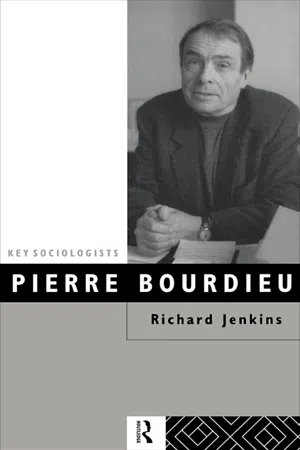
Pierre Bourdieu
About this book
This short critical introduction to the sociology of Pierre Bourdieu is a model of clarity and insight. Where Bourdieu's original writings are often densely argued and ambiguous, Richard Jenkins is direct, concise and to the point. He emphasises Bourdieu's contirbutions to the theory and methodology while also dealing in detail with his substantive studies of education, social stratification and culture. His book provides the best short English-language introduction to Bourdieu's work.
Information
1
A Book for Reading
Pierre Bourdieu has, with no doubt conscious irony, referred to his recent study of the French university system, Homo Academicus, as a ‘book for burning’. As an insider’s attempt to distance himself from, demythologise and analyse critically that system, it is, he suggests, vulnerable to colleaguely accusations of subversion or heresy, if not outright treachery. As with most of Bourdieu’s work, in particular his work over the last two decades, its subversive potential is, however, considerably undermined by the nature of the language that he uses and his general writing style. Idiosyncratic usages and neologisms, allied to frequently repetitive, long sentences which are burdened down with a host of sub-clauses and discursive detours, combine with complicated diagrams and visual schemes to confront the reader with a task that many, whether they be undergraduates, postgraduates or professional social scientists, find daunting. As the reader will gather from what I have just written, it is not that I have any necessary objections to either longish sentences or sub-clauses. Bourdieu’s writing, however, which he has described as ‘a permanent struggle against ordinary language’, [1] is, as I will argue in a later chapter, unnecessarily long-winded, obscure, complex and intimidatory. He does not have to write in this fashion to say what he wants to say.
In offering this introduction to Bourdieu’s work and thought, therefore, my first objective has been to discuss that work and thought outside the opaque language games of his sociological circle and his interpreters. In other words, my intention is to ‘translate’ Bourdieu into language which is as clear and as straightforward as possible. Hence, this is a ‘book for reading’. This objective is informed by two basic propositions: first, that it is worth writing such a book, and second, that it is possible to do so without doing violence to the subtlety and depth of his arguments.
With respect to the first of these, there can be little doubt that Bourdieu’s contributions to sociology and social anthropology are important. With the passing of Althusser, Barthes and Foucault he, more than any other comparable figure—Boudon or Touraine, for example—has come to personify the continued value and vigour of a distinctly French intellectual tradition within the social sciences. Occupying as he does a political and theoretical space constructed out of the divergent currents of Marx, Weber and Durkheim, structuralism and interactionism, pessimistic determinism and a celebratory belief in the improvisatory creative potential of human practice, he appears to be an attractive and heterodox source of inspiration for social theory in the 1990s.
There are a number of more specific reasons why Bourdieu’s work is so important. First, there is the major contribution which he has made to the debate about the relationship between structure and action which re-emerged during the late 1970s and early 1980s as the key question for social theory. Second, and by interesting comparison with, say, Anthony Giddens, that contribution has consistently been framed by an engagement between systematic empirical work—whether relying on ethnography or social survey approaches—and reflexive theorising. It is the tension between these two aspects of Bourdieu’s work that makes it so interesting: ‘theory without empirical research is empty, empirical research without theory is blind’.[2] Third, and as a consequence, perhaps, of the fact that Bourdieu has been an active social researcher throughout his career, epistemological questions about the nature of adequate sociological knowledge and the conditions under which it is possible are central to his project. These are questions of which many sociologists and anthropologists—whether they see themselves as primarily ‘theorists’ or ‘researchers’—have, to the detriment of their enterprise, lost sight.
Finally—although it would be possible to provide further justifications for writing a short introduction to his work—Bourdieu is, by virtue of the three points mentioned above, enormously good to think with. His work invites, even demands, argument and reflection. If one makes the initial effort, it is, I suspect, impossible to remain neutral about what he is saying. Whether one agrees with him or not there is something to be learned, something to be turned to good purpose in one’s own work, and irritating, persistent problems—creative sociological doubts—which are impossible to ignore. He raises tricky questions and helps to provide some of the means by which they may be answered. Bourdieu’s work offers the patient reader a tremendously useful intellectual resource.
As far as I’m concerned, I have very pragmatic relationships with authors: I turn to them as I would to fellows and craft-masters, in the sense those words had in the mediaeval guild—people you can ask to give you a hand in difficult situations.[3]
It is just such a ‘pragmatic relationship’ with Bourdieu’s writings that I hope to encourage here, a relationship that permits of the most trenchant criticism while recognising the great value of what he has to say.
Such a relationship is all the more necessary because, until fairly recently, the appropriation of Bourdieu’s work in the English-speaking world has been problematic. Because of the difficulty of his work, and also perhaps because of the uses to which the esoteric writings of a particular species of French intellectual can be put in the accumulation of cultural capital in certain areas of Anglophone academic life, Bourdieu has been more read about than read, more talked about than critically discussed. Some of his books—Reproduction in Education, Society and Culture is probably the best example—are very widely cited. By comparison with authors such as Barthes or Foucault, however, the critical literature dealing with Bourdieu is relatively sparse, although this lack is now beginning to be remedied.[4] What is more, on looking at the uses to which a text such as Reproduction has been put in the work of English-speaking writers, one often comes away with the impression that their knowledge and understanding of it are, at best, superficial.[5]
This, however, may be a shortcoming of more than just the Anglophone world. Martine Segalen, for example, has recently discussed Bourdieu’s influence upon French ethnology. She defines ‘strategies’, a key concept in Bourdieu’s analytical framework, as ‘the product of social rules where demographic variables and economic and “symbolic” capital intervene’.[6] As we will see later, to conceptualise strategies in terms of rules could not be further from the truth of Bourdieu’s model.
A further problem is the fact that much of the discussion of Bourdieu concentrates on a fairly narrow spectrum of his work. Very few critiques span the full range—from Algerian ethnography to the sociology of education to methodology—or even a substantial slice of it. This, of course, may be understandable. Bourdieu’s vision is broader and his scholarship more substantial than most of those, and I include myself in this, who write about him. It is a critical narrowness, however, which has unfortunately encouraged a less than adequate appreciation of what he is saying. It does Bourdieu a considerable injustice, for example, to regard him as primarily a sociologist of education or culture. There is much more to the man than this.
An example of this kind of tunnel vision can be found in social anthropologist Maurice Bloch’s discussion of Bourdieu’s structuralist analysis of the Kabyle house (a paper which is discussed in detail in Chapter Two). It is really only possible for Bloch to argue that Bourdieu’s model of the socialisation process is unidimensional and inadequate—i.e. making no allowances for ideology[7]—by virtue of his apparent ignorance of Bourdieu’s extensive, but nominally sociological, analyses of the French education system.
As a consequence, therefore, of superficiality, narrowness of focus or disciplinary fastidiousness one often encounters Bourdieu in other people’s writing as either a straw man or an idol without feet of clay. With the exception of his work on sport, I intend to make an attempt here to remedy this situation by dealing with all of Bourdieu’s oeuvre. In particular, I hope to convince the reader of the centrality to sociology and anthropology—certainly inasmuch as they are intellectual enterprises necessarily rooted in empirical research—of Bourdieu’s approach to epistemology and methodology. To reiterate my earlier point about ‘being good to think with’, his significance in this respect lies not so much in whether one accepts or rejects his arguments, but in the fact that he makes them at all.
This book, therefore, has three objectives: first, to produce a properly critical account of Bourdieu’s work which will be accessible to students; second, in doing so, to examine a broad range of Bourdieu’s work; and third, to place Bourdieu’s epistemological and methodological writings at the centre of that account. Before going on to tackle this agenda, however, it may be useful to situate his work in its proper context, his personal biography and intellectual career.
LIFE AND WORK
On many occasions, particularly during interviews, Bourdieu has talked about the relationship between his experience and history as a person and his intellectual project. Although he now occupies the most senior chair in sociology in France, at the Collège de France, he has come to it in a roundabout fashion. According to his most faithful English translator, Richard Nice, there is a myth—that of ‘the peasant boy confronting urban civilisation’—and there is a more serious version of Bourdieu’s life, that of a ‘petit bourgeois and a success story’.[8] One can perhaps hear echoes of that romantic myth when Bourdieu says things such as, ‘I didn’t have any accounts to settle with the bourgeois family’.[9] More directly, later in the same interview, in discussing his break with the ‘arrogance and distance’ which characterises the relationship between anthropology and its subject matter—people—he suggests that:
The difficulties I had in studying Kabyle peasants, their marriage patterns or rites, ‘from above’ is surely related to my encounter, as a child, with peasants whose views on such matters as honour or dishonour were in no form different from my own.[10]
Insofar as they are of any importance, here are some bare facts to begin with. Born in Denguin, a small town in the Béarn area of the Département des Basses-Pyrenées in south-eastern France, on 1 April 1930, Pierre Bourdieu is the son of a civil servant, un fonctionnaire. More petit bourgeois than peasant, perhaps, but it was a rural area and close to the land. In the early 1950s he attended the École normale supérieure in Paris, an elite teacher training college. Although he graduated as an agrégé de philosophie, he refused to write a thesis in reaction, by his own account, to the pedestrian and authoritarian nature of the education which was on offer. It was not only the institution, however, with which he (and others) were uncomfortable:
The pressure exerted by Stalinism was so exasperating that, around 1951, we had founded at the École normale (with Bianco, Comte, Marin, Derrida, Patiente and others) a Committee for the Defence of Freedom, which Le Roy Ladurie denounced in the communist cell at the École…[11]
For a year following his agrégation he taught in a provincial lycée. Then, in 1956, he was conscripted, serving for two years with the French Army in Algeria. It was this experience more than any other which appears to mark the beginning of his journey from philosophy to the social sciences. It was also a political experience:
After two arduous years during which there was no possibility of doing research I could do some work again. I began to write a book with the intention of high-lighting the plight of the Algerian people and, also, that of the French settlers whose situation was no less dramatic… I was appalled by the gap between the views of French intellectuals about this war and how it should be brought to an end, and my own experiences…Maybe I wanted to be useful in order to overcome my guilty conscience about merely being a participant observer in this appalling war.[12]
The book was Sociologie de l’Algérie, first published in 1958, [13] and for two further years Bourdieu stayed in Algeria, teaching at the University of Algiers and undertaking additional field research. He has described this, his first book, as ‘the poor attempt of an outsider’; be that as it may, it now, with the benefit of hindsight, appears to sit outside the subsequent developmental stream of his career. Very much a work of empirical social investigation, it offers, even yet, a wealth of information about Algeria and its peoples but little in the way of analysis. It was, nonetheless, a beginning and it provided him with useful research experience.
On his return to France in 1960 he spent a year as an assistant in the Faculty of Arts at the University of Paris. Having become something of an anthropologist, albeit a selftaught one, he attended Lévi-Strauss’s seminars at the Collège de France and ethnology lectures at the Musée de l’Homme. He also returned to reading Marx and worked as Raymond Aron’s assistant. Now it was sociology which beckoned.
Following three years at the University of Lille he returned to Paris in 1964, as Director of Studies at l’École pratique des hautes etudes, the Parisian power base upon which his subsequent career was initially founded. From this point on we witness an evergathering momentum of research activity and publication. A research grouping began to accrete around Bourdieu; in the rarefied intellectual cockpit of Paris he became a patron. In particular, there was the foundation in 1968 of the Centre de Sociologie Européenne, of which he remains the Director, and the subsequent launch of its associated journal, Actes de la recherche en sciences sociales, an innovative academic publishing venture which mixed text, photographs and illustrations in a refreshing and, until relatively recently, unique style. There are also a number of long-standing collaborators—Boltanski, Darbel, de St Martin and Passeron, to name only some—with whom Bourdieu has worked on what is obviously a programmatic and, to a degree, collective enterprise. There seems little doubt, however, that he is the driving force, much more than a first among equals:
I see the research group as a very little group, in comparison with others. Also the people who work with me are very modest. There are some of us who think that it is a strength of the group that they work so much, and that they are also so modest. They will accept and do things that arrogant people would not do and that is very important.[14]
There is an intriguing ambiguity in the above—a mixture of humility about the task in hand and (possibly) arrogance about his role in that task—which might be diagnostic or indi...
Table of contents
- Cover Page
- KEY SOCIOLOGISTS
- Title Page
- Copyright Page
- Acknowledgements
- 1: A Book for Reading
- 2: Anthropology and Structuralism
- 3: Experiments in Epistemology
- 4: Practice, Habitus and Field
- 5: Symbolic Violence and Social Reproduction
- 6: Culture, Status and Distinction
- 7: Uses of Language
- 8: Using Bourdieu
- Reading Bourdieu
Trusted by 375,005 students
Access to over 1.5 million titles for a fair monthly price.
Study more efficiently using our study tools.
Frequently asked questions
Yes, you can cancel anytime from the Subscription tab in your account settings on the Perlego website. Your subscription will stay active until the end of your current billing period. Learn how to cancel your subscription
No, books cannot be downloaded as external files, such as PDFs, for use outside of Perlego. However, you can download books within the Perlego app for offline reading on mobile or tablet. Learn how to download books offline
Perlego offers two plans: Essential and Complete
- Essential is ideal for learners and professionals who enjoy exploring a wide range of subjects. Access the Essential Library with 800,000+ trusted titles and best-sellers across business, personal growth, and the humanities. Includes unlimited reading time and Standard Read Aloud voice.
- Complete: Perfect for advanced learners and researchers needing full, unrestricted access. Unlock 1.5M+ books across hundreds of subjects, including academic and specialized titles. The Complete Plan also includes advanced features like Premium Read Aloud and Research Assistant.
We are an online textbook subscription service, where you can get access to an entire online library for less than the price of a single book per month. With over 1.5 million books across 990+ topics, we’ve got you covered! Learn about our mission
Look out for the read-aloud symbol on your next book to see if you can listen to it. The read-aloud tool reads text aloud for you, highlighting the text as it is being read. You can pause it, speed it up and slow it down. Learn more about Read Aloud
Yes! You can use the Perlego app on both iOS and Android devices to read anytime, anywhere — even offline. Perfect for commutes or when you’re on the go.
Please note we cannot support devices running on iOS 13 and Android 7 or earlier. Learn more about using the app
Please note we cannot support devices running on iOS 13 and Android 7 or earlier. Learn more about using the app
Yes, you can access Pierre Bourdieu by Richard Jenkins in PDF and/or ePUB format, as well as other popular books in Social Sciences & Social Classes & Economic Disparity. We have over 1.5 million books available in our catalogue for you to explore.