- 244 pages
- English
- ePUB (mobile friendly)
- Available on iOS & Android
eBook - ePub
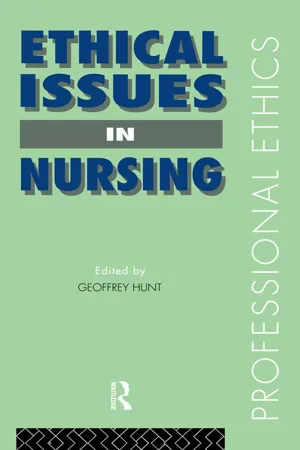
Ethical Issues in Nursing
About this book
This is the first book to take nursing ethics beyond stock 'moral concepts' to a critical examination of the fundamental assumptions underlying the very nature of nursing. It takes as its point of departure the difficulties nurses experience practising within the confines of a bioethical model of health and illness and a hierarchical, technocratic health care system. The contributors go on to deal openly and honestly with controversial issues faced by nurses, such as euthanasia and HIV.
Information
Part I
Specific issues
Chapter 1
Nursing and informed consent
An empirical study
Deborah Taplin
In 1985 I had reason, as a nurse, to interview a 36-year-old woman who was about to undergo a hysterectomy. A glance at her medical history revealed that she had undergone a tubal ligation ten years earlier and was therefore sterile. In the interview she told me that the most upsetting aspect of the impending surgery was the fact that she would, as a result, be unable to have any more children. She was surprised to learn that she was already sterile. In this case the consent procedure had not been followed. I wondered how many more such cases there were in British hospitals.
In 19901 undertook a pilot project at a major university hospital in London to investigate competent adult patients’ understanding of the surgical treatment which they had received.1 My hypothesis was that an adequate consent procedure was not being followed. Although the results may not be representative of every hospital ward in the UK, there is plenty of informal and anecdotal evidence to suggest that the situation I found is not untypical for many British hospitals. As the majority of the medical and nursing staff I came into contact with were, or will be, employed in other hospitals it is quite unlikely that the behaviour observed is unique to the particular setting studied.
Furthermore, a study by Byrne, Napier and Cuschieri carried out in a British surgical unit in 1987 showed that of a hundred patients interviewed twenty-seven did not know which organ was operated on and forty-four were unaware of the exact nature of the surgical process.2
I gave a structured interview to twenty men who had undergone a trans-urethral resection of the prostate and eighteen women who had had a dilatation and curettage. Granted the limitations and possible errors of a pilot study of this kind, the results still make dismal reading. On the whole, I found that inadequate preoperative information had been given. If a signature was present on a consent form then patients and medical and nursing staff appeared satisfied. These findings supported my hypothesis.
CONSENT IN GENERAL
I briefly set out here some general points about consent, to set the scene. Many of these points appear in the Department of Health’s recent guidelines, which every nurse should be familiar with.3
A patient has a right to withhold consent for examination or treatment, or withdraw it at any time. Consent is important in the law because of its connection with trespass to the person, that is, assault or battery. An assault is any act which causes in the person subjected to it an apprehension of the immediate infliction of a battery. A battery is the physical contact with another’s person. To have obtained informed consent is a defence against an accusation of assault and/or battery.
Consent may be express, when it is oral or written down, and this is the usual practice for surgical procedures. It is implied, for example in compliant actions such as raising one’s arm for an injection. Implied consent may be adequate for minor procedures.
The most important element in consent is the patient’s understanding of what is going to be done. Obtaining valid consent involves giving an explanation of the nature of the examination or treatment, of any substantial risks involved, of any side-effects and consequences for the life of the patient, mentioning alternatives, and giving all this information in a form which is comprehensible to the patient. Of course, the patient may be advised about a course of action, but it is important to back up this advice with the reasons.
In general one cannot give consent for another person. As Bridgit Dimond has explained: ‘There is no authority in law, apart from that given to the parent of a minor under 18, where a relative can give a valid consent for a patient.’4 As one might expect, there are circumstances where it would be right to give treatment without consent, such as for saving the life of an unconscious patient or to treat a mental disorder of a patient liable to be held in hospital under the Mental Health Act. I will be concerned here only with the consent of competent adults to surgical treatment in hospital.
THE RESEARCH STUDY
Method
I chose to use a structured interview rather than a self-completing questionnaire because I believe the interview is less likely to restrict the kinds of reply given. I was aware that I should not lead the patient’s answer.
To be admitted as a subject on the study each patient had to be: a) at least 18 years of age, b) able to speak and understand English, and c) mentally competent. Having obtained ethical approval for the study, subjects were initially identified on operating lists, and once on the wards I relied on the assessment of a registered nurse to decide which patients would be asked to participate.
In total twenty-five men who had undergone a trans-urethral resection of the prostate (TURP) and twenty-five women who had had a dilatation and curettage (D & C) were approached. Twenty-two men agreed to take part. Two of these were not admissible, one because he was very deaf and appeared to be disoriented and the other because he did not speak English. Eighteen women agreed to participate. This gave me a group consisting of thirty-eight people in all.
All the interviews were conducted post-operatively. They took place any time from four hours after surgery for ‘day patients’ to the second or third day after surgery for in-patients. One subject had had two operations and his interview was conducted after the second one.
The interviews were designed to establish the patients’ views about the consent procedure and to discover how much information each had been given as a basis for making an informed decision about treatment. Towards the end of 1989 the Department of Health issued ‘A Guide to Consent for Examination or Treatment’; this circular supported my thinking and added weight to the study.
Only eight simple questions were asked. I was aware that it was important to make the questions non-threatening, understandable and easy to answer.
Results
I now present the results, question by question. I list the answers given with the numbers of patients giving that answer or one very like it. Answers that were essentially the same were grouped.
1 Why did you need an operation?
Men’s answers: dribbling of urine 3; referred by GP for another health problem, enlarged prostate then noticed 1; emergency admission 3; failure of balloon dilatation 2; nocturea 4; enlarged prostate 2; referred by another specialist 1; problems for over six months 1; unable to pass urine and attempt to catheterise failed 2; haematurea 1.
Women’s answers: menorrhagia and fibroids or post-birth erosion 2; menorrhagia 4; irregular bleeding and polyps or hormone problems 3; vaginal discharge 1; post-partum haemorrhage 1; period problems 1; did not want a hysterectomy 1; irregular bleeding 3; dysmenorrhoea and polyps/fibroids 2.
2 When did you find out you needed treatment?
Men’s answers: outpatients’ department one to four weeks ago 3; one to three months ago 6; three months to one year ago 1; one to four years ago 5; emergency admission 3; after admission 2.
Women’s answers: outpatients’ department (OPD) one to four weeks ago 8; one to three months ago 1; discussed with GP 3; OPD appointment and GP 1; OPD appointment 3; heard of endometrial ablation and sought information 1; told needed hysterectomy in OPD, told of D & C on admission 1.
One man had been waiting for treatment for one month at the study hospital, but longer at another hospital. Another who had been admitted as an emergency had been in hospital for several days before learning of the proposed operation. Of those who were waiting one to four years: one man’s treatment had been delayed due to social problems and waiting list delays; one man had had some other treatment first; one man had another medical problem; and two of the men were having a second or fourth operation.
3 What operation did you have?
Men were given a choice of: a) Prostatectomy, b) TURP, and c) trans-urethral resection of the prostate. Women were given a choice of: a) dilatation and curettage and b) D & C. (It transpired during the interviews that only three women had D & C only on the consent form; the remaining women had had another procedure as well, such as laparoscopy or hysteroscopy. This is a design fault in the study.) The subjects were asked to identify either from memory or from the list which operation they had had. Most of the women had also undergone another medical procedure and they were also asked to identify that. I compared the replies given with the relevant written consent forms to see if the answers were the same.
Operation on the men’s consent form: TURP 9; TURP and cystoscopy 3; TURP and retrograde ejaculation 3; trans-urethral resection of the prostate 2; TURP and trans-urethral resection of the prostate 1; TURP and orchidectomy 1; bladder neck incision 1.
An additional consent form for a man who had had a haemorrhage after his TURP and needed vaginal packs inserted into the prostate bed, showed ‘removal of vaginal packs’.
Operation described by men: Did not know 13; possibly a transurethral resection of prostate 1; did not remember 1; prostatectomy 3; unsure, perhaps a prostatectomy 2.
Of the thirteen who said they did not know, one did not appear to understand what the operation was, judging by his description of the procedure. The man who had had the reactionary bleeding necessitating a second operation did not know what operation he had undergone on either occasion.
Operation on the women’s consent form: D & C and hysteroscopy 12; D & C and polypectomy 1; D & C 2; D & C, hysteroscopy and polypectomy 1; laparoscopic sterilisation 1; tubal ligation, removal of intra-uterine contraceptive device (IUCD), D & C and hysteroscopy 1.
Comparing the men’s consent forms with their statements we find that of those who were partially correct, one stated he had had a trans-urethral resection of the prostate and had signed his consent form for a TURP and retrograde ejaculation. One was unsure but thought he had had a prostatectomy, although his consent form stated TURP. Of two patients who thought they may have had a prostatectomy, one had signed his consent form for a bladder neck incision and the other for a TURP and orchidectomy. One patient stated that he had had a prostatectomy but had signed for a TURP.
Operation described by women: D & C and hysteroscopy 5; did not know or did not remember 5; did not read the form 1; D & C, hysteroscopy and laparoscopy 1; D & C 4; D & C and clipped tubes 1; D & C, IUCD removal and sterilisation 1.
Comparing the women’s consent forms with their statements we find that, of the seven women who gave the correct description, one who had signed for a D & C and hysteroscopy mentioned the D & C but not the hysteroscopy she had undergone; the consent form gave only D & C as the operation and the hysteroscopy was not mentioned. One patient, who identified D & C as the operation performed on her, had also undergone a hysteroscopy which was not mentioned on the consent form. Of those who were partially correct, one woman thought she had also had a laparoscopy, although she had not, and it was not mentioned on the form she had signed. Another woman knew of the D & C, the IUCD removal and the sterilisation but not of the hysteroscopy. Two who said only that they had had a D & C had also had a hysteroscopy, and one a polypectomy – both had signed consent forms for all these procedures. Another, who said she had had a D & C and clipped tubes, had in fact had the D & C and a laparoscopic sterilisation, but the consent form did not mention the D & C.
One woman thought the consent form was not filled in when she signed it, although she did in fact describe the same procedure as that mentioned on the form. Another woman stated that she should have had a laparoscopy but was told that as the operating theatre was not ready she did not actually have it; in fact there was no mention of laparoscopy on the consent form.
Clearly the comparisons show up a great deal of inconsistency and confusion.
4 Was there any other type of treatment available?
Answers: fourteen men said that no other kind of treatment was mentioned as being available, five said yes, and one said he did not know. Twelve women said no other kind of treatment was mentioned as being available, four said yes, one said that none was mentioned, and one was unsure.
Of the women who said that an alternative was mentioned two referred to ‘the pill’ and two to hysterectomy.
5 Were there any specific risks involved?
If the answer was yes, it was followed by the question: What were these risks?
Men’s answers:...
Table of contents
- Cover Page
- Half Title page
- Title Page
- Copyright Page
- Contents
- Series editors' foreword
- Notes on contributors
- Acknowledgements
- Introduction: Ethics, nursing and the metaphysics of procedure
- Part I: Specific issues
- Part II: General issues
- Bibliography
- Index
Trusted by 375,005 students
Access to over 1.5 million titles for a fair monthly price.
Study more efficiently using our study tools.
Frequently asked questions
Yes, you can cancel anytime from the Subscription tab in your account settings on the Perlego website. Your subscription will stay active until the end of your current billing period. Learn how to cancel your subscription
No, books cannot be downloaded as external files, such as PDFs, for use outside of Perlego. However, you can download books within the Perlego app for offline reading on mobile or tablet. Learn how to download books offline
We are an online textbook subscription service, where you can get access to an entire online library for less than the price of a single book per month. With over 1.5 million books across 990+ topics, we’ve got you covered! Learn about our mission
Look out for the read-aloud symbol on your next book to see if you can listen to it. The read-aloud tool reads text aloud for you, highlighting the text as it is being read. You can pause it, speed it up and slow it down. Learn more about Read Aloud
Yes! You can use the Perlego app on both iOS and Android devices to read anytime, anywhere — even offline. Perfect for commutes or when you’re on the go.
Please note we cannot support devices running on iOS 13 and Android 7 or earlier. Learn more about using the app
Please note we cannot support devices running on iOS 13 and Android 7 or earlier. Learn more about using the app
Yes, you can access Ethical Issues in Nursing by Dr Geoffrey Hunt,Geoffrey Hunt in PDF and/or ePUB format, as well as other popular books in Medicina & Infermieristica. We have over 1.5 million books available in our catalogue for you to explore.