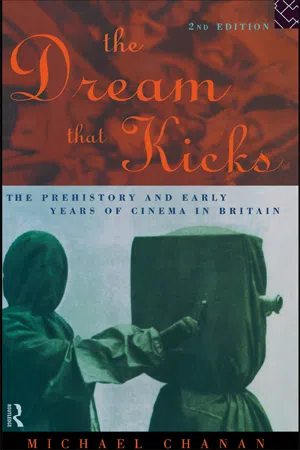
The Dream the Kicks is a classic account of the prehistory and early years of cinema in Britain. In this new paperback edition, which has been thoroughly revised to take into account recent scholarship of early cinema, Michael Chanan provides a fasciniating account of the rich and hitherto hidden history of the origins of film.
Chanan demonstrates that the theory of `the persistence of vision', which led to the invention of moving pictures, has been superceded by modern scientific findings. In its place, he puts forward a theory of invention as a type of bricolage, and shows that cinematography was a product of the forces of nineteenth century capitalism. He discusses the wealth of influences, both popular and bourgeois, on the culture of early cinema, including diorama, the magic lantern, itinerant entertainers and music hall. He looks at the relationship between film and photography, and considers the nascent film business, the ways in which early cinema was received by its audiences and the developing aesthetics of cinema in its first fifteen years.
eBook - ePub
The Dream That Kicks
The Prehistory and Early Years of Cinema in Britain
- 312 pages
- English
- ePUB (mobile friendly)
- Available on iOS & Android
eBook - ePub
The Dream That Kicks
The Prehistory and Early Years of Cinema in Britain
About this book
Information
Part 1
The arrival of moving pictures
Chapter 1
The site of film
One beam in a dark place hath exceeding much refreshment in it.
Oliver Cromwell
In spite of the extensive documentation which exists concerning the early days of film there is a sense in which the origins of film are obscure. Film has taught us to see the world anew, but it seems that the one thing it could not properly picture was its own birth. What we see in the earliest films is the beginning of a new way of seeing. What we don’t seem to see is how that way of seeing was first seen.
Sometimes there are anecdotes we can grab at, like the story of Hepworth and the parson. Cecil Hepworth was one of the English film pioneers. He was the son of a magic lantern lecturer and had an inventive turn of mind: his first contacts with the cinematograph came when another pioneer, R.W.Paul, bought from him some hand-feed arc lamps of his own design after Hepworth approached him at Olympia, where Paul gave his first paying film shows in March 1896. This was one month after the first public presentation in Britain of the cinematograph invented by the Lumière brothers in France. Hepworth soon began his own film career, inauspiciously, touring the country lecturing like his father, but with film instead of slides. On one occasion, in a church hall, in order to parry the displeasure of a suspicious parson over the prospect of a film of an exotic dance by a well-known music hall artiste, Hepworth had a brainwave and announced it as a film of Salome dancing before Herod! ‘Everyone was delighted’, he wrote later, ‘especially the parson. He said in his nice little speech afterwards that it was a particularly happy idea to introduce a little touch of bible history into an otherwise wholly secular entertainment. And he added that he had no idea that the cheenimartograph had been invented so long’ (Hepworth, 1967, p. 39; a slightly different version of the story is told in Hepworth, 1951). The parson’s sarcasm notwithstanding, there were indeed a great many people who were simply credulous before the phenomenon of film.
But what kind of credulousness was it and how did it arise? Could they not see a two-dimensional screen and a machine casting light and shadow upon it? To wonder how this effect could be achieved would not have been a surprising response, but to be taken in, as we know some of the early audiences were, as if this were some kind of magic—how was that possible? And then, when the first shock of the apparition was past, to accept the image as a full and complete picture of reality no matter what it left out—how could that have happened? Do these questions seem odd? Perhaps that’s only because the credulousness which greeted cinema at the beginning has survived to our own time.
We must go back into the prehistory of film if we want to understand the influences which were already affecting cinema in its earliest days. This prehistory has two main aspects. They can be looked at separately only if we also remember that they interacted in various ways at the same time. On the one hand, there’s the lengthy process of the invention of the apparatus itself—which in turn must be examined from at least two more interrelated aspects—technical and economic; and then there’s the development of cultural forms and popular entertainment during the nineteenth century and its legacy, which shaped the first films and created a dominant series of attitudes and expectations which audiences brought with them when they came to see them. The main link is obviously photography, but other forms are equally important, and again there’s more than one aspect to consider: traditions, attitudes and expectations differed in the different social classes, and it is therefore necessary to try and sort these out.
The basic principles of cinematography are not difficult to describe. A scene is exposed to a camera which takes photographs in rapid series at the rate of at least sixteen per second (though modern sound film speed is faster: 24 or 25 frames per second). In order to accomplish this, the film is mounted on a roll with perforations down the edge: between each exposure, a sprocket engages a perforation and pulls the film down to the next position, or frame; whereupon the shutter opens and closes and the process is repeated. The film is viewed by using the same kind of mechanism to project light through it on to a screen. (The Kinetoscope which Edison introduced in 1894 lacked projection: it was a peepshow device.) The machine which achieves this consists of a number of components engineered to a high degree of precision—lens, shutter, sprocket, etc., and the film itself—which only trial and error over a period of several years brought to fruition in the first functioning prototypes of 1895 and 1896.
In studying the technical origins of cinema it isn’t as if the only thing that matters is to settle the exact chronology, to sift the evidence and agree who invented what when (even though some arguments still take place on this score), and it will not be the approach of this book to deal with things in that sort of way. Basically, these things can tell us nothing by themselves that we don’t already know, namely, that film was invented somehow. To explain how cinematography came to be invented, how the inventors arrived at their inventions in the sense of what the process was and what were their motivations—this is another matter altogether. It cannot be achieved by passing blandly from one ‘fact’ to another. It hasn’t been achieved by those so-called histories which, as Geoffrey Nowell-Smith has put it, ‘accumulate facts or merge facts and impressions into linear narratives with scant regard for any process of definition, or delimitation of the area, or rigour of deduction’ (Nowell-Smith, p. 8).
Nowell-Smith belongs to a generation of critical film theorists who argue that it’s impossible to write a history of film unless you make it a primary task in so doing to confront the problem of how the institutions of cinema—the industry, the star system, the idioms, styles, genres, etc.—how these were constituted, instead of taking them for granted as ‘natural’ forms of evolution. I share this concern. How is it, I want to know, that cinema became a system in which moving images (later combined with recorded sounds) are assembled in various ways, according to various conventions, so that on the surface, as it were, the screen appears to be a kind of ‘window’ on to reality—whereas what is really screened is a world apart, both illusory and imaginary, which produces its own meanings, the genres which form our modern myths, legends and fantasies?
To realize this disjunction, the disjunction between process and appearance, leads to a conception of cinema not just as an artistic form but also an ideological one, where the screen obscures as much as it reveals and in the process represents not reality but an ideological version of it. What does ideology mean here? It is not just a set of ‘mistaken ideas’ about the social world, of which we accuse our political opponents, which correspond to their specific political interests and may or may not be present in a film. An ideology is rather a form of representing reality, expressed in art, philosophy, religion, political and legal systems, etc., which is largely the unconscious product of the organization of the social world and the position of the individual subject within it. This does not mean that ideologies are reducible to the effects of the economic base, a mechanical idea propagated by those whom Sartre called lazy Marxists, which was never advanced by Marx himself. Nor does it mean that ideology is never conscious, never intentionally constructed (at least in part) so as to represent economic or political self-interest; plainly it often is. But the formation of ideology is an extremely complex phenomenon and I don’t want to write a theoretical dissertation on the subject as a precondition for approaching the history of cinema. The truth is that an ideology and its effects cannot be studied apart from historical instances. One of the reasons for this, as we shall discover, is that many ideological elements are fundamentally remnants of previous ways of thinking which have been superseded in particular branches of knowledge but which retain their influence within general consciousness.
Nevertheless, these reservations made, I agree with those theorists who maintain that ideology is not just an added ingredient in a film but enters into the conception of a moving picture, and conditions the very nature of that conception. Conditions but not determines. For lazy Marxists, it was enough to describe the ideology of the capitalist film industry in some such formula as ‘the true interest of the bourgeoisie is that cinema should make up for what people do not have in real life’, which not only suggests a mechanical and deterministic explanation of the relationship between economic forces and ideological effects but seems to eliminate concern for cinema as an art form, not just an ideological one. Now it is perfectly true that the film industry after a hundred years is mostly concerned with providing the audience with pure escapism. But when you start asking more definite questions such as how the economic structure of the industry actually produces these results—when you begin the historical examination of these problems—such assertions quickly appear simplistic, and themselves ideological in form, rather than being serious critical attempts to grasp the nature of social and historical processes. The question, if it is true, is how it came about. And what is it about cinema that lends itself to such use? This book will, I hope, shed some light on these questions through an examination of the origins of cinema, cultural, technical and economic. The question that inevitably follows—Is it redeemable?—belongs elsewhere.
Concrete historical evidence tends to explode a whole series of myths and misconceptions about these origins which come from jumping to unhistorical conclusions. André Bazin, for example, foremost critic from an earlier generation, claimed that the idea of cinema existed fully grown in the inventors’ minds when they started. Certainly there came a point when some of the inventors had a pretty good idea of what it was they were trying to invent, and they said so. But many of those who contributed to the dialectic of invention were quite uninterested in the idea of moving picture projection. Men like Janssen, Muybridge and Marey, whose work is described below, weren’t trying to invent cinematography: they were involved in a search for quite different discoveries, in the fields of astronomy or the investigation of animal locomotion; they used rapid series photography as an instrument or tool of scientific research. Bazin knows about these men and to sustain his thesis therefore has to discount their contribution as somehow incidental; but this is merely to look away from what it is inconvenient to see. In fact, the developments they made in the techniques of rapid series photography became vital steps towards the achievement of cinematography. A fundamental question therefore arises here concerning connections that may exist in the methods and instruments involved in the processes of discovery and invention in different fields. A question about the twin processes of discovery and invention and the relationship between them. What do you need to discover in order to be able to invent something? What do you need to invent in order to be able to discover something?
Inventions don’t just happen, they don’t just drop from the skies or appear out of a vacuum in the mind of the inventor. In the first place, any invention depends on prior discoveries of some kind—discoveries which in some way dictate the initial purpose the invention is intended to serve. In the second place, the step from discovering something to an invention which embodies it and thence to its application for purposes previously unimagined also has to be explained. The invention normally has to be motivated in some way. Very few inventions are ever the result of mere disinterested curiosity, and they’re usually impractical if they are. The primary motivation is usually either economic necessity, or, as in the case of cinema, economic opportunity. In either case economic conditions play a determinate (but not determining) role, corresponding to the state of development of the technological conditions for the new invention.
In this respect cinematography is no different from other inventions of the nineteenth century. Devices which contributed to the invention grew out of a variety of contexts and found uses in other contexts before anyone arrived at the idea of moving pictures as we now know them. The same thing happened in all those branches of production which led to new devices, new machines, new instruments and new industries. During the 1850s, for example, piano manufacturers were trying to develop larger and more sonorous instruments suitable for the new large concert halls and for accompanying larger orchestras. One of the weaknesses of the original design of the piano which had become a major problem by the 1840s was that the strings kept breaking as more was demanded of them. Finally a new method of producing copper wire was invented in Britain in 1854. But this new kind of wire immediately proved to suit not only piano strings but also a whole range of industrial purposes, from agricultural machinery to suspension bridges. The invention of cinematography was similarly linked to technological progress, often as the by-product of such different developments as the search for new types of explosives, the industrialization of agriculture, and the invention of a new material for printers’ rollers.
Then comes the process of discovery which takes place once the invention has been achieved. What this largely consists in is the discovery of ways of using the invention which the inventors had not actually been trying to provide for, because these are uses which the invention itself has made possible, and which could not therefore have been envisaged beforehand. This is certainly true of the invention of cinematography. Cinema, the institution and the industry which we now have, was not in the minds of the inventors and could not have been. Film, that is, cinematography, was invented; but the cinema grew.
* * *
The starting point for the history of cinema must therefore be (as Nowell-Smith also argues) an acknowledgement that cinema (or film), before it acquired any identity of its own, was immersed in a series of histories which conditioned the process of invention. These histories are those of the relevant aspects of science and technology, economics, aesthetics, and so on; and the prehistory (and, later, history) of cinema is interwoven with them. What the relevant aspects of these histories are cannot be assumed beforehand; they can only be discovered by historical research. In other words, none of these histories is sufficient in itself; they each invoke the study of those further histories to which they are in turn related.
Historical research can also be carried out too narrowly by failing to consider what it was people saw, or thought they saw, when they first saw a film; in other words, what the subjective experience of seeing films for the first time was like. This is a deficiency in many historical studies of the origins of cinema, which sort through historical records without ever really grasping film as a new form of cultural production. And so for the most part we haven’t got beyond the stage of seeing the first films as curious historical records—records of historical interest simply because they’re the first films. We still see many of the scenes which film was exposed to at the beginning as a kind of historical dumb-show, descended from the peep-shows and panoramas, magic lanterns and dioramas, of the nineteenth century, where people saw the reconstruction of battles and volcanoes, famous historical scenes and natural wonders, in short, every spectacle under the sun.
The peep-shows of the nineteenth century were miniature forms, popular in fairgrounds and on the streets, but often quite elaborate in their lighting and perspective effects; their origins are lost. At the other end of the scale, the panorama, originally created in the late eighteenth century, and the diorama which followed, were evolved to cater for the more refined tastes and susceptibilities of the bourgeoisie, and then expanded to attract a more popular audience. The diorama was devised by Daguerre some years before he invented photography. In fact his interest in the idea of photography grew out of it: he was looking for a new way of producing the naturalistic scenic drops which the diorama employed. He had begun as a scene-painter at the opera, so he knew what kind of spectacle would tantalize the bourgeois audience: the diorama was a system of producing illusions by means of changing lights, so that various parts of the scene, or certain elements within it, appeared and disappeared. Within a few years dioramas had opened in leading cities throughout Europe, together with many imitations. In some places there were almost as many of them as there were cinemas a century later.
The magic lantern, which is particularly important in the origins of film because it involved projection, first appeared in the seventeenth century—Pepys bought one in London in 1666-as a development of the camera obscura, which artists used as an aid. The lantern employed a lens and lamp to project the image on a slide on to a screen. In the nineteenth century it became a public form of entertainment when new sources of illumination (limelight, gas light and later electricity) extended the throw and allowed projection before larger audiences, stimulating improvement of the lantern itself, the slides they showed, and the whole mode of presentation. Multiple lanterns and mechanical slides were developed capable of sophisticated effects including simple types of movement; the slide show became an entertaining (though always moral and edifying) lecture with musical accompaniment. In many ways it provided a crucial model for the development of the mass media over the following century, the first mass entertainment medium to inject a uniform view of the world into the heart of existing institutions such as the family and the school, thus moulding them from within, while at the same time reaching beyond the confines of any particular social class. Other entertainments, like music and theatre, adapted themselves to the social predilections of different audiences; in the case of the magic lantern it was fundamentally the same style of presentation which offered itself to all classes. The magic lantern was thus a key element in the process, which subsequently embraced all the media, of creating the myth of the average member of society, ‘the man (!) in the middle’, the model citizen of the modern democratic state.
As a pair of modern commentators have put it, ‘The magic lantern was widely used as a domestic toy, but was also an engine of public instruction’ (Martin and Francis in Dyos and Wolff, eds, p. 239). Indeed, its educational importance was recognized at the time by, for example, the Victorian popularizer of science John Henry Pepper, who spoke of it thus in his book The Boy’s Playbook of Science:
No other optical instrument has ever caused so much wonderment and delight, from its origin to the present time, as this simple contrivance. For a long time its true value was overlooked, and only ridiculous or comic slides painted, but its educational importance is now being thoroughly appreciated, not only on account of the size of the diagrams that may be represented on the disc, but also from the fact that the attention of an audience is better secured in a room when the only object visible is the diagram under explanation.
The popularization of science was one of the practices which the magic lantern, though not initiating it, certainly made its own, through the projection of ‘general interest’ slides on which the lecturer gave a somewhat anecdotal running commentary. Audiences for these presentations varied in size from little more than family groups to the capacity of a large hall; in 1891, 1,500 people attended a lecture at the Crystal Palace by D.W.Noakes, official lanternist at the Royal Albert Hall. In this way the magic lantern lecturer took his place as a mediator between the general audience and the nineteenth-century tradition of the scientific gentleman amateur, which played such a large role in the progress of science during the Victorian era. Later on, when film replaced the magic lantern, it took this tradition over, and for several years often retained the...
Table of contents
- Cover Page
- Title Page
- Copyright Page
- The dream that kicks
- Author’s note (first edition)
- Preface to the second edition
- Acknowledgements
- Our eunuch dreams
- Part 1: The arrival of moving pictures
- Part 2: The dialectic of invention
- Part 3: Culture and economics
- Part 4: The early years
- Bibliography
Trusted by 375,005 students
Access to over 1.5 million titles for a fair monthly price.
Study more efficiently using our study tools.
Frequently asked questions
Yes, you can cancel anytime from the Subscription tab in your account settings on the Perlego website. Your subscription will stay active until the end of your current billing period. Learn how to cancel your subscription
No, books cannot be downloaded as external files, such as PDFs, for use outside of Perlego. However, you can download books within the Perlego app for offline reading on mobile or tablet. Learn how to download books offline
Perlego offers two plans: Essential and Complete
- Essential is ideal for learners and professionals who enjoy exploring a wide range of subjects. Access the Essential Library with 800,000+ trusted titles and best-sellers across business, personal growth, and the humanities. Includes unlimited reading time and Standard Read Aloud voice.
- Complete: Perfect for advanced learners and researchers needing full, unrestricted access. Unlock 1.5M+ books across hundreds of subjects, including academic and specialized titles. The Complete Plan also includes advanced features like Premium Read Aloud and Research Assistant.
We are an online textbook subscription service, where you can get access to an entire online library for less than the price of a single book per month. With over 1.5 million books across 990+ topics, we’ve got you covered! Learn about our mission
Look out for the read-aloud symbol on your next book to see if you can listen to it. The read-aloud tool reads text aloud for you, highlighting the text as it is being read. You can pause it, speed it up and slow it down. Learn more about Read Aloud
Yes! You can use the Perlego app on both iOS and Android devices to read anytime, anywhere — even offline. Perfect for commutes or when you’re on the go.
Please note we cannot support devices running on iOS 13 and Android 7 or earlier. Learn more about using the app
Please note we cannot support devices running on iOS 13 and Android 7 or earlier. Learn more about using the app
Yes, you can access The Dream That Kicks by Michael Chanan,Professor Michael Chanan in PDF and/or ePUB format, as well as other popular books in Media & Performing Arts & Film History & Criticism. We have over 1.5 million books available in our catalogue for you to explore.