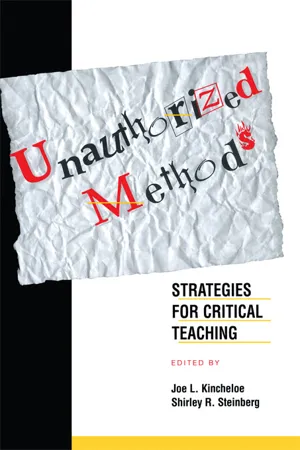
This work makes accessible and practicable some of the best theoretical innovation in critical pedagogy of the last decade. Issues of knowledge are explored as the authors consider how an integration of popular culture and cultural studies into the lesson plan can enrich and re-invigorate the learning experience. These essays, ranging widely in topic and educational level, are based in theory but are practice-oriented. In translating this theory, the contributors provide educators with techniques which will inform rather than oppress classroom skills.
eBook - ePub
Unauthorized Methods
Strategies for Critical Teaching
- 296 pages
- English
- ePUB (mobile friendly)
- Available on iOS & Android
eBook - ePub
Unauthorized Methods
Strategies for Critical Teaching
About this book
Information
I
LESSON PLANS FROM THE OUTER LIMITS:
UNAUTHORIZED METHODS
Teachers have a difficult job. Faced with pressures from a variety of angles, teachers must struggle to maintain their motivation and their self-esteem. The fact that so many do is a miracle of sorts, testimony to their dedication and to their drive. We consider such dedicated and adept teachers heroic figures and do everything possible to show our appreciation and our respect for them when they teach our children or when they appear in our graduate classes. Having said this, however we, like generations of analysts before us, believe that teachers suffer because of problems in their professional training not only at colleges of education but at colleges of liberal arts and sciences as well. When teachers emerge from higher education—through no fault of their own—they are frequently unprepared to teach at a level commensurate with their potential. Colleges of liberal arts and sciences too often teach broad survey courses that encourage memorization of isolated facts, not systematic analysis of the field.
Such systematic analysis might involve studies of the genesis of the field, of the field as a discourse with examination of the tacit rules that shape it and determine its future, of the various schools of thought within the field and the etymologies of their disagreements, and of the ways that knowledge has been produced in the field including the strengths and weaknesses of research strategies. These explorations constitute only a few of the ways potential teachers might transcend the memorization ritual; throughout this book we will present many more. In our effort to get beyond traditional methods of teaching and educating teachers, we will present lesson “plans” that refuse to discount the intelligence of teachers. We assume that teachers should be scholars, that they should possess the freedom to make their own plans and that they should honor the responsibility to be knowledge producers who are capable of comfortably performing both secondary and primary research. Indeed, we call for a new rigor in teacher education and in elementary and secondary education. This book serves as a set of introductory, nontraditional ideas on how to provide teachers with ways of thinking, researching, and instructing that empower them to implement this new rigor.
While Unauthorized Methods: Strategies for Critical Teaching will provide teaching methods and lesson plans, please note that throughout our careers as teachers we have been uncomfortable with these terms. Often methods and lesson plans have implied specific blueprints for teachers that give a step-by-step checklist of what to do and how to do it. Many methods and lesson plan books delineate a particular path, a “right way” for teachers who are assumed to have little research ability or subject matter knowledge. Not only does such material insult teachers by “dumbing down” expectations (or as Donaldo Macedo would call it, “stupidification”), but they rarely take the effects of the social, economic, and political context into account. The concepts of oppression and power inequalities are missing, as racism, gender bias, and class bias become forbidden topics. Yet the new rigorous paradigm of teaching and teacher education that we imagine foregrounds the interaction among context, power, method, and subject matter. This vision is practical, achievable, and desirable in a democratic society. We will first discuss impediments to its achievement and then imagine the implications of this vision. Our vision is indeed unauthorized in its notions of critical teaching without prescribed, teacher-proof methods.
PARADIGMATIC RUMBLING
Major changes have occurred in academia over the last two decades. New ways of seeing and making sense of reality have emerged that challenge comfortable academic protocols, that set up the possibility of new ways of producing knowledge. We have written extensively about these changes elsewhere and will not recite the philosophical/theoretical aspects of them here (for such information see Kincheloe 1991, 1993, 1995; Kincheloe and Steinberg 1993, 1997). Succinctly put, a paradigmatic change of major proportions has taken place. A paradigm is a constellation of concepts, values, and techniques used by a scientific community or by a dominant culture to make sense of themselves and their world. As frameworks of understanding, paradigms guide the ways knowledge is produced. Until Thomas Kuhn described his notion of paradigmatic change in 1962, most scholars believed that scientific knowledge accumulated gradually becoming more and more sophisticated and accurate. Kuhn and others undermined this view, maintaining that major conceptual change never comes as a result of a steady and orderly series of discoveries; on the contrary, conceptual change is abrupt, disconcerting, and traumatic. Einstein’s early twentieth-century challenge to the dominant paradigm in physics exemplifies traumatic paradigmatic change. The universality of Newtonian physics collapsed as theories of relativity and quantum mechanics portrayed a far more complex physical universe. The world could never again be viewed in the same way.
Traditional methods of understanding the world no longer seem appropriate to many of us. The culture of modernist positivism that has tacitly shaped teaching and teacher education throughout most of the twentieth century no longer answers the compelling questions of our time. When we use the term modernism we are referring to the era of Western history beginning with the rise of science in the seventeenth and eighteenth centuries. Unable to cure the Black Plague that killed one-forth of Europe’s population in the fourteenth century, Europeans sought new ways of making sense of the world. This impulse would lay the foundation of Western modernism and would express itself in the scientific method of Rene Descartes, Isaac Newton, and Francis Bacon. This scientific mode of reasoning, often termed reductionism, asserted that all aspects of complex phenomena can best be appreciated by reducing them to their constituent parts and then piecing these elements together according to causal laws (Mahoney and Lyddon 1988). A key aspect of modernist science has asserted that the same methods used to study the physical world should be used to study the social, psychological, and educational world. Serious problems emerge from such an assertion, as modernist researchers assume that students (like quartz crystals) are objects that will remain constant. Therefore, long-term generalizations can be made about children that disregard the ever-changing context in which they operate.
The label positivism was popularized by Auguste Comte, the nineteenth-century French philosopher, who argued that human thought had evolved through three stages: the theological stage (where truth was based on God’s revelation); the metaphysical stage (where truth was based on abstract reasoning and argument); and the positivistic stage (where truth was based on scientifically produced knowledge). Comte sought to discredit the legitimacy of nonscientific thinking that did not take sense knowledge (knowledge obtained through the senses—empirical) into account (Kneller 1984; Smith 1983). He saw no difference between the ways knowledge should be produced in the physical sciences and in the human sciences. From Comte’s perspective we should study sociology the same way we study biology. Society, he argued, is nothing more than a body of neutral facts governed by immutable laws. Like biology, society is governed by natural laws. Accordingly, social actions would proceed with lawlike predictability (Held 1980). In this context, education is also governed by unchanging laws; the role of the educator is to uncover them and then to act in accordance with them. For example, educational laws would include pronouncements on how students learn and how students should be taught. To the positivist educator there is only one correct way to teach and one correct body of subject matter. The context in which education takes place is irrelevant and the role of the teacher involves merely passing the correct subject matter to students using the correct pedagogical method.
The editors and authors of this book are united in their attempt to define counter-positivist instruction. Our lesson plans and methods are theoretically grounded on five differences from the old “authorized” paradigm:
1) Modernist positivism focuses on the parts (test scores, seating arrangements, different administrative strategies) in order to eventually understand the whole. In the new paradigm this relationship is reversed—the parts can only be understood in the context of the whole (the need to focus on our larger purposes as we learn methods of teaching);
2) Modernist positivism focuses on the identification of never-changing structures (knowledge as timeless truth, social laws, and a fixed core curriculum). The new paradigm sees every structure as dynamic, constantly interacting with changing processes (curriculum not as a fixed course of study but as a context-specific process changing with the evolving needs of society and individuals—the walk itself is just as important as the destination);
3) Modernist positivism claims that it produces an objective science untainted by human values (the curriculum is value-free, disinterested, merely the delineation of knowledge we have discovered). The new paradigm makes no claim for objectivity, as it celebrates human ways of knowing that are logical but also intuitive, emotional, and empathetic. Such an approach to knowledge production (epistemol-ogy) is often referred to as constructivism in that the world is “constructed” or brought forth in the process of knowing (learning becomes not as much an act of memorizing previously discovered information but an act of creating knowledge, of ordering our own experiences);
4) Modernist postivitism uses the architectural metaphor of a building to talk about knowledge—scientific information is characterized as the basic building block of matter (positivist science educators speak of DNA as the foundation that determines the structure of life, not just one of many aspects of living systems). The new paradigm uses the concept of a network where all aspects are interconnected (the science curriculum is never taught in isolation but in relation to networks of philosophical, political, economic, and theological knowledge—it is merely one part that influences and is influenced by the larger network of the universe);
5) Modernist positivism regards what it produces as the truth (the theory of evolution is true, the law of supply and demand in economics is true). In the new paradigm no “fact” exists in a vacuum. The characteristics of one entity are related to the characteristics of other entities. Because we can never understand and appreciate all of the possible relationships between parts, we never uncover the whole story. Thus, we offer only approximate explanations (the examples of teaching we offer in this book are not truths about teaching—they may indeed work for you in some situations, but in other contexts they may not work at all).
The new paradigm does not appeal to some people because of its complexity, its refusal to offer reductionistic answers to life’s complex questions. The old paradigm is comforting to many because of its faith in traditional methods of science to explain the nature of the world and the “truth” about teaching. In the old paradigm meaning was lost as information was turned into factoids, bits and pieces of data removed from context. We learned to think in fragments removed from the context that gives our thoughts meaning through their connection to the larger good. School has little to do with such connections—rarely do we talk about human problems and the inter-connectedness between them. We speak, for example, of adolescent suicide as a growing problem that needs to be addressed and we hold workshops to prepare teachers to identify those students who fit the “profile” of potential suicide victims. But that’s where the process stops. Rarely do we connect the growth of adolescent suicide to the larger context of late-twentieth-century life with its economic problems and its loss of meaning. Viewed within this larger context, youth suicide can be understood at a new level of sophistication. Immediately the decontextualized inadequacy of the teacher workshops confronts us. Once we begin to contextualize youth suicide our ability to develop viable responses to it improves dramatically. In the case of suicide or any other problem, the more ways we can contextualize the matter, the greater our understanding of it and the more likely we are to solve it.
We are vitally concerned with teachers and students being able to produce knowledge. Indeed, one of the key differences between education in the old paradigm and in the new paradigm is that the old model emphasizes the discovery of knowledge while the new one emphasizes the invention of knowledge. Thus, teachers are scholars who both contextualize and produce knowledge, all the while sharing their abilities with students. Thus, the classroom takes on the appearance of a “think tank,” an institution in which important knowledge is produced that has the value outside of the classroom. In modern positivism, teachers were instructed to say: “Give me the truth and I will pass it along to students in the most efficient manner possible.” In the new paradigm, teachers are encouraged to support themselves, to assert their freedom from all-knowing experts, to operate in an unauthorized manner. Such teachers often say: “Please support me as my students and I explore the world of mathematic, sociology, or whatever.” Teachers in the new paradigm refuse to accept without question the validity of the Western canon (the great books and ideas that have been taught in the traditional Western curriculum) as they seek knowledge from other cultures and traditions. Indeed, they are not content to operate within the framework that is taken for granted—they seek to recontextualize questions that have been traditionally asked about schooling and knowledge production in general. While they respect earlier insight and are reverential in respect to the genius of past eras, such educators display their veneration by continuing to question the work of their intellectual ancestors. Your own personal context and understanding may lead you to revise and to expand many of the ideas presented in this book.
Teachers in the new paradigm seek new ways of conceptualizing the world. Thus, in the spirit of Brazilian educator Paulo Freire, they problematize the information that confronts them. Freire and other educators (including Jo Anne Pagano, Deborah Britzman, Donaldo Macedo, Michael Apple, Philip Wexler, Joyce King, Gaile Canella, Ivor Goodson, Henry Giroux, Peter McLaren, William Pinar, and Tomas da Silva) have argued that any paradigm shift be viewed in a critical or socially transformative manner. Such a position maintains that knowledge always reflects larger power relationships in society. This means that those with social, economic, and political clout will have more say in what the schools consider official, validated knowledge than those without clout. Critical teachers understand this tendency and account for it in the way they work to problematize classroom information. Problematization in this critical new paradigm would, of course, involve asking questions such as where did the knowledge come from or who benefits as the result of the canonization of this knowledge. The ability to recognize these power-related dynamics lays the foundation for what Paulo Freire has called “critical consciousness.” Such a way of seeing moves individuals to recon-ceptualize their world in a manner that leads to transformative action, to social change.
Teachers who embrace these critical goals help students develop an awareness of themselves as social agents. This goal requires that teachers and students contextualize what happens in the classroom in relation to power and social justice issues as well as in relation to real lived experience. Thus, when students read a section of a science textbook that touts the virtues of nuclear power without references to environmental questions or allusions to Three Mile Island or Chernobyl, critical teachers insist that power questions be asked. Who benefits if we buy into such a description of nuclear power or who loses? These are central questions in such a context. A key question of this book is: How do we construct contexts for critical growth in our classrooms’? We will present activities and methodologies that teachers have used to encourage student reflection of the cultural values that shape personal views of the world and one’s place in it. Understanding the ways our consciousness is constructed is a fascinating exploration that not only provides insight into who we are but also into how the world works. Critical teachers in the new paradigm are enthralled by such questions.
AS TEACHERS, WE HAVE A RESPONSIBILITY TO BECOME SCHOLARS AND SELF-DIRECTED AGENTS
Teachers becoming excellent scholars will certainly not solve every problem in education, but we believe such a vision would constitute a damn good start in long-term educational reform. As we apologize for our glibness, we understand the structural problems that undermine education—not the least of which is an unequal distribution of wealth that robs the poor and marginalized of an equal opportunity to educational resources. Indeed our call for scholarly teachers in a more complex new paradigm is always accompanied by the belief that critical scholarly insight will render teachers better prepared to lead the struggle for political and economic democracy and social and educational justice. In the old paradigm elementary and secondary teachers were not even considered members of the traditional scholarly culture of higher education. Too many teachers have worked in the culture of the time clock, anti-intellectualism, ideological naivete, limited interpretive practice, and minimal analysis of the assumptions of the professional world. The logic of such working conditions emphasizes something quite unlike interpretive thinking. There is a tendency to surrender to the given, to view existing institutional arrangements, authorized arrangements, as objective realities. Without the catalyst of interpretation, and of an intellectually active analytical community, pronouncements tend to speak at a literal level—they speak “for themselves.” Without an analytical view of the everyday and of institutional requirements and activities, thought is fragmented and conceptual synthesis is blocked. Indeed, our relationship to knowledge is severed. As a result, our role as participants in social and institutio...
Table of contents
- Front Cover
- Half Title
- Title Page
- Copyright
- Dedication
- Contents
- Series Editor’s Foreword
- Chapter I Lesson Plans from the OuterLimits: Unauthorized Methods
- Part 1: From theory…
- Part 2: …to practice
- Notes on Editors and Contributors
- Index
Trusted by 375,005 students
Access to over 1.5 million titles for a fair monthly price.
Study more efficiently using our study tools.
Frequently asked questions
Yes, you can cancel anytime from the Subscription tab in your account settings on the Perlego website. Your subscription will stay active until the end of your current billing period. Learn how to cancel your subscription
No, books cannot be downloaded as external files, such as PDFs, for use outside of Perlego. However, you can download books within the Perlego app for offline reading on mobile or tablet. Learn how to download books offline
Perlego offers two plans: Essential and Complete
- Essential is ideal for learners and professionals who enjoy exploring a wide range of subjects. Access the Essential Library with 800,000+ trusted titles and best-sellers across business, personal growth, and the humanities. Includes unlimited reading time and Standard Read Aloud voice.
- Complete: Perfect for advanced learners and researchers needing full, unrestricted access. Unlock 1.5M+ books across hundreds of subjects, including academic and specialized titles. The Complete Plan also includes advanced features like Premium Read Aloud and Research Assistant.
We are an online textbook subscription service, where you can get access to an entire online library for less than the price of a single book per month. With over 1.5 million books across 990+ topics, we’ve got you covered! Learn about our mission
Look out for the read-aloud symbol on your next book to see if you can listen to it. The read-aloud tool reads text aloud for you, highlighting the text as it is being read. You can pause it, speed it up and slow it down. Learn more about Read Aloud
Yes! You can use the Perlego app on both iOS and Android devices to read anytime, anywhere — even offline. Perfect for commutes or when you’re on the go.
Please note we cannot support devices running on iOS 13 and Android 7 or earlier. Learn more about using the app
Please note we cannot support devices running on iOS 13 and Android 7 or earlier. Learn more about using the app
Yes, you can access Unauthorized Methods by Shirley Steinberg, Joe L. Kincheloe, Shirley Steinberg,Joe L. Kincheloe in PDF and/or ePUB format, as well as other popular books in Education & Education General. We have over 1.5 million books available in our catalogue for you to explore.