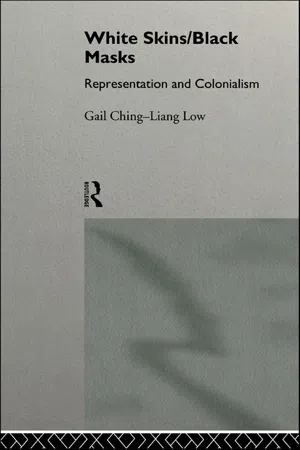
In this exciting re-reading of the classic work of Haggard and Kipling, Gail Ching-Liang Low examines the representational dynamics of colonizer versus colonized. Exploring the interface between the native 'other' as a reflection and as a point of address, the author asserts that this 'other' is a mirror reflecting the image of the colonizer - a 'cultural cross-dressing'.
Employing psychoanalysis, anthropology and postcolonial theory, Low analyzes the way in which fantasy and fabulation are caught up in networks of desire and power. White Skins/Black Masks is a fascinating entry into the current debate of post-colonial theory.
eBook - ePub
White Skins/Black Masks
Representation and Colonialism
- 312 pages
- English
- ePUB (mobile friendly)
- Available on iOS & Android
eBook - ePub
About this book
Information
Subtopic
Literary CriticismPart I
1
BODY/BORDER LINES
Haggard’s African writing is preoccupied with racial bodies. This engagement is not unusual, for in the latter half of the nineteenth century, the body functions as a privileged trope in a variety of discourses ranging from the medical, anthropological and literary to the critical. The body’s metaphoric standing renders it an exemplary historical map of social relations; the model of the physiologically healthy body was a common means of conceptualising psychological, national, literary and racial health. For not only are issues of sexuality, health and disease addressed physiologically but urban poverty, crime, race, nationality and literature also are discoursed upon via the figure of the body. This chapter will carve out four distinct thematic areas— health and the nation, the gendered body, the colonial body and the cultural body—with references to the culture and literature of the political Right in order better to situate the historical dimensions of the bodily fantasy surrounding white and black bodies.
HEALTH AND THE NATION
In their attempts to come to terms with previous historical versions of the late Victorian and Edwardian period as either a ‘crisis age’ or a ‘golden age’, contemporary historians have drawn attention to the centrifugal and centripetal tendencies in politics and society (Read, 1982). The former will be my focus, for such a narration of history echoes the paranoia and fears expressed by the forces on the pre-war Right and their attempts to reverse what they saw as Britain’s decline (Kennedy and Nicholls, 1981; Searle, 1971; Colls and Dodd, 1986). Fears for Britain’s vulnerability in the face of economic competition from the newly industrialised nations of America and Germany were accentuated by the emergence of Italy and Germany as imperial powers (Robinson, Gallagher and Denny, 1981). German and American productivity was exceptional. For example, US steel production overtook Britain in the 1880s, while in the next decade German output surpassed that of Britain (Porter, 1975:120). Sales of cotton goods showed signs, in a contemporary economist’s words, of ‘approaching something like stagnation’. Both US and German industrial development had reached a point where there was a marked decrease in foreign capital imports and in the sale of raw materials; both countries were also beginning to export capital and manufactured goods in large quantities. In 1894, statistics show Britain’s exports valued at £216 million with US, German and French exports valued at £181m, £148m and £123m respectively. German and American industrialisation had the benefit of more highly developed technology, mass production and a more systematic management of labour, and the increase in the scale of economic enterprises through the concentration of production and ownership saw the formation of trusts, monopolies and oligopolies. Britain was slow to adopt all these new measures. Her policy of free trade met with the protectionist policies of Germany, Russia, France, Austria, Hungary; this meant that Britain would have to pay duties on her goods exported to these countries while her own market was open to commercial penetration. In the intensified competition for markets and raw materials, the ‘official mind of imperialism’, confronted with the increasing insecurity of having trade routes, supplies and markets cut off by rival colonial powers, ‘concentrated on preserving authority’ in the mad scramble for Africa. Haggard felt keenly the importance of Empire in Britain’s declining fortunes. In 1882, he warned his readers that ‘great as she [Britain] is, her future looks by no means sunny’:
Events in these latter days develop themselves very quickly; and though the idea may, at the present moment, seem absurd, surely it is possible that, what between the spread of Radical ideas, the enmity of Ireland, the importation of foreign produce, and the competition of foreign trade, to say nothing of all the unforeseen accidents and risks of the future, the Englishmen of, say, two generations hence, may not find their country in her proud present position.
(Haggard, 1882:viii)
In the judgement of historians Gallagher and Robinson, this era of new imperialism was ‘largely the work of men striving in moredesperate times to keep to the grand conceptions of world policyand the high standards of imperial security inherited from the MidVictorian preponderance’ (Robinson, Gallagher and Denny, 1981:466).
Moreover, the social consensus at home was being fragmented by the Irish question, a growing trade unionism and a moremilitant women’s movement, producing, at least for the Right, asense of an imperilled island.
The sense of threat from without was matched by an uneasiness within England as concern with the problems of urban poverty became enmeshed with an obsession with ‘Darkest England’. This ‘other’ nation, the object of study by reformers, evangelists and sociologists, attested to the rapid growth of cities and fractured class relations which seem unbridgeable. The liberal Charles Masterman characterised relations between the rich and the poor as one of ‘complete separation, not only in sympathy and feeling, but in actual geographical aggregation’ (Masterman, 1901:iv). Discussions about conditions of poverty and deprivation among the labouring classes slide easily into discussions about different types of people. Henry Mayhew’s introduction to London Labour and the London Poor published in 1861 had already begun to enmesh social practices with physical and cultural characteristics by situating his study within the disciplinary paradigm of contemporary anthropology. In his attempts to enhance the scientific status of his work, Mayhew’s comparison of London’s ‘wandering tribes’ to the ‘Bushmen’ and ‘Hottentot Sonquas’ reads like a catalogue of racial attributes (Mayhew, 1968:1–2). Reverend Ross’s 1854 investigation into the parish of St James with Pockthorpe describes an environment of ‘large, low, populous districts’ where poisonous miasmic odours from animal droppings and vegetable refuse generated disease and misery. The human occupants’ ‘continual contact with filth without has much to do in producing indifference to filth within doors, and in debasing the characters of those who inhabit there’. Metaphors of disease and disorder migrate from the environs to their occupants. These people have ‘careless and dirty habits’ and are a ‘moral blight which infest’ local parishes; they are effectively the ‘heathens at home’, the ‘outcasts within…the pale of decency’ (Ross, 1854:4–5). Andrew Mearns’s 1883 pamphlet, The Bitter Cry of Outcast London, reinforces the idea of two nations in his depiction of the ‘vast mass of corruption’ ‘seething in the very centre of our great cities, concealed by the thinnest crust of civilization and decency’ (Keating, 1976:92). Mearns’s investigation into the living conditions of the urban poor begins with a comparison with the crowded horror of slave ships. His journey is a journey into the moral and physical abyss of ‘pestilential human rookeries…where tens of thousands are [crammed]…together’. Guiding readers firmly through the maze of ‘dark and filthy passages’ and directing their attention to ‘courts reeking with poisonous and malodorous gases’ ‘rotten and reeking tenements’ which ‘herd’ both men and women together in long ‘sleeping room[s]’, Mearns’s descriptions of the overcrowded conditions, destitution and exploitation which the urban poor had to endure is meant to provoke a sense of moral outrage. But his pamphlet draws on the rhetoric of bodily contagion and moral contamination which sets apart the slum dwellers from the middle class ‘reliable explorer’ and his readers (Keating, 1976:94, 96). In its depiction of ‘outcast London’, Charles Dickens’s slumming expedition, ‘On Duty with Inspector Field’, also registers outrage and fear. The shift in the 1880s from what Gareth Stedman Jones has called the language of ‘demoralization’ to that of ‘degeneration’ (Stedman Jones, 1971:281–290, 313) is conspicuous in Dickens’s presentation of the environs around St Giles Church and Ratcliffe Highway in London:
How many people may there be in London, who, if we had brought them deviously and blindfold, to this street. would know it for not a remote part of the city in which their lives are passed? How many, who in amidst this compound of sickening smells, these heaps of filth, these tumbling houses, with all their vile contents, animate and inanimate, slimily overflowing into the black road…could look around on the faces which now hem us in…the lowering foreheads, the sallow cheeks, the brutal eyes, the matted hair, the infected, vermin-haunted heaps of rags—and say, ‘I have thought of this’.
(Dickens, 1899:160)
Degeneration taps into a vein of writing on environmentalism and race. Victorian racial environmentalism draws on humoral theory which linked physiognomy, temperament and environment (Comaroff and Comaroff, 1992:220; Haley, 1978:30). Racial environmentalism details a paradigm in which external forces (such as climate) mould the racial character and physical differences of the various human groups. Acclimatisation leads to racial traits over a period of time (Schiebinger, 1993:136–139; Anderson, 1992:512–513). Hence the ease with which Masterman’s concern about rural-urban immigration slips into a biological discourse of gradual physical change. Being ‘reared’ in the crowded metropolis ‘with cramped physical accessories, hot, fretful life, and long hours of sedentary or unhealthy toil’, ‘the second generation of immigrants’ present a problem of some magnitude. This new ‘physical type of town dweller’ is ‘stunted, narrow chested, easily wearied; yet voluble, excitable, with little ballast, stamina, or endurance’ (Masterman, 1901:7–8). Stedman Jones argues that specifically for the period between the 1880s and 1890s, the theory of ‘hereditary urban degeneration’ received support from eminent writers such as Charles Booth and Alfred Marshall (Stedman Jones, 1971:128). Daniel Pick’s findings lend support; he contends that the sustained cultural pessimism of the 1870s and 1880s recast the Victorian evolutionary theory within the biological rhetoric of degeneration; urban centres were especially targeted as ‘literal breeding ground[s] of decay’ as ‘bodily degeneration was conflated with…social and urban crisis’ (Pick, 1989:180,190). As Haggard’s embittered narrator writes in the introduction to Allan Quatermain, ‘we breed the sickly people’ to fill modern hospitals.
An important strand of the ‘condition of England’ debate championed a bio-medical framing of urban degeneration and prophesied England’s fall from the development of a new physical breed of people. Alfred Marshall wrote of increased bodily deterioration and the ‘coming generation [s]’ lower than ‘average physique and…morality’ (Stedman Jones, 1971:128). The Lancet announced in 1888 that degeneration ‘is undoubtedly at work among town-bred population as the consequences of unwholesome occupations, improper [diet], and juvenile vice’. As concern about the state of health in inner cities turned into a debate about racial degeneration, anxiety over the nation’s development and defence became a question of healthy and unhealthy bodies. One respondent asked in the Lancet, ‘how can the unhealthy semen of such produce healthy offspring’ while another noted the ‘overtaxing of the physical and mental energies of national life-blood’ (Pick, 1989:190– 191). As Pick’s survey of the work of Henry Maudsley and Francis Galton reveals, capital, the physical body and the body politic were inextricably linked in the rhetoric of degeneration; ‘only by applying biological and medical truths to the body, the nation, and the empire, it was argued with increasing force, could the economy and society be sustained at all’ (Pick, 1989: 201, 191, 197).
The correlation between environment and health can be seen in Maudsley’s formulation of a racial or socio-biological past (Pick, 1989: 207). Despite evidence to the contrary, there was widespread belief that the labouring poor in the countryside was inherently superior or healthier than its urban counterpart. Haggard, inspired by General Booth in The Poor and the Land, speaks scathingly of ‘puny pygmies growing from towns or town bred parents’ in contrast to the ‘blood and sinew of the race’—the ‘robust and intelligent’ country-born English yeoman (Haggard, 1905:xix). Masterman remarked that whereas the ‘England of the past…[had] been an England of reserved silent men’, healthy and energetic for being ‘reared amidst the fresh air and quieting influences of the life of the fields’, the new generation of Englishmen were ‘physically, mentally and spiritually different’ and upon these ‘depend the future of the Anglo-Saxon Race’ (Masterman, 1901:7–8). This appeal to England’s rural past forms, of course, the basis of the ‘pastoralisation’ of England, an ideology which fostered the idea of England as an Edenic garden and elevated that ideal to the status of a national myth. It was directed at painting a picture of a simple, organic and classless society that, paradoxically, was England’s true nature and that to which she should return. William Watson, Alfred Noyes, Henry Newbolt and Alfred Austen, all contributed to the myth of rural England as the place where ‘home’ was both memory and ideal. In this idyllic vision, the passing of the yeomanry signified the demise of what symbolised England’s best—the traditional lifestyle of independent production, small estates and households bound by harmonious and customary ties of kinship and communal obligations (Thompson, 1963: 132; Comaroff and Comaroff, 1992:191; Masterman, 1905:304, 313). The pastoralisation of England cut across political parties with its dream of ‘rural regeneration’ and its rejection of urban alienation and disintegration (Pick, 1989:213; Masterman, 1909:14, 15, 190–191; Oldershaw, 1904:58). But what was also striking about this idealisation of nature was the racialising of rural life as the national body.
The pastoral society presented in the rhetoric of nationalism tropes an autochthonous breed of epic heroes; in Haggard’s words, ‘the Englishmen of the past were land dwellers, and their deeds are written large in history’ (Haggard, 1902:553). The ‘thews and sinews of her sons’ are ‘the foundation’ of everything that has made Britain great. Haggard’s reprint of Lord Walsingham’s letter in A Farmer’s Year reads, ‘take the people away from their natural breeding and growing grounds…and the decay of this country becomes only a question of time. In this matter, as in many others, ancient Rome has a lesson to teach us’ (Haggard, 1987:466). The metaphors of masculinity inscribed in the ‘thews and sinews’ of the nation, and the references to the moral lessons of Roman history, narrate the attack against what was constructed as the decadence of fin-de-siècle culture. Edward Gibbon’s depiction of Imperial Rome’s decline sounded alarm bells for Britain’s future demise and was framed within a rhetoric of bodily degeneration:
the minds of men were gradually reduced to the same level, the fire of genius extinguished, and even the military evaporated…the Roman world was indeed peopled by a race of pygmies when the fierce giants of the North broke in and mended the puny breed.
(Colls and Dodd, 1986:65–66)
The linking of the healthy body and the healthy mind, or the use of the body as an expression of the spirit can be traced back to Thomas Carlyle’s notion of ‘perfect harmony’ or a ‘general law’ of being which was to encompass man’s physical, psychological, moral and social health (Haley, 1978:70–73, 83–84). Charles Kingsley’s reinterpretation of the Carlylean ‘laws of nature’ as ‘healthy materialism’ substituted a spiritual environment for a material one and emphasised the body as the source of national and individual health and disease. Accordingly, Kingsley’s ‘muscular Christianity’ moralised on the disciplined male body. His manly hero acquired his virtues of daring, endurance, self-restraint and honour on the playing fields which taught not only physical but moral health and character-building. The principle of the healthy body was a national and racial imperative and Kingsley spoke of the need to ‘increase the English race’ and aid its development ‘to the highest pitch…in physical strength and beauty’ (Haley, 1978:117–119). Thomas Hughes, an even greater supporter of manly virtues, located the ‘muscular Christian’ in the ‘old chivalrous and Christian belief that a man’s body…be trained and brought into subject’; this trained race of people should then be used ‘for the protection of the weak, the advancement of all righteous causes, and the subduing of the earth which God has given to the children of men’ (Girouard, 1981:142). In the equation of body, racial and national health can be discerned the late Victorian fusing of Christian gentility, imperialism and social Darwinism. Manliness was seen as the natural characteristic of the British race. Garnet Wolseley argued in Fortnightly Review, that ‘strength and fearlessness are natural characteristics of our race’. Furthermore,
It is the nature of the Anglo-Saxon race to love those manly sports which entail violent exercise, with more or less danger to limb if not life…. This craving for the constant practice and employment of our muscles is in our blood, and the result is a development of bodily strength unknown in most nations and unsurpassed by any other breed of men.
(Wolseley, 1888:692)
His optimism in British manliness notwithstanding, Wolseley also warns readers of the urban sins of over-cultivation, refinement, the love of luxury and ease which were ‘calculated to convert manliness into effeminacy’, killing all the ‘virile energy’ that was vital to the ‘greatness of the nation’. Lord Meath’s contributions highlight the convergence of masculinity, race and the body politic (Meath, 1908). He asserts that the ‘continuance of the British race as one of the dominant peoples of the world’ is dependen...
Table of contents
- COVER PAGE
- TITLE PAGE
- COPYRIGHT
- ILLUSTRATIONS
- ACKNOWLEDGEMENTS
- NOTE ON SPELLINGS
- INTRODUCTION
- PART I
- PART II
- CONCLUSION
- NOTES
- BIBLIOGRAPHY
Trusted by 375,005 students
Access to over 1.5 million titles for a fair monthly price.
Study more efficiently using our study tools.
Frequently asked questions
Yes, you can cancel anytime from the Subscription tab in your account settings on the Perlego website. Your subscription will stay active until the end of your current billing period. Learn how to cancel your subscription
No, books cannot be downloaded as external files, such as PDFs, for use outside of Perlego. However, you can download books within the Perlego app for offline reading on mobile or tablet. Learn how to download books offline
Perlego offers two plans: Essential and Complete
- Essential is ideal for learners and professionals who enjoy exploring a wide range of subjects. Access the Essential Library with 800,000+ trusted titles and best-sellers across business, personal growth, and the humanities. Includes unlimited reading time and Standard Read Aloud voice.
- Complete: Perfect for advanced learners and researchers needing full, unrestricted access. Unlock 1.5M+ books across hundreds of subjects, including academic and specialized titles. The Complete Plan also includes advanced features like Premium Read Aloud and Research Assistant.
We are an online textbook subscription service, where you can get access to an entire online library for less than the price of a single book per month. With over 1.5 million books across 990+ topics, we’ve got you covered! Learn about our mission
Look out for the read-aloud symbol on your next book to see if you can listen to it. The read-aloud tool reads text aloud for you, highlighting the text as it is being read. You can pause it, speed it up and slow it down. Learn more about Read Aloud
Yes! You can use the Perlego app on both iOS and Android devices to read anytime, anywhere — even offline. Perfect for commutes or when you’re on the go.
Please note we cannot support devices running on iOS 13 and Android 7 or earlier. Learn more about using the app
Please note we cannot support devices running on iOS 13 and Android 7 or earlier. Learn more about using the app
Yes, you can access White Skins/Black Masks by Gail Ching-Liang Low,Gail Ching-Liang Low in PDF and/or ePUB format. We have over 1.5 million books available in our catalogue for you to explore.