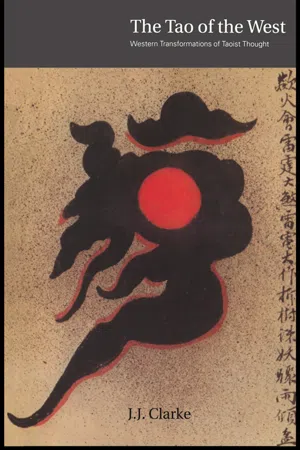
In this book, J.J. Clarke shows us how Taoist texts, ideas, and practices have been assimilated within a whole range of Western ideas and agendas. We see how Chinese thinkers such as Lao-tzu and Chuang tzu, along with practices such as Feng Shui and Tai Chi, have been used as a key Western inspiration in religion, philosophy, ethics, politics, ecology and health.
The Tao of the West not only provides a fascinating introduction to Taoism, it also offers a timely insight into the history of the West's encounter with this ancient tradition, and into the issues arising from inter-cultural dialogue. Anyone interested in understanding the key influence Taoism has had on the West will welcome and embrace this book.
- 288 pages
- English
- ePUB (mobile friendly)
- Available on iOS & Android
eBook - ePub
About this book
Information
1
‘THE WAY THAT CAN BE TOLD’
Introduction
Orientations and disorientations
The Daoist philosopher Zhuangzi tells us in a famous passage how he dreamed that he was a butterfly but, on waking, was unable to decide whether he was Zhuangzi dreaming that he was a butterfly or a butterfly dreaming that he was Zhuangzi. Has he indeed awoken, he wonders, or is he still dreaming? Can he even tell the difference? ‘There’s no telling whether the man who speaks now is the waker or the dreamer’, he muses. The sense of what is real or unreal, even the very distinction itself, becomes problematic for him. In the great transformation of things, dream and reality are endlessly confused (Graham 1981: 61, 91).
The West’s encounters with the ancient civilisation of China have often betrayed this sort of confused ambivalence. Western images of the remote kingdom of Cathay have frequently exhibited a dreamlike quality, begetting mythical visions of the lands and the traditions of China that are half real, half fantasy, exotic displacements for unconscious needs, reveries at once both disturbing and enchanting, both threateningly obscure yet also compellingly seductive. This semi-dreamworld has often had the impossibly idealised character of a Shangri-La, a spiritual utopia that sets our own unsatisfactory reality in sharp relief and which furnishes us with a mirror in which to reflect on our own shortcomings. Yet at the same time, it is a world of darksome menace summed up in portentous phrases such as ‘yellow peril’ or ‘oriental despotism’, a land of eternal stagnation that points an instructive contrast to the dynamic, progressive West. In the European mind China has long been what Zhang Longxi has called ‘the ultimate Other’, a myth and symbol of cultural difference that in various contradictory ways has reflected the West’s own inner tensions and contradictions, a dreamworld in which it has been able to enact ‘all sorts of fantasies, philosophical speculations, and utopian idealizations’ (1998: 20, 33). Even before Marco Polo’s expedition in the thirteenth century, a mythical image of China had formed in the minds of Europeans, an archetype of the exotic and fascinating. Such images were destined to be shaped and reshaped over the following centuries, and had a remarkably protean quality which, from the Renaissance onwards, not only served popular or literary needs but began to feed the West’s political, religious and philosophical imagination.1
Daoist ideas and traditions have inevitably been caught up in this volatile phantasm of China, though its importance in Chinese thought and culture has often been obscured. The commanding presence of Confucianism and its identification with the ruling orthodoxy in China has meant that we often see Daoism through Confucian eyes. It is the latter that have tended to dominate Western consciousness of China, and the comparison between the West’s perception of these two traditions is revealing. Whereas Confucianism has occupied an eminent, if frequently mythologised, place in the Western mind, in many respects the definitive symbol of Chineseness, Daoism has represented, as one scholar puts it, a ‘censured chapter of Chinese history’, or even, according to another, ‘the least understood, the most commonly ignored and maligned, of all the major religions of the world’, and according to yet another a tradition typically ‘written off wholesale as superstition…interpreted as pure religious mysticism and poetry’ (Lagerwey 1987: 274; Girardot in Schipper 1993: xvi; Needham 1956: 86).2 Where Confucianism has at various periods been rated in the West as an enlightened form of humanism, Daoism has often been dismissed as, at best, a vague if harmless nature-loving mysticism, a form of quietism, characterised by the search for inner peace at the expense of serviceable social and political precept or practical moral guidance. As a set of religious teachings, it has been associated with a number of fanciful activities such as flying though the air, living on dew, indefinitely prolonged orgasm, and the search for the elixir of immortality. Even Chinese intelligentsia have in recent times looked upon Daoism as an embarrassment and as a mark of China’s underdevelopment in relation to the West, a humiliating blemish on China’s record which must be erased in the drive towards modernisation.
There are signs that in the West we have at last begun to awaken from these jaundiced reveries. A palpable change of attitude has taken place in recent decades, one which affects not only attitudes towards Daoism but also towards China as a whole and towards the other great civilisations and belief systems of Asia. In broad terms, we have witnessed a transformation in the past century from an imperial age in which Eurocentric attitudes and values enjoyed world ascendancy, to one of profound challenge to the dominance of Western power and ideas. In the recent past there has emerged a manifestly greater openness and an enhanced permeability between the traditions of East and West which has led to an intensively critical examination of traditional Western misconceptions of the East. Hegel’s notorious pronouncement that ‘The history of the world travels from East to West, for Europe is absolutely the end of history, Asia the beginning’ (1944: 103), has certainly cast a long shadow over the West’s understanding of Eastern thought in general, and the cultural and philosophical traditions of Asia continue to be viewed by many as locked in their past, objects of little more than historical interest. Nevertheless a counter-movement has been under way for some time which has drawn Eastern ideas and practices with ever-increasing intimacy into the orbit of contemporary culture and debate, and, following the earlier emergence into favour of Hinduism and Buddhism,
Daoism has begun to penetrate Western consciousness. Daoism’s rising profile in the West is evident across a whole spectrum of domains ranging from the popular to the scholarly, from the spiritual to the philosophical. At one end of the spectrum can be observed the growing interest in such arts as taijiqan and feng-shui, and the way in which Daoist terms such as dao and yin/yang have begun to enter common vocabulary, and Daoist ideas such as ‘going with the flow of nature’ or ‘unblocking one’s energy’ have acquired fashionable cachet. We have witnessed, too, a flood of books on Daoist and related matters, whether pertaining to health, sexuality, ecology or simply the arrangement of one’s domestic furniture. Over the past few years, more than a hundred titles of the form ‘The Tao of…’ have been published, covering an extraordinarily diverse range of topics including physics, psychology, leadership, business, diet, baseball, relationships, women, Jesus, Islam, and even Muhammad Ali. It is easy to ridicule this genre as so much rubbish, and one scholar has expressed his concern that the bizarre theories that this peculiarly Western obsession has given rise to are bound to render Daoism ‘more obscure and unfathomable than before’ (Palmer 1991: 110). But this new literary fashion, along with the burgeoning interest in Daoist health techniques, represents a cultural phenomenon which tells us much about our contemporary concerns and anxieties, and is undoubtedly an expression of a growing preoccupation with self-cultivation and the quest for alternative means of personal and spiritual fulfilment. A common thread running through many of these practices and writings is the search for a religious dimension to life that goes beyond traditional organised religions and doctrines, and for a form of spirituality which offers a sense of harmony and psychological wholeness by drawing together mental, emotional and physical aspects of life. Along with a number of other movements, Daoism is proving increasingly attractive to people who seek a form of spirituality and self-fulfilment which focuses on the experience of embodied existence within the living world rather than on a transcendent world beyond, and which offers a way of discovering meaning through reconnecting human life with its roots in nature.
At the opposite end of the spectrum, there has taken place a veritable revolution in Daoist scholarship over the past fifty years or so. Since the pioneering work of Marcel Granet, Henri Maspero and Joseph Needham in the middle decades of the twentieth century, a growing band of orientalists has been engaged in the labour of translating, interpreting and commenting on the large corpus of Daoist texts, and in the detailed analysis of the intellectual and cultural evolution of Daoist ideas and institutions. This in turn has had wide ramifications, for it is largely thanks to this scholarly revolution that philosophers have now begun to give serious attention to the implications of Daoist writings, and that students of comparative religion have started to investigate Daoism as a religion of world stature. Areas as diverse as cosmology and politics, alchemy and ethics, and teachings in such fields as mysticism and meditation have all been the subject of extensive investigation, and the practice, symbolic meaning and sociological significance of the Daoist liturgical tradition have been closely investigated for the first time. Moreover, the realisation of the central and pervasive role that Daoism has played in the evolution of Chinese society has immeasurably enriched our understanding of Chinese history and culture in general.
At various points in the middle of the spectrum that spans both popular and scholarly concerns, we can also identify a whole range of academic and intellectual interests which have begun to take aspects of Daoist thinking seriously in novel ways, parallel in many respects with earlier enthusiasms for Buddhism and Hinduism. Here the driving force is not so much the demands of historical scholarship but rather the exploitation of Eastern ideas as the means for confronting and illuminating certain key contemporary issues. A number of thinkers has sought quite explicitly to draw on Daoism in this way: Martin Buber, C.G. Jung and Martin Heidegger, to mention a few distinguished examples from earlier in the twentieth century, have all engaged with Daoist ideas as a way of confronting and clarifying issues of immediate concern to them. More recently, thinkers as disparate as Joseph Needham and Fritjof Capra have pressed Daoism into the service of their own science-related projects, and more recently still American philosophers such as David Hall and Chad Hansen have begun to weave Daoist ideas into the very latest postmodernist debates. Academic philosophy’s reflection on these historical transformations has indeed been slow to materialise, and for the most part Chinese thought has been excluded from Western philosophical discourse. Nevertheless, there have been some promising signs of a widening of sympathies in the field of comparative philosophy over the past half-century, and, as we shall see, there is evidence of an increasing willingness to engage creatively with ideas from the Daoist tradition.
The aim of this book, then, is to give a broad historical and critical account of these emerging Western encounters with Daoism, tracing their historical genealogies and engaging with the range of contemporary debates that has arisen therefrom. It aims to give a picture of the overall shape of these intercultural engagements, one which is sufficiently detailed to provide a sense of their intellectual and cultural significance without burdening the reader with an exhaustive chronicle. In ‘telling the story’, I will need to examine the variety of ways in which this ancient tradition, apparently so alien and so ‘other’, has begun to enter into the spiritual and intellectual life of the West, and to become part of the complex ideological fabric of contemporary global culture. While, in the spirit of Daoism, I will avoid engaging in aggressive polemics, my aim is also to convey something of the intellectual vigour of this particular intercultural dialogue, and hence both to outline the debates that have surrounded Daoism’s entry into Western culture and to engage with the philosophical spirit of the argument where this seems called for. The very process of intercultural communication itself raises important philosophical questions such as those concerning the universality of reason, values and experience, questions about cultural difference, and broad political issues relating to Western imperialist hegemony in Asia. These along with other issues will inevitably demand attention as our historical project unfolds.
This work is primarily, therefore, a study in the history of ideas, an investigation into the actual historical passage of ideas from East to West, and into the social and cultural processes that facilitated this passage. Thus, by examining a wide selection of Western writers and movements that have explicitly engaged with Daoist thought, and by placing these within appropriate historical contexts, the book will seek to uncover the ways in which Daoism has entered Western consciousness, and to examine the methods by which ideas and texts from this ancient Chinese tradition have been selected, translated, interpreted, reconstituted and assimilated within the framework of modern Western thought.
It is also largely a study in the history of Western ideas. The interest of this book in Daoist thought, whether as an intellectual system or as a cultural phenomenon, is therefore an indirect one. Some initiation will of course be needed into the historical origins and background of this ancient tradition in China itself and into some of the basic Daoist concepts and teachings, particularly in view of the fact that they are likely to be unfamiliar to many Western readers. To this end, a brief outline of Daoist history in China is offered in Chapter 2, and at appropriate points in subsequent chapters the various elements of Daoist teaching are explained. Thus, while this book is not designed as an introduction to Daoism, it will, in the course of examining the Western assimilation of Daoism, provide the reader with a broad understanding of its history and an initiation to its teachings.
This will entail taking a wide cultural perspective on Daoism in its native land. One of the important results of recent research is that we are only now beginning to appreciate the richness, originality and extent of the Daoist contribution to Chinese culture at all levels, to its religious practice, whether public or private, to the arts of painting, poetry and landscape gardening, to the birth and development of Chinese science, to the evolution of its medical ideas and practices, to its political thought and practice. In the words of a leading French sinologist, Isabelle Robinet, Daoism:
has reabsorbed and digested, regathered and amalgamated, and preserved and organized various strands of Chinese culture…all without ever abandoning its own identity and coherence. It has thus become a constantly operating force coordinating and synthesizing Chinese traditions…[and] has impregnated all of Chinese civilization, penetrating ways of thinking in China in all kinds of ways.
(Robinet 1997: 23)
And to this should be added the influence of Daoism over the centuries on China’s neighbours – Cambodia, Korea, Japan and Vietnam – and more recently on the Chinese diaspora in Asia and beyond.3
The main target of this work, though, remains the Western appropriation of that tradition rather than Daoism in its Asian context, and this means that it must take into account recent critical debates concerning orientalist and postcolonial discourse in general. Through the writings of Edward Said and others, we have become acutely aware of the highly problematic nature of the dreamworld that Westerners have fallen into in their quest for ‘Oriental enlightenment’, and of the way in which Western knowledge of Asia, however scientific in intent, has often involved the construction of the ‘Orient’, not only as an imaginative distortion but as an ideology, as an expression and reinforcement of Western power over Asian peoples. Said has traced out important links between the discourse of orientalism in its various manifestations on the one side, and imperialism and colonial mastery on the other, making use of Foucault’s discourse analysis whereby the strategies of orientalists are seen as embedded in the whole process of discipline and control by Western colonial power. Orientalism, in its affirmation of the ideological fiction of the ‘West versus the rest’, has, according to Said, played a role in creating a Western ‘nexus of knowledge and power’ whereby ‘European culture gained in strength and identity by setting itself off against the Orient’. In broad terms, orientalism is ‘a structure erected in the thick of imperial contest whose dominant wing is represented and elaborated not only as a scholarship but as partisan ideology…[which] hid the contest beneath its scholarly and aesthetic idioms’ (Said 1985: 27, 3; Said 1989: 211).4
However, in spite of the importance of Said’s critique in enabling us to unmask some of the hidden agendas beneath the seemingly benign exterior of Western investigation of the Orient, his approach has left us with many questions. Does it, for example, perpetuate an essentialist binarism, encouraging the long-held view that East and West are absolutely distinct cultural entities, each sealed inescapably behind what Ragavan Iyer has called a ‘glass curtain’ and locked into an eternal cold war? And does Said’s argument rest too precariously on a reductive methodology which sees orientalism as explicable in the last analysis only in terms of the exigencies of colonial power? These are issues too wide-ranging to be dealt with here,5 but we shall in fact find ourselves beating a path which, though starting from a common assumption that Western ‘orienteering’ must be understood against the background of the West’s global expansion, moves in a different direction from that of Said.
This difference of direction is partly due to a recognition of the fact that, though the Western powers have wielded considerable imperial influence over China and much of the Western attitude towards that civilisation must be framed within that historical fact, the Western understanding and appropriation of Daoism cannot be theorised simply in these terms. In the first place, while it is true, as we shall see later, that the early attitudes towards Daoism were shaped in large measure by factors arising from a European missionary expansionism, Daoism featured only marginally within Western consciousness during the colonial epoch; the major thrust of Daoist studies occurred only subsequent to the main colonial period. By contrast with the Western ‘discovery’ of Hinduism, which helped both to reinforce European hegemony over India and at the same time to construct a nationalist Indian ideology, Daoism has played a much more neutral and insignificant role within the drama of imperial politics. It has neither helped to shape the mentality of colonial rulers nor been a focus of anti-imperialist struggle. The colonial mindset remains, of course, and attitudes towards Daoism still at times betray the stigma of our colonial history, but the recently emerging relationship with Daoism cannot be understood simply in terms of Western power over a passive and subjugated Orient.
Moreover, Daoism in particular and the Orient in general have often taken on the counter-hegemonic role of critic and even subverter of Western beliefs and values. By virtue of its very cultural remoteness and difference, the traditional East has often been seen to stand as an especially sharp contrast with indigenous Western traditions, in particular those that we have come to call ‘modern’, and as such it has constituted a mirror in which the West has been able to scrutinise itself in a revealing and critical light. Its role as external commentator, reminding us of the historical contingency of our own world-views, philosophical assumptions and social practices, is one which, as I suggested earlier, has a long history in orientalist discourse. One of the remarkable features associated with the West’s imperialist expansion over the past few centuries has been the way in which Western thinkers have sought, not only to appropriate and control, but energetically to advocate and privilege non-European systems of thought. While Western missionaries have struggled for centuries with only limited success to convert Asian people to the Christian faith, the West has eagerly embraced Eastern ideas and practices and has, in a sense, carried out its own counter-missionary project. It is not simply that imperial expansion has brought about awareness of a greater sense of cultural plurality and susceptibility towards otherness, but that this in turn has given stimulus to bouts of both critical self-analysis and spiritual renewal on the part of the West. From this point of view, the ‘clash of civilizations’, to use Samuel Huntington’s portentous phrase, which is often seen as a battleground of mutual animosity and incomprehension between East and West, or at worst of xenophobic and racist opprobrium, can become the building site for the creation both of an enhanced empathy and of a productive dialogue which encourages reflection on the adequacy of our own understanding and a stimulus to new thinking.
The West’s engagement with Daoism itself, though driven by Western assumptions and preoccupations, has certainly not been unequivocally oppressive or manipulative. Nor has it been the exclusive domain of Westerners. As will become evident below, the growth of Daoist interest in the West has been the product of Asian as well as Western labour, and the Daoist renaissance in the West is in some respects parallel to a renewal of interest within Asia itself. With the increasing number of Chinese, Japanese and Korean scholars involved in this work, and with the revival of Daoist practices within Chinese cultural spheres, the Daoist renaissance has now taken on an international dimension where it is difficult to separate out Asian from European interests. Moreover, co-operation between Asian and Western scholars is now commonplace, a good example of which is the conference held in Xian in October 1995 at which sixty-five delegates from China and Germany exchanged ideas concerning the Daodejing (Hoster and Waedow 1995).
In the light of factors such as these, I find myself parting company with the more reductive versions of Said’s orientalist critique. We will see that the relationship between Daoism and Western thought is too complex to be shoehorned into a simple model of Western power imposed on a passive East, or into the old binarism which constructs the East as wholly alien and other. In the course of the chapters which follow, it will be argued not only that Daoism has come to play an increasingly important facilitative role in prompting a rethinking of Western ...
Table of contents
- COVER PAGE
- THE TAO OF THE WEST
- TITLE PAGE
- COPYRIGHT PAGE
- PREFACE
- 1: ‘THE WAY THAT CAN BE TOLD’: INTRODUCTION
- 2: ‘THE MEANING IS NOT THE MEANING’: ON THE NATURE OF DAOISM
- 3: ‘CRAMPED SCHOLARS’: WESTERN INTERPRETATIONS OF DAOISM
- 4: ‘THE GREAT CLOD’: DAOIST NATURAL PHILOSOPHY
- 5: ‘GOING RAMBLING WITHOUT DESTINATION’: MORAL EXPLORATIONS
- 6: ‘THE TRANSFORMATION OF THINGS’: THE ALCHEMY OF LIFE, SEX AND HEALTH
- 7: ‘THE WAY IS INCOMMUNICABLE’: TRANSCENDENCE
- 8: ‘THE TWITTER OF BIRDS’: PHILOSOPHICAL THEMES
- 9: ‘JOURNEY TO THE WEST’: BY WAY OF CONCLUDING
- APPENDIX I: CHINESE DYNASTIC CHRONOLOGY
- APPENDIX II: WADE–GILES/PINYIN CONVERSION TABLE
- NOTES
- BIBLIOGRAPHY
Trusted by 375,005 students
Access to over 1.5 million titles for a fair monthly price.
Study more efficiently using our study tools.
Frequently asked questions
Yes, you can cancel anytime from the Subscription tab in your account settings on the Perlego website. Your subscription will stay active until the end of your current billing period. Learn how to cancel your subscription
No, books cannot be downloaded as external files, such as PDFs, for use outside of Perlego. However, you can download books within the Perlego app for offline reading on mobile or tablet. Learn how to download books offline
Perlego offers two plans: Essential and Complete
- Essential is ideal for learners and professionals who enjoy exploring a wide range of subjects. Access the Essential Library with 800,000+ trusted titles and best-sellers across business, personal growth, and the humanities. Includes unlimited reading time and Standard Read Aloud voice.
- Complete: Perfect for advanced learners and researchers needing full, unrestricted access. Unlock 1.5M+ books across hundreds of subjects, including academic and specialized titles. The Complete Plan also includes advanced features like Premium Read Aloud and Research Assistant.
We are an online textbook subscription service, where you can get access to an entire online library for less than the price of a single book per month. With over 1.5 million books across 990+ topics, we’ve got you covered! Learn about our mission
Look out for the read-aloud symbol on your next book to see if you can listen to it. The read-aloud tool reads text aloud for you, highlighting the text as it is being read. You can pause it, speed it up and slow it down. Learn more about Read Aloud
Yes! You can use the Perlego app on both iOS and Android devices to read anytime, anywhere — even offline. Perfect for commutes or when you’re on the go.
Please note we cannot support devices running on iOS 13 and Android 7 or earlier. Learn more about using the app
Please note we cannot support devices running on iOS 13 and Android 7 or earlier. Learn more about using the app
Yes, you can access The Tao of the West by J.J. Clarke in PDF and/or ePUB format, as well as other popular books in Philosophy & Eastern Philosophy. We have over 1.5 million books available in our catalogue for you to explore.