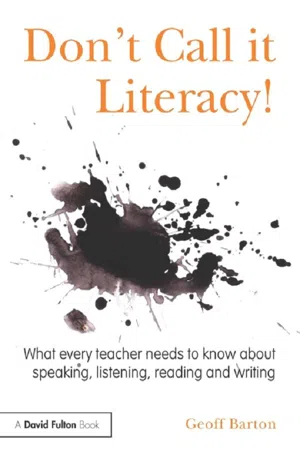
Don't Call it Literacy!
eBook - ePub

Don't Call it Literacy!

What every teacher needs to know about speaking, listening, reading and writing

  1. 190 pages
  2. English
  3. ePUB (mobile friendly)
  4. Available on iOS & Android
eBook - ePub

Don't Call it Literacy!

What every teacher needs to know about speaking, listening, reading and writing

About this book

"Every teacher in English is a teacher of English," said George Sampson, one of the early school inspectors, back in 1921. It's never been truer, or more relevant.

Literacy has a major impact on young people's life-chances and it is every teacher's responsibility to help build their communication, reading and writing skills. However, this book isn't just about literacy; it's also about what great teachers do in their classrooms, about applying knowledge consistently across classrooms, in order to help pupils to become more confident in their subjects.

This book shows every teacher – whatever your subject – the simple steps which could transform your students into better speakers, listeners, readers and writers. Harnessing a range of straightforward, but powerful techniques, it shows you how to help each student in your subject to improve their spelling, to use the key vocabulary of your subject more accurately and to speak, read and write with confidence like a historian, scientist, designer or mathematician.

The book is structured into clear sections which are then divided into short, easy-to-absorb units on the classroom implications of what we know about literacy. Don't Call it Literacy! also includes:

  • language commentaries which exemplify points made by the author;
  • talking points at the end of each unit for self-assessment;
  • a glossary for non-specialists;
  • subject specific vocabulary for building students' word power;
  • tutor time spellings lists;
  • a reading list on teaching, language, literacy and education.

Written by a leading authority in the field, this book will help both trainee and practising secondary school teachers to turn their classroom into literacy-friendly environments, increasing the motivation and achievement of their students.

Trusted byĀ 375,005 students

Access to over 1.5 million titles for a fair monthly price.

Study more efficiently using our study tools.

Information

Publisher
Routledge
Year
2012
Print ISBN
9780415536028
eBook ISBN
9781136280726

Part One Literacy Essentials

This part is designed to establish the territory: what we mean by literacy, what we should rightfully expect of every teacher, how a school might ensure consistency across every teacher in every subject in every classroom. It has been written to underpin all that follows and, in particular, to lend support to senior leaders and literacy coordinators in their role of establishing consistency of practice across and between classrooms and teachers.
Language Commentary
That word ā€˜practice’ catches a lot of people out - teachers as much as pupils. Should we use ā€˜practice’ or ā€˜practise’?
Some users (those with a secure grammatical grasp) need to be told no more than that the former usage is a noun (as in ā€˜my practice, your practice, the practice’) and the latter a verb (as in ā€˜I practise, you practise, she practises’). For many of us, that still doesn’t help a lot.
The easiest way to get it right every time is to replace ā€˜practice/practise’ in your mind with ā€˜advice/advise’, two words that we would be unlikely to use incorrectly: thus ā€˜I need to practise’ becomes self-evidently the verb form because we would say ā€˜I need to advise’ rather than ā€˜I need to advice’.

What We Know about Literacy in the Uk

DOI: 10.4324/9780203112007-1
Tales of our nation’s endemic illiteracy are frequently overstated, especially in certain newspapers. In truth, we have very little genuine illiteracy, if by that we mean people actually unable to read or write at all.
Yet for a highly developed economic country, our national literacy levels can seem alarming. It is a source of considerable surprise, for example, when we read statistics about the state of the nation’s reading and writing habits: we see how many children come from backgrounds where expectations of talking, interacting, reading and writing are so very different from what we might consider normal.
We need also, as teachers, to keep feeling angry that after eleven or more years of compulsory education in our schools, something like half of our young people come out unable to achieve a clutch of C grades at GCSE that include the basics of English and Maths. Perhaps, unlike some of our international competitors, we have too easily accepted this as an inevitable norm.
The best picture of our national literacy levels comes from the National Literacy Trust (www.literacytrust.org.uk). In 2010 they produced a comprehensive survey of UK literacy, which they called, grandly, Literacy: State of the Nation, A picture of literacy in the UK today.
Here are some of its more striking statistics of relevance to us in schools. They are followed by some questions for discussion. These might provide a useful starting-point for reflection in your school or department about the literacy levels of the pupils you work with and their attitudes and backgrounds.
Literacy levels in the UK:
  • One in six people in the UK struggle with literacy. This means their literacy is below the level expected of an eleven year old.
Attitudes towards reading and writing:
  • 22.2% of young people aged eight to sixteen say they enjoy reading very much and 28.4% say they enjoy it quite a lot. 39.2% say they like it a bit and 10.2% say they do not enjoy reading at all.
  • 66% of adults believe that the ability to read, write and communicate is a fundamental right in modern society.
  • 92% of the British public say literacy is vital to the economy, and essential for getting a good job.
  • A quarter of children and young people do not recognise a link between reading and success.
  • Children and young people who engage in technology based texts, such as blogs, enjoy writing more and have more positive attitudes towards writing - 57% express a general enjoyment of writing vs. 40% who don’t have a blog.
  • There is a consistent gender difference in attitudes towards writing. Boys do not enjoy writing as much as girls (38% vs. 52%), either for family/friends or for schoolwork and are more likely to rate themselves as ā€˜not very good writers’ (48% vs. 42%).
  • Technology based materials are the most frequently read, with nearly two-thirds of children and young people reading websites every week, and half of children and young people reading emails and blogs/networking websites (such as Bebo, MySpace) every week.
Reading and writing frequency:
  • 73% of parents and carers say their child often reads.
  • Age is closely linked to attitudes towards reading and reading behaviour. 30% of five to eight year olds read a book every day compared with only 17% of fifteen to seventeen year olds. However, teenagers are more likely to read other materials such as blogs, websites and newspapers.
  • 14% of children and young people in lower income homes rarely or never read their books for pleasure.
Parents reading with their children:
Talking Points
  • So how does the national picture for the UK compare with what you know of the pupils who come to your school?
  • For pupils coming from backgrounds where conversation, reading and writing are sporadic and perhaps impoverished, what first impressions does your school give of an attitude to talking, reading and writing?
  • What do you know of the attitudes of your pupils and parents to, say, reading and writing? How could you find out more?
  • How might a survey of pupils’ attitudes help to develop further your school or department’s approach to the promotion of reading and writing?
  • Parents are the most important reading role models for their children and young people. 71% of young people say that their mothers are their most important role model for reading and 62% say their fathers
  • One in five parents easily find the opportunity to read to their children, with the rest struggling to read to their children due to fatigue and busy lifestyles. Of the parents that read to the children, 67% are mothers compared to just 17% of fathers.
  • Recent research has shown that the likelihood of fathers reading to their children is linked to their socio-economic background. Fathers with higher incomes are more likely to read to their children, for example, 21% of dads in Ā£40-50k income homes are the principal reader, compared to just 11% in homes with an annual income of Ā£10-15k.

How Much Does a Teacher of Any Subject Need to Know about Literacy?

DOI: 10.4324/9780203112007-2
George Sampson was an educational guru in the days before ā€˜guru’ had been poached from its Hindu origins (meaning a spiritual guide) to be used blandly in sentences such as ā€˜George Sampson was an educational guru’.
Sampson was also one of the first school inspectors. Despite that, we forgive him, because in 1921 he wrote something which has become a literacy mantra (another word loan from Hindi, by the way): ā€˜Every teacher in English is a teacher of English’ (English for the English , Cambridge University Press, 1921). You won’t find a literacy consultant who doesn’t quack that, probably rather too frequently.
But it is sometimes presented as if we need all of our teachers to be experts in teaching spelling and grammar. We don’t. But we do need teachers who are themselves confident communicators, readers and writers and who can then - critically - take the skills they implicitly use and make them explicit to their pupils.
That’s essentially the approach in this book - the assumption that, whatever our subject specialism, as teachers we are members of what we might call the ā€˜Literacy Club’. Even the most linguis-tically insecure of us will be competent readers and writers. Our job is to help our pupils to acquire such competence and turn it into confidence.
Thus, as a teacher of, say, History, I have a responsibility to help my pupils not just to know about history, but to speak, read and write like a historian.
That will involve having some specialist knowledge - for example, the conventions of historical writing and of the ways that historians themselves write about history. But more important will be an analytical self-awareness, which allows us to identify how we speak, read and write about history so that those skills can then be made explicit for our youngsters.
In this approach teachers’ literacy responsibilities are akin to an apprenticeship model: we are passing on the skills from an older generation to a younger one, and, as I argue throughout this book, that is best done through a process of demystifying what we do - explaining, demonstrating, modelling, teaching and giving feedback. It’s the stuff of teaching - the things great teachers do in their subjects all the time. Now it’s time to make our literacy expertise more explicit for our pupils.
Later parts of the book explore some of the specific knowledge associated with teaching ways of reading and types of writing. For now I am concerned with what we might term generic skills - the kind of skills and knowledge we should expect of every teacher in every subject. These, I would suggest, ought to form part of a school’s core expectations of its teachers and teaching assistants and be embedded in induction, training and performance management.

Twelve Generic Areas of Literacy Every Teacher Should Know

To demystify talk:
  • Being aware of what works in teacher talk and what doesn’t: thereby talking less, giving better explanations, asking better questions, and resisting some of the clichĆ©s of teacher talk (always relying on hands up, asking closed questions, not giving thinking time, commenting on each answer).
  • Understanding the difference between social, exploratory and presentational talk.
  • Using a variety of groupings for structured talk - pairs, same-sex, friendship groups, by ability, by interest, random.To demystify reading:
  • Knowing how to use layout and language to make texts accessible in handouts and in presentations - e.g. white space, typographical features, summaries, bullets, short paragraphs.
  • Providing assessment criteria and models of appropriate text types.
  • Setting objectives for talk and providing language models - e.g. level of formality, key words and phrases.
  • Using a range of strategies to support pupils’ reading - e.g. reading aloud, key words and glossaries, word banks, display, paired reading, talking about texts before answering.
To demystify writing:
Talking Points
  • So which of these do you do most and least?
  • Which do you need to learn more about?
  • Which do you most strongly agree with and disagree with?
  • Being able to write accurate, clear English, and knowing the essential ingredients in well-written prose.
  • Being clear and explicit about the conventions of the writing you expect from pupils - e.g. audience, purpose, layout, key words and phrases, level of formality.
  • Knowing approaches for actively teaching writing skills - such as shared composition, modelling the writing process and judicious use...

Table of contents

  1. Cover Page
  2. Half Title Page
  3. Title Page
  4. Copyright Page
  5. Dedication
  6. Table of Contents
  7. Introduction: why literacy matters
  8. Part one: literacy essentials
  9. Part two: speaking and listening
  10. Part three: reading
  11. Part four: writing
  12. Appendices
  13. Subject-by-subject spelling lists
  14. Week-by-week spellings
  15. Reading list
  16. Afterword
  17. Index

Frequently asked questions

Yes, you can cancel anytime from the Subscription tab in your account settings on the Perlego website. Your subscription will stay active until the end of your current billing period. Learn how to cancel your subscription
No, books cannot be downloaded as external files, such as PDFs, for use outside of Perlego. However, you can download books within the Perlego app for offline reading on mobile or tablet. Learn how to download books offline
Perlego offers two plans: Essential and Complete
  • Essential is ideal for learners and professionals who enjoy exploring a wide range of subjects. Access the Essential Library with 800,000+ trusted titles and best-sellers across business, personal growth, and the humanities. Includes unlimited reading time and Standard Read Aloud voice.
  • Complete: Perfect for advanced learners and researchers needing full, unrestricted access. Unlock 1.5M+ books across hundreds of subjects, including academic and specialized titles. The Complete Plan also includes advanced features like Premium Read Aloud and Research Assistant.
Both plans are available with monthly, semester, or annual billing cycles.
We are an online textbook subscription service, where you can get access to an entire online library for less than the price of a single book per month. With over 1.5 million books across 990+ topics, we’ve got you covered! Learn about our mission
Look out for the read-aloud symbol on your next book to see if you can listen to it. The read-aloud tool reads text aloud for you, highlighting the text as it is being read. You can pause it, speed it up and slow it down. Learn more about Read Aloud
Yes! You can use the Perlego app on both iOS and Android devices to read anytime, anywhere — even offline. Perfect for commutes or when you’re on the go.
Please note we cannot support devices running on iOS 13 and Android 7 or earlier. Learn more about using the app
Yes, you can access Don't Call it Literacy! by Geoff Barton in PDF and/or ePUB format, as well as other popular books in Education & Education General. We have over 1.5 million books available in our catalogue for you to explore.