eBook - ePub
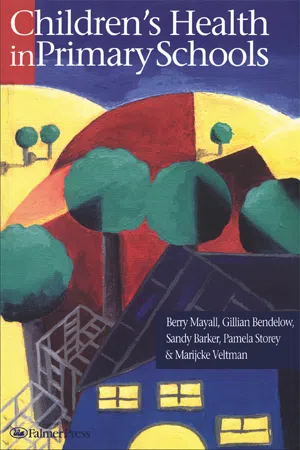
Children's Health In Primary Schools
- 240 pages
- English
- ePUB (mobile friendly)
- Available on iOS & Android
eBook - ePub
Children's Health In Primary Schools
About this book
Argues the need for schools to examine the school environment and its effects on children's and staff's well-being.
Information
Part I
The Survey
1 The Survey
This part of the book details and discusses the results from the first stage of the project, the survey data collected by a postal questionnaire in the autumn of 1993. The questionnaire was sent to 1031 schools, a one in twenty sample of the approximately 20,000 schools listed in the Primary Education Directory 1993 and representing each LEA in England and Wales. Questionnaires were sent out at the beginning of November 1993 and were addressed to the headteacher. The total number of replies was 620, giving an overall response rate of 60 per cent, (61 per cent from England, 52 per cent from Wales). Although the response rate varied by LEA, the sample included schools from all parts of England and Wales. When compared with data from other sources, the survey schools are seen to be broadly representative of primary schools in England and Wales with regard to age-range, size of school, and denominational status.
The questionnaire covered aspects of the physical environment, health education, health maintenance, issues relating to food and exercise, how accidents and illness were dealt with by the school and the role of the school health service. The questionnaire also invited respondents to comment on the particular strengths and weaknesses of their school and over three-quarters of respondents provided these additional comments. (For more detail of the method, and the questionnaire, see Appendix 1.) In all the tables shown, ‘N’ denotes the base number used to calculate percentages.
The Schools: Environments and People
The first base-line set of topics we aimed to describe concerned the type of area served by the school, the age-range, the numbers of children and staff-child ratios. These topics are the ones we found most useful for analysis purposes, to identify differences between schools.
Location
We asked about the type of geographical catchment area the schools served, using categories of inner city, city, large town, small town and rural.
Table 1.1: Location of survey schools (%)
Table 1.2: Age-range of survey schools (%)
For purposes of analysis, in most cases, we have put together City and Large Town. So our sample fell into four categories, described as inner-city, city (31 per cent), town and rural.
In selecting our case-study schools, area was one factor. The final choice included an inner-city school (City), two schools in large town areas (County and Town), a school in a small town (North), one in a rural area (Village), and another sited rurally between two villages (Infant).
Age-range
Most schools catered for the whole primary age-range (4/5–10/11 years). A quarter dealt with the lower age-range of between 4 and 5 and up to 7, 8 or 9. However 12 per cent were junior (7–11) and a further 2 per cent (10) were middle schools (8–12/13). For analysis purposes the junior and middle schools, which cater for the older section of the age-range, have been put together. Three main categories have been devised from the data:
Although this study is concerned only with school-age children, we asked, for descriptive purposes, whether schools had a nursery class. Overall, 27 per cent of the survey schools had at least one nursery class. These were less common in rural schools, where only 13 per cent reported a nursery class compared with 53 per cent of the inner-city schools.
Our case-study schools included three primary schools (City, Town and Village) an infant school (Infant), and two junior schools—North and County (the latter had until recently been a middle school).
Number of Children
The survey schools ranged widely in size from 7 through to 600 children. There were marked differences in numbers according to the location of school. Thus 52 per cent of rural schools had fewer than 100 pupils compared to only 8 per cent of inner-city schools. Whereas 27 per cent of inner-city and 31 per cent of city schools had over 300 children, only 4 per cent of the rural schools were this large. (See Table A2.1)
Table 1.3: Numbers of children in survey schools (%)
Virtually all the survey schools (99 per cent, or all but six) were mixed and 98 per cent were maintained schools. By denomination, 66 per cent were nondenominational, 24 per cent were Church of England, 9 per cent were Roman Catholic and 1 per cent were of other denominations—two non-conformist (United Congregational) and three Church of Wales.
One of the topics we wished to pursue in more detail in the case-studies was relationships between the size of the school and the health-care systems in place. So numbers of children was one factor determining our choice of case-study schools. Village had just over 100, and Infant 150 children, Town, City and North had over 300, and County, the largest, had over 500 children.
Staff-Child Ratios
Just as we shall see that sheer numbers of children in the school affects many aspects of the service offered, so too adult-child ratios are critical. The ratio of adults to children in school is one indication of the schools’ ability to give the children good care. We asked for numbers of teaching staff (full-time or part-time) and numbers of non-teaching staff. In order to keep the questionnaire manageable for respondents, and in order to maximize responses, we enquired only about numbers of adults, not about what proportion of a full-time job they did. Consequently, the data on staff-child ratios must be treated with some caution, since we count here all adults on the staff, not full-time equivalents. However, we also know from our case-studies that many part-timers habitually spend longer hours on the premises. Probably, the broad picture is representative of staff-child ratios. The full break-down is given in Table A2.2
Generally, as might be expected, the smaller the school, the better the teacher-child ratio; of schools with fewer than 100 children 48 per cent had under fifteen children per teacher, compared to 9 per cent of schools with 100+ children, and 2 per cent of those with 200+ children. The majority of schools with over 100 children had a ratio of twenty to twenty-four children per teacher: 50 per cent of schools with 100+ and 57 per cent of schools with 200+ children. In the biggest schools, ratios were the highest: 23 per cent of schools with over 300 children had a ratio of twenty-five or more children per teacher.
By location, rural schools had the lowest ratios, and inner-city and city schools had lower ratios than schools in the large and small towns. Presumably rural schools have fewer children in each age band. One explanation for the favourable city ratios is higher allocation of staff for special needs children, and for linguistic minority children, as indeed we found at City school.
Table 1.4: All staff-child ratios in survey schools (%)
We asked about other staff: all paid non-teaching staff, including secretaries, caretakers, classroom helpers, playground and dinner supervisors, special needs support. Again, this was a head count, rather than a full-time equivalent (FTE) count. Table A2.2 shows that on this basis the most favourable ratios were reported from rural schools.
In line with our interest in how many adults overall were available to take a share in caring for the children, we put together all teaching and non-teaching staff in order to consider staff—child ratios:
It can be seen that children’s opportunities for contact with staff varied widely, with 19 per cent of children competing with up to six others, and 12 per cent at the other extreme competing with 13 or more.
Location was important and the most striking percentages are consistent with the points made above. Rural children did best: two-thirds reported ratios of up to nine children per adult, with 40 per cent reporting ratios of 1–7. Almost half the inner-city schools also reported nine or fewer children per adult.
Finally, on this front, we looked at all staff-child ratios by the size of the school. This confirms the point that the smaller the school the better a child’s chances of adult attention; 70 per cent of schools with under 100 children had one member of staff to a maximum of seven children. This favourable ratio was current in only 19 per cent of schools with 100–199 children and only 1 per cent of those with more than 200 children. At the other end of the scale, only 1 per cent of the smaller schools had fourteen or more children per adult, but in 20 per cent of the largest schools, this was the situation.
We enquired whether respondents thought the school was well staffed in terms of numbers and types of staff, as regards the maintenance and promotion of children’s health. Generally, schools were positive on both counts, with 70 per cent and 76 per cent respectively reporting their staffing as good. Only 7 per cent gave a poor rating for numbers of staff, and only 2 per cent a poor rating for types of staff. There were no significant differences by the size of the school. But staff-child ratios were significantly lower in those reporting their staffing as very good (mean 9.6:1) compared with those reporting it as poor or very poor (12.1:1). Since 1993–94 when the survey took place, there has been very great media concern about rising class sizes. For instance a Guardian report (25 October 1995) reported 7.4 per cent and 11 per cent rises in classes of thirty-one or more and thirty-six or more respectively for the year 1995–96.
However, it was generally the case that respondents praised the school and the staff as providing a caring environment for the children. It is almost axiomatic that staff regard this as a central function of primary school. Thus in the last section of the questionnaire, where we invited comments on the strengths of the school, the principal topic mentioned—40 per cent of comments—was the caring and committed staff:
Caring staff who make the best of the situation.
Just a caring environment, which we constantly promote.
Unpaid Help
In addition to paid staff, we asked whether schools received any regular unpaid help, under four categories: classroom work, school trips, swimming and any other help. Most schools reported some unpaid help in the classroom (88 per cent) and on school trips (87 per cent); fewer (57 per cent) reported help with swimming and 30 per cent reported a wide range of other regular unpaid help, mainly with cookery, craft and the library, but also with fundraising, administration, DIY and building maintenance. A minority (20 per cent) of schools reported help in all four categories, 41 per cent recorded three and 26 per cent two categories. Eight per cent reported help in only one area and 6 per cent either had no help or missed the question.
It is consistent with these findings that those schools with a parents’ organization were more likely to have unpaid help in the school. Most schools (84 per cent) reported a Parent Teacher Association (PTA) or similar association. Slightly higher proportions of Church of England schools (90 per cent) had PTAs, compared to 82 per cent of non-denominational and 79 per cent of the Roman Catholic schools. In total, 22 per cent of schools with a parents’ association (but only 8 per cent of other schools) were getting regular unpaid help with all four tasks. By denomination, the Church of England schools reported slightly more help than the other denominational or non-denominational schools; 26 per cent reported help in all four categories.
Comments
This section has described some important aspects of the wide range of circumstances in which children spend their days in primary school. Schools across England and Wales, sited in a range of locations, varied widely in the numbers of children, in the age-range children would meet and live with, and in the chances children had of adult attention. The extent to which schools can get help from parents and other local people also varies and, as our case-studies suggest, there are many relevant factors: for instance, the strength of the local community (as at Village); the social and psychological damage suffered by parents in areas of high unemployment (North); the recognition by the school of the need to use a range of ways of attracting parents from a range of ethnic cultures (City); the extent to which local people are willing and able to help the school financially as well as socially (County). The data reported on in this section is, unfortunately, rather loaded with numbers and numerical comparisons. We have given the information in some detail in order to point to the range and, ultimately, inequalities of children’s experience at school.
2 The School Buildings and Playspace
Comments made by schools about their physical environment painted some starkly contrasting images:
We have a beautiful building and a very calm safe environment. We have a little wood, a playing field and a wild garden as well as a playground. All our equipment is new and up to date. (Post-1965 city primary school with 200 pupils)
It is old, damp and has restricted space both within classrooms and in terms of playground space. Apart from playground markings there is no play equipment in the playground. (Pre-1875 town primary with 180 pupils)
Perhaps the most striking feature of the primary school as a context for children’s daily life is the huge range in the character and quality of the buildings and playspace.
Age and Type of School Building
We were interested in how staff assessed the school building as a health-related environment for the children and we tried to identify the character of the building by asking about its age and type. The answers probably give a broad picture of character, although, as respondents noted, many schools had grown ‘organically’ and comprised a range of buildings dating from different periods. As one small town school in the south-west writes:
The school buildings have been ‘knocked through’ over the last 50 years to provide access and accom...
Table of contents
- Cover Page
- Title Page
- Copyright Page
- List of Tables
- List of Figures
- List of Colour Plates
- Acknowledgments
- Foreword
- Introduction
- Part I: The Survey
- Part II: The Case-studies
- Part III: The View from the Children
- Part IV: Discussion
- Bibliography
Trusted by 375,005 students
Access to over 1.5 million titles for a fair monthly price.
Study more efficiently using our study tools.
Frequently asked questions
Yes, you can cancel anytime from the Subscription tab in your account settings on the Perlego website. Your subscription will stay active until the end of your current billing period. Learn how to cancel your subscription
No, books cannot be downloaded as external files, such as PDFs, for use outside of Perlego. However, you can download books within the Perlego app for offline reading on mobile or tablet. Learn how to download books offline
Perlego offers two plans: Essential and Complete
- Essential is ideal for learners and professionals who enjoy exploring a wide range of subjects. Access the Essential Library with 800,000+ trusted titles and best-sellers across business, personal growth, and the humanities. Includes unlimited reading time and Standard Read Aloud voice.
- Complete: Perfect for advanced learners and researchers needing full, unrestricted access. Unlock 1.5M+ books across hundreds of subjects, including academic and specialized titles. The Complete Plan also includes advanced features like Premium Read Aloud and Research Assistant.
We are an online textbook subscription service, where you can get access to an entire online library for less than the price of a single book per month. With over 1.5 million books across 990+ topics, we’ve got you covered! Learn about our mission
Look out for the read-aloud symbol on your next book to see if you can listen to it. The read-aloud tool reads text aloud for you, highlighting the text as it is being read. You can pause it, speed it up and slow it down. Learn more about Read Aloud
Yes! You can use the Perlego app on both iOS and Android devices to read anytime, anywhere — even offline. Perfect for commutes or when you’re on the go.
Please note we cannot support devices running on iOS 13 and Android 7 or earlier. Learn more about using the app
Please note we cannot support devices running on iOS 13 and Android 7 or earlier. Learn more about using the app
Yes, you can access Children's Health In Primary Schools by Sandy Barker,Gillian Bendelow,Berry Mayall,Pamela Storey,Marijcke Veltman in PDF and/or ePUB format, as well as other popular books in Education & Education General. We have over 1.5 million books available in our catalogue for you to explore.