Systematic support for improving education and learning in further and higher education has moved to centre stage in recent years- a phenomenon reflected in the booming membership of professional development bodies.
This title complements the authors' introductory Guide to Staff and Educational Development, also in this series. This book provides a more detailed consideration of the fundamental issues in staff and educational development, analysing the context in which it functions, the roles undertaken by practitioners and ways in which staff and educational development can be promoted and managed at senior and institutional levels, as well as for individuals.
Written in an engaging, accessible style, it is rooted in practice with a wealth of case study material and practical advice. The book covers areas such as:
* how professionals learn and develop
* developing institutional policy and strategy for development
* leading an educational development unit
* programmes in learning and teaching in higher education
* areas of specialist expertise
* career pathways
Enhancing Staff and Educational Development combines the insights of seasoned developers with the innovations of new developers, and will be a compelling read for anyone dedicated to the improvement of teaching and learning.
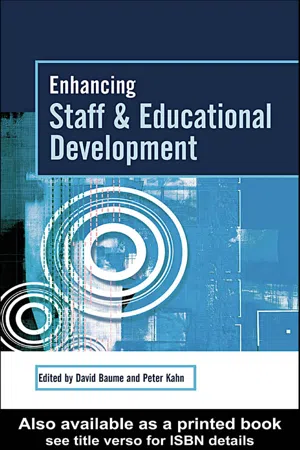
- 224 pages
- English
- ePUB (mobile friendly)
- Available on iOS & Android
eBook - ePub
Enhancing Staff and Educational Development
About this book
Information
1
Locating educational development: identifying and working with national contexts, policies and strategies
George Gordon
INTRODUCTION
In Chapter 10 of A Guide to Staff and Educational Development (2003), the companion volume to this book, Diana Eastcott and Neill Thew illustrate from their personal experiences how staff and educational developers, or as they are sometimes called academic developers – hereafter often called, for brevity, developers – have worked creatively with national agendas.
This chapter explores the framing, designing and provision of staff and educational development from the perspective of national contexts, policies and strategies. Later in the chapter reference is made to the knotty issue of how these are translated into meanings which resonate within institutions and departments/subject groupings and with individual practitioners.
BACKGROUND
Staff and educational development have a substantial and complex history. At the local level the level of institutions, there is considerable variation in detail, e.g. remit, staffing, location, resourcing, management and priorities. Such variety would imply that local policies, strategies and issues are dominant, determining arrangements and dictating outcomes. In large measure that deduction is valid, although often there has been filtering through the complex, often unrecorded, lenses of localized and cosmopolitan traditions of expectations and practice. Additionally, developments have always been open to external influences. Indeed, notwithstanding the resistance within the academy to externally-driven agendas, these have figured prominently in the historical evolution of staff and educational development.
For example, provision at the University of Strathclyde dates from studies in the 1960s and early 1970s into the preparation of new lecturers for their roles as university teachers. That led to the appointment of a single individual, Dr Alex Main, who held the post of Adviser in Educational Methods. Supported actively by the Principal and Vice-Chancellor, he drove forward a series of developments over a decade and a half. A different phase at Strathclyde commenced in 1987 with the creation of the Centre for Academic Practice, with myself as founding Director.
Another illustration of complex influences can be found in the USA, where student, faculty and public concern about the preparation of graduate teaching assistants has resulted in the widespread development of dedicated programmes of preparation and indeed, a number of specialist centres. Whilst some argue that the position of teaching can be understated in research universities, those are the institutions which tend to make the greatest use of postgraduate tutors, otherwise known as graduate teaching assistants (GTAs), to release faculty from some teaching to enable them to dedicate more time to research, and they feature prominently in the provision of GTAs.
Handling procedures for the evaluation of student feedback provides another illustration of what might be described as a climatically determined role for development. Not all centres have the role, and many which have it often find that it is something of a mixed blessing, but until recent developments in managed learning environments, the development centre was often viewed both as the source of relevant expertise on student evaluation and the logical base for the operation of the procedures.
FRAMING THE DISCUSSION
Much could be written on the way in which the national context can, does and should help to shape local provision. It is important, however, first of all to highlight a number of key issues that help to frame this discussion. In particular, we focus on six aspects.
First, within institutions, staff and educational development are generally expected to serve the needs and priorities of three constituencies, namely: the institution, disciplines/subjects, and individuals. The latter will always include staff, invariably academic staff, increasingly research, academic-related and analogous, and occasionally other groups or grades of staff, depending upon the locus and remit of the particular provision. Sometimes direct involvement with students is excluded from the remit, although even in such situations they can be accessed via departments, e.g. through curriculum design or assessment projects. Whilst it is difficult to cite substantive statistical evidence, the trend has been towards greater involvement in aspects of the learning experience of students. The reasons for this will be discussed later in this chapter, particularly under ‘Widening participation and massification’.
Second, and directly related to the foregoing, development is generally classed as an academic service. Serving the needs of others is a motivating and honourable activity, and it has permeated much of the thinking and operational practice of development practitioners. A dilemma, or at least tensions, can occur when key members of the ‘served’ constituencies place particular, and restrictive, interpretations upon the nature of the academic service. In a nutshell, the debate frequently pivots around arguments by managers and/or other internal voices that developers should primarily, even exclusively, function as ‘locals’, focused upon serving internal needs. It would generally, if sometimes reluctantly, be acknowledged that developers must be given developmental opportunities and support. The principal bone of contention tends to surround the extent to which developers should become ‘cosmopolitans’, i.e. recognized national and international experts and practitioners and the proportion of their time which should properly be devoted to such activities. Suffice to say that there is no simple solution which will please all parties. The issue resurfaces in the section below on working with national contexts.
Third, as Land (2003) discovered in his research, staff and educational developers hold differing orientations to their work and role. Land identified 12 orientations, namely:
- managerial;
- political strategist;
- entrepreneurial;
- romantic;
- vigilant opportunist;
- researcher;
- professional competence;
- reflective practitioner;
- internal consultant;
- modeller-broker;
- interpretative–hermeneutic; and
- discipline-specific.
Each orientation favours a particular operational focus. Each also colours the preferred strategy and approach. Combinations of orientations can, and do, occur, especially amongst those inclined to strategic matters. Some orientations represent a strong personal preference about the approach to the task, such as the orientation to work as an internal consultant or to promote the ethos and practice of the reflective practitioner. If you espouse that orientation, others certainly tend to expect it to be axiomatic that you model it in your practice. Of course, that is true of each orientation, but the crucial, and easily overlooked, factor is that what is being modelled differs, sometimes greatly. You may find it helpful to bear Land’s orientations in mind as you read through the following discussion about national contexts, policies and strategies. Which of Land’s orientations do you think will be most effective in working on which national agendas?
Fourth, the preceding points infer that staff and educational (academic) development is concerned with helping people, disciplines and institutions to reflect, evaluate and improve or as Gosling and D’Andrea (2002) have argued, to manage change: ‘You can’t be in the business of educational development without also being committed to bringing about change’ (p. 1).
They sought to frame their research in terms of three strategies for change:
- power/coercive strategies;
- rational–contractual strategies; and
- normative–re-educative strategies.
They deduce that many developers favour normative-re-educative strategies which build upon a winning hearts and minds philosophy and endeavour to work within institutions on the basis of commitment and involvement, and seeking to utilize the interests and engagement of individuals. Much has been written on that vein of argument. It has the considerable merits of going with the grain of academia, although it often can be problematic to achieve up-scaling/wider dissemination and uptake.
Fifth, everyone involved in staff and educational (academic) development is committed to the work, convinced of its importance and can cite examples of successes and achievements. However, as in so many areas of educational practice, it can be quite difficult both to document improvements and, more particularly, to attribute these exclusively to specific interventions or actions.
Finally, in pursuing change, developers need to become adept at distinguishing trend from fad, substance from fashion – not easy tasks. Predicting which current enthusiasms are fads and which have a longer future in a medium with a life as long as a book is a sure way to being proven wrong, but I am reasonably confident that the professionalization of teaching in higher education, in some form or another, is here to stay, and that the use of technology to support learning will increase. It is hard to be as confident in predicting government policies and enthusiasms.
National contexts
In the opening chapter of the second edition of Academic Tribes and Territories (Becher and Trowler 2001), the authors highlight nine macro-sets of influences upon academic cultures, namely:
- the post-industrial environment;
- the globalized landscape;
- massification;
- the relationships between academia, government and industry;
- marketizing knowledge;
- economy, efficiency and effectiveness;
- patterns of growth and fragmentation;
- changing landscapes; and
- shifting academic territories.
Staff and educational developers need to be aware of paradigm shifts in disciplines and ongoing changes in the production of knowledge and sensitive to different academic discourses. That is assisted where there is an academically-based cluster of developers within an institution and/or strong collaborative links exist with faculties/schools and departments/disciplines. That said, it is difficult to be knowledgeable of every nuance, especially in situations of rapid change or considerable internal academic turmoil. Yet such conditions often foster the greatest sensitivities, when developers can, unwittingly, be perceived by individual academics as favouring a viewpoint which they oppose.
Currently there is an extensive array of topics which could legitimately be covered in a discussion of national contexts, policies and strategies. For practical purposes the primary focus will be upon the situation in the UK, although many of the initiatives and issues affect other systems of higher education. The ten topics which I have chosen for more detailed discussion in this chapter are:
- the changing scene in relation to quality assurance, assessment and audit;
- widening participation;
- massification;
- the influence of the Learning and Teaching Support Network (LTSN) and the Institute for Learning and Teaching in Higher Education (ILTHE);
- enhancement initiatives promoted by the funding bodies;
- research policies;
- borderless education and e-learning;
- the increasing emphasis upon the learning experience of students;
- specific legislation.
Before turning to that imposing list, five further points should be borne in mind.
First, there can be, and have been, significant differences, even divergences, between the responses to various aspects of the changing scene by institutional managers, individual academics and developers.
Second, considerable variation exists within the system, largely based upon institutional mission and tradition.
Third, developers can, and do, access external support, as well as building internal bridges and partnerships. Some sources of external support are well-established such as the Staff and Educational Development Association (SEDA), others are newer, e.g. LTSN, ILTHE and the Association for Learning Technology (ALT).
Fourth, as the range of influences and the sources of support increase, there is the consequential dangers of ‘noise’ or overlap, which busy academics can readily criticize. Whilst the World Wide Web appears to offer a solution, ‘it is only a click away’, that can often prove untrue and frustrating and lead to tensions and criticisms.
Fifth, in the climate where some academics fear that external agendas are impinging too closely upon their academic identities, developers need to pay a great deal of attention to the way they phrase arguments for change. Perhaps the appropriate prayer for developers is: ‘Please don’t let them shoot the messenger’. However, that highlights crucial questions, such as whether, when and how to act as the messenger?
TEN AREAS OF NATIONAL CONTEXTS/POLICIES/STRATEGIES
With these points in mind, the remainder of this chapter explores the ten areas of national contexts/policies/strategies identified above. Most are UK wide, but some apply primarily or solely to institutions covered by a specific Funding Council. The order of treatment is a personal preference rather than a strictly chronological one, although there is a broad pattern of deviation and scale of impact upon developers. Throughout the ten areas runs the thread of potential as against actual impact. A degree of post-hoc rationalization and coherence could be introduced by marshalling everything within the Learning and Teaching Strategy or Enhancement Strategy which institutions are required to submit to their respective Funding Council. However to do so would in my view conceal traditions which exist in institutions and the tensions or messiness (Newton 2002) which are strong features of practice on the ground.
Quality assurance and audit
Reference is made in the Interim Report of the Teaching Quality Enhancement Committee (2002) to the fact that many participants in the focus groups drawn from across the academic community commented that the work of Quality Assurance Agency for Higher Education (QAA), and its predecessors, whilst not universally welcomed, had led to the enhancement of practice within institutions. Those views echo the research by Brennan (1997, 2000) that learning from assessment (and audit) had occurred.
Elsewhere I have observed that:
At the level of the department or course team, effective learning and enhancement involves welding together individual commitment, professionalism, expertise and creativity in a coherent and explicit manner, which can be communicated effectively to students (actual and prospective), assessors, external assessors, internal reviewers and other interested parties.
(Gordon 2002: 215)
Viewed from the bridge (the perspective of senior management), the challenges may be to improve institutional performance, as measured by the external report, and/or improve practices and enhance the student experience and/or purposefully contribute to the institutional strategy and culture. Individual
practitioners are influenced by other factors such as their professional desire to do a good job, concerns abo...
Table of contents
- Cover Page
- Title Page
- Copyright Page
- Notes on the editors and contributors
- Foreword
- Introduction – An overview of enhancing staff and educational developmennt
- 1. Locating educational development: identifying and working with national contexts, policies and strategies
- 2. Developing Institutional Policy And Strategy For Academic Development: How Can Senior Management And Educational Development Units Work Productively Together?
- 3. Leading An Educational Development Unit
- 4. Leading Programmes In Learning And Teaching
- 5. Writing For Development
- 6. The Impact Of Staff Development Programmes And Activities
- 7. Investigating Staff And Educational Development
- 8. How Do Professionals Learn And Develop? Implications For Staff And Educational Developers
- 9. Careers Within Staff And Educational Development
- 10. Development And Beyond
- 11. How Shall We Enhance Staff And Educational Development?
Trusted by 375,005 students
Access to over 1.5 million titles for a fair monthly price.
Study more efficiently using our study tools.
Frequently asked questions
Yes, you can cancel anytime from the Subscription tab in your account settings on the Perlego website. Your subscription will stay active until the end of your current billing period. Learn how to cancel your subscription
No, books cannot be downloaded as external files, such as PDFs, for use outside of Perlego. However, you can download books within the Perlego app for offline reading on mobile or tablet. Learn how to download books offline
Perlego offers two plans: Essential and Complete
- Essential is ideal for learners and professionals who enjoy exploring a wide range of subjects. Access the Essential Library with 800,000+ trusted titles and best-sellers across business, personal growth, and the humanities. Includes unlimited reading time and Standard Read Aloud voice.
- Complete: Perfect for advanced learners and researchers needing full, unrestricted access. Unlock 1.5M+ books across hundreds of subjects, including academic and specialized titles. The Complete Plan also includes advanced features like Premium Read Aloud and Research Assistant.
We are an online textbook subscription service, where you can get access to an entire online library for less than the price of a single book per month. With over 1.5 million books across 990+ topics, we’ve got you covered! Learn about our mission
Look out for the read-aloud symbol on your next book to see if you can listen to it. The read-aloud tool reads text aloud for you, highlighting the text as it is being read. You can pause it, speed it up and slow it down. Learn more about Read Aloud
Yes! You can use the Perlego app on both iOS and Android devices to read anytime, anywhere — even offline. Perfect for commutes or when you’re on the go.
Please note we cannot support devices running on iOS 13 and Android 7 or earlier. Learn more about using the app
Please note we cannot support devices running on iOS 13 and Android 7 or earlier. Learn more about using the app
Yes, you can access Enhancing Staff and Educational Development by David Baume,Peter Kahn in PDF and/or ePUB format, as well as other popular books in Education & Education General. We have over 1.5 million books available in our catalogue for you to explore.