The Iraq War and Democratic Politics contains the work of leading scholars concerned with the political implications of the Iraq War and its relationship to and significance for democracy. The book shuns simplistic analysis and provides a nuanced and critical overview of this key moment in global politics. Subjects covered include:
* the underlying moral and political issues raised by the war
* US foreign policy and the Middle East
* the fundamental dilemmas and contradictions of democratic intervention
* how the war was perceived in the UK, EU and US
* the challenges of creating democracy inside Iraq
* the influential role of NGOs
* the legitimacy of the war within international law
* the relationship between democratic government and intelligence.
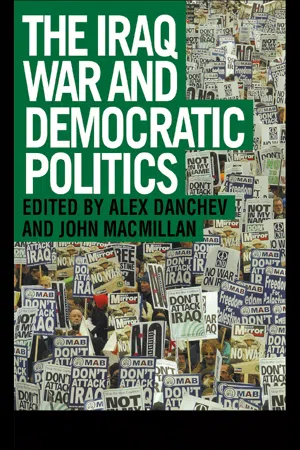
- 288 pages
- English
- ePUB (mobile friendly)
- Available on iOS & Android
eBook - ePub
The Iraq War and Democratic Politics
About this book
Information
1
Introduction
The Iraq War and democratic politics1
John MacMillan
The Iraq War of 2003 was one of the most controversial wars fought by the United States and the United Kingdom in the post-1945 period and arguably the most radical.
The drive to war generated unprecedented levels of public protest and caused major and often very public diplomatic and political divisions between states, including those within the ‘club’ of Western democracies. Whilst the war itself was a brief affair, a year after George W.Bush declared the cessation of hostilities there remained a high level of military insurgency, political disorder and uncertainty over the future. The war continues to cast a long shadow over domestic politics and to command high-profile media attention. Yet from the national political institutions that bestowed or withheld their authority for the war, as a value system through which the legitimacy of the war has been contested, to the political model for a post-Saddam Iraq, democracy has been intimately intertwined with the war. It is this relationship, between democracy, democratic politics and the war, that forms the subject matter of this book.
Whilst democracies have used substantial military force with some frequency in recent years—witness for example Somalia, Bosnia, Kosovo, Sierra Leone, East Timor, Afghanistan—Iraq stands out: it disturbs more deeply. The reason for this, ultimately, is the question of the war’s ‘meaning’, for it has brought into much sharper focus a range of existential concerns over the character of democratic politics and foreign policy and the role of democracies in the world at large, concerns which are at root those over the political identity and moral constitution of contemporary democratic states. From the general trend towards ‘exceptionalism’ in relation to questions of world order and foreign policy and the specific principle of preventive war, through the disregard for a set of international and democratic norms intended to restrain the overwhelming military power of democracies, to the false premises upon which the war was justified and the dehumanization and abuse of ‘liberated’ Iraqis, the war has severely challenged the authority of the West’s claims to moral and political leadership.
During the 1990s foreign policy debate in Western democracies, particularly the United States, could be understood through the paradigm of an embedded if embattled (neo-)liberal internationalism. Sure, the Republican Right maintained a vociferous criticism of Clinton’s foreign policy during this period, but it was dissatisfaction with the norms and polices of the liberal internationalist paradigm that provided its common thread. These norms included a greater presumption in favour of multilateralism, which included a recognition in principle (if not necessarily in practice) of the moral authority of the United Nations, and acceptance of certain restraints on the use of force. With Iraq, however, one can clearly see the erosion of this paradigm as a framework for understanding the conduct of democratic state foreign policy. The Rightward turn and radical contestation of the aims and means of US foreign policy provide the ideological context of this shift. A series of new security exigencies most clearly evident in the pervasive fears of ‘terror’ and the spread of weapons of mass destruction provide a dynamic and fluid political environment in which the limits of the politically possible and morally acceptable have been challenged and pushed back. The long-term repercussions of Western involvement in the Middle East and Islamic worlds, particularly of support for conservative and repressive regimes, are apparent in the rise of violent and committed transnational substate revolutionary networks, at the same time as the conceptual and political limitations of Western influence in the region are becoming more apparent. Iraq, then, proffers an abundance of meaning, but of inchoate, disorientating, twenty first century meaning.
That the world’s most powerful democracy, the United States, with the support of a small number of democratic allies including in particular the United Kingdom, chose war as the response most fitting its existential condition and the pursuit of its interests at this juncture forms the central concern of this book. Accordingly, The Iraq War and Democratic Politics seeks to understand and interpret this dangerous turn in world politics. Whilst some chapters address the national debates in a number of states including the United States, the United Kingdom, Turkey and the ‘European dimension’ and offer insights into the evolving nature of the democratic process, others offer analyses and commentaries on the implications of contemporary trends in democratic politics from a number of perspectives.
Democracy and the war
Since the end of the Cold War it is ‘democracy’ that has provided reaffirmation of the West’s political authority through serving as the principal political and ideological rationale for the leadership and hegemony of the world’s most powerful group of states, of which the United States is clearly pre-eminent. For many in the West at least, ‘democracy’ and ‘democratic values’ are not only key indicators of political legitimacy but also primary mediators of meaning. That is to say, the values, principles and experience of democracy profoundly shape both the perception and judgement of action in the political world. In the case of Iraq, the relationship between democracy and the war is complex, for the war marks both the crisis and the continuation of democracy, the contravention and the extension of democratic politics.
Central to the widespread concern over the Iraq War have been questions of its morality, purpose and motives. Yet whilst Iraq presents these in exceptionally stark terms, these are questions that have beleaguered democracies whenever they have used—or in some instances failed to use—force in the post-Cold-War period. Indeed, a residual lack of consensus on the question of the use of force, apparent in a trail of democratic dilemmas and experimentation, has been costly in both human and political terms. In part, this problem is in the nature of the beast, for underlying democratic discourses of just war, humanitarian intervention and collective security rests the basic truth that war is a brutalizing and dehumanizing activity, whoever undertakes it and for whatever purpose. Yet it is the efforts by democratic states to exercise and/or justify the use of force in terms of higher values—the pursuit of higher goods—than the pursuit of state interests alone that add layers of politically significant complexity and create tensions and dissonance between the proclaimed ends of foreign policy and the means through which these are pursued. Indeed, a review of the use of force by democracies in the post Cold War period illustrates the difficulty democracies have faced in using force in a morally and politically satisfactory manner. One repeatedly finds democracies struggling to know how to act and to do so in a way that is in keeping with the values and sensibilities of their societies, which may themselves be deeply divided. That the period has for the most part been marked by an incomparably favourable geo-strategic environment strongly suggests that the reasons for this are internal and conceptual.
One important factor here is cultural: the widely promoted belief in the invincibility and precision of hi-tech weaponry has led to a gross overestimation within certain democratic societies of what war and force can achieve. The promises of swift, clean and decisive military action found in the language of Top Gun, surgical strikes and the ‘Revolution in Military Affairs’ stutter, however, when faced with high-level aerial bombing, unexploded cluster bombs and the realities of street-to-street fighting and house searches. But there has also been a conceptual shift in the use of force that has not been fully appreciated. In the post-Cold-War period, as Charles William Maynes has noted, deterrence—the use of force to prevent states doing bad things outside their borders—has largely been replaced by compellence—the use of force to persuade states to do good things inside their borders. Given the mixed or hybrid nature of the Iraq War, the point that exercised Western politicians throughout the 1990s remains pertinent: are democratic citizenries ‘prepared to see their young men and women make the supreme sacrifice in the name of controlling others rather than defending ourselves?’2 This question is itself part of the long recognized point that hard democratic state structures and capabilities are in certain respects and to a certain extent counter-balanced by their softer societal core—or underbelly—which limits the ability of democratic states to take full advantage of their military superiority
This is significant, for fundamental to the strategic use of force is that the military instrument be part of a credible political process which, in the case of democracies, is a political process that should properly be concordant with democratic values and principles. That the coupling was poorly made in Iraq is clear from the levels of domestic dissent and from the naive and ethnocentric assumptions about the post-war bases of order in Iraq, readily apparent in the spiral of insurgency and repression under the occupation.
But it is not only Iraq where democracies have failed either to appreciate the political implications of the use of force or to mobilize sufficient political resources to address the post-combat stage. March 2004 witnessed the earlier victims of ethnic cleansing in the UN-administered province of Kosovo become the perpetrators. As one recent analysis has argued, an important contributory factor to this violence has been the policies of the administering authority: the management of the question of Kosovo’s final status and the increasing disengagement from the elemental task of socio-economic reconstruction.3 This seeming inability to match the willingness to intervene with a full commitment to assume the ensuing responsibilities for reconstruction creates the paradoxical condition coined by Michael Ignatieff as Empire Lite.4 Whilst any state, regardless of regime type, would face the problem of synchronizing the military and political momentums of conflict, a series of post-colonial value tensions and political and fiscal constraints create especial problems for democracies in this regard.
The Persian Gulf War of 1990–1 was in several respects as near a model of (liberal internationalist) paradigmatic simplicity as one is likely to find, but even here costly complexities and dilemmas quickly emerged. The war was waged in response to a clear-cut violation of international law—Iraq’s invasion of Kuwait—against which the United States was able to secure a wide-ranging international coalition for the limited political goal of reversing the invasion. Yet an irresponsible confusion of signals proved costly for Iraqis as many were emboldened by George H.W.Bush’s statement that another way the fighting could stop would be ‘for the Iraqi military and the Iraqi people to take matters into their own hands, to force Saddam Hussein the dictator to step aside’. In the post-war revolt, Saddam Hussein lost control of fourteen of Iraq’s eighteen provinces, but the West’s clear message to Saddam that it had no intention of assisting the uprising enabled him to brutally re-establish his rule.5 Politically, behind the scenes in Washington there lurked the question of the US role in the world and the value of its multilateral approach, apparent in disquiet and anxieties that such international action did not benefit the United States in proportion to the role it played, including the sacrifice of American lives while many others paid only financially.6
Faced with the break-up of Yugoslavia, particularly following the secession of Bosnia Herzegovina in February 1992, the West’s dilemmas over the use of force became visible for all to see. George H.W.Bush’s policies of economic sanctions against Serbia, humanitarian assistance to the Bosnian Muslims and an arms embargo against all parties were criticized by presidential candidate Bill Clinton on the grounds that the United States had a moral responsibility to punish Serb action and to respond more forcefully to reports of ethnic cleansing. In office, however, the Clinton administration’s endless meetings on the topic were described by one participant as ‘group therapy—an existential debate over what is the role of America’.7 Protracted discussions were marked, among other things, by an inability to decide whether the administration was facing a civil war or aggression in Bosnia and an unwillingness to act alone or to exert pressure on NATO. Yet it is the episode of Srebrenica, in which the failure to defend a UN safe area led to the genocide of 7,000 Bosnian Muslims, that provides the most bitter testimony to the responsibilities that accompany intervention in foreign affairs and the failure of the democracies to meet them.
The UN-authorized US-led operation in Somalia from 1992 to 1995 clearly illustrated the difficulty of engaging in humanitarian and peacekeeping operations without getting drawn into the wider conflict and towards peace imposition: the ‘mission-creep’ phenomenon. Somalia also illustrated that in asymmetric warfare there are a number of political factors that may deny the militarily superior party the advantage that might be expected when faced with a determined local opposition. The greater tragedy of Somalia, however, was that it effectively foreclosed intervention in Rwanda in 1994 in what has been called the ‘preventable genocide’ of 800,000 Tutsis and moderate Hutus.8
The NATO air campaign against Serbia in 1999 was justified in terms of the need to demonstrate firm resolve in the face of ethnic cleansing in Kosovo, particularly given the indecision that surrounded Bosnia. Yet the political and military differences between alliance members led to considerable disagreement over how to prosecute the war and very real concerns for the collapse of collective political will. This, in turn, further fuelled unilateralist tendencies within a Pentagon that was displeased with being hamstrung by its European allies. Further, the war highlighted the moral contradictions of bombing civilians in Serbia for the protection of civilians in Kosovo, which was itself a consequence of the political requirements of avoiding US military casualties. For the purposes of the present discussion, however, the most significant feature of the Kosovo War was the willingness of many, particularly on the liberal left, to support a war they recognized as illegal (in terms of public international law) but not illegitimate (in terms of liberal values).9
This shift to legitimacy over legality, discussed by Patrick Thornberry, is indicative of the wider liberal transformative project that has gained momentum in the postCold War period and of which the Iraq War is one, albeit extreme, manifestation. Whilst liberals may differ over specific policies, there has been fairly widespread agreement upon the desirability of revising the norms of international society—particularly those pertaining to sovereignty and the use of force—in the light of new geopolitical realities and opportunities. Certainly it is not only Tony Blair and George W.Bush that have called for the reformulation of democratic norms and practices in this period. At the root of this transformative project is the fundamental liberal dissatisfaction with the world as it is and the belief that the spread of liberal values would be beneficial for the people of the world, which is an assumption critically discussed in this book by John Horton and Yoke-Lian Lee. A core working assumption of this generic liberal position is that a state’s domestic political system is the primary determinant of its international behaviour and that the spread of democracy is an important (if not necessarily sufficient) part of the progressive development of the international society of states.
Politically this project is clearly apparent in the pervasiveness of ‘good governance’ criteria attached to much of the foreign aid given by democratic states and donor agencies to developing and transitional states. It is apparent also in the rhetoric of the Democratic as well as the Republican administrations in the United States: the interest of the Bush administration in the spread of ‘democracy’—or ‘freedom’—echoes the Clinton’s administration’s pronouncements on ‘democratic enlargement’.10 Whilst the language of Bush’s ‘axis of evil’ may be formulated for a different domestic political audience, the rhetoric plays to the same democratic antipathy towards dictators as did his predecessors’ concern with ‘outlaw’ or ‘backlash’ states.11
It was the Secretary-General of the United Nations in his report, An Agenda for Peace (1992), who asserted that the ‘time of absolute sovereignty…has passed’,12 which was a position subsequently endorsed by the Commission on Global Governance’s report, Our Global Neighbourhood (1995). However, the willingness of many on the liberal left to override sovereignty, by force if necessary, in the nam...
Table of contents
- Cover Page
- Title Page
- Copyright Page
- Contributors
- 1. Introduction: The Iraq War and Democratic Politics
- 2. The Global Setting: Us Foreign Policy and the Future of the Middle East
- 3. Bush’s War the Iraq Conflict and American Democracy
- 4. The Neo-Cons: Neo-Conservative Thinking Since the Onset of the Iraq War
- 5. The United Kingdom
- 6. The European Dimension
- 7. Turkey: Democratic Legitimacy
- 8. ‘It Seemed the Best Thing to Be Up and Go’: On the Legal Case for Invading Iraq
- 9. The Transition to Democracy In Iraq: Historical Legacies, Resurgent Identities and Reactionary Tendencies
- 10. The Democratic Transition In Iraq and the Discovery of Its Limitations
- 11. Iraq, Political Reconstruction and Liberal Theory
- 12. Afghanistan and Iraq: Failed States, or Democracy On Hold?
- 13. The Iraq Body Count Project: Civil Society and the Democratic Deficit
- 14. Story Development: Or, Walter Mitty the Undefeated
Trusted by 375,005 students
Access to over 1.5 million titles for a fair monthly price.
Study more efficiently using our study tools.
Frequently asked questions
Yes, you can cancel anytime from the Subscription tab in your account settings on the Perlego website. Your subscription will stay active until the end of your current billing period. Learn how to cancel your subscription
No, books cannot be downloaded as external files, such as PDFs, for use outside of Perlego. However, you can download books within the Perlego app for offline reading on mobile or tablet. Learn how to download books offline
Perlego offers two plans: Essential and Complete
- Essential is ideal for learners and professionals who enjoy exploring a wide range of subjects. Access the Essential Library with 800,000+ trusted titles and best-sellers across business, personal growth, and the humanities. Includes unlimited reading time and Standard Read Aloud voice.
- Complete: Perfect for advanced learners and researchers needing full, unrestricted access. Unlock 1.5M+ books across hundreds of subjects, including academic and specialized titles. The Complete Plan also includes advanced features like Premium Read Aloud and Research Assistant.
We are an online textbook subscription service, where you can get access to an entire online library for less than the price of a single book per month. With over 1.5 million books across 990+ topics, we’ve got you covered! Learn about our mission
Look out for the read-aloud symbol on your next book to see if you can listen to it. The read-aloud tool reads text aloud for you, highlighting the text as it is being read. You can pause it, speed it up and slow it down. Learn more about Read Aloud
Yes! You can use the Perlego app on both iOS and Android devices to read anytime, anywhere — even offline. Perfect for commutes or when you’re on the go.
Please note we cannot support devices running on iOS 13 and Android 7 or earlier. Learn more about using the app
Please note we cannot support devices running on iOS 13 and Android 7 or earlier. Learn more about using the app
Yes, you can access The Iraq War and Democratic Politics by Alex Danchev,John MacMillan in PDF and/or ePUB format, as well as other popular books in Politics & International Relations & Middle Eastern History. We have over 1.5 million books available in our catalogue for you to explore.