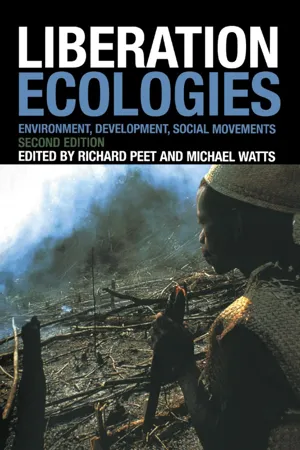
Liberation Ecologies brings together some of the most exciting theorists in the field to explore the impact of political ecology in today's developing world. The book casts new light on the crucial interrelations of development, social movements and the environment in the South - the 'bigger' half of our planet - and raises questions and hopes about change on the global scale.
The in-depth case material is drawn from across the Developing World, from Latin America, Africa and Asia. The issues raised in contemporary political, economic and social theory are illustrated through these case studies.
Ultimately, Liberation Ecologies questions what we understand by 'development', be it mainstream or alternative, and seeks to renew our sense of nature's range of possibilities.
- 464 pages
- English
- ePUB (mobile friendly)
- Available on iOS & Android
eBook - ePub
Liberation Ecologies
About this book
Information
Part I
RENEWING POLITICAL ECOLOGY
1
LIBERATING POLITICAL ECOLOGY*
Michael Watts and Richard Peet
Even society as a whole, a nation, or all existing societies put together, are not owners of the Earth. They are merely its occupants, its users; and like good caretakers, they must hand it down improved to subsequent generations.
(Marx, Capital, vol. 1)
In this world which is so respectful of economic necessities, no one really knows the real cost of anything which is produced. In fact the major part of the real cost is never calculated; and the rest is kept secret.
(Debord, The Society of the Spectacle)
We begin by recalling some recent stories, distinguished more than anything by their ubiquity and familiarity. First, the occupation by a militant youth wing of the Istekiri people of a number of Chevron oil flow-stations in the Nigerian Niger Delta. Over the last five years, increasingly militant ethnic minorities in the oil-producing Delta have aggressively occupied oil installations operated by transnational petroleum companies. This comes in the wake of a growing clamor over the control of local petro-revenues by impoverished oil producing communities, and claims for compensation for the ecological destruction associated with forty years of commercial drilling and pumping. A second story speaks to the question of economic globalization. The United Nations Development Program says that globalization is dangerously polarizing the “haves” and “have-nots” with little in the way of regulatory structures to counter its risks and threats. Central to the UN agenda is the need for a new multilateral environmental agency to regulate the global commons (the seas, ozone and so on). Third, there is a report about escalating conflicts between, on the one hand, the Brazilian federal ministry of agriculture and coalitions of regional states (led by the Marxist-oriented Rio Grande do Sul), and on the other, local agro-cooperatives. Contention centers on the potential environmental and social consequences of the widespread introduction into Brazil of genetically modified soy by the Monsanto corporation. And not least, there is a story of massive waterpoisoning in Bangladesh.
Environmental issues of this sort speak to the goals of Liberation Ecologies in two important ways. First, they are very much the object of study for a field of political ecology that seeks to understand the complex relations between Nature and Society through careful analysis of social forms of access and control over resources—with all their implications for environmental health and sustainable livelihoods. And second, they display vividly what geographers refer to as the politics of scale. These news stories encompass a number of political arenas, from the body to the locally imagined community to state and intra-state struggles to new forms of global governance.
Struggles over biotechnology or corporate responsibility may appear common-place and pedestrian. But it is precisely their quotidian character that marks the extent to which “Nature” is now so deeply embedded in our twenty-first century political identities. This “green reading” of the popular press comes at a moment when we recently celebrated the thirtieth birthday of a foundational moment in environmental activism, namely the first Earth Day in 1970, and subsequently two years later the United Nations Stockholm Conference on the Environment. But has the politics of the environment changed since these defining moments? One obvious difference is the enhanced knowledge of, and sensitivity to, trans-border and global forms of environmental harm (ozone depletion, global climate change, toxic dumping), and the extent to which green issues are legislated through inter-state agreements (the Rio Agenda 21 and the Biodiversity Convention of 1992 for example) and multilateral (inter-governmental) organizations. Indeed one of the striking trends in the last decade has been the “greening”—with limited success it needs to be said—of multilateral institutions like the World Bank (e.g. the Global Environmental Facility), the World Trade Organization, and regional associations such as the European Union and the North American Free Trade Association (NAFTA).
Another difference turns on the restructuring of global capitalism itself, and quite specifically the profound environmental changes associated with the rapid growth and maturity of the newly industrializing countries and the collapse of the Socialist bloc since 1989. The chickens of rapid industrialization in Brazil and Taiwan, and fifty years of Stalinist hyper-industrialization in the former sovietsphere, came home to roost in the 1990s. And not least, the deepening reach of transnational capital, marked incidentally by the rise of a massive corporate and transnational environmental technology industry (Pratt and Montgomery 1998), has its counterpoint in a proliferation of social movements which typically link economic and ecological justice (the politics of distribution) with human rights and cultural identity (the politics of recognition). New social movements can be understood as an effort by national and global civil society—social networks and transnational coalitions—to impose some sort of control over transnational corporations and irresponsible or rogue states, most especially the environmental externalities (e.g. toxic dumping) and distributional conflicts generated by the export of industry to the Third World via an increasingly deregulated world economy. The road from Stockholm to Rio is littered, then, with new ecological problems and different ecological politics.
Driven by momentous political and economic changes and by apocalyptic visions of impending global ecological doom, the environmental question now very much occupies center stage. The World Bank Report for 2003 addresses the question of sustainable development in the context of enormous pressures on “local and global common property resources” (water, soil, fisheries) as well as “local and global sinks” (the ability of the biosphere to absorb waste and regulate climate). Nature and the economy evolve in different ways and at different speeds, says the World Bank, and in an era of globalization the ability of natural life support systems to adapt is in question. The challenge, they say, “is daunting” (World Bank 2003:1). The meanings of terms like sustainability are hotly contested (M.O’Connor 1994). But the new lexicon is so endemic that it appears with as much frequency in the frothy promotional literature of the World Bank as in the rhetoric of the Sierra Club, the US military, or the myriads of Third World grassroots environmental and community movements. Whatever its semantic ambiguity, sustainability has the effect of linking three hitherto relatively disconnected discourses. It is now taken for granted that the global environmental crisis, and renewed concern with global demography (the return of the Malthusian specter), are inseparable from the terrifying map of global economic inequality. In sharp contrast to the 1960s, even conventional views confirm that eradicating poverty through enhancing and protecting livelihood strategies is as much an environmental sustainability issue and a fertility question (in which women’s employment and education figures feature centrally), as it is a “simple” asset or resource endowment question (World Bank 1992).
Located on this expansive canvas of intellectual and political-economic ferment, Liberation Ecologies explores, through a series of thematic chapters and rich case-studies drawn from Latin America, Africa, and East, Southeast and South Asia, the current debates over development and the environment. In choosing this title we seek to emphasize a number of concerns. Obviously we wish to mark the potential liberatory or emancipatory potential of current political activity around environment and resources. However we also wish to signal the fact that the proliferation of environmental concerns linked to questions of development has other profound theoretical and practical consequences. One is that the politics of the environment seem to embrace a wide terrain including not just new social movements, but transnational environmental alliances and networks as with the World Social Forum, multilateral governance through for example the Global Environmental Facility of the World Bank, and a sensitivity to a panoply of local conflicts and resistances that may not warrant the term “movement.” Another is that theories about environment and development—political ecology in its various guises— have been pushed and extended both by the realities of the new social movements themselves, and by intellectual developments associated with green Marxism, cultural and social theory, discourse theory and poststructuralism. These exciting new developments—many of which appear in the chapters which follow—represent, for us, the possibility of a more robust political ecology which integrates politics more centrally, draws upon aspects of discourse theory which demand that the politics of meaning and the construction of knowledge be taken seriously, and engages with the wide ranging critique of development and modernity particularly associated with Third World intellectuals and activists such as Vandana Shiva, Arturo Escobar and Victor Toledo. Liberation Ecology highlights, in other words, new theoretical engagements between political ecology, Marxism and social theory on the one hand, and a practical political engagement with new movements, organizations and institutions of civil society challenging conventional notions of development, politics, democracy and sustainability on the other.
In this Introduction, we address ways in which environmental problems have been addressed in the last thirty years, with particular attention to the field of political ecology. We provide a history of a field that now contains a large body of work, possesses its own electronic journal, and (as one might expect of a “mature” science) contains substantial debates within its ranks, together with providing an overview of its conceptual toolkit and its theoretical claims. We show how, since its formation in the 1970s, political ecology has been challenged and deepened both by “internal” theoretical debates and by the “external” environmental and political economic realities it seeks to explain. Political ecology, over the last decade, has grappled with environmental politics by way of a broader and more sophisticated sense of the forms of political contention and a deeper conception of what is contended, what we refer to in shorthand as “liberation ecology.” Central to the new political ecology is a sensitivity to environmental politics as a process of cultural mobilization, and the ways in which such cultural practices—whether science, or “traditional” knowledge, or discourses, or risk, or property rights—are contested, fought over and negotiated.
INTELLECTUAL ORIGINS OF POLITICAL ECOLOGY
What, then, is political ecology? The origins of the couplet—politics and ecology—is instructive. It dates back to the 1970s (Watts 1983a) when a variety of commentators— journalist Alexander Cockburn, anthropologist Eric Wolf, and environmental scientist Grahame Beakhurst—coined the term as a way of thinking about questions of access and control over resources (that is to say the toolkit of political economy), and how this was indispensable for understanding both the forms and geography of environmental disturbance and degradation, and the prospects for green and sustainable alternatives. The fact that such writers were concerned to highlight politics and political economy—that is to say a sensitivity to the dynamics of differing forms of, and conflicts over, accumulation, property rights, and disposition of surplus—reflects a concern for distancing themselves from other accounts of the environmental crisis which sought to locate the driving forces in technology, or population growth, or culture or poor land use practice.1
Political ecology’s originality resided in its efforts to integrate human and physical approaches to land degradation, through an explicitly theoretical approach to the ecological crisis capable of addressing diverse circumstances (soil erosion in Nepal, water pollution in Delhi) and capable of accommodating both detailed local study and general principles. As a defining text puts it: “[T]he phrase ‘political ecology’ combines the concerns of ecology and a broadly defined political economy. Together this encompasses the constantly shifting dialectic between society and land-based resources, and also within classes and groups within society itself” (Blaikie and Brookfield 1987:17). Less a problem of poor management, inappropriate technology, or overpopulation, environmental problems were social in origin and definition. Analytically, the fulcrum of any Nature-Society study had to be the “land manager” whose relationship to nature must be considered in a “historical, political and economic context” (1987:239). Hence, rapid deforestation in eastern Amazonia, to take one example, needed to be understood in terms of why those who were clearing tropical rainforests did so in the pursuit of economically inefficient and environmental destructive cattle ranching, and how these social forces—ranchers, peasants, workers, transnational companies—were shaped by larger political-economic forces, not the least of which was the Brazilian government acting through subsidies, class alliances, and the military. In the first generation of political ecology, however, land managers were almost wholly male, rural, Third World subjects, and curiously un-political in their practices and intentions.
What set of ideas and events “produced” this welding together of ecology and political economy in the first place? To simplify one can say that efforts to link culture and environment in anthropology and geography arose in part through a combination of Darwinian or evolutionary thinking, the new sciences of ecosystems and cybernetics, the growing political visibility of Third World peasantries (in China and in Vietnam), and the consequences of the Cold War and the atomic bomb. We emphasize a post-1945 confluence between three sets of ideas. First, the important connection between on the one hand cybernetics and systems theory—which derived from the theory of machines and from artificial intelligence developed particularly during the Second World War— and on the other community ecology. The central figures were Gregory Bateson and Howard Odum who, while different in intellectual orientation, provided languages and concepts for thinking about humans in eco- and living systems, the flows of matter, information, and energy that coursed through human practice with respect to the environment, but also the mechanisms—homeostasis, equilibrium, flexibility—by which “adaptive structure” could be maintained in ecosystems (see Watts 2002).
Second, within anthropology and geography the twin themes of cultural evolution and cultural materialism provided a powerful Darwinian framework for thinking about not only historical change but also patterns of resource use and human adaptation in differe nt environments. In geography this approach was referred to as cultural ecology, but it was the Columbia school of ecological anthropology which provided the most sophisticated ideas. Peter Vayda and Roy Rappaport (1967) in the 1960s showed how tribal subsistence people in isolated regions could maintain an “adaptive structure” with respect to their environment. In Rappaport’s (1968) terms the native’s “cognized model” of the environment-embodied in various ritual, symbolic and religion practices—could elicit adaptive behavior understood in terms of the “operational” model of Western ecology. The pig killing rituals of the Tsembaga Maring of highland Papua New Guinea could function as a thermostat preventing overpopulation by pigs and maintaining some sort of environmental balance with their fragile ecology. Much of this ecological anthropology of the 1960s sought the “hidden” adaptive functions of culture with respect to the ecosystem, in order to build an abstract model of adaptive structure which existed in all living systems (see Bateson 1972, Wilden 1972).
The third lineage is rooted in the social science of the nuclear age and the post-war development of human responses to hazards and disasters. The immediate threat wa...
Table of contents
- COVER PAGE
- TITLE PAGE
- COPYRIGHT PAGE
- ILLUSTRATIONS
- CONTRIBUTORS
- PREFACE TO THE SECOND EDITION
- ACKNOWLEDGMENTS
- Part I: RENEWING POLITICAL ECOLOGY
- Part II: DISCOURSE AND PRACTICE
- Part III: INSTITUTIONS AND GOVERNANCE
- Part IV: CONFLICT AND STRUGGLE
- Part V: MOVEMENT
Trusted by 375,005 students
Access to over 1.5 million titles for a fair monthly price.
Study more efficiently using our study tools.
Frequently asked questions
Yes, you can cancel anytime from the Subscription tab in your account settings on the Perlego website. Your subscription will stay active until the end of your current billing period. Learn how to cancel your subscription
No, books cannot be downloaded as external files, such as PDFs, for use outside of Perlego. However, you can download books within the Perlego app for offline reading on mobile or tablet. Learn how to download books offline
We are an online textbook subscription service, where you can get access to an entire online library for less than the price of a single book per month. With over 1.5 million books across 990+ topics, we’ve got you covered! Learn about our mission
Look out for the read-aloud symbol on your next book to see if you can listen to it. The read-aloud tool reads text aloud for you, highlighting the text as it is being read. You can pause it, speed it up and slow it down. Learn more about Read Aloud
Yes! You can use the Perlego app on both iOS and Android devices to read anytime, anywhere — even offline. Perfect for commutes or when you’re on the go.
Please note we cannot support devices running on iOS 13 and Android 7 or earlier. Learn more about using the app
Please note we cannot support devices running on iOS 13 and Android 7 or earlier. Learn more about using the app
Yes, you can access Liberation Ecologies by Richard Peet, Michael Watts, Richard Peet,Michael Watts in PDF and/or ePUB format, as well as other popular books in Politics & International Relations & Political Economy. We have over 1.5 million books available in our catalogue for you to explore.