eBook - ePub
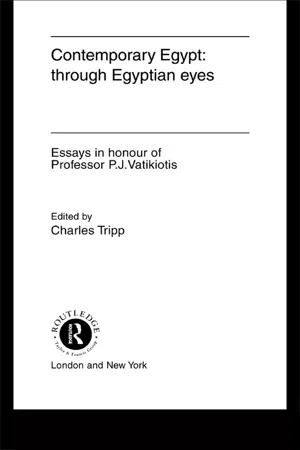
Contemporary Egypt: Through Egyptian Eyes
Essays in Honour of P.J. Vatikiotis
- 176 pages
- English
- ePUB (mobile friendly)
- Available on iOS & Android
eBook - ePub
About this book
This book brings together expert essays on the social and political forces and personalities that have shaped modern Egypt, and the economic, political and diplomatic dilemmas facing the country.
Trusted by 375,005 students
Access to over 1.5 million titles for a fair monthly price.
Study more efficiently using our study tools.
Chapter 1
The political press in Egypt, 1882–1914
Abbas Kelidar
The rapid growth of the native press in the 1870s marked it for a major role in the evolution and development of Egypt's political consciousness. It featured so prominently in the events leading to the Urab revolt that a Press Law was passed to regulate its activities in 1881. The defeat of Urabi by British forces brought about a lull which only lasted a few years. By the turn of the century, the press had not only resumed its former role, but had become a legitimate platform for the expression of public opposition to the British occupation of Egypt. Although its tone was as strident as that of the Urabist press, it did not receive the attention of the authorities until 1903. In his annual report for that year, Lord Cromer, who, in his capacity as British Consul-General in Cairo, had become the virtual ruler of Egypt following the British occupation in 1882, insisted that there was no such phenomenon as a ‘press question’.1
This assertion was valid only for the first seven years which followed the entry of British troops into Cairo. Between 1882 and 1889 there was hardly a native newspaper to speak of. This was perhaps scarcely surprising, since the British occupation had led to the imprisonment or deportation of many of the journalists who had played a leading part in mobilising public opinion during the events which had led to the deposition of Khedive Ismail in 1879 and to the Urabi revolt two years later. However, prior to the occupation, the concern expressed and the measures taken to deal with the activities of the press showed that there was not only a press question, but that it had made a significant impact on politics and the conduct of public affairs.
In the absence of legitimate institutions through which the Egyptians could participate in the government of their country, political activity was conducted through the press. Newspapers became a substitute for political parties and thus acted as the main vehicles for the expression of views and opinions on matters of national importance. The press also served as a legal means for the propagation of anti-British nationalist sentiment. As such, it made an important contribution to the radicalisation of political trends in Egypt. The general agitation generated by newspaper articles made life extremely difficult for the British occupation authorities. Egyptian editors and publicists of diverse political opinions and outlooks employed the medium of the press to such an effect that this period in the development of Egyptian nationalism was aptly described as the ‘journalistic phase’.2
Egyptian journalism was not the exclusive preserve of the nationalists. There were a few leading newspapers which owed their allegiance to other parties with direct interest in Egyptian affairs. Some of the press was backed and financed by foreign powers like Great Britain, France, and the Ottoman state; others were supported by the Khedive of Egypt and/or rival political groups. Each was to promote its own respective interest or those of its patrons.
By 1903, the Egyptian press had several decades of growth and development behind it. The modern press, like so many other aspects of European culture, had originally come to Egypt with the French expedition led by Napoleon in 1798. The expedition was accompanied by two printing presses. One of these was equipped with Greek, Arabic and French characters.3 In Arabic, only official proclamations, notices and communiqués were printed. However, following the murder of General Kléber in 1800, the first Arabic newspaper, Al-Tanbih was founded by General Menou, who appointed Ismail al-Khashab as its first editor. There is some doubt as to whether the paper was ever published, but it seems certain that its appearance was short-lived.4
Some thirty years later, Muhammad Ali, by then the absolute ruler of Egypt, ordered the publication of an official newspaper in 1828 which became known as Al-Waqa'ial-Misriyya.5 Al-Waqa'i was followed by several papers sponsored by various government departments, such as the Military Gazette in 1833, and the Commerce and Agriculture Journal in 1848.6 It was this period which Al-Hilal, in an historical review, called the first stage in the development of the Egyptian press.7 The main feature of the press at this stage was its official character. It contained various administrative, economic and judicial items of information. This type of journalism continued to dominate the press in Egypt until the accession of Khedive Ismail in 1863.
Under the rule of Khedive Ismail, the Egyptian press underwent a major transformation. It became overtly politicised, giving expression to a ferment of new ideas in a style of Arabic prose which marked the introduction of modern journalism. The main preoccupations of writers and editors were political matters related to the movement of Islamic reform, the westernisation of Egyptian society and politics, as well as the question of Egyptian independence. Ismail's headlong drive for the modernisation of Egyptian culture, accompanied by the desire for the assertion of his independence from both the Ottoman state and his European creditors, namely Great Britain and France, provided fresh impetus for the growth and development of the press. The modernising Khedive employed the press to serve his interests and purposes, not only in Egypt, but also in Turkey and Europe.8 The Khedive's political mouthpiece was a publication named Wadi al-Nil, edited by Abdullah Abu al-Sa'ud, whose main task was to promote Ismail's interests.9
Ismail encouraged, financed and protected newspaper editors, journalists and writers from all parts of the Islamic world. The immigration into Egypt of prominent men of letters from the Arab provinces of the Ottoman Empire, especially from Syria, had a stimulating influence on the native press of Egypt. These men, mainly Christians who had been educated at the Protestant missionary schools in Beirut, were much more receptive to European notions and norms than their Muslim counterparts. They settled in Egypt to practise their profession away from the restrictions and censorship of the Ottoman authorities.
The presence of Muslim writers like Abd al-Rahman al-Kawakibi and Rashid Rida, as well as the arrival in Cairo of Jamal al-Din al- Afghani in 1871, served to reinforce the ranks of those engaged in a nascent publishing industry of some repute and standing in the Muslim world. A further stimulus to the emergence of a political press was provided by the apparent success of the Ottoman constitutional movement in the 1870s. All these factors helped the rapid development of political journalism in Egypt, and some of the most important Muslim and Arab publicists made their best contribution to the changing nature of Muslim politics in this period. By the end of Ismail's reign in 1870 there were sixteen well-presented journals in Egypt, ten of which were in Arabic.10
The policies of Khedive Ismail imposed an impossible financial burden on Egypt, and the extravagance in which he indulged caused his rule to grow weaker. It was not long before the European powers intervened to assume supervision of the country's finances, under the dual control of Great Britain and France—a measure which served to curb the Khedive's autocratic excesses.11 An immediate reaction to this was the emergence of a bolder political press. Some journalists began to criticise Ismail, demanding the introduction of constitutional rule to Egypt.12 Journalists like Abu Nazzara, the Egyptian Jewish publicist James (Ya’qub) Sanu’a, and the editors of Al-Ahram, the Syrian Taqla brothers, who started their pro-French publication in 1875, led the campaign against the autocracy and the financial policies of Ismail.13 In the meantime, journals like the weekly Jaridat Misr, founded and edited by the Syrians Salim al-Naqqash and Adib Ishaq, respectively, continued to defend Egyptian interests and to oppose European control.
Following the imposition of Anglo-French financial control in 1876, Egypt became virtually a European colony. Under Ismail the country experienced rapid and radical change. The spread of activist political ideas was accelerated by the deposition of Ismail in 1879. The willingness of his successor, Khedive Tawfiq, to cooperate with the European Control Commission brought down upon his head the wrath of the nationalist press which characterised his reign. This was particularly noticeable in the segment of it which was influenced by the religious reform movement of al-Afghani and his Egyptian disciple, Muhammad Abduh.14 Newspapers which had enjoyed some licence during the last days of Ismail's rule basked in almost unlimited freedom under Tawfiq.15 This was made possible by the liberalising attitude of the European powers under whose tutelage Tawfiq came to administer the country. Journalists took full advantage of the new conditions to criticise the regime, and to demand the introduction of constitutional reform and representative government.16
The emergence of the military officer, Ahmad Urabi, as a nationalist leader at the beginning of the 1880s, was accompanied by the appearance of several newspapers representing the views of the nationalist movement and its National Party.17 Foremost among these publications, which included Misr al-Fatat, Al-Mufid, Al-Mahrusa and Al-Burhan, was Al-Ta'if, edited by the orator of the Urabi revolt, Abdullah al-Nadim. All these newspapers condemned the Khedive, called on the Egyptians to rally to the support of Urabi, and demanded Ottoman intervention to save the Muslims of Egypt from European domination. Press attacks became so violent and the appeals so emotive that the government was forced to issue the Press Law of 1881, to curb and regulate the press. The Law empowered the government to suspend or suppress any publication in the interest of public order, or of religious and social propriety.18
The Law of 1881 was soon overtaken by political events in the country. The vociferously violent campaign against European control of Egyptian affairs came to an end with the defeat of the Urabi revolt in 1882. The rout of the Urabists by British military forces gave Great Britain exclusive control over Egypt and caused a lull in the activities of the press. Many of the revolutionary journalists were either gaoled, deported or went into hiding.19 However, the pause served a useful purpose. It enabled writers, publicists and journalists to take fresh stock of the situation as it developed and to reorient themselves accordingly. Previously, they had been concerned with the twin problems of Islamic conservatism on the one hand, and religious reform on the other. Henceforth they had to contend with aspects of the ‘Egyptian Question’, namely, the problem of foreign control and national independence. For many of them, the British occupation of Egypt became the most important issue in their lives. Focusing on it, almost to the exclusion of all other matters, gave rise to a renewed and vibrant national struggle for the independence of Egypt as an independent nation-state.
In response to the requirements of changing circumstances, the Egyptian press began to develop new themes and to consider fresh prospects. In doing so, it became entangled with a constantly shifting political situation in Europe and the Middle East. Editors and publicists sought to exploit the rivalry and alliances among the European powers to Egypt's advantage, and became divided accordingly until the outbreak of the First World War. Newspapers like Al-Zaman and Al-Muqattam supported Great Britain and defended British interests in Egypt and the Middle East. Others, like Al-Ahram and Al-Liwa, the latter for the first few years only, backed France and called for French intervention to contain total British domination of Egypt. While newspapers such as Al- Mu’ayyad and Al-’Alam (the latter a successor to Al-Liwa), invoked Ottoman sovereignty over Egypt and demanded effective Ottoman resistance to British designs in the region, as well as protection for the people of Egypt. By 1907 when Al-Jarida appeared, its editor, Ahmad Lutfi al-Sayyid, was able to confine the columns of his newspapers to the application of the European concept of the nation-state to Egypt. However, until the appearance of Al-Liwa in 1900, edited by the flamboyant Mustafa Kamil, and Al-Jarida by the more reflective al-Sayyid, the Egyptian press was dominated by Al-Ahram, Al-Muqattam and Al-Mu’ayyad.20
Al-Ahram was the oldest of these papers. It was started in Alexandria by Salim and his brother Bishara Taqla in 1875. The paper was pro-French and therefore anti-British, a function of Anglo-French rivalry in Egypt.21 Al-Ahram was also pro-Ottoman, due mainly to the editors’ deference to Egypt's position in the Muslim world. The Taqla brothers were strong advocates of Ottoman independence and unity, an endeavour for which they were remunerated and honoured by the Ottoman sultans.22
Opposed to Al-Ahram was Al-Muqattam whose editors, like those of Al-Ahram, were Syrian Christians, namely Faris Nimr and Ya’qub Sa...
Table of contents
- Cover Page
- Title Page
- Copyright Page
- Notes on the contributors
- Foreword
- Acknowledgements
- Chapter 1: The political press in Egypt, 1882–1914
- Chapter 2: Makram Ebeid: politician of the majority party
- Chapter 3: Ali Mahir and the politics of the Egyptian army, 1936–1942
- Chapter 4: Mustafa Al-Nahhas and political leadership
- Chapter 5: Relations between Egypt and the United States of America in the 1950s
- Chapter 6: Nasser and the Egyptian press
- Chapter 7: Egypt in the balance
- Chapter 8: Interpretations and misinterpretations of the Egyptian economy
- Chapter 9: Egyptian diplomacy: East-West detente and North-South dialogue
Frequently asked questions
Yes, you can cancel anytime from the Subscription tab in your account settings on the Perlego website. Your subscription will stay active until the end of your current billing period. Learn how to cancel your subscription
No, books cannot be downloaded as external files, such as PDFs, for use outside of Perlego. However, you can download books within the Perlego app for offline reading on mobile or tablet. Learn how to download books offline
Perlego offers two plans: Essential and Complete
- Essential is ideal for learners and professionals who enjoy exploring a wide range of subjects. Access the Essential Library with 800,000+ trusted titles and best-sellers across business, personal growth, and the humanities. Includes unlimited reading time and Standard Read Aloud voice.
- Complete: Perfect for advanced learners and researchers needing full, unrestricted access. Unlock 1.5M+ books across hundreds of subjects, including academic and specialized titles. The Complete Plan also includes advanced features like Premium Read Aloud and Research Assistant.
We are an online textbook subscription service, where you can get access to an entire online library for less than the price of a single book per month. With over 1.5 million books across 990+ topics, we’ve got you covered! Learn about our mission
Look out for the read-aloud symbol on your next book to see if you can listen to it. The read-aloud tool reads text aloud for you, highlighting the text as it is being read. You can pause it, speed it up and slow it down. Learn more about Read Aloud
Yes! You can use the Perlego app on both iOS and Android devices to read anytime, anywhere — even offline. Perfect for commutes or when you’re on the go.
Please note we cannot support devices running on iOS 13 and Android 7 or earlier. Learn more about using the app
Please note we cannot support devices running on iOS 13 and Android 7 or earlier. Learn more about using the app
Yes, you can access Contemporary Egypt: Through Egyptian Eyes by Charles Tripp in PDF and/or ePUB format, as well as other popular books in History & Middle Eastern History. We have over 1.5 million books available in our catalogue for you to explore.