- 240 pages
- English
- ePUB (mobile friendly)
- Available on iOS & Android
eBook - ePub
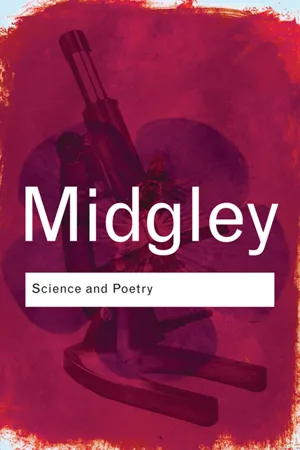
Science and Poetry
About this book
Crude materialism, reduction of mind to body, extreme individualism. All products of a 17th century scientific inheritance which looks at the parts of our existence at the expense of the whole.
Cutting through myths of scientific omnipotence, Mary Midgley explores how this inheritance has so powerfully shaped the way we are, and the problems it has brought with it. She argues that poetry and the arts can help reconcile these problems, and counteract generations of 'one-eyed specialists', unable and unwilling to look beyond their own scientific or literary sphere.
Dawkins, Atkins, Bacon and Descartes all come under fire as Midgely sears through contemporary debate, from Gaia to memes, and organic food to greenhouse gases. After years of unquestioned imperialism, science is finally forced to take a step back and acknowledge the arts.
Information
Part I
VISIONS OF
RATIONALITY

1
THE SOURCES OF
THOUGHT
IS ART A LUXURY?
Is there any connection between poetry and science? Academic specialisation usually divides these topics today so sharply that it is hard to relate them on a single map. But there is one very simple map which does claim to relate them, a map which is worth looking at because it has quite an influence on our thinking. It is the map which the distinguished chemist Peter Atkins draws in the course of arguing that science is omnicompetent, that is, able to supply all our intellectual needs. He notes that some people may think we need other forms of thought such as poetry and philosophy as well as science because science cannot deal with the spirit. They are mistaken, he says. These forms add nothing serious to science:
Although poets may aspire to understanding, their talents are more akin to entertaining self-deception. They may be able to emphasise delights in the world, but they are deluded if they and their admirers believe that their identification of the delights and their use of poignant language are enough for comprehension. Philosophers too, I am afraid, have contributed to the understanding of the universe little more than poets.… They have not contributed much that is novel until after novelty has been discovered by scientists.… While poetry titillates and theology obfuscates, science liberates.(From ‘The Limitless Power of Science’ in Nature’s
Imagination, ed. John Cornwell, Oxford University
Press, 1995, p. 123)
Though this view is not usually declared with quite such outspokenness and tribal belligerence it is actually not a rare one. A lot of people today accept it, or at least can’t see good reason why they should not accept it, even if they don’t like it. They have a suspicion, welcome or otherwise, that the arts are mere luxuries and science is the only intellectual necessity. It seems to them that science supplies all the facts out of which we build (so to speak) the house of our beliefs. Only after this house is built can we — if we like — sit down inside it, turn on the CD player and listen to some Mozart or read some poetry.
As we shall see, however, this is not how we actually live our lives, still less how we ought to try to live them. Attempts to impose this pattern have distorted the intellectual scene of late from a number of angles. For instance, the idea that science is a separate domain, irrelevant to the arts, has often produced a strange kind of apartheid in the teaching of literature, a convention whereby important and powerful writings get ignored if their subject-matter concerns science, or even the physical world. Thus, criticism of Conrad’s sea-stories tends to treat the storms and other natural disasters in them merely as scenery for the human dramas involved, rather than as a central part of their subject-matter. But if Conrad had simply wanted to study human behaviour he could have stayed in Poland. Similarly, H.G. Wells and the whole vigorous science-fiction tradition derived from him were long cold-shouldered out of the literary syllabus and have not yet fully reached it — even though writers like Conrad and Henry James admired Wells deeply and saw the force of his vision. Until quite lately, even Frankenstein was ignored. Potent ideas expressed in these writings have thus not been properly faced and criticised in the teaching of literature. These ideas are, of course, often ones about how the science by which we study the physical world relates to the rest of life, which is an extremely important topic. They include a wide range of matters that can help us in trying to understand and face the environmental crisis.
All this means that intending students face a rather bewildering choice. On the one hand they are offered a narrow, somewhat inward-looking approach to literature. On the other, they face a kind of science-teaching which never mentions the social attitudes and background assumptions that influence scientific thought — indeed, one that often views any mention of these topics as vulgar and dangerous. Thus, they may study either the outer or the inner aspect of human life, but must on no account bring the two together.
In fact, despite the efforts of many reformers, Descartes still rules. Mind and body are still held apart. Their division tends to produce a population of one-eyed specialists on both sides, specialists who are mystified by their respective opposite numbers and easily drift into futile warfare. It is surely worth while to take a much harder look at the misleading imaginative picture of the intellectual life which is the source of this habit.
LUCRETIUS AND THE VISION OF ATOMISM
This divisive picture is really very odd, one which does not fit the actual history of thought at all. Rereading Atkins' words lately, I began to think about his remark that poets and philosophers ‘have not contributed much that is novel [to the understanding of the universe] until after novelty has been discovered by scientists’. What struck me then was the influence that a single great philosophic poem — Lucretius' On The Nature Of The Universe – De Rerum Natura – has actually played in the formation of modern Western thought, and especially of Western science.
That poem was the main channel through which the atomic theory of matter reached Renaissance Europe. It was forcibly stated there, all ready to be taken up by the founders of modern physics. Of course it was the Greek atomist philosophers who had invented the theory, and no doubt their work would have reached later thinkers in some form even without Lucretius' poem. But the force and fervour of the poem gave atomism a head start. It rammed the atomists' imaginative vision right home to the hearts of Renaissance readers as well as to their minds. That vision included, not just the atomic theory itself, but also the startling moral conclusions which Epicurus had already drawn from it. In this way it forged a much wider strand in Enlightenment thinking.
For Lucretius did not see atomism primarily as a solution to scientific problems. Following Epicurus, he saw it as something much more central to human life. For him it was a moral crusade — the only way to free mankind from a crushing load of superstition by showing that natural causation was independent of the gods. Human beings, he said, are so ceaselessly tormented by anxiety about natural events that they exhaust themselves in precautions against them that are useless and sometimes horrible, such as human sacrifice:
They make propitiatory sacrifices, slaughter black cattle and despatch offerings to the Departed Spirits.… As children in blank darkness tremble and start at everything, so we in broad daylight are oppressed at times by fears as baseless as those horrors which children imagine coming upon them in the dark. This dread and darkness of the mind cannot be dispelled by the sunbeams, the shining shafts of day, but only by an understanding of the outward form and inner workings of nature.… How many crimes has religion led people to commit.(De Rerum Natura, trans. R.E. Latham, London, Penguin,
1951, book 2, lines 50–62, book 1, line 101)
Thus it was Lucretius who launched the notion of science as primarily a benign kind of weedkiller designed to get rid of religion, and launched it in great rolling passionate hexameters which gave it a force it would never have had if it had been expressed in unemotive prose. His work is visibly the source of the anti-religious rhetoric that is still used by later imperialistic champions of science such as Bertrand Russell and Atkins himself.
WHY VISIONS MATTER
This is not just a debating point for the deplorable war of the two cultures. The story of the influence that Greek atomistic philosophers had, by way of a Roman poet, on the founding of modern science is not a meaningless historical accident. It is a prime example of the way in which our major ideas are generated, namely, through the imagination. New ideas are new imaginative visions, not just in the sense that they involve particular new images (such as Kekule’s image of the serpent eating its tail) but in the sense that they involve changes in our larger world-pictures, in the general way in which we conceive life. These changes are so general and so vast that they affect the whole shape of our thinking. That is why something as important as science could not possibly be an isolated, self-generating thought-form arising on its own in the way that Atkins suggests. To picture it as isolated in this way — as a solitary example of rational thinking, standing out alone against a background of formless emotion — is to lose sight of its organic connection with the rest of our life. And that organic connection is just what makes it important.
Changes in world-pictures are not a trivial matter. The mediaeval world-picture was static and God-centred. It called on people to admire the physical cosmos as God’s creation, but it viewed that cosmos as something permanently settled on principles that might well not be open to human understanding. By contrast, the atomists showed a physical universe in perpetual flux, a mass of atoms continually whirling around through an infinite space and occasionally combining, by pure chance, to form worlds such as our own. This insistence on the ultimate power of pure chance, which is still such an important principle in today’s neo-Darwinist thinking, was thus already central to this early atomist vision.
In principle, this new universe was physically comprehensible because we could learn something about the atomic movements and could thus understand better what was happening to us. But it was not morally comprehensible. It had no meaning. According to Lucretius, the attempt to comprehend the world morally had always been mistaken and was the central source of human misery. In their mistaken belief that they could reach such an understanding, anxious and confused people had taken refuge from their ignorance in superstition:
in handing over everything to the gods and making everything dependent on their whim.… Poor humanity! to saddle the gods with such responsibilities and throw in a vindictive temper!… This is not piety, this oft-repeated show of bowing a veiled head before a stone, this bustling to every altar, this deluging of altars with the blood of beasts.… True piety lies rather in the power to contemplate the universe with a quiet mind.(Book V, lines 1185 and 1194–1203;
emphasis mine)
This reference to the possibility of true piety is interesting and we must come back to it. But his main point is a simple one. Instead of this anxious pursuit of bogus social explanations for natural events — instead of these wild speculations about irresponsible gods, people should become calmer and look for physical explanations which, though much slighter, would be reliable so far as they went, and would thus quench their anxiety.
That dynamic and chilling yet ordered world-picture made physical speculation seem possible and indeed necessary. At the Renaissance, moreover, it came together with another picture which had not been available before — namely that of the world as a machine. The invention of real complex machines such as clocks gave the human imagination an immensely powerful piece of new material. Machine-imagery changes the world-view profoundly because machines are by definition under human control. They can in a sense be fully understood because they can be taken to pieces. And if the world is essentially a machine, then it can be taken to pieces too and reassembled more satisfactorily. It was the fusion of these two imaginative visions that made modern science look possible. And it had to look possible before anybody could actually start doing it.
This dependence of detailed thought on entirely non-detailed visions is a central theme of this book. The originating visions are, of course, necessarily vague. When the Greek atomists spoke of the various kinds of atoms as having their own specific movements, they had not the remotest idea of what these movements might be or how anybody could trace them. Though it was central to their position that the movements themselves were fixed, definite and invariable, they could not, in the nature of the case, possibly supply examples. They had to convey their point through the necessarily vague medium of imagery. What they were supplying was much more like a Turner sketch than it was like a photograph, and it was not in the least like an engineer’s diagram.
At this imaginative stage, then, they were putting forward a theory about exactness — they were envisaging an ideal of exactness comparable with that which we now think of as typical of science. But they had not got anything like an exact theory. At this stage, this kind of vagueness is not a vice, any more than it is a vice in a map of the world that it does not show the details of the small areas within it. It is natural and proper that our detailed thinking arises from imaginative roots. But it is important that we should recognise the nature of these roots — that we should not confuse the ideal of exactness with the actual achievement of it.
Impressive and influential theories like this one do not originally gain their influence by telling us exact facts about the world. It is usually a long time before they can provide any such facts. Actual precision comes much later, if at all. But theories are not half-established facts either. They are ways of looking at the facts – pairs of spectacles through which to see the world differently. What makes theories persuasive in the first place is some other quality in their vision, something in them which answers to a wider need. There is always an imaginative appeal involved as well as an intellectual thirst for understanding. Theories always answer a number of different needs, needs which those who are moved by them are not aware of. As they are used and developed, this plurality of power-sources begins to become visible and can result in serious conflicts.
THE MEANING OF DETERMINISM
For example, the determinism which the atomists introduced — the belief in a completely fixed physical order — obviously did not originally owe its appeal to being established as an empirical fact. It is an assumption that goes infinitely beyond any possible evidence, one that is made for the sake of its useful consequences. The way in which it seemed to guarantee the regularity of nature was highly convenient for science. But of course that convenience could not show it to be true. Determinism was not and could not be a conclusion about the world proved by scientific methods. It was an assumption made in order to make the scientific enterprise look, not just plausible so far, but infinitely hopeful. In the modern age, however, that infinite hope became more or less compulsory. When twentieth-century physicists began to question this dogmatic determinism it became obvious that scientists did not view it merely as a dispensable tool but as a matter of faith, a central plank of scientific orthodoxy. Einstein, when he objected to the reasonings of quantum mechanics by insisting that God does not play dice, was talking metaphysics, not physics. Karl Popper, commenting on this, remarks: ‘Physical determinism, we might say in retrospect, was a daydream of omniscience which seemed to become more real with every advance of physics until it became an apparently inescapable nightmare.’ (In ‘Of Clouds and Clocks’ in his book Objective Knowledge (Oxford, Oxford...
Table of contents
- Cover
- Half Title
- Full Title
- Copyright
- Dedication
- CONTENTS
- Acknowledgements
- Introduction
- PART I Visions of rationality
- PART II Mind and body: the end of apartheid
- PART III In what kind of world?
- Notes
- Index
Trusted by 375,005 students
Access to over 1.5 million titles for a fair monthly price.
Study more efficiently using our study tools.
Frequently asked questions
Yes, you can cancel anytime from the Subscription tab in your account settings on the Perlego website. Your subscription will stay active until the end of your current billing period. Learn how to cancel your subscription
No, books cannot be downloaded as external files, such as PDFs, for use outside of Perlego. However, you can download books within the Perlego app for offline reading on mobile or tablet. Learn how to download books offline
Perlego offers two plans: Essential and Complete
- Essential is ideal for learners and professionals who enjoy exploring a wide range of subjects. Access the Essential Library with 800,000+ trusted titles and best-sellers across business, personal growth, and the humanities. Includes unlimited reading time and Standard Read Aloud voice.
- Complete: Perfect for advanced learners and researchers needing full, unrestricted access. Unlock 1.5M+ books across hundreds of subjects, including academic and specialized titles. The Complete Plan also includes advanced features like Premium Read Aloud and Research Assistant.
We are an online textbook subscription service, where you can get access to an entire online library for less than the price of a single book per month. With over 1.5 million books across 990+ topics, we’ve got you covered! Learn about our mission
Look out for the read-aloud symbol on your next book to see if you can listen to it. The read-aloud tool reads text aloud for you, highlighting the text as it is being read. You can pause it, speed it up and slow it down. Learn more about Read Aloud
Yes! You can use the Perlego app on both iOS and Android devices to read anytime, anywhere — even offline. Perfect for commutes or when you’re on the go.
Please note we cannot support devices running on iOS 13 and Android 7 or earlier. Learn more about using the app
Please note we cannot support devices running on iOS 13 and Android 7 or earlier. Learn more about using the app
Yes, you can access Science and Poetry by Mary Midgley in PDF and/or ePUB format, as well as other popular books in Philosophy & Epistemology in Philosophy. We have over 1.5 million books available in our catalogue for you to explore.