- 512 pages
- English
- ePUB (mobile friendly)
- Available on iOS & Android
eBook - ePub
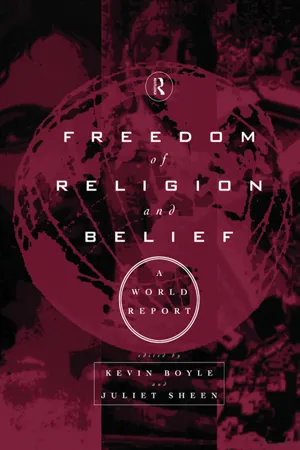
Freedom of Religion and Belief: A World Report
About this book
This report, the first of its kind yet to be published, provides a detailed and impartial account of how the individual's right to hold beliefs is understood, protected or denied throughout the world. Consisting of accessible, short edited entries based on drafts commissioned from experts living in the countries surveyed, it exposes persecution and discrimination in virtually all world regions. The book:
* provides an analysis of United Nations standards of freedom of religion and belief
* covers over fifty countries, divided into regions and introduced by a regional overview
* covers themes including: the relationships between belief groups and the state; freedom to manifest belief in law and practice; religion and schools; religious minorities; new religious movements; the impact of beliefs on the status of women; and the extent to which conscientious objection to military service is recognised by governments
* draws on examples of accommodation and co-operation between different religions and beliefs and identifies the main challenges to be overcome if the diversity of human conviction is to be established.
Information
Topic
Theology & ReligionSubtopic
PoliticsEurope
REGIONAL INTRODUCTION
Old and new regional international organisations are following common policies to build democratic security and human rights throughout the continent. The values for which the Council of Europe has worked for fifty years, pluralism, human rights, democracy and inter-cultural tolerance, are now central to the mandate of the Organisation for Security and Cooperation in Europe (OSCE) and the European Union. The interest in and imperative for increased cooperation has been promoted partly by traumatic memories of Europe’s past conflicts and even genocides, but also by a sense that Europe has developed its culture from many sources, including Jewish, Christian and Muslim principles of humanity and tolerance.
Where religious identity coincides with nationhood, ethnicity, minority status, linguistic heritage or regional predominance, one finds religion quickly exploited, even by erstwhile atheistic politicians, to justify struggles for self-determination or independence. Too seldom do they enlist—or do religious leaders and people assert—the capacity for religion to promote cooperation, harmony and reconciliation.
The religious component in many European tensions and conflicts is sometimes incidental or contrived, but it can become explosive, especially as atavistic emotions or traumatic memories are revived. The atrocities perpetuated in the Bosnian conflict now being examined by the UN War Crimes Tribunal at The Hague offer a grim illustration. One of the contrasts of Europe is that such a secular and materialistic climate can still sustain primitive, exclusivist, ignorant and arrogant manifestations of religious hate. Northern Ireland is a recurrent depressing example.
It is one of the great paradoxes of the present decade that, even as virtually all constitutions across the continent guarantee freedom of religion, conscience and belief, there are new possibilities of misusing or reducing such liberties. There is growing concern that freedom to preach and to choose one’s religion can be misused, both by established or majority religions and by new religious movements, and can become a licence for violent or insidious forms of proselytism or sectarianism. However, it is still possible for some governments to invoke principles of ‘national unity’ or ‘laicity’ in order to inhibit or even to persecute authentic forms of religious or cultural self-definition, especially those practised or expressed by minorities.
With the establishment of constitutional guarantees of protection, at least for majority religions, throughout Europe, the debate about religious liberty has largely shifted away from how governments practise tolerance to how religious communities show tolerance and afford freedom of conscience and belief to their own members and to their neighbours of other faiths or ideologies. Ecumenism among adherents of the various confessional forms of the same religion has developed widely throughout Europe but is often affected, although not determined, by widely varying church-state relations.
Still greater contrasts of practice appear when the issue widens beyond cooperation and reciprocity among Christians to relationships among people of various religions in Europe and their relations with the state. Rights which had been protected for Christians and Jews are being extended to Muslims and others, but not without considerable resistance or reluctance on the part of many in the majority communities.
Since Muslims constitute the largest religious minority in most European countries, and the majority in Albania and Turkey, many issues of freedom of religion, conscience and belief in Europe involve the complex history of Christian-Muslim rivalry and hostility (and of their positive and fruitful interaction). Both educational and political efforts are needed to sustain the liberal and open elements in a European Islamic society which is too often caricatured and demonised in the press and from fascist political platforms.
Jews continue to be victims of intolerance in Europe. Anti-Semitic acts have been widely reported. It is a mark of how vulnerable a religious minority in Europe can be that, despite so much information and education about the Holocaust, revisionist historians and manipulative politicians can still be active. Historical memory can also be very short about, for example, the sufferings of Armenians, Serbs or Roma-Sinti people.
Religions in Europe, so long marginalised and manipulated, too often weak and self-serving as their adherents’ own self-criticism makes clear, are still part of the human dimension and the ‘soul’ of Europe. They need to be protected and given their rights, but they should not misuse those rights by sowing discord or enmity. They need to exercise their responsibilities to show tolerance within their own communities and between their various communities, but also with those neighbours who may ignore or reject religious beliefs.
ALBANIA
| Albania | |
| GDP (US$bn) | 3.3b |
| Population | 3,400,000 |
| Annual population growth (%) | 2.3 |
| Urban population (%) | 36 |
| Working population (%) | 48a |
| Literacy (%) | 85 |
| Ratifications | 1; 2; 3; 4 |
The Republic of Albania offers the most vivid example of transition in the former communist world on the issues of freedom of conscience. Albania was the poorest, smallest and most isolated of the former communist European states. It was a prison state with many thousands of political prisoners; the President of the Ex-Political Prisoners Society, Osmar Kazazi, spent almost forty-two years in prison or detention, almost the entire span of the Hoxha regime. For nearly four decades, the Albanian government attempted to eliminate all forms of religion from society, substituting an atheistic ideology. Enver Hoxha died in 1985. Since 1990, Albania has sought to establish a democratic state with guarantees of basic human rights, including the freedom of religion or belief. A measure of its success was acceptance of its application to join the Council of Europe in 1995. However, elections in May 1996 were reportedly marked by allegations of irregularities and police assaults on socialist supporters.
The atheist state
In November 1944, the Communist Party initiated a new constitution in which Article 15 stated: ‘Freedom of conscience and belief is guaranteed to all citizens…Religious communities are free to exercise and practise their religions.’ A few months later an agrarian reform bill was passed which deprived religious institutions of much of their property. The Jesuit and Franciscan orders were closed and foreign Catholic priests, nuns and monks were expelled from Albania. Dozens of local clergy and intellectuals, Catholic, Muslim and Orthodox, were accused of ‘propaganda against the state’, tried and sentenced, imprisoned and tortured because of their beliefs; many were executed or died in prison or in suspicious circumstances.
Religious persecution became a tool in the hands of the dictatorship whose aim was to reshape the spiritual life of the believers according to communist patterns. Centuries of Ottoman and other foreign rule made the new government feel vulnerable to external influence and internal dissent. In 1949, the Presidium of the People’s Assembly ordered each of the four principal religious communities—Muslim, Bektashi (Shia Muslim), Orthodox and Catholic—to prepare draft statutes in which a pledge of loyalty to the state was to be expressed. Once the decrees were in force, penal sanctions protecting the constitutional guarantee of freedom of religion were removed.
The atheisation of Albania was achieved through the closing down of all foreign religious communities, orders, associations and missions, a mass persecution of clergy, the closing of mosques and churches, confiscation of property and religious objects and public ridicule of religion as ‘the opiate of the people’. According to personal testimonies of those who survived, the years 1966–67 were the worst as the ethos and methods of the Chinese Cultural Revolution were transplanted to Albania. At the Fifth Party of Labour Congress in 1966, the dictator Enver Hoxha called for an offensive against religion and religious institutions which began with the closing down of St Nichel’s Church in the Lezha district in December 1966; the village priest was dismissed and the church building was adapted into a house of culture. By the end of the 1960s, the government had wiped out all forms of organised clergy in Albania.
Hoxha’s 1967 circular, entitled On the Fight Against Religion, Religious Prejudices and Customs, guided all the district party committees to
spearhead our struggle against religion, concentrating on religious dogmas, its philosophical principles, especially its idealistic and mystic contents, as well as against religious rites which have become part of the daily life of the believers, and of the unbelieving, too.
At the end of this period, 2,169 religious institutions, including 740 mosques, 508 Orthodox churches and monasteries, 157 Catholic churches, 530 tekkes and other holy Muslim places, had been closed down or demolished.
The 1976 Albanian constitution and the 1977 Penal Code laid down in statute the Albanian regime’s campaign against religion. The country’s laws now openly sanctioned the theory and practice of discrimination against freedom of thought and basic human rights. Article 37 of the 1976 constitution stated: ‘The state recognises no religion whatever and supports atheistic propaganda for the purpose of inculcating the scientific materialist world outlook in the people.’
Article 55 of the Penal Code on agitation and propaganda against the state provided an anti-democratic legal framework:
fascist, anti-democratic, religious, warmongering, anti-socialist agitation and propaganda, as well as the preparing, distribution and keeping of literature of such content with the intention and purpose of weakening or undermining the state of the dictatorship of the proletariat is punishable with privation of freedom from three to ten years.
The catalogue of abuses lists severe penalties for owning a Bible or Qur’an, the enforcement of the name-change programme—religious names were excluded from ‘suitable’ national names for new-born infants and religious place names were altered—and a total prohibition of religious symbols and sharing one’s religious beliefs and customs. The atheisation programme proved ineffective in so far as a diminished form of private religious sentiment and practice survived in Albania. However, the impact of the repression on the expression of beliefs among Albanians was so profound that it has been noted that the clandestine nature of such religious practice as survived resulted in its lacking reference to public and institutional religion, thus often depriving practitioners of its religious meaning. Fearing that their children would reveal family religious practices, as they had been taught to do in school, adults were inhibited from practising religion in the privacy of their homes, which in turn prevented them from handing their beliefs down to the younger generation.
Restoration of freedoms and constitutional initiatives
In 1990, the wind of freedom and democracy which swept across Eastern and Central Europe also swept through Albania. Two constitutional initiatives have supported restoration of guarantees of freedom of conscience, religion or belief. First, Albania’s ‘temporary constitution’ in 1991 was supplemented by a Charter of Rights in 1993. According to Article 7, ‘The Republic of Albania is a secular state. The state respects freedom of religious faith and creates conditions to exercise it.’ Second, the draft constitution of the Republic of Albania, ‘the new Albanian constitution’, received nationwide discussion but was rejected in a national referendum in November 1994.
Albanians quickly adjusted to the new reality. Even before the ‘temporary constitution’ was voted in, church bells in Shkodra and Korea were ringing again and a visitor to Tirana was able to hear prayers said from the city’s central mosque. Soon, at the request of Albanian authorities, the international community began helping the country’s ‘revolutionary’ politicians in drafting new legislation and the world of religion moved in. Public ‘evangelism’ and restoration of religious buildings accelerated.
There have been several efforts to draft law on religions. In 1991 a proposal would have required leaders of religious groups to be of Albanian nationality and approved by the President of the Republic on the recommendation of the particular religious community. Seen as an Albanian reaction to fears of Greek influence, this sparked sustained protest. A different law was published in 1993, but not acted upon.
A ‘Law on Communist Genocide’, passed in 1995, excludes from politics anyone who held a Communist Party post before March 1991 and appears intended to help strengthen the present government’s hold on power. Elections held in spring 1996 were condemned by foreign observers as unfair.
Social and religious composition
Albania contains three traditional religious groupings among its 3.4 million people: 65 per cent Muslim, 23 per cent Orthodox (predominantly to the south) and 12 per cent Catholic (to the north). The Muslim-descended population, two-thirds of Albanians, reflects the influence of centuries of Ottoman rule. Reluctantly, the traditional communities are admitting the limitations of these statistics as another, major group needs to be included as well: the non-believers, many of whom are atheists. More than twenty, mostly Christian, denominations have prepared statutes and filed requests for official registration with the state in recent years; their presence is not reflected in the traditional divisions of Albanian religion.
The Greek minority is the largest ethnic minority; others are Vlachs, Roma and Slav speakers and small numbers of Armenians. During the communist period Greeks (along with other national minorities) were subject to serious discrimination and human rights abuses, particularly in terms of religious freedom, education in their mother tongue and freedom of publication. Today, political radicalisation in the Greek minority has led to confrontations and a much criticised trial in 1994 of activists of the Democratic Union of the Greek Ethnic Minority People of Albania (OMONIA).
Religion-state relations
The new religious freedom and democratic reality exposed a genuine difficulty for many Albanians. In the words of the Muslim representative of the Secretariat for Relations with Religious Communities of the Council of Ministers:
We have a dilemma here. How to operate in this new situation by protecting religious liberty for every religion, yet maintaining religious harmony among the three main religions. We may be violating human rights if we impose restrictions, yet we feel like protecting the existing order.
Political machinations present obstacles in the way of codifying guarantees of freedom of conscience; these are reminiscent of the recent infamous past and supported by a rhetoric of intolerance both in parliament and in the public media. Parliamentarians admit that the proposed law and the new constitution reflect the political preferences of the majority religious group, Muslims. The case of the Greek minority’s autocephalous Albanian Orthodox Church—after the enthronement of the Orthodox Archbishop who is of Greek nationality—has been handled with political expediency. The Albanian government considered the appointment of a Greek national as a ‘temporary’ appointment ‘until an Albanian priest is prepared to assume his functions’. Four Greek bishops appointed by the Archbishop were refused entry to Albania because of their nationality. Most of the Christian denominations in Albania, whose clergy were almost wiped out during the decades under communism, are currently headed by expatriates, not Albanian nationals. The much smaller Sv Jovan Vladimir Orthodox Brotherhood, related to the 45,000 Serbs, Montenegrins and Govanci living in Albania, has been promised registration after threatening to complain to the Organisation for Security and Cooperation in Europe.
The issue of requiring Albanian citizenship and nationality of a leader of an Albanian religious community is thus perceived as a limitation of religious freedom, and the particular matter of the Orthodox Church and the Greek community was taken up with the government by the Special Rapporteur on Religious Intolerance in his 1994 and 1995 reports.
Tensions also exist within the constitutional, governmental and social context between applying the provision of ‘separation of religion (church) and state’ and attempts to reestablish Albania as a religious state. Sociological data available today disprove the notion that the majority of Albanians are in fact Muslim. It is evident that the majority of Albanians are non-believers. The intellectual and non-Muslim communities are afraid that monopolies of the past are being turned into new monopolies, often supported by politically motivated foreign religious forces. This confusion was amplified when President Berisha brought the country into the Islamic Conference, as a member of the W...
Table of contents
- Cover
- Halftitle
- Title
- Copyright
- Contents
- Editorial
- Preface
- United Nations Declaration
- Acknowledgements
- Note from the editors
- List of abbreviations
- Key to statistics
- Introduction
- Africa
- The Americas
- Asia-Pacific
- Europe
- Middle East
- Select bibliography
- Index
Trusted by 375,005 students
Access to over 1.5 million titles for a fair monthly price.
Study more efficiently using our study tools.
Frequently asked questions
Yes, you can cancel anytime from the Subscription tab in your account settings on the Perlego website. Your subscription will stay active until the end of your current billing period. Learn how to cancel your subscription
No, books cannot be downloaded as external files, such as PDFs, for use outside of Perlego. However, you can download books within the Perlego app for offline reading on mobile or tablet. Learn how to download books offline
Perlego offers two plans: Essential and Complete
- Essential is ideal for learners and professionals who enjoy exploring a wide range of subjects. Access the Essential Library with 800,000+ trusted titles and best-sellers across business, personal growth, and the humanities. Includes unlimited reading time and Standard Read Aloud voice.
- Complete: Perfect for advanced learners and researchers needing full, unrestricted access. Unlock 1.5M+ books across hundreds of subjects, including academic and specialized titles. The Complete Plan also includes advanced features like Premium Read Aloud and Research Assistant.
We are an online textbook subscription service, where you can get access to an entire online library for less than the price of a single book per month. With over 1.5 million books across 990+ topics, we’ve got you covered! Learn about our mission
Look out for the read-aloud symbol on your next book to see if you can listen to it. The read-aloud tool reads text aloud for you, highlighting the text as it is being read. You can pause it, speed it up and slow it down. Learn more about Read Aloud
Yes! You can use the Perlego app on both iOS and Android devices to read anytime, anywhere — even offline. Perfect for commutes or when you’re on the go.
Please note we cannot support devices running on iOS 13 and Android 7 or earlier. Learn more about using the app
Please note we cannot support devices running on iOS 13 and Android 7 or earlier. Learn more about using the app
Yes, you can access Freedom of Religion and Belief: A World Report by Kevin Boyle,Juliet Sheen in PDF and/or ePUB format, as well as other popular books in Theology & Religion & Politics. We have over 1.5 million books available in our catalogue for you to explore.