- 192 pages
- English
- ePUB (mobile friendly)
- Available on iOS & Android
eBook - ePub
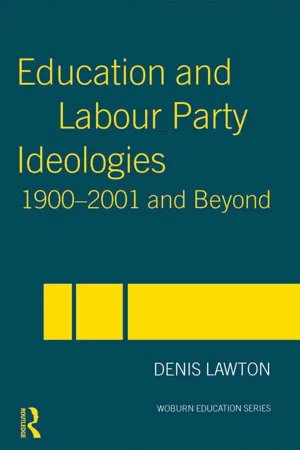
Education and Labour Party Ideologies 1900-2001and Beyond
About this book
In 1997 Tony Blair broke with tradition by naming education as a major priority for the General Election Manifesto. In the past, Labour leaders had tended to give education a much lower priority. Despite this, Blair has been greatly criticised for his educational programme 1997-2001. Was he taking education away from traditional labour values of fairness and equality? Was Blair's 'Third Way' just 'Thatcherism in Trousers'?
Denise Lawton approaches such questions by analysing labour education policies since 1900 and shows that from the very beginning the labour Party lacked unity and ideological coherence concerning education. Specifically, there has always been a tension between those like the early Fabians who saw educational reform in terms of economic efficiency, and the ethical socialists whose vision of a more moral society stressed the importance of social justice in education. After an assessment of Labour ideologies in the past, this book concludes with an examination of New Labour and the 'Third Way' in education and suggests some changes that will be necessary in the near future.
Information
1
Nineteenth-century background
By the turn of the century several of the major assumptions which had guided Victorian economic and social policy were being questioned. At the centre lay the body of ideas known as laissez-faire.
(John Stevenson in Pimlott, 1984, p. 15)
The history of the Labour Party begins in 1906, or 1900 if you prefer to date the founding of the Party from the establishment of the Labour Representation Committee (LRC). In any case, it is necessary to stress the importance to the Labour Party of various events, movements and ideas, including socialism, in the nineteenth century that have left some kind of permanent legacy. This chapter is intended to paint in that background but trying not to over-simplify an extremely complex story.
England in the nineteenth century
The nineteenth century opened with England at war with France. In the eighteenth century there had been two great changes – the Industrial Revolution and the French Revolution, both of which strongly influenced the development of education. France had been a commercial and colonial rival for centuries, and in 1800 Nelson was establishing British naval supremacy throughout the world; in 1815 Wellington (with a little help from the Prussians) would finally defeat Napoleon who had been seen not only as a military threat but, curiously, as a symbol of the subversive thinking of the Enlightenment and of the French Revolution and the wars that followed. A major result of the Industrial Revolution was urbanisation with all its advantages and disadvantages.
After 1815 there was much discontent in England: food prices were high but wages were low, with many workers unemployed. Working-class living conditions were often appalling. The government responded to the problem of disaffection with harsh, repressive legislation and incidents such as the notorious Peterloo ‘massacre’. Elsewhere in Europe the scene generally became one of conservative political regimes, designed to put the clock back to pre-1789 ways of life. The intellectual ethos was also conservative, even reactionary. Such writers as Chateaubriand in France and many others in England were openly anti-democratic. Queen Victoria, much later in the century, declared that she would not wish to be a monarch in a democracy.
In 1848, there were uprisings in Germany, Italy and France which caused some alarm in Britain, but there was no serious threat of revolution in England apart from the Chartists who were by then in decline.
By the end of the century, Britain was less confident and becoming less powerful; for example, confidence had been shaken by the ‘Great Depression’ from about 1876. Although the seriousness of this setback has sometimes been exaggerated, there were fears at the time, by politicians and many others, that Germany and the USA were overtaking Britain industrially, in some respects, as well as in military power. At a more abstract level the Victorians were disturbed by Darwin’s ideas about evolution (published in 1857).
After a series of conflicts, in Zululand, Afghanistan, China and the Crimea, the century ended with Britain again at war, the Boer War. It was significant that Britain was fighting an imperialist war far away from Europe, and not doing very well. A major difference between 1800 and 1900 was a changing attitude to the concept of imperialism which affected many aspects of life in Britain, including education. Queen Victoria had become Empress of India in 1876.
An age of reform
Despite a background of poverty and injustice in a rapidly urbanising society, the nineteenth century in England has often been referred to as an ‘Age of Reform’. Partly as a result of the Chartist movement, Britain gradually approached the principle of one person one vote, as the franchise was extended. Before the end of the century, some precursors of the suffragettes were indicating that women’s rights could not be ignored for ever (Married Women’s Property Acts were passed in 1870 and 1882). Legislation to humanise working conditions in factories and mines was gradually introduced, but started from a low base: exploitation and oppression of men, women and children had been taken for granted, but public opinion was changing. Trade unions were developing; they were eventually accepted and legalised, and the TUC was established in 1868. Victorian morality changed in several respects that indicated an increase in humanitarianism: for example, the abolition of slavery and flogging in the army; better care for the sick and the wounded (personified by Florence Nightingale); more humane treatment of children – including in schools – the National Society for the Prevention of Cruelty to Children was founded in 1884 (preceded in 1824 by the Royal Society for the Prevention of Cruelty to Animals).
Parliamentary reforms
At the beginning of the nineteenth century discussions were taking place about the reform of Parliament, but many regarded the status quo as all but perfect, despite the existence of ‘rotten boroughs’, ‘pocket boroughs’, the possibility of MPs buying their seats, and other practices which came to be regarded as ‘corrupt’. At the beginning of the century there were loose groupings of Whig and Tory members, but nothing like the tight discipline and control over parties that developed in the twentieth century; the system was only slowly moving towards the idea of a two-party system of government with a ‘loyal opposition’. The King or Queen was regarded as a ‘constitutional’ monarch with limited powers, but certain royal prerogatives remained in England that from time to time caused constitutional problems, even minor crises.
The three Parliamentary Reform Acts during the century (1832, 1867 and 1884) gradually extended the franchise to members of the middle classes, and even to more affluent working-class men. This tended to sharpen the distinction between Tories and Liberals (who replaced the Whigs as the second major party). No one represented working-class and trade union interests as such, although the Liberal Party tended to be more sympathetic to some of the causes of the under-privileged, and even sponsored a few working men as parliamentary candidates, the Lib-Labs. The Liberal Party was certainly not a working-class party, and it was this vacuum that the Labour Party was to fill in the twentieth century, eventually replacing the Liberal Party as the main party of the left. Not many working men stood for Parliament in the 1868 general election, following the 1867 Reform Act. The Labour Representation League was set up in 1869 partly to make sure that working-class men eligible to vote were registered. But the League lacked money to support candidates or MPs. Trade unions were not yet in a position to provide financial help. The practical solution had seemed to be to work with the Liberal Party. So it might have remained had the Liberals been more co-operative, but in many constituencies they were hostile to working-class candidates: in the 1874 election only two working-class men were elected with Liberal support.
The idea of a separate party gradually gained ground although many trade unionists remained loyal to the Liberals. A major reason for the emergence of the Labour Party was that it was, above all, a party committed to working-class representation. As such, it brought together a number of quite different ideologies and traditions: Liberal, Radical, Fabian and various shades of socialist thinking including ethical socialism, Christian socialism and Marxism. It was not surprising that such a mixture would give rise to internal disputes about policies. Those looking forward to a revolution were a small minority, but there were varying degrees of attachment to ‘class conflict’ and opposition to capitalism. From the beginning the majority view was that parliamentary methods should be followed, and violence should be avoided.
Industrialisation and the roots of socialism
By the 1880s, socialist politics, as distinct from working-class politics, was developing: criticisms of laissez-faire capitalism were increasing, not only from theorists such as Robert Owen and Karl Marx, who was still little known, but in private and public discussions of various kinds, such as socialist clubs and debating societies. The word ‘socialist’, according to the Oxford Dictionary, was first used in the 1830s, but Tony Crosland found an earlier example in The Cooperative Magazine in 1827. It referred to the London ‘Co-operators’ whose socialism was based on an ethical view of society (Crosland, 1956, pp. 101–2). Much of the early use of the word in Britain was connected with Robert Owen (1771–1859) whose vision of a better society was based on moral principles such as social justice. Some would say ‘liberty, equality and fraternity’, adding ‘for all’ to distinguish socialist doctrine from the less inclusive values of the revolting French bourgeoisie in 1789 who still linked rights with property. It would not be appropriate to attempt a comprehensive definition of socialism here; better to accept it as a general word that embraces a wide range of attitudes. Some socialists would agree with Clem Attlee: ‘I joined the socialist movement because I did not like the kind of society we had and wanted something better’ (As it Happened, 1954). I would, therefore, like to stress that socialism is a relatively modern idea resting on two post-Enlightenment concepts: first, the notion of progress; second, the principle that all adults should be treated equally – hence another possible connection between socialism and women’s rights.
In addition, a number of non-socialist writers, for example Thomas Carlyle (1795–1881), were influential. Carlyle’s view of society was essentially that of a romantic, right-wing radical who disliked the decadent, modern industrial society with its utilitarian emphasis on the cash-nexus and laissez-faire individualism which he regarded as morally inferior to the old paternalistic links that had involved duties and obligations. Carlyle was also critical of the landowning aristocracy who produced nothing (except piles of birds they shot from time to time). His thinking, although backward-looking in some respects, was seeking some kind of non-materialistic social philosophy. He had briefly flirted with the ideas of Saint-Simon, but was not attracted by Chartism, British socialism or even democracy. From the point of view of Labour ideas his importance was that he was highly critical of the existing society and was advocating something morally superior to the dominant values of Victorian Britain. Many early Labour leaders had read Carlyle and been influenced by him.
John Ruskin (1819–1900), was equally dissatisfied with industrialism. He recognised the impossibility of reverting to the old order, and saw the need for a new kind of society. Ruskin went further than criticising the ugliness of industrial society, setting up a model farm to be worked as a co-operative by a group of Sheffield socialists. The experiment failed but perhaps added credibility to his progressive sentiments. Ruskin was best known for his books on art and architecture but his mature writings contain interesting examples of powerful social criticism, for example, Unto This Last (1860–62). He also wrote letters to ‘the working men of England’ which were published as Fors Clavigera (1871–84). He said that the modern factory with its division of labour prevented a genuine relationship between a worker and his work; labour had become meaningless and was a burden rather than the joy it ought to be.
Ruskin frequently criticised nineteenth-century education for being based on wrong values such as competition rather than ‘brotherhood’. He also believed that art should be a central concern of education for all – girls as well as boys. His writings influenced individuals as different as William Morris and Gandhi who claimed that reading Ruskin had changed the course of his life. C.P. Trevelyan who, as we shall see, moved from the Liberal Party to Labour, also expressed enthusiasm for Ruskin. Writers, on the right as well as on the left, had the effect of casting doubt on the values and practices of laissez-faire capitalism. Some readers of all classes were impressed by the kind of social criticism they found in Carlyle and Ruskin, and, a little later, in William Morris. All these writers helped to change public opinion. (Henry George’s lecture tour of 1882 was also influential.)
To achieve radical reform it was necessary to have direct access to the power of Parliament. The Liberal Party had not gone far enough to satisfy working-class demands. There were considerable numbers of working men’s clubs and local socialist societies but they were not suitable for organising elections or raising funds sufficient to pay MPs once they were elected. The Lib-Lab idea became increasingly discredited as a means of supporting working-class interests. This was the main reason for trade unions deciding to line up with such organisations as the Fabian Society and the Social Democratic Federation to get more working-class representatives elected to Parliament and to have a party organisation to support them once they were there. To say that the Labour Representation Committee (LRC) and, a few years later, the Labour Party was ‘a broad church’ is to underestimate the range of beliefs within ‘Labourism’ at the beginning of the twentieth century and the hostility between some of the groups. Not all of the groups or individuals within Labour gave education a high priority.
Education in the nineteenth century
Throughout the century two sharply different attitudes towards the education of the poor were developing. At the beginning of the nineteenth century, the prevailing upper-class view was that education was essentially a private matter and that if any interference by government were undertaken it should be to assist, but not to provide, a deliberately inferior kind of education for the children of the poor. Even the philosophical radicals, often regarded as educational reformers, did not advocate education of high quality for working-class children. They believed that in a modern society all children should be educated, but capitalism demanded different kinds of education and training for different classes: capitalism could not work if all children received exactly the same kind of education.
At the opposite extreme, the developing socialist view was that in the long run education should be free, with equal opportunity for all – girls as well as boys; in the short run action should be taken to give the children of the poor as much access to education as possible.
Some who have been referred to as reformers, such as Hannah More (1745–1833), were firmly in the first category – she believed in reading, but no writing, for children of the poor. Other ‘reformers’ wanted a limited amount of education for the poor, for religious and humanitarian reasons, but would have drawn the line a long way from equality. For example, in 1802 the elder Sir Robert Peel had introduced the ‘Health and Morals of Apprentices Act’ which limited the hours of work of pauper children employed as apprentices in factories to 12 hours a day. His intention was to prevent unscrupulous mill owners from having an unfair advantage over ‘enlightened’ employers. This was the first of a series of ‘Factory Acts’; in some of the Acts education is referred to as part of the argument for limiting working hours, but the intention was to provide basic instruction, not to challenge ‘middle-class education’.
In 1807 Samuel Whitbread introduced a Parochial Schools Bill proposing 2 years free schooling for children between 7 and 14. It was strongly opposed, among others, by Davies Giddy, MP, who claimed that education for the labouring classes ‘would be prejudicial to their morals and happiness; it would teach them to despise their lot in life, instead of making them good servants in agriculture and other laborious employments. Instead of teaching them subordination, it would render them fractious and refractory … it would enable them to read seditious pamphlets, vicious books … it would render them insolent to their superiors’ (Hansard Vol. IX, 1178) quoted by Barnard (1961, p. 55).
Soon after this Robert Owen (1771–1858) published A New View of Society (1813) in which he described the school at his mill in New Lanark. Few industrialists followed his example, but in 1818 a committee which included James Mill and Henry Brougham started a school, following Owen’s model, in Westminster, and in 1820, another in Spitalfields. They appointed Samuel Wilderspin (1792–1866) to take charge. He published an interesting book On the Importance of Educating the Infant Children of the Poor (1823). We will return to both Owen and Wilderspin in a later section on educational ideas.
In May 1816 Henry Brougham (1778–1868) had moved for a select committee to enquire into the state of education among the poor. This was granted, Brougham became chairman and introduced a number of education Bills advocating some kind of state involvement, but none of them was passed. In 1833, the Radical MP, John Roebuck, asked the House to consider ‘the means of establishing a system of National Education’. The scheme proposed was complex and was too ambitious to be acceptable to the Commons. But there was support for the more modest idea of giving some financial help towards the education of the poor, and a few days later Lord Althorp, Chancellor of the Exchequer, included in his budget a sum of £20,000 to be made available to the two religious societies (the Church of England National Society and the Non-Conformist British and Foreign Schools Society) to be spent on school buildings. In 1839 in order to make sure that the government money was being properly spent, a Committee of the Privy Council on Education was set up with authority to appoint two inspectors of schools, Her Majesty’s Inspectors (HMI). This was not yet state education but there was an element of state control being introduced. Some advocates of working-class schools, for example, Hodgskin, objected very strongly to this development (see Simon, 1960, p. 215).
Both of ...
Table of contents
- Cover
- Half Title
- Title Page
- Copyright Page
- Contents
- Foreword and acknowledgements
- 1 Nineteenth-century background
- 2 The early years 1900–39: ideas and contradictions
- 3 World War II 1939–45
- 4 The Attlee governments 1945–51: missed opportunities in education
- 5 Labour in opposition 1951–64: a chance to theorise and revise
- 6 The Wilson governments 1964–70
- 7 Heath and a taste of Thatcher 1970–74
- 8 Wilson and Callaghan 1974–79
- 9 Thatcherism 1979–90
- 10 A Labour education policy found and lost 1990–97
- 11 Education, education, education or targets, targets, targets? 1997–2001
- 12 The future of Labour education 2001–10 and beyond: targets or worthwhile learning?
- Postscript October 2003
- Bibliography
- Index
Trusted by 375,005 students
Access to over 1.5 million titles for a fair monthly price.
Study more efficiently using our study tools.
Frequently asked questions
Yes, you can cancel anytime from the Subscription tab in your account settings on the Perlego website. Your subscription will stay active until the end of your current billing period. Learn how to cancel your subscription
No, books cannot be downloaded as external files, such as PDFs, for use outside of Perlego. However, you can download books within the Perlego app for offline reading on mobile or tablet. Learn how to download books offline
Perlego offers two plans: Essential and Complete
- Essential is ideal for learners and professionals who enjoy exploring a wide range of subjects. Access the Essential Library with 800,000+ trusted titles and best-sellers across business, personal growth, and the humanities. Includes unlimited reading time and Standard Read Aloud voice.
- Complete: Perfect for advanced learners and researchers needing full, unrestricted access. Unlock 1.5M+ books across hundreds of subjects, including academic and specialized titles. The Complete Plan also includes advanced features like Premium Read Aloud and Research Assistant.
We are an online textbook subscription service, where you can get access to an entire online library for less than the price of a single book per month. With over 1.5 million books across 990+ topics, we’ve got you covered! Learn about our mission
Look out for the read-aloud symbol on your next book to see if you can listen to it. The read-aloud tool reads text aloud for you, highlighting the text as it is being read. You can pause it, speed it up and slow it down. Learn more about Read Aloud
Yes! You can use the Perlego app on both iOS and Android devices to read anytime, anywhere — even offline. Perfect for commutes or when you’re on the go.
Please note we cannot support devices running on iOS 13 and Android 7 or earlier. Learn more about using the app
Please note we cannot support devices running on iOS 13 and Android 7 or earlier. Learn more about using the app
Yes, you can access Education and Labour Party Ideologies 1900-2001and Beyond by Denis Lawton in PDF and/or ePUB format, as well as other popular books in Pedagogía & Educación general. We have over 1.5 million books available in our catalogue for you to explore.