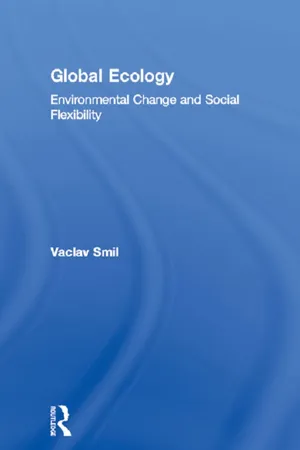
The magnitude and rapidity of global environmental change threatens the perpetuation of life on Earth. Many aspects of this crisis are familiar to us - the destruction of tropical rainforests, the hole in the Antarctic ozone, desertification, soil erosion - yet we avoid the underlying challenge of a rapidly deteriorating ecological system and the breadth and complexity of responses demanded.
Integrating an analysis of both social and environmental needs, the book explores the premises and problems of different paths towards global management.
With its emphasis on flexible response, Global Ecology furthers our understanding of biospheric change and of our abilities and weaknesses in managing the transition to a sustainable society.
- 256 pages
- English
- ePUB (mobile friendly)
- Available on iOS & Android
eBook - ePub
About this book
Information
1
ELUSIVE UNDERSTANDING
ELUSIVE UNDERSTANDING
WHY THERE IS SO MUCH UNCERTAINTY ABOUT ENVIRONMENTAL CHANGE
Perhaps too the difficulty is of two kinds, and its cause is not so much in the things themselves as in us.
Aristotle Metaphysics
Effective action may not require perfect understanding, but a sensible, realistic grasp is essential. After generations of intensifying scientific research and management experience we have such a knowledge to ease our way through many difficult environmental challenges—but we still lack it in a much larger number of cases, including most of the matters of critical global importance. Moreover, we will not be able to resolve most of the uncertainties during the next one or two generations, that is, during the time of increasing pressures to adopt unprecedented preventive and remedial actions.
Undoubtedly the greatest obstacle to a satisfactory understanding of the Earth’s changing environment is its inherent complexity, above all, the intricate and perennially challenging relationship of parts and wholes, a great yin-yang of their dynamic interdependence. But this objective difficulty is greatly complicated by subjective choices and biases of people studying the environment: overwhelmingly, they favour dissection and compartmentalization to synthesis and unification, they rely excessively on modelling which presents too frequently a warped image of reality, and they are not immune to offering conclusions and recommendations guided by personal motives and preferences.
This makes it very difficult to separate clear facts from subtle biases and wilder speculations even for a scientist wading through a flood of publications on fashionable research topics. Policy-makers often select interpretations which suit best their own interests, and the general public is exposed almost solely to findings with a sensationalizing, catastrophic bias. To come up with generally acceptable sets of priorities for effective remedies is thus very difficult—and bureaucratization and politicization of environmental research and management make it even harder to translate our imperfect understanding into sensible actions. Before addressing these complications, I will first review the genesis of our environmental understanding and the emergence of environmental pollution and degradation as matters of important public concern.
MODERN CIVILIZATION AND THE ENVIRONMENT
Yet we can use nature as a convenient standard, and the meter of our rise and fall.
Ralph Waldo Emerson, The Method of Nature (1841)
Shortly after the beginning of the twentieth century the age of the explorer was coming to the close. Yet another generation was to elapse before the last isolated tribes of New Guinea were contacted by the outsiders (Diamond 1988), but successful journeys to the poles—Robert Peary’s Arctic trek in 1909 and Roald Amundsen’s Antarctic expedition in 1911—removed the mark of terra incognita from the two most inaccessible places of the Earth (Marshall 1913).
Four centuries of European expansion had finally encompassed the whole planet. But this end of a centuries-old quest was not an occasion for a reflection on limits and vulnerabilities of the Earth: such feelings were still far in the future, in the time of Apollo spacecrafts providing the first views of the blue-white Earth against the blackness of the cosmic void.
For an overwhelming majority of people life at the beginning of the early twentieth century differed little from the daily experience of their ancestors two, ten, or even twenty generations ago. They were subsistence peasants, relying on solar energies and on animate power to cultivate low-yielding crops. Even the industrializing countries of Europe and North America were still largely rural, horses were the principal field prime movers, and there were hardly any synthetic fertilizers. Environmental degradation and pollution accompanied the advancing urbanization and mass manufacturing based on coal combustion, but these effects were highly localized.
Grimness of polluted industrial cityscapes was an inescapable sign of a new era —but not yet a matter of notable public, governmental or scientific concern. Study of the environment had little to do with changes brought by man. The earliest attempt at a grand synthesis of man’s impact on natural environments (Marsh 1864) was so much ahead of its time that it had to wait almost another century for its successor (Thomas 1956). But foundations were being laid for a systematic understanding surpassing the traditional descriptions. During the nineteenth century most of the available information about the Earth’s environment was admirably systematized in such great feats of advancing science as writings of Alexander von Humboldt (1849), Henry Walter Bates (1863) and Alfred Russel Wallace (1891), or in the maps of the British Admiralty. But our understanding of how the environment actually works was only beginning.
Rapidly advancing biochemistry and geophysics were laying the foundations for understanding the complexities of grand biospheric cycles. By the late 1880s Hellriegel and Wilfarth (1888) identified the nitrogen-fixing symbiosis between legumes and Rhizobium bacteria, by the late 1890s Arrhenius (1896) published his explanation of the possible effects of atmospheric CO2 on the ground temperature and Winogradsky isolated nitrifying bacteria (Winogradsky 1949). At the same time, Charles Darwin’s (1859) grand syntheses turned attention to the interplays between organisms and their surroundings, and physiologists offered revolutionary insights into the nutritional needs of plants, animals and men (Atwater 1895). Still, the blanks dominated, and the absence of highly sensitive, reproducible analytical methods precluded any reliable monitoring of critical environmental variables.
Wilhelm Bjerknes set down the basic equations of atmospheric dynamics in 1904—but climatology remained ploddingly descriptive for a few more decades (Panofsky 1970). Need for an inclusive understanding of living systems was in the air—but ecological energetics was only gathering its first tentative threads (Martinez-Alier 1987). And environmental studies everywhere retained an overwhelmingly local and specific focus and a heavily descriptive tilt with quantitative analyses on timid sidelines.
Everyday treatment of the environment did not show any radical changes—but new attitudes started to make some difference. The closing decades of the nineteenth century saw the establishment of the first large natural reserves and parks, and the adoption of the first environmental control techniques after a century of industrial expansion which treated land, waters and air as valueless public goods. The new century brought the diffusion of primary treatment of urban waste water and the invention of electrostatic control of airborne particulates (Bohm 1982). The two world wars and the intervening generation of economic turmoil were not conducive to greater gains in environmental protection, but a number of ecological concepts found its way into unorthodox economics as well as into some fringe party politics (Bramwell 1989).
Alfred Lotka (1925) published the first extended work putting biology on a quantitative foundation, and Vladimir Ivanovich Vernadsky (1929) ushered the study of the environment on an integrated, global basis with his pioneering book on the biosphere. Arthur Tansley defined the ecosystem, one of the key terms of modern science (Tansley 1935), and Raymond Lindeman, following Evelyn Hutchinson’s ideas, published the first quantification of energy flows in an observed ecosystem (Lindeman 1942). While its understanding was advancing, the environment of industrialized countries kept on deteriorating. Three kinds of innovations, commercialized between the world wars, accounted for most of this decline.
Thermal generation of electricity, accompanied by emissions of fly ash, sulphur and nitrogen oxides and by a huge demand for cooling water and the warming of streams, moved from isolated city systems to large-scale integrated regional and national networks (Hughes 1983). Availability of this relatively cheap and convenient form of energy rapidly displaced fuels in most industrial processes and started to change profoundly household energy use with the introduction and diffusion of electric lights, cooking and refrigeration. The last demand was largely responsible for the development of a new class of inert compounds during the 1930s: their releases are now seen as the most acute threat to the integrity of the stratospheric ozone (Manzer 1990).
The automobile industry shifted from workshops to mass production, making cars affordable for millions of people (Lacey 1986) and spreading the emissions of unburned hydrocarbons, nitrogen oxides and carbon monoxide over urban areas and into the countryside which became increasingly buried under asphalt and concrete roads. And the synthesis of plastics grew into a large, highly-energy-intensive industry generating toxic pollutants previously never present in the biosphere, and it introduced into the environment a huge mass of virtually indestructible waste (Katz 1984).
Post-1950 developments amplified these trends and introduced new environmental risks as the world entered the spell of its most impressive economic growth terminated only by the Organization of Petroleum-Exporting Countries’ (OPEC’s) 1973–4 quintupling of oil prices. In just 25 years global consumption of primary commercial energy nearly tripled, that of electricity went up about eightfold, and there were substantial multiples in demand for all leading metals, as well as in ownership of consumer durables. New environmental burdens were introduced with the rapidly expanding use of nitrogenous fertilizers derived from synthetic ammonia first produced in 1913 (Holdermann 1953; Engelstad 1985), and with the growing applications of the just discovered pesticides (dichloro-diphenyltrichloro-ethane (DDT) was first used on a large scale in 1944): nitrates in groundwater and streams and often dangerously high pesticide residues in plant and animal tissues.
Environmental pollution, previously a matter of local or small regional impact, started to affect increasingly larger areas around major cities and conurbations and downwind from concentrations of power plants as well as the waters of large lakes, long stretches of streams and coastlines and many estuaries and bays. Better analytical techniques were recording pollutants in the air, waters and biota thousands of kilometres from their sources (Seba and Prospero 1971). Only a few remedies were introduced during the 1950s. Smog over the Los Angeles Basin led to an establishment of the first stringent industrial emission controls in the late 1940s (Haagen-Smit 1970). London’s heavy air pollution, culminating in 4000 premature deaths during the city’s worst smog episode in December 1952, brought the adoption of the Clean Air Act, the first comprehensive effort to clean a country’s air (Brimblecombe 1987).
Electrostatic precipitators became a standard part of large combustion sources, black particulate matter started to disappear from many cities and visibility improved; this trend was further aided by the introduction of cleaner fuels—refined oils and natural gas—in house heating. But as the years of sustained economic growth brought unprecedented affluence to larger shares of North American and European populations, they also spread a growing uneasiness about intensifying air pollution and about degradation of many ecosystems. By the early 1960s these cumulative concerns pushed the environment into the forefront of public attention.
ENVIRONMENT AS A PUBLIC CONCERN
We cannot consider men apart from the rest of the country, nor an inhabited country apart from its inhabitants without abstracting an essential part of the whole.
A.J.Herbertson (1913)
Human impacts became first a matter of widespread public discourse and political import in the United States. Rachel Carson’s (1962) influential warning about the destructive consequences of pesticide residues in the environment has been often portrayed as the prime mover of new environmental awareness. In reality, the impulses came from many quarters, ranging from traditional concerns about wilderness preservation to new scientific findings about the fate of anthropogenic chemicals.
Mounting evidence of worsening air pollution was especially important in influencing the public opinion as sulphates and nitrates, secondary pollutants formed from releases of sulphur and nitrogen oxides started to affect large areas far away from the major sources of combustion. Europeans were first to note this phenomenon in degradative lake and soil changes in sensitive receptor areas (Royal Ministry of Foreign Affairs 1971). The decade brought also the first exaggerated claims about environmental impacts. Commoner (1971) feared that inorganic nitrogen carries such health risks that limits on fertilization rates, economically devastating for many farmers, may be needed soon to avert further deterioration. His misinterpretation was soon refuted (Aldrich 1980), but there was no shortage of other targets. Once the interest in environmental degradation began, the western media, so diligent in search of catastrophic happenings, and scientists whose gratification is so often achieved by feeding on fashionable topics, kept the attention alive with an influx of new bad news.
These concerns were adopted by such disparate groups as the leftist student protesters, who discovered yet another reason why they should tear down the ancien régime, and large oil companies which advertised their environmental pedigrees in double-page glossy spreads (Smil 1987). Search for the causes of environmental degradation brought theories ranging from an influential identification of the Judaeo-Christian belief (man, made in God’s image, set apart from nature and bent on its subjugation) as the principal root of environmental problems (White 1967), to predictable, and even more erroneous, Marxist-Leninist claims putting the responsibility on capitalist exploitation.
White overdramatized the change of the human role introduced by Christianity (Attfield 1983), and ignored both a greater complexity of Christian attitudes and an extensive environmental abuse in ancient non-Christian societies (Smil 1987). Emptiness of ideological claims was exposed long before the fall of the largest Communist empire by detailed accounts of Soviet environmental mismanagement (Komarov 1980).
In the summer of 1970 came the first attempt at a systematic evaluation of global environmental problems sponsored by the Massachusetts Institute of Technology (Study of Critical Environmental Problems 1970). The items were not ranked but the order of their appearance in the summary clearly indicated the relative importance perceived at that time. First came the emissions of carbon dioxide from fossil fuel combustion, then particulate matter in the atmosphere, cirrus cloud from jet aircraft, the effects of supersonic planes on the stratospheric chemistry, thermal pollution of waters and DDT and related pesticides. Mercury and other toxic heavy metals, oil on the ocean and nutrient enrichment of coastal waters closed the list.
Just a month later Richard Nixon sent to the Congress the first report of the President’s Council on Environmental Quality, noting that this was the first time in the history that a nation had taken a comprehensive stock of the quality of its surroundings. Soon afterwards his administration fashioned the Environmental Protection Agency by pulling together segments of five departments and agencies: environment entered the big politics. And it entered international politics with the UN-organized Conference on Human Environment in Stockholm in 1972 where Brazilians insisted on their right to cut down all of their tropical forests—and Maoist China claimed to have no environmental problems at all (UN Conference on the Human Environment 1972).
OPEC’s actions in 1973–4, global economic downturn and misplaced worries about the coming shortages of energy, turned the attention temporarily away from the environment but new studies, new revelations and new sensational reporting kept the environmental awareness quite high. Notable 1970’s concerns included the effects of nitrous oxide from intensifying fertilization on the fate of stratospheric ozone (CAST 1976), carcinogenic potential of nitrates in water and vegetables (NAS 1981), and both the short-term effects of routine low-level releases of radio-nuclides from nuclear power plants and the long-term consequences of high-level radioactive wastes to be stored for millennia (NAS 1980).
And with the economic plight of poor nations worsened by the higher prices of imported oil came the western ‘discovery’ of the continuing dependence of all rural and some urban Asian, African and Latin American populations on traditional biomass energies (Eckholm 1976) and the realization of how environmentally ruinous such reliance can be in the societies where recent advances in primary medical care pushed the natural increase of population to rates as high as 4 per cent a year. Naturally, attention focused also on other causes of defor...
Table of contents
- Cover Page
- Title Page
- Copyright Page
- Epigraph
- Contents
- List of figures
- Preface
- 1 Elusive Understanding
- 2 Existential Necessities
- 3 Environmental Change
- 4 Effective Strategies
- 5 Cascading Complications
- 6 Possible Outcomes
- References
- Index
Trusted by 375,005 students
Access to over 1.5 million titles for a fair monthly price.
Study more efficiently using our study tools.
Frequently asked questions
Yes, you can cancel anytime from the Subscription tab in your account settings on the Perlego website. Your subscription will stay active until the end of your current billing period. Learn how to cancel your subscription
No, books cannot be downloaded as external files, such as PDFs, for use outside of Perlego. However, you can download books within the Perlego app for offline reading on mobile or tablet. Learn how to download books offline
Perlego offers two plans: Essential and Complete
- Essential is ideal for learners and professionals who enjoy exploring a wide range of subjects. Access the Essential Library with 800,000+ trusted titles and best-sellers across business, personal growth, and the humanities. Includes unlimited reading time and Standard Read Aloud voice.
- Complete: Perfect for advanced learners and researchers needing full, unrestricted access. Unlock 1.5M+ books across hundreds of subjects, including academic and specialized titles. The Complete Plan also includes advanced features like Premium Read Aloud and Research Assistant.
We are an online textbook subscription service, where you can get access to an entire online library for less than the price of a single book per month. With over 1.5 million books across 990+ topics, we’ve got you covered! Learn about our mission
Look out for the read-aloud symbol on your next book to see if you can listen to it. The read-aloud tool reads text aloud for you, highlighting the text as it is being read. You can pause it, speed it up and slow it down. Learn more about Read Aloud
Yes! You can use the Perlego app on both iOS and Android devices to read anytime, anywhere — even offline. Perfect for commutes or when you’re on the go.
Please note we cannot support devices running on iOS 13 and Android 7 or earlier. Learn more about using the app
Please note we cannot support devices running on iOS 13 and Android 7 or earlier. Learn more about using the app
Yes, you can access Global Ecology by Vaclav Smil in PDF and/or ePUB format, as well as other popular books in Biological Sciences & Ecology. We have over 1.5 million books available in our catalogue for you to explore.