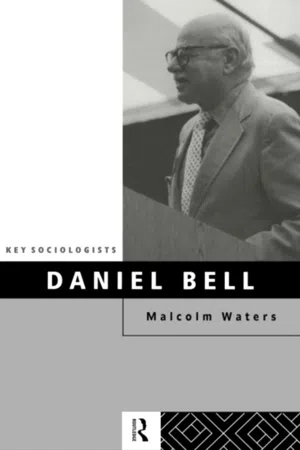
Daniel Bell is perhaps the most famous sociologist of his generation. He has been hailed as the prophet of the emergence of a new society, the postindustrial society, and as one of the leading conservative critics of contemporary culture.
In this invaluable introduction, Malcolm Waters presents Bell's arguments clearly and fairly, as well as noting the problems with his work. The three books that have made Bell famous, The End of Ideology, The Coming of Post-Capitalism are drawn upon, as well as his lesser known works on education and social forecasting. A thoroughly comprehensive account of a key, albeit highly controversial, contemporary sociological figure.
- 200 pages
- English
- ePUB (mobile friendly)
- Available on iOS & Android
eBook - ePub
Daniel Bell
About this book
Information
1
Return of a Prodigal Son
In the early 1970s Kadushin (1974) conducted a major research exercise to seek to establish the membership of the American intellectual elite. Using a sampling methodology that was only somewhat flawed he defined (public) intellectuals as people who contributed to a set of widely circulating magazines and journals but who were not themselves full-time journalists. He then surveyed this group, following a reputational methodology, to try to discover who was most influential among them, who constituted the elite. By counting votes he came up with a list of 70 names. He divided these 70 into three ranks according to ‘natural breaks’ in the distribution: the top ten, the next ten, and the rest. By dint of alphabetization, Daniel Bell’s name can be found first among the top ten (1974: 30–1).[1] He sits alongside such other key public figures as Noam Chomsky, John Kenneth Galbraith, Norman Mailer, Susan Sontag and Edmund Wilson. There is no other sociologist in the top ten, although Hannah Arendt and David Riesman are in the top twenty and Edgar Z. Friedenberg, George Lichtheim, Nathan Glazer, Seymour Martin Lipset, Robert K. Merton, Robert Nisbet and Franz Schurmann can be found lower down alongside W. H. Auden, Marshall McLuhan and Barrington Moore. The list includes neither of the leading theoretical sociologists, Alfred Schütz and Talcott Parsons, nor does it include either the leading empirical sociologists, Otis Dudley Duncan, Erring Goffman and Paul F. Lazarsfeld or the philosophers of social science, Carl Hempel and Ernest Nagel. Put simply, Kadushin’s research confirms the fair estimate that Daniel Bell is probably the most famous sociologist of the postwar generation[2] and, for that reason alone, a series on ‘key sociologists’ would be incomplete without a volume describing his work.[3]
Bell did not, however, become a famous sociologist by being a popularizer, like his nemesis, Alvin Toffler, that purveyor of what Bell calls ‘future schlock’. Rather, his influence derives from his capacity to take big ideas, that may or may not be of his own origination, and to have the courage and tenacity to run with them. While they may not be universally acceptable, all of them are pieces of good sociology because they have centred wideranging and long-standing academic debates. He is responsible for three big ideas that any professional sociologist will recognise: the end of ideology, the post-industrial society and the cultural contradictions of capitalism.
Bell first mounted his argument about the end of ideology in 1955 (EI;[4] also see Chapter 4). It suggests that party politics is entering a phase in which it is no longer governed by the extremist ideologies of the left and right and in which the political parties that are the major contenders for power are in broad agreement about the need for a mixed economy, a welfare state and liberal democracy. The post-industrial-society thesis was first mobilized about ten years later (COPIS; also see Chapter 6). It proposes that socio-economic structures are entering a major historical phase-shift out of manufacturing goods and towards the production of services. This shift is accompanied by an intellectualization of technology, the rise of a scientific knowledge class and a renewed communalism in politics. Bell floated his third big idea, that capitalist societies are riven by threatening and disruptive contradictions at the cultural level, as a sequel to the post-industrial-society thesis (CCC; also see Chapter 7). It argues that capitalism originated in a coherent relationship between an economy that demanded work discipline and a Protestant culture based on frugality and abstemiousness. As capitalism has developed, these ‘realms’ have been driven apart by an increasing emphasis on consumption. The main contradiction of capitalism lies between the continuing stress on discipline and hierarchy in the economy and an emphasis on the gratification of the self in the culture. For Bell this disjunction and its several subsidiary contradictions will eventually result in a decomposition of culture unless a fundamental reversal takes place.
These ideas have always been controversial and are fully accepted by almost no-one other than Bell himself. However, they have remained continuously on offer in the market place for sociological ideas since they were first formulated. It has now become impossible to address the prospects for long-term social transformation or to consider the turns being taken by modern culture without addressing Bell. We can begin this retrospective on his work with a brief examination of the biography that stimulates and directs it.
BIOGRAPHY[5]
Bell was born 1919 in the Lower East Side of New York City, in what used to be called the ‘garment district’. Most of his family had chain-migrated from the Bialystok area that lies between Poland and Russia. The patriarch was his paternal grandfather who sold coal in winter and ice in summer from a horsedrawn cart. The family name was Bolotsky but this was probably an invention only a few generations old, constructed to avoid military service. His father died when Bell was eight months old and he lived, along with his mother and siblings, with other extended kin, usually maternal sisters, until about 1927. Because his mother was employed full time as a pattern-maker, he was often placed in a Hebrew day orphanage according to the demands of work on his mother’s time. By the age of 11 Bell had a new legal guardian, his paternal uncle Samuel Bolotsky. Samuel was a dentist and upwardly mobile and the name Bolotsky did not fit such a career. So a group of cousins got together to choose new names – some became Ballin, some Ballot and some Bell. Notwithstanding these developments, Bell experienced the full gamut of poor, immigrant Jewish experience: Yiddish as the first language, Hebrew school, ethnic street gangs, petty crime, racketeering and the public poverty of waterfront shacks.
By his own supposition, these experiences of poverty predisposed Bell to become a socialist. When he was 13 he joined the Young People’s Socialist League, one of a number of socialist groups that lived in an uneasy relationship with the Jewish garment-workers’ unions. He joined after reading Upton Sinclair’s The Jungle, declaring to his melamed (teacher) that he had found the truth and no longer believed in God. An enduring picture of Bell is that at that tender age he spent long hours in the Ottendorfer branch of the New York Public Library reading not only socialism but sociology. By the age of 15 he was taking courses in dialectical materialism at the Rand School of Social Science. He was tempted by communism in both its Trotskyite and Stalinist varieties but he was persuaded by Rudolf Rocker, an old Anarchist, to read Berkman’s pamphlet ‘The Kronstadt Rebellion’. Reading about Trotsky and Zinoviev’s brutal decision to put down by force the naval mutiny at Kronstadt in 1921 persuaded Bell to remain a democratic socialist. At the City College of New York (CCNY) where he joined a socialist reading group called ‘Alcove No. 1’ Bell was regarded as something of an oddity. The other members, who included Meyer Lasky, Irving Kristol, Nathan Glazer and Irving Howe, were mainly Trotskyites and many were later to convert to become the core of the neo-conservative movement. In the fashion of a Talmudic scholar Bell knew his Marx verbatim but he remained opposed to violent revolution and committed to a mixed economy.
In retrospect, Bell interpreted his choice in terms of Weber’s famous distinction between the ‘ethics of responsibility’ and the ‘ethics of ultimate ends’ (1981). Like Weber he believes that simultaneous adherence is impossible because the former can involve a loss of principle while the latter sanctions abhorrent means. Like Weber, Bell opted for the ethics of responsibility because it provided the best answer to the question: ‘Given the existing conflict, how can I solve it with the least internal and external damage for all concerned?’ (1981: 537)
When Bell went to CCNY in 1935 he majored in classics rather than sociology. He chose to do so on the advice of a brilliant young communist instructor named Moses Finkelstein[6] who suggested that ancient history was the best preparation for sociology because one could there examine entire and coherent cultures. After he graduated in 1938 Bell spent a year in graduate school at Columbia University but without any apparent result. He left, for reasons unexplained, and spent most of the next 20 years of his life working as a journalist.[7] Most of the war years were spent at the New Leader, a vehicle mainly used by socialdemocratic supporters of the union movement, first as a staff writer and then as managing editor. From 1948–58 he was a staff writer and then Labor Editor at Fortune, the voice of American big business. In these roles he learned about the realities of political struggle and he also learned how to produce large volumes of written material quickly. He estimates that he wrote 426 articles in the 20 years after 1948 (WP: xviii n). Bell never lost this journalistic facility, even after entering academic life on a permanent basis. Indeed, the high point of his journalistic career might have been in 1965 when he founded The Public Interest with Irving Kristol as a forum for the rehearsal of great public debates.
Bell’s academic career began as early as 1945 when he accepted a threeyear appointment teaching social science at the University of Chicago. Later, during the Fortune years, he moonlighted as an adjunct lecturer in sociology at Columbia (1952–6). However, he moved out of journalism permanently in 1958 as an Associate Professor in the same university. He recalls his conversation on the occasion with the proprietor of Fortune, Henry Luce:
When I left Fortune in 1958 Mr. Luce was puzzled at my decision and asked for the reasons, with the thought that he might be able to match a rival offer. There are, I told Mr. Luce, four good reasons for going back to academe – June, July, August and September. Mr. Luce thought that more money might compensate for time, but I decided otherwise. I have never regretted that decision. [WP: xix n][8]
He received his Ph.D. from Columbia in 1960 for a compilation of his published work and was promoted to full Professor in 1962. He moved to Harvard in 1969 and was appointed to his prestigious endowed chair as Henry Ford II Professor of Social Sciences in that university in 1980.
Bell never shrunk from public life to the closeted comforts of the ivory tower. Most of his public service was devoted to insisting on a sociological contribution to planning for the future at the national level. He was seriatim: a member of the President’s Commission on Technology, Automation and Economic Progress 1964–6 and co-chair of its Panel on Special Indicators; chair of the Commission on the Year 2000 that he founded under the aegis of The American Academy of Arts and Sciences, 1964–74; American representative on the OECD’s Inter-futures Project, 1976–9; a member of the President’s Commission on a National Agenda for the 1980s and chair of its Panel on Energy and Resources; and a member of the National Research Council Board on Telecommunications and Computers.
In the later years of his career, Bell has been the recipient of numerous honours, prizes and visiting lectureships. The most prestigious of these include: Guggenheim Fellowships in 1972 and 1983; the Hobhouse memorial lecture at the University of London, 1977; Vice-President of the American Academy of Arts and Sciences, 1972–5; the Fels Lecture at the University of Pennsylvania, 1986; the Suhrkamp Lecture at Goethe University, Frankfurt, 1987; the Pitt Professorship in American Institutions and a Fellowship of King’s College, Cambridge, 1987–8; the American Academy of Arts and Sciences Talcott Parsons Prize for the Social Sciences, 1992; an American Sociological Association Award for a distinguished career of lifetime scholarship, 1992; and no less than nine honorary doctorates.
Bell retired from his professorship in 1990 and, rather than return to the distracting pulsations of New York, chose to remain within the leafy serenity of Cambridge, Massachusetts. He lives just across the street from the American Academy of Arts and Sciences to which he devoted much of his energy and at which he continues to hold the position of Scholar-in-Residence. He is still active:
[I]n recent years I have returned to journalism as a means of supplementing my retirement income, and in the last years I have done a considerable number of articles, most of these on economic and political questions. I write a monthly article for Shukan Diamond, a Japanese weekly on business affairs, and that article is now ‘syndicated’ by me and appears in Korea, Indonesia, Mexico, Italy and Spain. Occasionally, these appear in Dissent an American quarterly, such as a long one on the break-up of American capitalism. [Bell to Waters 30/8/93]
VALUE-COMMITMENTS
It is clear from his writing that Bell experiences all the torture of the contradiction between being a deep believer in the capacity of religion to provide meaning and simultaneously of not being a practising member of any religion. The key prodigal act was the declaration of atheism and the embracement of socialism that he made when he was thirteen.[9] While he has long-since returned from socialism, the return to religious practice has been much more difficult.
I am Jewish [but] I am not a Jew by faith in the fundamentalist sense; I’m not a believer in the narrow sense. I am a Jew by fate in terms of who we are. And that, it seems to me, has always been true, that Judaism has never been religion. Judaism is defined as being a people. [Simons 1988: 68]
Yet the promise of a cultural tradition that can stably provide meaning and morality remains tantalizing because the ties of ancestry remain: ‘I am bound, in the faith of my fathers, to the thread, for the cord of culture – and religion – is memory’ (WP: 354). Even a secularized ethnic Jewishness holds particular tensions for the intellectual – to embrace cosmopolitanism is to deracinate oneself, to make ethnicity central closes oneself off from the main debate. Bell is, therefore, in an important sense, a homeless wanderer.
I have found no ‘final’ place, for I have no final answers. I was born in galut and I accept – now gladly, though once in pain – the double burden and the double pleasure of my self-consciousness, the outward life of an American and the inward secret of the Jew. I walk with this sign as a frontlet between my eyes, and it is as visible to some secret others as their sign is to me. [WP: 322]
This tension is, according to Bell’s friend and mentor, Irving Howe, directly reflected in his sociological output.
[W]e thought we should know everything. … Meyer [Schapiro], I would say, is the ultimate example of the whole idea of range and scope. On a more modest level somebody like Danny Bell lives by the same notion. Behind this is a very profoundly Jewish impulse: namely, you’ve got to beat the goyim at their own game. So you have to dazzle them a little. [Howe 1982: 284]
The return from socialism was accomplished much more easily, although it has been the topic of much secondary speculation, often from Trotskyites who cannot make sense of the reversion (see e.g. Brick 1986; Leibowitz 1985). It happened in 1947 and, in retrospect, Bell describes it thus:
You see, a young man who’s very ambitious, such as I was, wants to write a book. In ’44–’45 I began a book and had a contract with John Day for a book called the Monopoly State. … I began sitting daily in the New York Public Library, in that famous room 315, and reading and reading, and suddenly I thought: all this is silly. I only know this second-hand; I know this by imputation: I’m using some mechanical categories; I’m making comments on them, and it’s all silly. I suddenly realized I was educated in a vulgar Marxist framework, if you want to put it that way, making imputations about corporate behavior and I never really knew what was going on. And suddenly I felt that all this was silly. I had a manuscript that was about 300 to 400 pages and I looked at it and I said to myself: this is really nonsense. [Leibowitz 1985: 65]
It is possible that Trotskyites and others make too much of Bell’s reconstruction and too little of the reconstruction of some others from the CCNY study groups more committed to communism, such as Howe, Lasky, Glazer and, in extremis, Kristol. Although Bell read Marx he was never a Communist, unless a Menshevik, so that the reversion was more like a deviation towards the centre than a volte face. Importantly, it coincided with several significant biographical developments, not least the move from New Leader and Common Sense to Fortune. Bell’s personal rejection of ideology was linked to an academic interest in its societal rejection. His first monograph (MS; see Chapter 4), published in 1952, examined the failure of socialism in the USA and he also worked on the collapse of ideological extremism on the right (RR). The culmination, of course, was the end-of-ideology thesis that was originally produced for a conference of the Congress for Cultural Freedom, a London-based, anti-communist intellectual group that, probably unknown to Bell, received some of its income from the CIA (Wald 1987: 351).[10]
The milieu that brings together the issues of religion and political ideology is the ‘New York Intellectual Circle’:
These New York Jewish Intellectuals came together as a selfconscious group, knowing each other, discussing ideas they held in common, differing widely and sometimes savagely, and yet having that sense of kinship which made each of them aware that they were part of a distinctive sociohistorical phenomenon’. [WP: 130]
They had a common Jewish immigrant experience, they often spent their early years as socialists if not communists, and they were educationally mobile, often through CCNY and Columbia. In its maturity, the tone of the circle was distinctly illiberal, refusing to denounce McCarthyism or the American military engagement in Vietnam, opposing affirmative action for blacks and women, standing radically opposed to student protest, and endorsing unquestioning American support for the state of Israel. They were highly integrated – Kadushin finds that over 50 per cent of the American intellectual elite lived in NYC and that about half of that elite was Jewish, although he does not specify the exact overlap (1974: 22–3)[11]. More importantly, most of the key intellectual journals were located there.
There is little doubt that Bell was a key figure in the circle, partly by virtue of his contacts with the inner group and partly because of his editorship of some of the more influential periodicals. However, he has always rejected the label ‘neo-conservative’ that Michael Harrington invented for many of its members even though such authors as Steinfels (1979) always include Bell in the category.[12] In support of Bell’s claim it must be admitted that he has always criticized the bureaucratic yoke to which American labour fin...
Table of contents
- Cover Page
- Title Page
- Copyright Page
- Figures
- Preface
- 1 Return of a Prodigal Son
- 2 The Three Realms
- 3 Labour and Capital
- 4 The Exhaustion of Political Extremism
- 5 An Excursion into Education
- 6 The Post-industrial Society
- 7 The Contradictions of Culture
- 8 Revelations of a Technologized Future
- 9 Dazzling the Goyim
- Notes
- References
Trusted by 375,005 students
Access to over 1.5 million titles for a fair monthly price.
Study more efficiently using our study tools.
Frequently asked questions
Yes, you can cancel anytime from the Subscription tab in your account settings on the Perlego website. Your subscription will stay active until the end of your current billing period. Learn how to cancel your subscription
No, books cannot be downloaded as external files, such as PDFs, for use outside of Perlego. However, you can download books within the Perlego app for offline reading on mobile or tablet. Learn how to download books offline
Perlego offers two plans: Essential and Complete
- Essential is ideal for learners and professionals who enjoy exploring a wide range of subjects. Access the Essential Library with 800,000+ trusted titles and best-sellers across business, personal growth, and the humanities. Includes unlimited reading time and Standard Read Aloud voice.
- Complete: Perfect for advanced learners and researchers needing full, unrestricted access. Unlock 1.5M+ books across hundreds of subjects, including academic and specialized titles. The Complete Plan also includes advanced features like Premium Read Aloud and Research Assistant.
We are an online textbook subscription service, where you can get access to an entire online library for less than the price of a single book per month. With over 1.5 million books across 990+ topics, we’ve got you covered! Learn about our mission
Look out for the read-aloud symbol on your next book to see if you can listen to it. The read-aloud tool reads text aloud for you, highlighting the text as it is being read. You can pause it, speed it up and slow it down. Learn more about Read Aloud
Yes! You can use the Perlego app on both iOS and Android devices to read anytime, anywhere — even offline. Perfect for commutes or when you’re on the go.
Please note we cannot support devices running on iOS 13 and Android 7 or earlier. Learn more about using the app
Please note we cannot support devices running on iOS 13 and Android 7 or earlier. Learn more about using the app
Yes, you can access Daniel Bell by Malcolm Waters in PDF and/or ePUB format, as well as other popular books in Social Sciences & Social Science Biographies. We have over 1.5 million books available in our catalogue for you to explore.