Time to Listen to Children is a practical guide to effective communication with children. Professionals working with children in a variety of settings examine the skills required to help children articulate their problems and feelings. They discuss issues such as training, cultural background and religion and give accounts of their work in the following settings:
* education
* social services
* voluntary organizations
* medical settings
* law
Contributors practice a variety of therapeutic techniques, including play, music and art therapy.
Time to Listen to Children will be a valuable resource for social workers, teachers and counsellors in training and for all professionals who wish to adopt a skilled, reflective and active approach to their work with children.
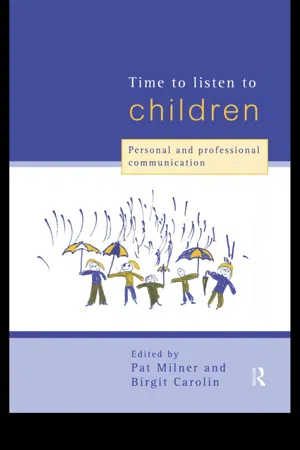
eBook - ePub
Time to Listen to Children
Personal and Professional Communication
- 256 pages
- English
- ePUB (mobile friendly)
- Available on iOS & Android
eBook - ePub
Time to Listen to Children
Personal and Professional Communication
About this book
Information
Part I
SETTING THE SCENE
Why have we for so long neglected one of the most important tools of prevention, namely, listening to the voices of children themselves? Long before they can speak, infants reveal by their behaviour and through their play whether their need for loving, consistent care is being met or not; while older children show even more unmistakably ‘early warning’ signs and, of course, can express their anxieties verbally, provided there is someone who is perceptive enough and has time enough to listen.
The Needs of Children
(Mia Kelmer Pringle 1980: 161)
(Mia Kelmer Pringle 1980: 161)
1
A MEDLEY OF CHILDREN’S VOICES
Birgit Carolin and Pat Milner
Beyond the walls, I can hear the children playing
In the riverbed. If I could tell what they are crying
It would lighten my darkness like knowing the language of birds.
(Chuilleanain 1994)
In the riverbed. If I could tell what they are crying
It would lighten my darkness like knowing the language of birds.
(Chuilleanain 1994)
Introduction
The word infant means ‘wordless’, without speech. Yet every infant is born with a voice and the urge, powerful as hunger, to communicate. Long before language can convey their meaning, babies are programmed to communicate emotion and need, insistently, even stridently, in a way no listener can ignore.
Infants are, equally, born listeners. Within the womb they have become attuned to their mother’s heartbeat, movements, patterns of rest and activity. As newborn babies they can distinguish the voices of those who care for them and are startled by sudden, loud noises, although they can sleep through thunderstorms and the sound of heavy traffic. Long before they have learned to copy the sounds they hear, they are busy experimenting with their own voices, shaping their own language. When they begin to acquire the vocabulary that names their familiar world, they are actively putting to use all that they hear around them.
If we, as adults were half so attentive, there would be no need for this book to be written. If we still had the capacity, with which we were born, to absorb what we hear and to take seriously what children say (or do not say, because of shyness or fear), there would be less misinformation and suspicion around listening to them.
This chapter contains the voices and words of children of all ages. The written contributions by young people were eagerly and readily given; they gladly chose their pseudonyms – or remained themselves – and are excited about appearing in print. Those who are too young to write have made their own important contribution by demonstrating how, with actions, sounds and words, they express their feelings and communicate their needs in the confident expectation of being heard.
It is time to listen.
We begin by overhearing children in their everyday lives.
In a playground
It is an afternoon in early autumn, warm and bright. The playground is bubbling with the sound of children: an eager noise composed of mingled calls, shouts, cries and laughter. Their play is energetic and purposeful, under the watchful eye of adults, who occasionally come to the rescue of a little one in trouble, or comfort an older one whose sobs rend the air. Here is a toddler on the seesaw, crowing with delight each time he flies up and chortling in happy anticipation of the bump when he comes down to earth. His mother, her eye on the pram that has begun to rock to the rhythm of her awakening baby, cannot persuade him to get off the seesaw when she does. Obstinately he clings on but without her he is grounded. ‘More, more, more!’ he insists. ‘MORE !’ She obligingly leans on her end, so that he can once more enjoy the sensation of lift-off, reminding him that it is time to go home for tea. They call to one another across the length of the seesaw between them – he demanding, she demurring – and finally she turns firmly away to attend to the baby, whose cries are becoming persistent. The little boy pushes vigorously upwards as far as his sturdy legs allow, and then climbs off. He has accepted the inevitable with good humour and races to catch up with his mother, who lingers with the pram, waiting for him.
In a Chinese restaurant
Amy, aged 7, and her younger brother Henry, aged 4, both dressed in their best and on best behaviour, are out for a meal with their parents and grandparents. In this unfamiliar situation, they need the support of their mother and father and also of their toys. Henry is accompanied by his large and floppy puppy with ears well chewed, and Amy has chosen to bring two small creatures: Nibbles the rabbit and Finn the dolphin, who are conveniently portable. She speaks to them softly, encouraging them to ‘be good’, and reads them the menu, proud of her newly acquired skill. There is nothing on the menu suitable for rabbits or dolphins to eat, so she says soothingly: ‘When we get home, you can have some carrot cake, Nibbles. And I’ll make you some fish-pie, Finn. Just be patient.’
Henry, in the meantime, has climbed on his father’s lap and remarks that he wants his dummy. His father agrees equably to take him to the baby shop tomorrow and buy him a dummy – and maybe a cot? Henry is delighted. ‘I want to go back to being a baby and suck my dummy and sleep in my cot.’ ‘OK,’ says his dad, ‘and maybe we’ll buy you some nappies too?’ This, in Henry’s opinion, is carrying the joke too far. ‘No nappies!’ he says firmly, wrinkling his nose and pulling a face in disgust. ‘But I do want a dummy.’ And he puts his thumb in his mouth as he snuggles down more comfortably on his father’s knee.
Normally a confident boy, Henry’s security has crumbled in the face of a recent house move, followed by starting school: two severe shocks to his system that make him partly wish he could put the clock back. His father’s ability to understand and humour him affectionately is helping him to recover his usual sunny self.
In a nursery
Today is Soshema’s birthday. She’s not sure how old she is but is wearing a new dress (a little large, for her to grow into) and her fine, black hair is tied on top of her head for this special occasion. She is looking radiant but bewildered and is quite tongue-tied; her badge speaks for her, proudly announcing ‘It’s my birthday’. When all the children are gathered together for a song and a story, everyone sings ‘Happy Birthday’ to Soshema and she smiles shyly. Later, at the head of the table with friends on either side, when a cake with three glowing candles appears, she knows exactly what to do.
With the help of her teacher, Gill has made a news booklet which they later share with her mother. ‘When I wanted my mummy I went shopping and slipped over’, is illustrated by a sad sketch of a solitary little person. One month later, because both her teacher and parents have heard Gill’s wish to be taken to school by her mother, rather than her father, the picture changes. It becomes a bold and colourful scene announcing: ‘My mummy takes me to school and I was pleased.’
Fact and fiction merge in the news books: ‘One day I went to the farmyard and there I saw some cows. Then I kept falling off the cow sometimes.’
Adult activities are coolly appraised: ‘I went to the cinema yesterday and I watched a funny film. A funny slobbery kiss from a boy to a girl . . . and then they danced like they were getting married.’
Important information is conveyed: ‘We sorted our toys out – me and Jim but not Joe – Joe he smacks.’
Children and fairy tales
In another nursery school, a trainee teacher describes how in her encounters with 3- to 4- year-old children she is struck by the degree to which they are familiar with the social and moral ‘rules’ that are explored in the story of Goldilocks. The children’s comments highlight their spontaneous and vociferous condemnation of the behaviour of Goldilocks:
| Sophie: | She's naughty! Naughty girl. |
| Teacher: | Why is she naughty, Sophie? |
| Sophie: | Because she ate all ihe porridge and she's going to break the chair. |
Goldilocks is, from the start, seen as the villain and the bear family the wronged party, who deserve sympathy:
| Matthew: | The bears are angry. She ate their porridge. |
| Amy: | And they don't even know who did it! |
| Joshua: | Shall we tell them? |
The children find Goldilocks’ behaviour quite unacceptable. Not only does she violate the happy home of the archetypal family (‘She’s broken the house’ and ‘She’s got muddy shoes on!’), but her entering the bears’ cottage is seen as fundamentally wrong. The children relate this immoral behaviour to their own experience of their social world:
| Georgia: | We wouldn t do that. . . . We re good girls. And if we went to someone else's house we would be lonely. |
| Peter: | She could go away. Or stand there and wait for the persons to come back. Cos they might be bothered [if she went in uninvited]. |
When the children come to role play the story, the nursery teacher tries to introduce the possibility of a reconciliation between the bears and Goldilocks, but the children will have none of it. Perceiving Goldilocks as the villain, they are quite convinced of the need both to punish the ‘bad’ and to protect the ‘good’: ‘If I was a bear I’d growl at her, Grrr!’ says Charles, outraged at her anti-social behaviour.
Thus, children have the chance to redress the balance to fit their own views of punishment. Liberal growling and shaking of paws by the bears (instantaneously transformed into menacing characters), is common whenever Goldilocks is caught in the cottage.
| Alice: | Who's been sleeping in my bed? |
| Bears: | GRRRRRRR! |
| Teacher: | [as Goldilocks] I'm very, very, sorry. |
| Luke: | Well now you have to go back. Grrrrr! |
| Teacher: | How about if I made you some porridge and a pot of tea? Would that be alright? I think you're friendly bears. |
| Alice: | Well we're not! Grrr! |
Having become an apologetic Goldilocks, the teacher was still given short shrift by the unforgiving bears, convinced of their righteousness in treating her harshly.
Because the story ends without the classic ‘happily ever after’, it lacks the fairy tale’s usual resolution of conflict, and this is unsettling for some of the children:
| Teacher. | And they always locked their door, .. . [reading text] |
| Elite | But she could open it. |
| Teacher: | But she couldn't, could she, now they always lock it? |
| Elite: | Maybe she might bring a knife with her. |
| Amy: | To chop the door down to get in |
Children have a great need for justice, as they see it, to prevail, and the unpunished Goldilocks is a continuing threat to both the bears’ and their own well-being (Carolin 1997).
In nursery schools, children can safely explore the world just outside their own families and communicate the excitement of discovery. In primary schools, their horizons expand further still and they are given opportunities for learning, not only in the classroom, but on school visits.
Reception class visit to a museum
Twenty-five children, with their teacher, file into the vast entrance hall of the museum, wide-eyed and excited. This is a grand building, spacious and complex, with a bewildering array of unfamiliar objects. Here is a huge statue of a naked lady with a life-size tortoise at her feet; her bare bottom provokes a knowing nudge from one boy to another in passing, and a reproving look from their teacher, as they hurry to climb the immense stairs. Awed by the lofty room in which they are now seated cross-legged on the fine old carpet, these children have been urged by their parents and teachers to ‘be good’, but are not yet sure how they will be expected to behave in these unfamiliar surroundings. One little girl confides to the museum teacher that she is feeling ‘nervous’; others are showing apprehension or eager anticipation for this adventure. They are to be introduced, at the formative age of 5, to some of the riches of their cultural heritage. Until recently, museums were not inclined to welcome children. Now, thanks to enlightened museum and educational policies, many are opening their doors to younger school-age children in the hope that, by fostering interest at an early age, museums will remain a source of pleasure and learning for a lifetime, and also a source of their own future revenue.
These children will hear a familiar fairy tale, but first, the museum teacher establishes a rapport with them by introducing herself and inviting comments about their past experiences of museums and their observations on this one. Skilfully, she leads them step by step from what they already know towards the new: education in the best sense, a drawing out of the children’s knowledge and understanding, memory and imagination. They listen intently to one another and to the teacher, who encourages them to look about as they respond to her questions. She prepares them by showing a picture book without text, which nevertheless tells a story, and invites...
Table of contents
- Cover Page
- Title Page
- Copyright Page
- Contributors
- Foreword
- Acknowledgements
- Introduction
- Part I: Setting the Scene
- Part II: Multicultures, Multifaiths
- Part III: At Work With Children
- Part IV: Listening Creatively
- Part V: Children,Research and the Law
Trusted by 375,005 students
Access to over 1.5 million titles for a fair monthly price.
Study more efficiently using our study tools.
Frequently asked questions
Yes, you can cancel anytime from the Subscription tab in your account settings on the Perlego website. Your subscription will stay active until the end of your current billing period. Learn how to cancel your subscription
No, books cannot be downloaded as external files, such as PDFs, for use outside of Perlego. However, you can download books within the Perlego app for offline reading on mobile or tablet. Learn how to download books offline
Perlego offers two plans: Essential and Complete
- Essential is ideal for learners and professionals who enjoy exploring a wide range of subjects. Access the Essential Library with 800,000+ trusted titles and best-sellers across business, personal growth, and the humanities. Includes unlimited reading time and Standard Read Aloud voice.
- Complete: Perfect for advanced learners and researchers needing full, unrestricted access. Unlock 1.5M+ books across hundreds of subjects, including academic and specialized titles. The Complete Plan also includes advanced features like Premium Read Aloud and Research Assistant.
We are an online textbook subscription service, where you can get access to an entire online library for less than the price of a single book per month. With over 1.5 million books across 990+ topics, we’ve got you covered! Learn about our mission
Look out for the read-aloud symbol on your next book to see if you can listen to it. The read-aloud tool reads text aloud for you, highlighting the text as it is being read. You can pause it, speed it up and slow it down. Learn more about Read Aloud
Yes! You can use the Perlego app on both iOS and Android devices to read anytime, anywhere — even offline. Perfect for commutes or when you’re on the go.
Please note we cannot support devices running on iOS 13 and Android 7 or earlier. Learn more about using the app
Please note we cannot support devices running on iOS 13 and Android 7 or earlier. Learn more about using the app
Yes, you can access Time to Listen to Children by Birgit Carolin, Pat Milner, Birgit Carolin,Pat Milner in PDF and/or ePUB format, as well as other popular books in Psychology & History & Theory in Psychology. We have over 1.5 million books available in our catalogue for you to explore.