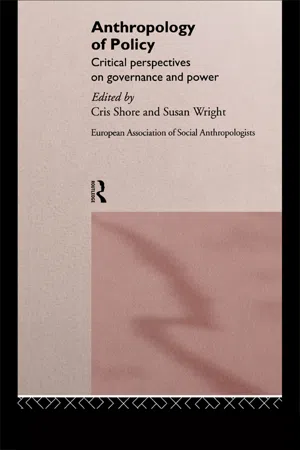
eBook - ePub
Anthropology of Policy
Perspectives on Governance and Power
- 312 pages
- English
- ePUB (mobile friendly)
- Available on iOS & Android
eBook - ePub
Anthropology of Policy
Perspectives on Governance and Power
About this book
Arguing that policy has become an increasingly central concept and instrument in the organisation of contemporary societies and that it now impinges on all areas of life so that it is virtually impossible to ignore or escape its influence, this book argues that the study of policy leads straight into issues at the heart of anthropology.
Information
Part I
Policy as language and power
Chapter 2
Writing development policy and policy analysis plain or clear
On language, genre and power
Raymond Apthorpe
He struck the tips of his fingers together. He had found the right words: clear, practical, superior. She would not, with her clumsy vocabulary, dare answer him.
(Canetti 1982)
The language and the writing of policy and research on policy function as a type of power.1 Often the primary aim of policy language is to persuade rather than inform, yet rarely is it subject to critical scrutiny. Anthropology, with its concern with genres, performances and agencies, can contribute crucially to scrutiny of policy and analysis of policy through its language.
The ‘power of language’ arises from congruencies (and other relations) of social, political and cultural institutions with linguistic mechanisms. Therefore policy in its announced (written or spoken) expression requires both institutionalist and mechanist examination. Its purchase on events comes from somewhere in between the linguistic and extra-linguistic, that is, it draws from wording and willing as vocabulary and grammar, and language as ceremony and office.
It is useful to think of policy writing as a ‘genre’. Genre makes a written artefact analysable. It provides ‘a counterpart at the textual level of the concept of sociological boundaries thereby defending inquiries from the danger of degenerating into purely [mechanist] technical, linguistic, analyses’ (Green 1983: ix). Genre is ‘a broadly conceived textuality…realized in the dialogic engagement of particular people and particular utterances with one another (rather than in the timeless and placeless notion of Saussureian langue)’ (Baxter and Fardon 1991:4, 7). Genre comes from somewhere in between the structural and the functional, the institutional and the mechanical. Its power of agency is owed to this relative indeterminacy of origin and effect.
In anthropology as well as power, in policy analysis as well as in policy, rehearsal of what is and ought to be done and why and how, distracts our attention from genre (Green 1988). This chapter treats the writing of policy and of policy analysis as susceptible to, and deserving of, critical attention. A particular case of a global development policy research is considered: Why, despite its empiricism and geographical scope, did this research not make the difference to development policy it sought? But first a few generalities.
THE WRIT OF LANGUAGE
Language as policy and power is exercised through genres or, as we will also say, ‘styles’ of expression. Modes, genres or styles in this sense are some of the forms of practices which are properly subject to analysis in part as stylistics. By ‘style’ here is meant not literary style but something akin to Foucault’s ‘gaze’ according to which a focus is selected and pursued. One example is when the power of some policy statements depends on being plain, and better still, absolutely plain, in gaze and style. In this case, from lack of clarity, a certain sense of purpose and identity can be drawn, and a symbolic force achieved. The power of other statements may depend on being clear, rather than plain, the former as in ‘the clear truth’, the latter as in ‘the plain truth’. Clarity comes from something being taken away (e.g. ‘being economical with the truth’), while plainness comes from nothing being added.
A second example is goal language. Where the primary purpose of charters, constitutions and creeds is ideological, the first requirement is that they be in a form and style of goal language which inspires, uplifts, persuades, gains support, defines parameters, gives a badge to wear (Thompson 1985).
As a third example consider, for instance, from everyday life the assuring and reassuring ‘See you’. ‘See you at this same time next week’, the television announcer smiles straight into the lens of the camera which with its back-up paraphernalia transmits her or his image to your home. It is your favourite programme and announcer. You are touched, warmed—and entirely apt to overlook the fact that (through the medium of television) your announcer hasn’t actually seen you—or even your image—this week or ever. ‘See you next week’, unpacked, comes down to ‘see me next week’. In this instance, the message sent is completely contrary to the information given. This is characteristic of intent to persuade not only you or me but everyone. A friend or acquaintance saying ‘see you’ to another on parting without any time element or other qualification, sends a definite message, but the information is completely open-ended and vague. The same technique is used in policy as well as everyday speech.
A fourth example of style in policy writing is a focus on what Williams (1983) called ‘keywords’ or Baumann (1987) called ‘key words’. Such words, of which there are various types, depend on context as well as text, on perspectives as well as objectives, performing as winsome, winning or weasel words. Then power comes as much from the barrel of a phrase or sentence as a gun. Winning (and losing) words have moral ways, and political effect, all of their own.
Where policy may fail as practice, it may succeed as composition and code. But where the socio-semiotic facts of life depend for their grip on not being noticed as artefacts, undoubtedly the reasons for this success will be elusive to pin down. For example, and however paradoxically, the writing and style of policy analysis is usually less seriously examined than the wording and writing of policy. This is why this chapter takes up a case of research and policy analysis by way of illustration.
‘Policy’ as in ‘policy statement’ and ‘policy studies’ involves the presentation of a position that is held to be exemplary in some way, and in a style chosen mainly to attract, please and persuade you (though later it may be applied to you). This is the shine of ‘policy’ on show, on parade. What is thus announced may be justified both as what ‘is known’, as well as what ‘stands to reason’. It is most unlikely to be said to depend on a weighing of positions and evidence, hard bargaining, drastic exclusions and the like. Rather it must be something simply plain or clear. Bitter evidence may be more refutable as well as exposing of what is judged to be best kept out of the public eye. Typically the perennial speech of policy involves utterance about things which inescapably ought to be done and which, at the same time, we are assured can and will be done once ‘the policy’ is ‘in place’.
Hearing, seeing, saying no evil. A fourth wise monkey would write no evil. But little policy writing is the work of a fourth wise monkey. The plainer (as in one genre), or the clearer (as in another), a policy is painted, the more it is driven by evasion and disguise. The more writing sets out to please those who desire to be pleased by it, the more it is constitutive of what it is meant to allay, promise or punish. Unexamined styles of language practice, then, divert policy statements and policy studies from making a difference to policy. Wording policy in its utterances and communiques is a craft and fine art in itself. Much time and effort will have been spent on wording (unless it came ‘naturally’, that is by practice and habit). Until the right form of willing and wording is found, we may be waiting, as well as wanting, for policy and policy analysis. In the end, as in the beginning, is the word. Leaving wording—and writing and reading— unexamined leaves a good part of the agenda that was set with the aid of it unexamined also.
RADICAL REALISM AND IDEAL RURALISM
To illustrate the achievement of genre and the power of writing in development policy research, we may consider by way of a particular case the set of ‘green revolution’ studies carried out by many researchers (including the present writer) in the 1970s. This global research project was managed by Andrew Pearce. He overviewed its findings and recommendations in a final publication Seeds Of Plenty, Seeds Of Want (1980; see also, Pearce et al. 1977). All these studies were meant by their authors to stand, as we might put it now, as realist and radical studies of people’s livelihoods.
The project of realism is the epitome of plain style—‘to tell it as it is’. By ‘radical’ we (literally) meant getting to the roots (including ‘grassroots’) of institutions and technologies. ‘Radical’ also meant something close to ‘critical’: few rural development studies at that time were empirical field studies so what the field had to tell, as it were, had therefore not been told. The empirical philosophy is that to be empirical is to be realist, and being realist about policy and policy analysis is to be radical.
The expression ‘green revolution’ referred to high-yielding grain hybrids. The purpose of our study (known as Global-2 to its UN sponsors and the United Nations Research Institute for Social Research which devised and executed it) was to assess the social and economic results of the hybrids bred for their high yield capacities which to some seemed much less rosy than it was supposed they would be. The organizing concept selected and defined by Andrew Pearce for these studies was ‘rural livelihood’, a multiplex idea comprising a series of coincident concerns with technologies and institutions, description and prescription, diagnosis and prognosis. The research guidelines he circulated to all the case study researchers referred also to the matter of the state and its powers and tendencies of incorporation. Ultimately, however, what was written up was not the effect of these tendencies for both rural livelihoods and the state but only for the former. Our terms of reference called for descriptive and diagnostic research. The lead assumption was that if you were a peasant or a small farmer, you would be seeking your living mainly from the land, and this would be a meagre living only. All the odds—what Andrew came to call biblically ‘the talents effect’—would be against anything better.
It was, then, a premise from the outset that, in the rural areas selected for study, ‘something was wrong’. This was not simply research to close an ‘ethnographic gap’— research for the sake of research—it was research to evaluate rural development policy. Nevertheless, ‘peasant farming’ was not envisaged as being in such great difficulty as to have reached or be reaching a terminal stage. It was not supposed that this particular mode of livelihood should be allowed or induced to disappear altogether and replaced by another. Perhaps it was for this reason that the research design did not include scope for comparison of peasant farming with other types of farming. (Precedent may have played a greater part than selective choice, however, as UNRISD’s earlier studies of cooperatives— including mine—neglected to include comparison with non-co-operatives.)
At all events, ‘peasant farming’2 stood not only as the actual problem to be investigated, it was also the solution to be found, in the sense that a reformed peasant farming, not something different in kind like collectivization or corporatization, was the scenario to be considered. While, at first sight, therefore ‘rural livelihood’ may appear to stand as a seemingly innocuous and neutral device for the marshalling of descriptive data, it proves on further inspection to be a coalescence of all sorts of considerations. This is the first issue to note critically.
Is this to go too far with an analytical unpacking of what was announced as something that would serve simply as a rallying point for the making of field observations? Possibly, yet while it did serve usefully in this role, this was not research seeking description of village and farm life for its own sake alone. Therefore, it would be odd if the chosen unit of descriptive account were unrelated to the project’s ultimate objective, which was evaluation and prescription.
In 1973, when the project was well under way and reaching tentative conclusions, a meeting in Manila was convened jointly by the United Nations Research Institute for Social Research (UNRISD)3 and the International Rice Research Institute (IRRI) in the Philippines (whose parent organization elsewhere had pioneered the type of hybrid botanical research concerned). At that time, both institutes were undertaking rural studies on the social and economic consequences of the new cereal varieties. The purpose of the meeting was scientific, for each institute to take note of the work of the other, to make comparisons and perhaps some mutual adjustments accordingly. But on those few occasions when both sides actually bothered to turn up at a particular session, there was nothing like any such meeting of minds or exchange (except of abuse).
IRRI branded UNRISD’s objectives as (hopelessly) ‘leftist’. UNRISD sought to maintain that while it was indeed very much in the business of political economy, (hopefully) that was not the same thing as ‘leftism’ at all. UNRISD called IRRI’s approach ‘technicist’. IRRI said UNRISD was ‘subversive’. Each label was equally vigorously repudiated. Neither side would concede any degree of objectivity, of ‘science’, to the other. No area of common concern, let alone agreement (including agreement to differ), emerged whatever.
Some years after that non-event, a joint master’s thesis in development studies at the Hague’s Institute of Social Studies compared and contrasted the two organizations’ research approaches and findings. Among its conclusions, the following stand out:
UNRISD’s concept of development was more encompassing; it viewed development in terms of welfare, structural and normative aspects. Through these perspectives, UNRISD addressed itself to problems relating to the entire (rural) economy. In effect, [its] postulates on the impact of agricultural technology are similar to some of those of both modernization and dependency. In contrast, the postulates of IRRI are confined to those of modernization alone…IRRI states that as a result of increase in real income, farmers have moved up to a higher rung on the agricultural ladder…UNRISD on the other hand…very much addressed itself to the social imbalances and economic disparities that already exist and are attributable largely to the fact that social policy and reform have not kept pace with the spread of the technology. While IRRI views the commercialization of agriculture positively (as an index of modernization), UNRISD on the other hand deplored it, because it aggravates the dependency of small peasants. Land distribution is skewed in most developing countries, and small peasants generally live from ‘subsistence farming’, lacking the necessary ability and resources required for the adoption of the new technology.
(Lorenzco and Maranan 1980)
These generalizations sum up well the differences between the two research institutes in relation to their respective green revolution studies. Where perspectives are considered to be so different, objectives can hardly be similar.
As it may be put now, decades later, in contention were two styles of genre in analysis. These could be labelled respectively as UNRISD’s plain realist and IRRI’s clear idealist. What UNRISD defined as the enemy (of its own ‘radical realism’, as this chapter terms it) was what it saw as an ‘ideal ruralism’. This was ‘ideal’ because, as a syndrome of abstract conceptions, it made for preoccupation not with any actual pattern of rural livelihood but only an ideal type. Radical realism says it is uncomfortable with such abstraction. It complains that ruralism revels too much in it, and turns too much to ‘technical’ terms (which it brands ‘jargon’). This is a good portrait and can to a fair extent be recognized by its sitter. Such ded...
Table of contents
- COVER PAGE
- TITLE PAGE
- COPYRIGHT PAGE
- CONTRIBUTORS
- PREFACE AND ACKNOWLEDGEMENTS
- INTRODUCTION
- PART I: POLICY AS LANGUAGE AND POWER
- PART II: POLICY AS CULTURAL AGENT
- PART III: POLICY AS POLITICAL TECHNOLOGY GOVERNMENTALITY AND SUBJECTIVITY
- EPILOGUE
Trusted by 375,005 students
Access to over 1.5 million titles for a fair monthly price.
Study more efficiently using our study tools.
Frequently asked questions
Yes, you can cancel anytime from the Subscription tab in your account settings on the Perlego website. Your subscription will stay active until the end of your current billing period. Learn how to cancel your subscription
No, books cannot be downloaded as external files, such as PDFs, for use outside of Perlego. However, you can download books within the Perlego app for offline reading on mobile or tablet. Learn how to download books offline
We are an online textbook subscription service, where you can get access to an entire online library for less than the price of a single book per month. With over 1.5 million books across 990+ topics, we’ve got you covered! Learn about our mission
Look out for the read-aloud symbol on your next book to see if you can listen to it. The read-aloud tool reads text aloud for you, highlighting the text as it is being read. You can pause it, speed it up and slow it down. Learn more about Read Aloud
Yes! You can use the Perlego app on both iOS and Android devices to read anytime, anywhere — even offline. Perfect for commutes or when you’re on the go.
Please note we cannot support devices running on iOS 13 and Android 7 or earlier. Learn more about using the app
Please note we cannot support devices running on iOS 13 and Android 7 or earlier. Learn more about using the app
Yes, you can access Anthropology of Policy by Cris Shore, Susan Wright, Cris Shore,Susan Wright in PDF and/or ePUB format, as well as other popular books in Ciencias sociales & Política pública. We have over 1.5 million books available in our catalogue for you to explore.