- 256 pages
- English
- ePUB (mobile friendly)
- Available on iOS & Android
eBook - ePub
About this book
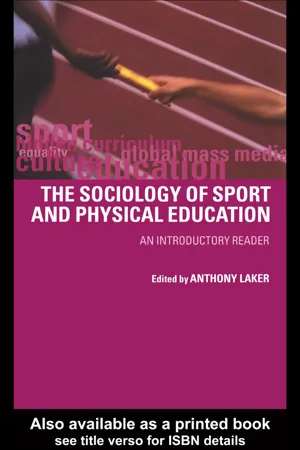
This text, intended for undergraduates on various education and sport related degree courses, covers the key, current issues in the field of sociology of sport and physical education. The first section of the text covers the importance of sport in culture, its theoretical background, and methodological issues in research. The main body of the text then discusses issues including the sporting body, participation and socialisation into sport, the hidden curriculum, critical pedagogy, and sport and the media. Laker discusses in depth gender, race and ethnicity, class, and equality, and he looks at sport and the media, and the involvement of politics. The chapters are each rounded off with challenging 'reflection' questions, activities and tasks for the reader to fulfill.
Information
1 Culture, education and sport
Anthony Laker
Introduction
The purpose of this chapter is to place sport in a social, cultural and educational context. This implies definitions of culture, education and sport, and the academic juxtaposition of each to the others. However, it will be seen that culture, education and sport have commonly-held meanings which, in some cases, eradicate the need for further clarification. So, apart from defining these important concepts, this chapter will also deal with the pervading nature of sport in society, sport as a system of sub-cultures and the degree to which sport has become an important symbol for individuals and societies worldwide. Sport has a variety of functions for different segments of society and therefore different meanings to those different populations.
Everyone knows what a culture is. Everyone knows what education is. And everyone knows what sport is. But everyone has slightly different definitions of culture, education and sport. What we require are commonly understood definitions of terms for the purpose of this chapter. The mere fact that we need to define these terms for the purposes of this analysis highlights the problem that definitions and meanings are context specific and will vary as the contexts of their usage changes. The potential differences in the meanings of sport have already been touched upon, but culture as a term can evoke different interpretations.
There is an inevitable and symbiotic relationship between culture, education and sport. Education and sport are two of the major institutions of our society. As such, they interact with each other, and of course other institutions, to contribute to what we commonly regard as culture and society. In this way, neither education nor sport are ideologically neutral because they have implicit values which we incorporate into recognition of both culture and society. This incorporation of sport and education into the meaning of society and culture legitimates them and gives them both a value and a place. Although we have only referred to sport and education here, it can be seen how the various societal and cultural components (such as religion, work and the family) are constructed through systems of meaning that are legitimated through practice and adoption and perpetuate the commonly-held view of culture and society.
The above argument indicates the real value of sport and education; that is, they have importance in many of our everyday lives, and they are a part of the fabric of our society. The emotions, particularly those of parents, raised by education and the number of newspaper pages devoted to sport are a testament to this importance.
Culture
There is a commonly-held view that culture is art; paintings, sculptures, drama and the like, but that is mistaken. The artistic view of culture is limited by its narrowness of application—it is only one aspect of culture, and is sometimes referred to as ‘high’ culture. The converse is that a ‘low’ culture also exists and refers to football, pop music, and TV. This élitist view has little appeal in academic debate and, as the boundaries between these two opposing cultural dichotomies becomes ever more blurred, the currency of this framework is devalued.
A culture is a system of shared values, meanings and symbols that enables societies and individuals to operate effectively without continually redefining these values, meanings, symbols and points of reference. Imagine the impossibility of having to say what we meant by religion, for example, every time we used the term; or what morality meant to us; or what we understood by the word sport. Take the symbol of the cross. In one context it indicates religion, spirituality, and the religious claim that Jesus died on a cross to grant us salvation. In another context, as a traffic sign, a cross means two roads intersecting, and we must therefore drive with care. A cross on its side, in yet another context, indicates that something is wrong, incorrect and possibly needs to be done again. The meaning of the symbol clearly depends upon the context in which the symbol is placed.
As well as being things and items, symbols can be found in actions and language. Hand gestures, facial expressions, body language and head movements sometimes have specific meanings in different cultural contexts. In western society, we commonly throw paper and small pieces of household rubbish on a fire. However in Nepal, the Hindu and Buddhist household gods live in the hearth and it is an insult to throw rubbish at them. Giving or receiving items with one’s left hand is poorly regarded in some Asian and eastern cultures because of the sanitary function for which the left hand is used. It is far better to offer and receive with both hands. Nearer to our own western experience, Churchill’s V for victory hand gesture has come to be interpreted as a peace symbol. Although connections can be made between victory and peace, these are different concepts located in different times but represented by the same symbol.
These differences within shared meanings are what make separate cultures unique. People within the culture do not have to define their symbols at every social interaction. The commonly-held perception of meaning lubricates the social process. Within cultures there are sub-cultures. These smaller groupings of individuals also share systems of values and meanings and this develops their clear and separate identities. Some of the most obvious examples are surfers and bikers. Each of these groups has very distinctive ways of dressing, talking and behaving that are clearly identified as being peculiar to the group. The distinct nature of language, appearance and actions is what binds the fabric of sub-cultures together and makes them strong in their separateness and individuality. A subculture must have at least one unifying characteristic. For the surfing sub-culture, one of the unique characteristics of that community is that they go into the sea and ride waves, they surf. There is also an exclusionary nature to sub-cultures which means that without possessing the unique characteristic one could never join the sub-culture. So one could never be included in the surfing sub-culture if one did not surf. There are undoubtedly privileged groups who enjoy limited access to the sub-culture. In the case of surfing, board and wetsuit manufacturers, journalists, photographers and the like will be allowed this access, but they will not be part of the core group, the essential sub-culture.
Education
We all have a view of what education means. In one role or another, we have all experienced education. We have been children at school so we know what it is like to be a pupil. We know what goes on in schools, even if only superficially, so we know what schools are like to work in. And many of us have seen school through our own children’s eyes, so we think we know a lot about school, and therefore about education. This interpretation is similar to other people’s interpretation because they have also been through the same process and experiences. Therefore, this interpretation gets reinforced and every time we use the word education, we do not have to explain what we mean. The meaning of education is a commonly-held meaning that is the culturally acceptable one.
Mention education to most people and they will get a mental image of a school; a lesser number will also think of higher education, perhaps in a university. Even fewer will picture adult education, job training, pre-school groups, taking up a new sport, reading a book, or going on holiday. All these activities are educational in that they encourage learning. So although the common perception of education may be limited, the possibilities for inclusion are many and would have a consensus of approval.
Dictionary definitions can be illuminating when considering cultural meanings. To educate derives from Latin and literally means to lead forth. In theorising about the education process in general, this literal meaning has an attraction to those who will be doing the leading, i.e. the teachers. It invests them with authority, power and control. It implies that knowledge is a product held by a few, to be packaged and made available to the many who are then led to this knowledge as if it were an enlightenment. Critical theorists take this view and have produced a wealth of commentary on just this aspect of the education process, some of which is reported in later chapters. This sociological interpretation of education illustrates why definitions vary and why sometimes technical definitions are required.
For many, education is what we get at school; for teachers, education is an enlightening teaching and learning process; and for critical theory sociologists, education is a socially controlling mechanism. It could be assumed that this would lead to confusion. However, the context in which the term is used refines the definition and allows a commonly-held meaning to prevail. So, in general terms, parents talking with each other about education would probably be referring to the package of knowledge that children receive at school; teachers in a staff meeting would be discussing the process of teaching and learning; and critical theorists writing in academic journals would refer to the sociologists’ meaning of education.
Sport
As with education, sport has a common core of shared meaning and a periphery of additional meanings that are very much context-dependent. In other words, although most of us have a common understanding of what sport is, it can still mean different things to different people. In general terms we recognise that football is sport, but that ballroom dancing is not; motor racing is sport, but driving to work is not; sailing a boat on an ocean is sport, but sailing on a tanker delivering oil is not. It is not necessary to define what we mean by sport whenever the word is used. However, the same sport can have different meanings to different groups of people. As an example of these differing meanings let us consider the sport of tennis. To a professional tennis player tennis is a job; to a club player, however competitive, tennis is essentially a recreation; to a spectator at Wimbledon, tennis may be a temporary diversion or an all consuming vicarious passion. In short, a sport, and sports, mean different things to different people even though there is an over-riding perception of what a sport is, and what sports are.
If we look more closely at a set of meanings of the sports experience, we can more closely approach the function of sport. Sport for a group of hillwalkers will mean things like freedom from everyday worries, possibly a sense of awe and wonder, and an exhilaration at being in a natural and remote environment. Sport for a group in an aerobics class could mean getting and staying healthy, socialising and stress reduction. The groups mentioned here have positive interpretations of sport. Unfortunately for some children, the experience of sport is not always positive and can come to mean getting wet and cold and being exposed to failure, and may lead to a complete lack of enthusiasm and enjoyment. It can clearly be seen that in promoting the benefits of sport and an active lifestyle, school sport and physical education have a major contribution to make. Thus, sport has different connotations for different groups in different contexts.
Outside school, sport has a number of different functions. The most obvious of these is as a form of recreation. The vast majority of those who take part in sport outside an educational environment do so as a form of recreation. The amateur footballer, the ten-pin bowler and the hillwalker pursue their activities for recreation. There is a sub-category of these recreational sports people; those for whom physical activity is merely body maintenance, a way of keeping fit to preserve or improve their health. This group may or may not find enjoyment in their participation. However, if enjoyment is not part of their experience, they are unlikely to remain participants for long. The enjoyment of the body maintenance group usually comes from the knowledge that they are fit and healthy and possibly from improvements in physical performance and fitness levels.
The sense of enjoyment in sport is what motivates recreational participants. Joy in movement, joy in the surroundings and shared joy in shared company are powerful motivators in encouraging and maintaining sporting participation. This carries a strong message for those involved in recreation and sports provision and also for those involved in sport in education i.e. physical education and school sport. That is, that enjoyment has to be at the heart of the process if continued participation is to be a realistic aim.
The basis for taking part in sport is linked to the notion of attaining some kind of benefit from that participation. As discussed, the benefit for recreational participants is, most notably, enjoyment. Professional sports people obtain a different kind of benefit from their participation; they take part for monetary gain. Provision of an income is the benefit they invoke by being involved in sport. Of course this also applies to a variety of occupations that revolve around sport and is not limited to active, professional sportsmen and sportswomen. So sports coaches, recreation managers, physical education teachers, agents, promoters, and a whole variety of associated occupations use sport and physical activity as a provider of income. Of course, there are also a number of drawbacks, or costs, to sports participation for these groups. Recreational sports people pay for their enjoyment both financially and with the use of their time; they have rationalised that their participation is worth the balance of costs. Professionals pay in other ways. Obviously, they devote their time to sport, as others devote their time to their jobs, but in many sports there is a risk of long-term injury and possible delayed disability. Although professionals work for an employer, either for themselves or for a team owner, they inevitably become public property in terms of media exposure, of public relations work and in the miriad of trivial ways demanded by fans of their heroes. This is a cost often forgotten when the big salaries of sports stars are discussed. So, although participant groups perceive a benefit from sport, there are also costs that must be accounted for.
Sport in education
School sport and physical education are defined by a commonly-held perception. Physical education means playing games. That, unfortunately, is the most prevalent interpretation of the school subject. However, viewing a curriculum within a school very clearly dispels this notion and it can be seen that physical education is an educational process that uses human movement as its medium. Pupils will learn physical skills; they will learn about human movement and through human movement. The activities that constitute physical education will vary according to the context. In England and Wales there is a National Curriculum that dictates what state schools must do in physical education so there is very little variation between schools. Physical education uses games extensively, but not exclusively, as its medium of instruction. Gymnastics, dance, track and field athletics, swimming and outdoor pursuits are also all used to one degree or another as part of physical education programmes in many schools.
These common definitions are reinforced by the hegemonic process that pertains in many societies and institutions. Kirk and Tinning (1990:1–21) suggest that physical activity programmes in educational institutions are instrumental in promoting a socially acceptable form of sport and activity. Very early in our development, physical education in schools begins to form what will become our view, and therefore eventually the societal view, of what sport, recreation and physical activity are. The selection of activities in any curriculum implies that those activities have some benefit over other activities and are therefore of more value than other activities. In this way a dominant segment of society constructs an authorised view of sport and physical education. This version represents the privileging of one set of ideas over other sets of ideas. When these privileged versions are challenged the authority quickly acts to impose the authorised view. In the mid-1980s, teachers of physical education challenged the emphasis on competitive games in the National Curriculum of England and Wales. They claimed that it did not lead to a balanced physical education for all pupils. The response came in the form of Sport. Raising the Game (DNH, 1995) which stated that sport should return to the heart of school life. Opposition had been eliminated and the authorised version imposed.
In light of the above, it is now understandable why school sport usually refers to organised, competitive contests between groups of pupils either within a school, as in house or tutor group matches, or between schools in the form of representative teams. This is much the same meaning that sport has in a wider context, the major difference being that school sport claims an educational component.
Sport, in the educational guises of physical education and school sport, has a major role to play in the education of young people. In spite of the restricted offering of socially acceptable forms of physical education and sport that constitute its educational manifestation, there are still a number of major cultural benefits to be gained from the experience of sport in school.
Society wants young people who can live within it, abiding by its regulatory codes of behaviour, conformity and productivity. Society wants people who have been inculcated...
Table of contents
- Cover
- Title
- Copyright
- Contents
- List of tables
- List of contributors
- Introduction
- 1 Culture, education and sport
- 2 Theoretical background
- 3 Methodological issues in research
- 4 Femininity, masculinity and difference: what’s wrong with a sarong?
- 5 The social construction of the body in physical education and sport
- 6 Race, ethnicity and sport
- 7 Equality, equity and inclusion in physical education and school sport
- 8 Socialisation and participation in sport
- 9 The hidden curriculum and the changing nature of teachers’ work
- 10 Critical pedagogy: what might it look like and why does it matter?
- 11 Political involvement in sport, physical education and recreation
- 12 Global sport and global mass media
- Index
Trusted by 375,005 students
Access to over 1.5 million titles for a fair monthly price.
Study more efficiently using our study tools.
Frequently asked questions
Yes, you can cancel anytime from the Subscription tab in your account settings on the Perlego website. Your subscription will stay active until the end of your current billing period. Learn how to cancel your subscription
No, books cannot be downloaded as external files, such as PDFs, for use outside of Perlego. However, you can download books within the Perlego app for offline reading on mobile or tablet. Learn how to download books offline
Perlego offers two plans: Essential and Complete
- Essential is ideal for learners and professionals who enjoy exploring a wide range of subjects. Access the Essential Library with 800,000+ trusted titles and best-sellers across business, personal growth, and the humanities. Includes unlimited reading time and Standard Read Aloud voice.
- Complete: Perfect for advanced learners and researchers needing full, unrestricted access. Unlock 1.5M+ books across hundreds of subjects, including academic and specialized titles. The Complete Plan also includes advanced features like Premium Read Aloud and Research Assistant.
We are an online textbook subscription service, where you can get access to an entire online library for less than the price of a single book per month. With over 1.5 million books across 990+ topics, we’ve got you covered! Learn about our mission
Look out for the read-aloud symbol on your next book to see if you can listen to it. The read-aloud tool reads text aloud for you, highlighting the text as it is being read. You can pause it, speed it up and slow it down. Learn more about Read Aloud
Yes! You can use the Perlego app on both iOS and Android devices to read anytime, anywhere — even offline. Perfect for commutes or when you’re on the go.
Please note we cannot support devices running on iOS 13 and Android 7 or earlier. Learn more about using the app
Please note we cannot support devices running on iOS 13 and Android 7 or earlier. Learn more about using the app
Yes, you can access Sociology of Sport and Physical Education by Anthony Laker in PDF and/or ePUB format, as well as other popular books in Social Sciences & Education General. We have over 1.5 million books available in our catalogue for you to explore.