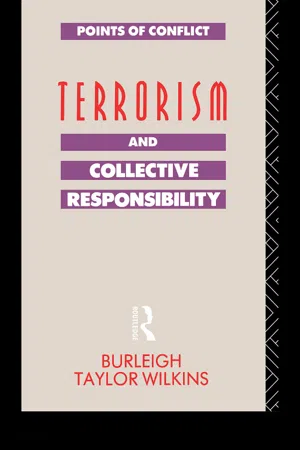
The terrorist threat remains a disturbing issue for the early 1990s. This book explores whether terrorism can ever be morally justifiable and if so under what circumstances.
Professor Burleigh Taylor Wilkins suggests that the popular characterisation of terrorists as criminals fails to acknowledge the reasons why terrorists resort to violence. It is argued that terrorism cannot be adequately understood unless the collective responsibility of organised groups, such as political states, for wrongs allegedly done against the groups which the terrorists represent is taken into account. Terrorism and Collective Responsibility provides an analysis of various models of collective responsibility, and it takes into account recent discussions of military responsibility and business ethics. The book also explores the problems that terrorism poses for the just war tradition.
The arguments of prominent philosophers against terrorism are critically examined and the claim that terrorism necessarily violates the rights of innocent persons is considered. Wilkins sets forth an original definition of terrorism that is sure to provoke controversy.
- 176 pages
- English
- ePUB (mobile friendly)
- Available on iOS & Android
eBook - ePub
Terrorism and Collective Responsibility
About this book
Information
Part 1
Terrorism
1
Can terrorism be justified?
Probably the most important division in moral philosophy is between consequentialists who believe that the rightness or wrongness of an action is determined by its contribution to an ideal end state such as the greatest happiness of the greatest number and deontologists who deny that this is so, at least in cases where the action in question would involve the violation of the rights of an individual or individuals. One of the few amusing aspects of the usually grim topic of terrorism is the way in which consequentialists such as R.M.Hare and Kai Nielsen seek to dissociate themselves from terrorism, treating it ever so gingerly as though fearful it might explode in their hands doing great harm to whatever variety of consequentialism they espouse.1 Yet it seems to me plain enough that if there were good reasons for believing that terrorism would contribute to bringing about some ideal end state, then the consequentialist would be hard pressed to reject it as a morally legitimate means to that ideal end state. What then is wrong with terrorism if it cannot be condemned on consequentialist grounds? The deontologist’s case against terrorism can be stated fairly simply: terrorism involves the violation of the rights of persons who may be killed or harmed; even if no one is actually killed or harmed by the terrorist, there is the threat of harm, and threats are a species of coercion, making people behave in ways that they would not otherwise choose; moreover, the persons who are, or maybe, the victims of terrorism are frequently not those whose conduct the terrorist wishes to affect.
Here Carl Wellman’s distinction between the primary and the secondary targets of terrorism is useful, and his example of William Randolph Hearst (the primary target of the SLA) and Patricia Hearst (the secondary target) is well chosen.2 No matter what William Randolph Hearst, a publisher of considerable influence and affluence, may have failed to do for the poor and downtrodden, and no matter how suitable from a certain ideological perspective he may have been as a target for terrorism, his daughter had done nothing to merit the treatment she received; and while her father undoubtedly suffered, this was mainly due to the suffering he believed his daughter might be experiencing. The kidnapping of William Randolph Hearst as a means of coercing the publisher into changing his policies and behavior must be regarded as significantly different from the kidnapping of his daughter as a means of coercing him into changing his policies and behavior. Should any person ever be coerced into doing what is morally right? The answer may well be yes, under certain circumstances. Should any person ever be coerced by threats of violence into doing what is morally right? Perhaps the answer will still be yes, but it seems far more doubtful that a person should be coerced into doing what is morally right by threats of violence against another individual. Even if Patricia Hearst had been a mature and articulate champion of the policies her father espoused there is still something especially repugnant about the manner in which she was used. And doesn’t the Hearst example show exactly what is wrong with terrorism? Can’t any member of a society be regarded as a potential hostage for the terrorist who seeks to coerce that society, or some significant segment thereof, into changing its ways?
It is important to remember that terrorism is not all of a piece, that it includes in addition to often highly publicized acts of violence against persons, acts which damage or destroy property and acts which disrupt communication or travel within a country. For the remainder of this chapter, however, I shall write only about acts of violence against persons; and if such acts are found to be, under certain circumstances, morally justifiable, this will not establish that terrorism in all its forms is morally justifiable. Still, on the assumption that violence against persons is the most significant form that terrorism can take, it would be extremely important if it could be shown, on grounds acceptable to the deontologist, that terrorism involving violence against persons may, under certain circumstances, be morally justifiable.
One other preliminary note needs to be made at this point: not every act that terrifies is to be counted as an act of terrorism. Wellman notwithstanding,3 I cannot regard the rapist who coerces his victim into submission by threats of violence as a terrorist; nor for that matter can I regard the bombings of Hiroshima and Nagasaki as acts of terrorism, though undoubtedly they are properly regarded as terrifying acts aimed at coercing the Japanese into surrender. It seems to me that the rapist example somehow slips under the net of what any reasonable definition of terrorism would properly cover, while any definition which allowed the bombings of Hiroshima and Nagasaki to count as instances of terrorism would be too broad. The rape described in Wellman’s example should not be considered as a terrorist act because typically it has objectives other than the alteration of social or political policy, which I see as being an essential aspect of terrorism. The bombings of Hiroshima and Nagasaki, while obviously intended by the American government to alter the policies of the Japanese government, seem for all the terror they involved more an act of war than of terrorism, which is not to say that the state of being at war precludes terrorist activities directed against the enemy. But only the choice of weaponry and the extent of the subsequent carnage make these bombings different from other, more routine bombings, though the choice of largely civilian targets may perhaps have placed them in the category of unjust acts of war.
One thing that makes terrorism of interest philosophically is that it compels us to rethink from a somewhat different perspective the question of when, if ever, it is morally justifiable to do violence to another person. The traditional answers, while perhaps valid, will take us only so far. It is generally agreed that it is justifiable to do violence to another person in self-defense; some wars can be accommodated under the category of self-defense where this is construed in terms of a community of persons defending themselves against aggressors. It is also agreed, though less generally, that even violence against an innocent person can be justified in the name of self-defense, in cases where he or she is being used by an aggressor as a hostage or a shield. If in the Second World War the Japanese Army had dispersed crucial weapons and supplies throughout Hiroshima and Nagasaki, and if these weapons and supplies could only have been destroyed by attacks upon the entire cities, then we would, I think, be far less troubled about the moral legitimacy of our attacks upon them. (Here I assume that Japan was the aggressor.) But what about terrorism which seems to be no respecter of innocence among persons, and which seems all too willing to sacrifice innocent lives as a means to social or political change? Can we fail to be shocked by the anarchist who justified tossing a bomb into a crowded café in Paris on the ground that there are no innocent bourgeois? (But would it be blasphemous to suggest that we might be somewhat less shocked had he deliberately chosen a café known to be frequented by captains of industry, whom he would have regarded as ‘class enemies’?)
Though the victims of terrorist acts may be oppressors or aggressors or tyrants, or their collaborators, often they are not. Often they are innocent, at least as innocent as civilian populations in wartime. If we condemn unjust wars, or unjust acts committed in wartime, are we not also committed to condemning any terrorism in which violence, or the threat of violence, is inflicted upon innocent persons, except in those instances where they are being used as hostages or shields? Terrorism poses this problem: can we ever justify inflicting violence upon innocent persons in circumstances other than self-defense? Will a ‘justification’ of terrorism succeed only by shrinking the notion of what is to count as innocence and/or by extending the range of activities to be considered as self-defense? Is there such a thing as collective guilt, and if there is can it ever be used to justify acts of violence against persons on the ground that they are members of a certain community or group?
I believe that any adequate answer to the question of when, if ever, terrorism is justified must take into account the problem of collective guilt, which is surely one of the murkiest and least explored topics in moral philosophy and which, to my knowledge, has been entirely neglected by those who have written on terrorism. On the question of whether there is such a thing as collective guilt opinions differ: there are those who believe that we, all of us, are guilty of each and every wrong done by any human being, a view which Mohandas Gandhi seems to have held; there are those who believe that we can be guilty only of those wrongs which we have done in our individual capacity, a view which seems to be lurking just below the surface in the writings of some political libertarians; and there are those of us who are not satisfied with either of these extreme positions and who are attracted to, but disturbed by, the idea that guilt may be at least in some cases collective. If we are to make sense of the notion of collective guilt, I believe that solidarity in the sense of a shared or common interest is our best guide, and that the absence of wrongdoing by individuals who are nevertheless said to share in some collective guilt remains perhaps the biggest stumbling-block. The reason why humanity at large fails to be a satisfactory basis for pronouncements about collective guilt, except for the Mohandas Gandhis of this world, may be that the interests we share with humanity at large tend to be too slight or fragile, though this shows signs of changing. There are, however, communities of a less extensive and more tangible sort where shared or common interests are already conspicuously present: in families, in neighborhoods, in business or cultural institutions, in political states, and perhaps, if Marxists are correct on this point, in social and economic classes. Pride or shame in what is done in, by, or on behalf of such communities is probably the best phenomenological clue we have to locating the interests, and values we share with others. But where collective guilt is concerned we tend to balk at admitting to guilt for things done in, by, or on behalf of those communities whose interests and values we share, when as individuals we did not actively participate in the doing of the things in question. However, the tie between collective guilt and individual wrongdoing is not a conceptual one; and where collective guilt is concerned we can turn to the law for examples of liability without contributory fault. For example, even if personally entirely innocent of the offense, a bank officer may be held strictly liable for the wrongdoing of a bank employee; and a convincing rationale having to do with the vigilance which society can reasonably expect of bank officers in hiring and management procedures can be given for this practice. In addition, Joel Feinberg, the master taxonomist, has uncovered the following models of liability with fault: liability with a fault that is non-contributory; contributory group fault where the fault is collective and distributive; and contributory group fault where the fault is collective but not distributive.4 I shall return shortly to these three models and to some of Feinberg’s examples, but first I wish to consider an example of collective guilt which is, I believe, especially relevant to the question of whether terrorism can ever be justified.
I would suppose that in the history of imperialism, of racial and religious persecutions, and in the economic exploitation of one group by another there are numerous instances of collective guilt, but to my mind the clearest and most indisputable example in recent history is to be found in the persecution of the Jews in Nazi Germany. After the Second World War there was in fact an admission of guilt by the newly established West German government, and Chancellor Adenauer acknowledged an obligation on the part of the German people to make moral and material amends for crimes perpetrated in the name of the German people; through treaty negotiations with Israel, West Germany agreed to pay out some 715 million dollars. As an example of penance this payment of reparations may be lacking somewhat in moral purity: Adenauer was under pressure from the American government and from world opinion, political considerations were obviously much involved, and the negotiations were between a new German government, perhaps even a new German state, and the newly created state of Israel. Nevertheless the example does fit, however awkwardly, the classic picture of guilt, confession, and repentance in the form of efforts to make amends through reparations.
But what exactly was the nature of the guilt involved in this case? Karl Jaspers in his brilliant book, The Question of German Guilt, distinguished four kinds of guilt: criminal guilt, political guilt, moral guilt, and what he called ‘metaphysical guilt.’ According to Jaspers, criminal guilt involved the violation of national and international laws and would be determined by trials of accused individuals in courts of law, including most conspicuously the Nuremberg trials; political guilt is necessarily collective and involves the liability of the German nation, a liability which, however, does not establish moral guilt; moral guilt concerns individuals who must answer in their own conscience the question of whether they lived in moral disguise, or with a false conscience, or in self-deception, or in a state of inactivity during the Hitler period; metaphysical guilt is defined as the lack of ‘absolute solidarity with the human being as such’ and found its expression in the feeling of guilt at being alive when one’s Jewish neighbors were being taken away. Having made these distinctions, Jaspers warns against their misuse: political liability requires the German nation to make material reparations, but it does not establish moral guilt in the individual; criminal guilt, well, yes, but this affects only a few; moral guilt, here only my conscience can decide, and my conscience won’t be too hard on me; metaphysical guilt, well, that’s ‘a crazy idea of some philosopher’—there’s no such thing, or, at least as the philosopher himself admits, no one can charge me with it. Jaspers replies in part that there can be no radical separation of moral and political guilt, the reason for this being that there is no absolute division between politics and human existence: ‘There is a sort of collective moral guilt in a people’s way of life which I share as an individual, and from which grows political realities.’5 Jaspers then proceeds to examine various excuses having to do with historical and political circumstances, such as the weaknesses exhibited by the Allies who could surely have stopped Hitler at any of several points, the impotence of the German people in the face of the oppression and terrorism of the Nazi regime, and the ignorance of the German people concerning the cruelties going on in the concentration camps; and for reasons I haven’t time to discuss he rejects them all.
Frequently in twentieth-century philosophy, analytic philosophy and existentialism have been at odds, existentialism having been created, or so it seems at times, to provide extravagant hypotheses to be demolished by analytic philosophy. This is not so in the present case, for Jaspers and Feinberg (who makes no mention of Jaspers) appear complementary to one another, and many of the distinctions Jaspers makes can be expressed in terms of a vocabulary familiar to analytic philosophers. Thus, the distinction between moral guilt and metaphysical guilt can be explained partially in terms of the difference between the failure to do one’s duty and the failure to perform a supererogatory act: we have a duty of mutual aid to other human beings, to come to their assistance when they are hurt or in trouble, even at the price of considerable inconvenience to ourselves, but the duty of mutual aid does not require us to sacrifice our lives to save the life of another; and obviously nothing requires us to risk our lives in circumstances where we know that we cannot save the life of another. Still we can feel quite bad and even guilty in some circumstances where no one has come forward, even if we do not blame ourselves individually for having failed to do so. Metaphysical guilt, far from being a philosopher’s invention, seems intelligible along the lines of Feinberg’s model of contributory group fault, where the fault is collective but not distributive. Feinberg gives the example of the Jesse James train robbery: one armed man holds up an entire car full of passengers, and only heroes could have been expected to lead a self-sacrificial charge against the robber; however, the whole group could have resisted successfully, but fails to do so. On Feinberg’s reading, while we cannot blame any individual passenger for failing to act, there is a flaw in the group. He writes, ‘but a whole people can be blamed for not producing a hero when the times require it.’6 Perhaps the metaphysical guilt which the individual German felt when he stood by helplessly as his Jewish neighbors were taken away, the feeling that he was somehow tainted just by remaining alive under such circumstances, reflects the failure of the community of which he is a member to have produced the hero or heroes which successful resistance to the Nazis would have required.
It seems correct to say that the moral guilt of the German people significantly resembles but does not entirely fit the model of liability with non-contributory fault and the model of contributory group fault where the fault is collective and distributive. Feinberg gives this example of liability with non-contributory fault: one man drinks heavily at a party, then drives home at normal (high) speeds, and injures a pedestrian; the claim that we are all guilty is a way of saying that this is a very common practice in which most of us participate, and that while the man who has caused the injury has done more harm than the rest of us it does not follow that he is more guilty or more at fault than the rest of us. For this model to fit exactly the German example most if not all Germans would have had to be anti-Semitic; then the Nazis would only have been doing what the other Germans would have done in similar circumstances, but this seems not to have been the case. Still the Nazis were successful in ‘fanning the flames’ of anti-Semitism, and it is difficult to see how the persecution of the Jews could have continued over the years without some considerable ‘grassroots’ support. Feinberg gives this example of contributory group fault where the fault is collective and distributive: all the members of a group or community are privy to a crime or tort as conspirators or accomplices or joint tortfeasers. Here it would be wrong to say that all Germans were privy to the crimes being committed by the Nazis, but surely many of them were. According to the criminal law, complicity in a crime takes a variety of forms and reflects varying degrees of participation: there are perpetrators, inciters, abettors, and protectors. Those who give refuge to the perpetrators, those who encourage and congratulate them, those who withhold knowledge of what the perpetrators have done, and those who are bribed into silence are all legally guilty of complicity. Here it should be noted that the postwar trials of Germans who were involved in the persecution of the Jews tended to be limited to actual perpetrators, and that their inciters, abettors, and protectors were largely ignored; had this not been the case, then the ‘few’ who were found criminally guilty would surely have been more numerous. Where moral guilt is concerned it is important to note that complicity extends beyond the limits of the law. Someone who sees that a crime is about to be committed, or is in process of being committed, but keeps silent simply because he or she doesn’t wish to get involved may be morally guilty of complicity even if legally innocent. (Recent Good Samaritan laws requiring individuals to report a crime in progress may be seen as an attempt to bring the law into line with what many of us believe is already morally required.) Jaspers writes, ‘We knew about concentration camps, though ignorant still of the cruelties going on there.’7 This sounds very much like a radical version of moral complicity, implying not suspicion but knowledge of an elaborate crime continuing over many years, though ‘we’ remained ignorant of its full extent. Also, it is arguable that many individuals who advanced their careers with the assistance or approval of the Nazis in power were in effect allowing themselves to be bribed into silence. Thus, it would seem that the German people were morally guilty where the fault in question—complicity—was collective and distributive among many but not all Germans.
Concerning what Jaspers calls political guilt, this is collective and distributive in the fullest sense. Only those Germans who actually resisted the Nazis by completely severing their ties to the political community, and who renounced all benefits accruing from membership in such a community, would be exempt; and it is an interesting question whether, upon returning from exile or emerging from the underground to participate in the new post-war Germany, they would not then become retroactively politically guilty! It would seem that they could not, morally speaking, easi...
Table of contents
- Cover Page
- Title Page
- Copyright Page
- Preface
- Introduction
- Part 1: Terrorism
- Part 2: Collective Responsibility
- Notes
Trusted by 375,005 students
Access to over 1.5 million titles for a fair monthly price.
Study more efficiently using our study tools.
Frequently asked questions
Yes, you can cancel anytime from the Subscription tab in your account settings on the Perlego website. Your subscription will stay active until the end of your current billing period. Learn how to cancel your subscription
No, books cannot be downloaded as external files, such as PDFs, for use outside of Perlego. However, you can download books within the Perlego app for offline reading on mobile or tablet. Learn how to download books offline
Perlego offers two plans: Essential and Complete
- Essential is ideal for learners and professionals who enjoy exploring a wide range of subjects. Access the Essential Library with 800,000+ trusted titles and best-sellers across business, personal growth, and the humanities. Includes unlimited reading time and Standard Read Aloud voice.
- Complete: Perfect for advanced learners and researchers needing full, unrestricted access. Unlock 1.5M+ books across hundreds of subjects, including academic and specialized titles. The Complete Plan also includes advanced features like Premium Read Aloud and Research Assistant.
We are an online textbook subscription service, where you can get access to an entire online library for less than the price of a single book per month. With over 1.5 million books across 990+ topics, we’ve got you covered! Learn about our mission
Look out for the read-aloud symbol on your next book to see if you can listen to it. The read-aloud tool reads text aloud for you, highlighting the text as it is being read. You can pause it, speed it up and slow it down. Learn more about Read Aloud
Yes! You can use the Perlego app on both iOS and Android devices to read anytime, anywhere — even offline. Perfect for commutes or when you’re on the go.
Please note we cannot support devices running on iOS 13 and Android 7 or earlier. Learn more about using the app
Please note we cannot support devices running on iOS 13 and Android 7 or earlier. Learn more about using the app
Yes, you can access Terrorism and Collective Responsibility by Burleigh Taylor Wilkins in PDF and/or ePUB format, as well as other popular books in Philosophy & Ethics & Moral Philosophy. We have over 1.5 million books available in our catalogue for you to explore.