eBook - ePub
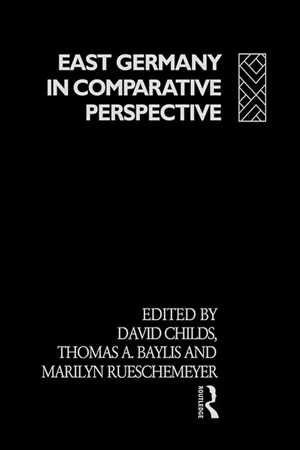
East Germany in Comparative Perspective
- 254 pages
- English
- ePUB (mobile friendly)
- Available on iOS & Android
eBook - ePub
East Germany in Comparative Perspective
About this book
As a new decade begins the popular demand for change has meant that the social and political fabric of the the Eastern Bloc countries has been irrevocably altered. This book offers a comprehensive analysis of the key political, economic and social areas of East German society, such as the military and the church, areas which will intrinsically involved with the movement for change.
Information
1
The SED Faces the Challenges of Ostpolitik and Glasnost
David Childs
THE GDR BETWEEN BONN AND MOSCOW
Abgrenzung
There are few states of any standing with which the GDR does not enjoy full diplomatic relations: Chile, Israel, South Africa and South Korea are among them, as is the Federal Republic of Germany (FRG). However, unlike the other four states mentioned, the GDR has conducted formal relations with Bonn since the Basic Treaty establishing such relations came into force in June 1973. Under the Treaty, the two states affirmed the inviolability of the frontier between them ‘now and in the future’ and total respect for each other’s territorial integrity. Article 6 committed them to respecting each other’s independence and separateness (Unabhängigkeit und Selbständigkeit) in their internal and external affairs. They also agreed to exchange permanent representatives. Yet, despite this agreement, the Federal Republic does not classify these relations as normal diplomatic relations between foreign states. It does not regard the GDR as a foreign state nor does it regard its citizens as foreigners. It is merely a German state which is part of the same German nation as itself. The theory is ‘two states, one nation’.
On the day the Treaty was signed, the Federal Government, through its representative Egon Bahr, informed the GDR in a letter that the Treaty, ‘does not contradict the political aim of the Federal Republic of Germany to work towards a state of peace in Europe in which the German people will be able to achieve once again, in free self-determination, its unity’. When the representatives of the two states took up their work in 1974, the West German was dealt with as a foreign diplomat who conducts his relations through the GDR Foreign Ministry, whereas the GDR’s man in Bonn was told by the Federal Republic that he was to work through the Chancellor’s office. The Federal Republic continued to regard GDR Germans simply as Germans and, a great advantage to the GDR, continued with the previous trade relations. The ruling SED’s response was a policy of Abgrenzung, or delimitation, between the GDR and the Federal Republic. It sought to wipe from the consciousness of the 17 million people it ruled, the common ties between themselves and the 60.7 million Germans of the Federal Republic. This policy, already annunciated by Hermann Axen in September 1970, denied any common German history or culture. According to this theory, expounded by Erich Honecker in May 1973, there had always been two cultures in Germany, the culture of the ruling exploiter class and the culture of the progressive working class. Since 1945 these two had developed further still in different directions: West German culture had become decadent and the progressive working class culture had evolved into the socialist national culture of the GDR. In practical terms, the policy of Abgrenzung meant that many public bodies in the GDR were required to change their names to remove the word ‘German’ from them. The East German radio, for instance, changed its name from the Deutschlandsender to the ‘Voice of the GDR’ (Stimme der DDR). This was just one of very many changes. Remarkably, some retained their old names – perhaps the strangest case being the railway which continued to be called the Deutsche Reichbahn as it had been before May 1945. The political parties retained their old names as well. Thus the SED is still the Socialist Unity Party of Germany, the LDPD is still the Liberal Democratic Party of Germany and the NDPD remains the National Democratic Party of Germany. Another visible sign of change was that from January 1974 all GDR vehicles leaving the Democratic Republic had to carry the international registration letters ‘DDR’ and not, as previously, ‘D’ for Germany. The banknotes were also changed to give the necessary emphasis on the GDR. Embarrassingly, the ‘national hymn’ of the GDR was no longer sung because verse one contains the line, ‘let us serve you well, Germany, united fatherland’. The constitution was also revised in 1974, removing the references in the 1968 constitution to Germany and stressing the eternal ties with the Soviet Union. Unlike 1968 there was no referendum to attempt to popularize and then legitimize the changes.
The Abgrenzung measures were the SED’s nervous response to the closer relations with West Germany in the wake of the Basic Treaty. The SED was in a difficult position, and Moscow required it to be more ready to compromise with West Germany because the Soviet Union itself wanted better relations with Bonn. Many in the SED leadership feared this development as a policy which they considered to be detrimental to the GDR’s vital interests. Walter Ulbricht, who headed this group, was forced to stand down in 1971 and make way for the more flexible Honecker. The SED realized it needed Bonn to help it get more recognition on the international stage and to assist it economically. Both these factors, recognition and an improving economy, were vital to stability. Yet the closer ties leading inevitably to more human contacts could slow the development of Marxist– Leninist consciousness in the GDR and threaten the SED’s way of doing things and could, perhaps, even threaten the system ultimately.
Trade with Bonn
In most respects the Moscow-decreed policy towards West Germany brought with it great benefits for the SED’s GDR. International recognition came swiftly once Bonn and the Western powers had signalled that they had abandoned their veto. In December 1972 alone, twenty states took up diplomatic relations with the GDR – including the Western neutrals Switzerland, Sweden and Austria, the first NATO state Belgium, and pro-western Iran. In January 1973 thirteen other states, including other NATO members, followed. Britain and France agreed relations in February. (The USA waited until September 1974.) In September 1973 the GDR and the FRG were admitted to the UNO as members 133 and 134 respectively. Economic aid and trade helped the economy as did the millions of visitors from the West.
The units of account in Table 1.1 approximate to one DM per unit. For the Federal Republic, trade with the GDR is not of great significance in terms of its total economy, as it represents only 1.5 percent of its external trade in 1985. Certain Länder where unemployment is above average – the Saar and North-rhine-Westphalia for instance – would like to export more coal and steel to the GDR. There is a consensus in West Germany among all parties that trade with the GDR should be encouraged for political reasons, as a means of keeping Germany together by creating a vested interest on the part of the GDR in better relations with Bonn. For the Democratic Republic, trade with the FRG is of far greater significance. In 1985 it represented 8.3 percent of its total external trade. Only the Soviet Union, with over 38 per cent of the GDR’s external trade in 1985, is more important. The trade with West Germany is far more important to the GDR than the percentage would indicate. It is responsible for a considerable part of the GDR’s hard-currency earnings. It is trade conducted under favourable terms because it is not treated by West Germany as foreign trade. It therefore avoids the tariff barriers of the European Community. In addition, the agreements regulating this trade do not oblige the partners (in practice the GDR) to balance their trade in any one year due to the existence of the so-called ‘swing’. This represents in effect an interest-free credit. West Germany has also been a source of direct credits in the 1980s. In 1983 a credit of 1 billion DM was made available and in 1984 a further credit of 950 million DM. The Federal Republic has also helped towards improving the physical communications between West Germany and Berlin, used by East German as well as by West German traffic. In 1980 the Federal Republic agreed to pay (for the period up to 1989) 50 million DM for West German and West Berlin use of the transit routes between West Germany and West Berlin. Much revenue from private sources flows into the GDR from the West. The churches help to maintain their sister organizations in the GDR and West Germans appear to give generously to their relatives in the East. How else can we explain the many hard-currency-only Intershops throughout the GDR?
Table 1.1. Development of trade between the GDR and FRG 1960–1986 (in millions of units of account)
‘Human Contacts’
It would be wrong to presume that it was only after the beginning of Brandt’s Ostpolitik was introduced that West Germans started to visit the GDR. There were many visitors before the improvement in relations in the 1970s. In the main, these visitors were individuals who had relatives in the GDR or who were there on business. Many who had left the GDR without official permission could not return there for fear of arrest. For those without compelling reasons to go there the GDR was not an attractive place. West Germans who wanted to visit the GDR and who did not have relatives there were sometimes regarded with some suspicion in the Federal Republic itself. After the Basic Treaty was signed, the West German authorities encouraged people to visit the other German state and there were few restrictions on who could, and who could not, go to this Warsaw Pact state. The GDR was persuaded to ease matters by passing legislation releasing those who had fled from the GDR from their citizenship and from fear of prosecution (in most cases) if they visited their old homeland. The Berlin Agreement, signed in 1971 by the USA, the Soviet Union, France, and Britain, laid the basis for regular visits by West Berliners to East Berlin and the GDR. Various other agreements led to the improvement of physical communications between the two states, as well as the postal and telecommunication services.
In an effort to restrict the number of visitors from the West, the GDR put up the minimum daily currency exchange rate of Deutschmarks into GDR-marks per visitor per day in November 1973 and in October 1980. In addition to the visits shown in Table 1.2, millions more visits have been made by West Berliners over the period since 1971. In both cases the visits were hit by the increase in the minimum currency exchange rate
Table 1.2. Visits by citizens of the FRG to the GDR (stays of one or more days)
What of visitors in the other direction? Since the end of 1964 the GDR had been allowing its pensioners to visit relatives in the West. They were sent forth with virtually no money and were forced to rely very largely on their relatives and some small official West German help. Few others, except for those on official business, were allowed to journey to the West. The pensioner traffic developed as follows:
| 1965 | 1,218,825 |
| 1970 | 1,048,070 |
| 1975 | 1,330,389 |
| 1980 | 1,554,764 |
| 1985 | 1,609,000 |
| 1987 | 3,800,000 |
As a result of the Ostpolitik a new category of visitor from the GDR could be received in the West. These were travellers on ‘urgent family business’ – such as the marriage, serious illness, or death of a close relative. In 1973, the first full year of this scheme, 41,498 East Germans were allowed to make the trip. The figure then fluctuated around the 40,000 mark until 1977. Over the last 10 years it has developed as follows:
| 1978 | 48,659 |
| 1979 | 41,474 |
| 1980 | 40,455 |
| 1981 | 36,667 |
| 1982 | 45,709 |
| 1983 | 64,025 |
| 1984 | 61,133 |
| 1985 | 66,000 |
| 1986 | 573,000 |
| 1987 | 1,200,000 |
These visitors from the GDR arrive in West Germany with virtually no money as they are only allowed to change 15 GDR-marks per annum into West German currency. (Before 30 June 1987 the amount was 70 marks per annum.) The Federal Republic now helps such visitors with a gift of 100 marks per year, and visitors from the GDR are also entitled to free medical care during their stay in West Germany.
One other form of human contact which has greatly developed since the early 1970s is the East–West telephone conversation. Before the Basic Treaty was negotiated this form of communication was very restricted, due to neglect of existing equipment and failure to modernize the telephone service between the two German states. This was, of course, due to political factors. In 1975 there were only 9.7 million calls from West Germany to the GDR, which was itself an improvement on earlier years. Telephone traffic then developed quite rapidly as new lines were installed and the political situation improved. By 1980 there were over 23 million calls from the Federal Republic to East Germany. In 1985 a record number of 26.4 million calls were made and in 1986 there were 30.3 million. It is estimated that for 1987 the number was 32 million. There are no figures available for calls made in the East–West direction. As one might expect, given the increase in telephone traffic, the number of letters sent between the two parts of Germany has fallen in recent years. The number of letters sent from West to East fell from 80 million in 1975 to 75 million in 1980 and 61 million in 1985. It rose to 63 million in 1986. In the other direction 140 million were dispatched in 1975, falling to 70 million in 1980 but rising again to 108 million in 1985. In 1986, 105 million letters were sent from the GDR to the Federal Republic. No explanation has been offered for the apparent greater enthusiasm of East Germans to write letters, bearing in mind the great difference in the size of the populations. Perhaps the greater difficulty in phoning was a factor. The greater number of letters from the GDR to West Germany is even more surprising when one considers that many East Germans are not supposed to have any contact with citizens of Western states. The total number of letters sent through the GDR post in all directions has remained fairly constant: it was 1,249 million in 1955; 1,376 million in 1970; 1,256 million in 1980; and 1,271 million in 1986.
Strauss in the GDR
The SED has had to cope with distinguished political visitors from West Germany as well as with millions of ordinary tourists. The first of these were Herbert Wehner, chairman of the parliamentary group of the Social Democratic Party (SPD) and Wolfgang Mischnick, chairman of the Free Democratic (FDP) parliamentary group. They met Honecker at the end of May 1973. Interestingly enough, both were born in Dresden in what became part of the GDR. It was an astonishing visit because both were technically, according to SED ideology, ‘class enemies’. Wehner, a Communist in the Weimar Republic, had been denounced on many occasions in Neues Deutschland. Later, pictures of Honecker with other ‘class enemies’ were to appear in the East German media. In 1975 he met Chancellor Helmut Schmidt in Helsinki at the Conference on Security and Co-operation in Europe. The two leaders met again in Belgrade in 1980 at the funeral of President Tito. On the same occasion Honecker met Willy Brandt, SPD chairman, and Federal President Karl Carstens. Schmidt and Honecker met again in 1981 when the Chancellor visited the GDR. Other funerals provided useful opportunities for Honecker to have conversations with West German leaders. He met President Carstens at Brezhnev’s in 1982, Chancellor Kohl at Andropov’s in 1984 and again at Chernenko’s in 1985. Meanwhile the visit of the Bavarian leader Franz Josef Strauss to the GDR in July 1983 was something of a minor sensation. For decades Strauss had been a popular target for Neues Deutschland and East German cartoonists. Despite the ups and downs of USA–USSR relations, and even GDR– FRG relations, top politicians were increasingly on the move in both directions. In the 1980s West German politicians seemed to be compelled to make a ritual visit to the GDR. In January 1985 Johannes Rau, Prime Minister of Northrhine-Westphalia and SPD Chancellor candidate in the 1987 elections spent four days in the GDR during which he met Honecker. In November of the same year his colleague from the Saar, Oskar Lafontaine, made the same trip. Both have been among the many West German political visitors since then. In the meantime, most of the senior members of the Politburo of the SED had been to Bonn. What do all these trips add up to? In the case of the GDR, trade has been an important consideration, less so in the West German case. More important in both cases has been the need to prove to their respective peoples that they care about détente in Germany. For the GDR leaders their encounters with West Germans are an important part of their bid to win recognition from their own people but, for this, they have to pay a price. It becomes increasingly difficult to present the West German leaders as ‘class enemies’, ‘imperialists’, and ‘warmongers’. Thus, it follows that, if they are not such wicked creatures, then their ‘NATO state’ cannot be the danger it has been presented as being, and that many restrictions on individual rights in the GDR are totally unnecessary. These contacts are, then, on the one hand, a means of stabilizing the regime, but, on the other, they make the old-style Marxist–Leninist state more difficult to uphold.
The old-style Marxist–Leninist state, which probably reached its true zenith under Ulbricht – despite some of Honecker’s early moves to go further down this road – has been under severe pressures from other sources since 1971. These have been: western television; Eurocommunism; Solidarity in Poland; the peace movement in West Germany; and, more recently, Gorbachev’s version of reform Communism in the Soviet Union.
When the Berlin Wall went up in 1961 only about 17 percent of East German homes had television and in those days it was fairly easy for the ...
Table of contents
- COVER PAGE
- TITLE PAGE
- COPYRIGHT PAGE
- TABLES
- FIGURES
- CONTRIBUTORS
- PREFACE
- ABBREVIATIONS
- 1 THE SED FACES THE CHALLENGES OF OSTPOLITIK AND GLASNOST
- 2 THE SED AFTER TWO CONGRESSES: PARTY POLICY IN THE GORBACHEV ERA
- 3 LEADERSHIP STRUCTURES AND LEADERSHIP POLITICS IN HUNGARY AND THE GDR
- 4 SOCIAL COURTS IN THE GDR AND COMRADES’ COURTS IN THE SOVIET UNION: A COMPARISON
- 5 SOCIALIST TRANSFORMATION AND GENDER INEQUALITY: WOMEN IN THE GDR AND IN HUNGARY
- 6 IS THE GDR THE FUTURE OF HUNGARY AND THE BALTICS? DISSENT AND THE LUTHERAN CHURCH IN EASTERN EUROPE
- 7 COMPARISONS OF CONSUMER MARKET DISEQUILIBRIA IN HUNGARY, POLAND, ROMANIA, YUGOSLAVIA AND THE GDR
- 8 ENTERPRISE AND ASSOCIATION IN SOVIET PLANNING: COMPARISONS WITH THE EAST GERMAN EXPERIENCE
- 9 THE FOREIGN ECONOMIC POLICY OF THE GDR AND THE USSR: THE END OF AUTARKY?
- 10 THE POLITICS OF EAST–SOUTH RELATIONS: THE GDR AND SOUTHERN AFRICA
Trusted by 375,005 students
Access to over 1.5 million titles for a fair monthly price.
Study more efficiently using our study tools.
Frequently asked questions
Yes, you can cancel anytime from the Subscription tab in your account settings on the Perlego website. Your subscription will stay active until the end of your current billing period. Learn how to cancel your subscription
No, books cannot be downloaded as external files, such as PDFs, for use outside of Perlego. However, you can download books within the Perlego app for offline reading on mobile or tablet. Learn how to download books offline
Perlego offers two plans: Essential and Complete
- Essential is ideal for learners and professionals who enjoy exploring a wide range of subjects. Access the Essential Library with 800,000+ trusted titles and best-sellers across business, personal growth, and the humanities. Includes unlimited reading time and Standard Read Aloud voice.
- Complete: Perfect for advanced learners and researchers needing full, unrestricted access. Unlock 1.5M+ books across hundreds of subjects, including academic and specialized titles. The Complete Plan also includes advanced features like Premium Read Aloud and Research Assistant.
We are an online textbook subscription service, where you can get access to an entire online library for less than the price of a single book per month. With over 1.5 million books across 990+ topics, we’ve got you covered! Learn about our mission
Look out for the read-aloud symbol on your next book to see if you can listen to it. The read-aloud tool reads text aloud for you, highlighting the text as it is being read. You can pause it, speed it up and slow it down. Learn more about Read Aloud
Yes! You can use the Perlego app on both iOS and Android devices to read anytime, anywhere — even offline. Perfect for commutes or when you’re on the go.
Please note we cannot support devices running on iOS 13 and Android 7 or earlier. Learn more about using the app
Please note we cannot support devices running on iOS 13 and Android 7 or earlier. Learn more about using the app
Yes, you can access East Germany in Comparative Perspective by Thomas A. Baylis,Dr David Childs,Erwin L. Collier,Marilyn Rueschemeyer,David Childs in PDF and/or ePUB format, as well as other popular books in Politics & International Relations & Political Economy. We have over 1.5 million books available in our catalogue for you to explore.