- 100 pages
- English
- ePUB (mobile friendly)
- Available on iOS & Android
eBook - ePub
About this book
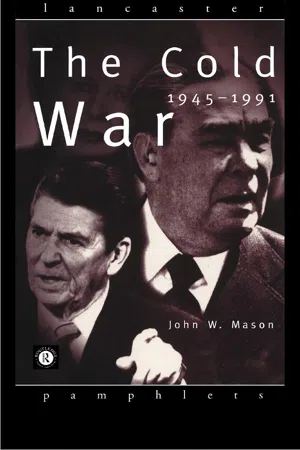
Mason provides concise coverage of the entire Cold War, paying particular attention to the Soviet-American dimension. This pamphlet:
* Analyzes the origins of the conflict
* Examines how the existence of nuclear weapons gives a unique character to the period
* Discusses the involvement of other nations and regions, particularly China
* Explains how and why the cold war ended
* Draws on recent research of revisionist scholars.
1 The origins of the cold war in
Europe, 1945–9
1917: The historical roots of Soviet and American foreign policy
The year 1917 was a momentous one in the history of the twentieth century. It was the year when the two great extra-European powers— the Soviet Union and the United States—stepped into the mainstream of history to proclaim two rival world ideologies. The United States, under President Wilson, entered the First World War not to restore the balance of power but to end the whole European state system and ‘make the world safe for democracy’ under a new international order. Russia, under the leadership of Lenin, had the Bolshevik Revolution, withdrew from the war and called for a ‘world’ revolution. There is a sense, ideologically speaking, in which it is accurate to speak of the cold war beginning in 1917. The full impact of these two events, however, was not to be felt until after 1945, when political power moved from the centre of Europe to Moscow and Washington.
There are three main sources of Soviet foreign policy. First is the historical experience of Tsarist Russia before 1917. Since the seventeenth century Russia had been subject to attack and invasion, especially from the West, and therefore always felt insecure. Second, after the Bolshevik Revolution of 1917 Russia dropped out of the First World War and was subsequently invaded by the Western allies in the years 1918–20. Churchill spoke of ‘strangling Bolshevism in the cradle’, which confirmed the Soviet leaders’ belief that the West was aiming at the capitalist encirclement of the Soviet Union. Third, the Soviet Union was inspired by the ideology of Marxism-Leninism, which predicted the collapse of capitalism. But as Lenin declared, before the collapse, ‘a series of terrible conflicts between the Soviet Republic and the bourgeois states is inevitable’.1
If the Soviet Union always felt weak and insecure, the United States, by contrast, felt safe and aware of its strength. The historical experience of the United States was that of isolationism. But when Japan attacked Pearl Harbor in December 1941 and brought the United States into the Second World War, President Roosevelt revived Woodrow Wilson’s language of universalism. He defended United States policy in terms of the abstract principles of democracy and economic freedom (later enshrined in such documents as the Atlantic Charter (1942) and the Declaration of Liberated Europe (1945)). The high-sounding moral rhetoric of American foreign policy infuriated the Soviet Union, but it happened to reflect the United States’ long-term economic interests. Roosevelt called for an economic policy of the ‘Open Door’—free trade and equal access to raw materials—in order to prevent a relapse into the Depression of the 1930s.
Both the Soviet Union and the United States, then, wanted security after 1945, but each defined it in a different way. The Soviet Union was still a regional power after 1945 and security for it meant ‘friendly’ states on its border. The United States was a global economic power and security for it meant a world open to the free exchange of goods, money and people.
The breakdown of the Grand Alliance in 1945:
Yalta and Potsdam
On 22 June 1941 Nazi Germany attacked the Soviet Union with 270 divisions in the greatest land war in history. United States public opinion was still isolationist. But when Japan attacked the United States naval base at Pearl Harbor (7 December 1941) and Hitler declared war on the United States three days later, the latter joined Britain and the Soviet Union in the Grand Alliance. Almost immediately the problem of setting up a secondfront in Western Europe came to dominate the Alliance.
The second front came in June 1944, but by then the Soviet Union had already borne the brunt of the war against Germany, suffering losses estimated at a ratio of fifty Soviet soldiers killed for every one American. Whatever the reason for the delay in setting up the second front, it was to have far-reaching consequences for the post-war political settlement. The West had to try to win at the conference table what it had forfeited on the battlefield. The West’s primary objective was to defeat Hitler, but it also feared the intrusion of Soviet power into Eastern Europe. The key country here was Poland.
Poland was the country over which the Second World War had broken out when Germany invaded it in September 1939; likewise, Poland was at the centre of the origins of the cold war after 1945. In October 1944 the Soviet Union allowed the pro-Western Warsaw uprising to be crushed by the Nazi occupation forces. It was now becoming clear that the Soviet idea of ‘friendly’ governments in Eastern Europe clashed with America’s long-term interests.
In an attempt to reach some agreement on their outstanding differences, the Big Three (the United States, Soviet Union and Britain) met for a week at Yalta in the Crimea in February 1945. At Yalta it was agreed to divide Germany into four zones of occupation and have the Soviet Union enter the war against Japan three months after Germany’s defeat. But the most important issue was Poland. Stalin recognised only the communist-based Lublin Polish Government; at the same time he signed the Declaration of Liberated Europe, which called for Eastern European governments ‘broadly representative of all democratic elements…and free elections of governments responsible to the will of the people’.2
Did Roosevelt really believe that the Soviet Union would honour its pledge to hold free elections in Poland and the rest of Eastern Europe? If he did not, he kept such thoughts to himself and led the American people to believe that no fundamental differences existed between the Soviet Union and the United States. It was a fatal misjudgement. Stalin had no problem squaring the ideal with the real. The Red Army occupied Poland and no paper declarations could remove it. Stalin’s view was clearly expressed to the Yugoslav Milovan Djilas in April 1945: ‘this’ war is not as in the past: whoever occupiesterritory also imposes his own social system as far as his army can reach. It cannot be otherwise.’3
Roosevelt died on 12 April 1945 and Vice-President Harry Truman took over the presidency. Some historians have seen the transition from Roosevelt to Truman as the moment when the cold war began. But there is no evidence to show that Truman was intent on reversing Roosevelt’s policy towards the Soviet Union. No solution had been found to the Polish question. No agreement had been reached on the future shape of the United Nations Organization. In May 1945, however, Truman abruptly ended Lend- Lease aid to the Soviet Union.
The Big Three met for their last conference of the war at Potsdam, outside Berlin, in July 1945. The German question dominated the sessions: agreement was reached on the need for the joint occupation and demilitarisation of Germany, but the issue of reparations brought out fiercely opposing views. A complicated agreement was finally reached whereby the Soviet Union would take reparations from its own zone of occupation and also receive 25 per cent of all machinery and industrial plant from the Western zones. In return, the Soviet Union would send to the Western zones food, coal and raw materials to the value of 60 per cent of what it received from the West. The agreement began to unravel within a year.
‘Atomic diplomacy’—Hiroshima and after
One week after the Potsdam Conference, on 6 August 1945, the United States dropped the first atomic bomb on Hiroshima. The effect of the bomb on United States diplomacy towards the Soviet Union and the origins of the cold war has been the subject of heated controversy among historians. Gar Alperovitz, in his revisionist work Atomic Diplomacy, claims that Truman’s hard-line attitude towards the Soviet Union was the direct con-sequence of America’s possession of the bomb.
Alperovitz argues that the United States dropped the bomb on Japan mainly as a demonstration of its military power to the Soviet Union and, subsequently, was able to use it as a diplomatic lever to wring concessions from the Soviet Union in Eastern Europe. It is true that Truman began to take a harder line against the Soviet Union in the autumn of 1945, but thiswas mainly owing to Republican pressure in Congress. At the same time the United States began to demobilise, reducing its forces from 12 million to 3 million in one year, and this weakened its bargaining power.
At the London Conference of Foreign Ministers in September 1945 the United States refused to recognise the puppet governments of Romania and Bulgaria. But there is no evidence to suggest that Stalin’s foreign policy was influenced by the United States’ possession of the bomb. Indeed, Adam Ulam suggests that the United States’ early monopoly of the bomb (the Soviet Union acquired the bomb in August 1949) actually weakened United States foreign policy by inducing a sort of Maginot psychology. ‘Like a miser with a treasure’, Ulam writes, ‘so America hugged the evanescent atom monopoly to its bosom, equally unable to exploit it or to exchange it for something useful.’4
The conditions for the creation of the cold war were set in the Second World War out of disagreements among the Big Three about what kind of post-war settlement should be made in Europe and the Far East. Each side acted according to its own historical dictates:
when Germany collapsed in May 1945 their very different visions of the future shape of Europe and the world stood revealed. The cold war was not the product of one event or decision—it was the result of a fundamental clash of ideologies and interests between the Soviet Union and the West.
Eastern Europe: cockpit of the cold war, 1945
The immediate origins of the cold war lie in the conflict between the Soviet Union and the West over Eastern Europe. At Yalta Churchill declared that, for Great Britain, the fate of Poland was a question of honour. Stalin replied that, for the Soviet Union,
it is not only a question of honour but also of security… not only because we are on Poland’s frontier, but also because throughout history Poland has always been a corridor for attack on Russia… . During the last thirty years our German enemy has passed through this corridor twice…. It is not only a question of honour but of life and death for the Soviet State.5
What Stalin said about Poland was true to a lesser extent of the other Eastern European countries. He therefore insisted that their governments be ‘friendly’ towards the Soviet Union, which in practice meant not allowing free elections.
By contrast, United States interests in Eastern Europe were abstract and idealistic. The United States was thousands of miles away and traditionally had little trade with the area. It must be remembered that most of the states of Eastern Europe—Finland, Estonia, Latvia, Lithuania, Poland, Czechoslovakia, Hungary, Romania, Bulgaria and Yugoslavia—were created after the First World War out of old dynastic empires according to the principle of national self-determination proclaimed by President Woodrow Wilson. In 1945 Roosevelt was determined to have a just and lasting peace settlement based on the principle of a people’s rights to choose their own form of government and where they wanted to live.
Roosevelt placed great hopes on the establishment of the United Nations Organization (April 1945) and this is crucial to an understanding of his wartime diplomacy regarding Eastern Europe. It meant that all decisions about territorial changes were postponed until after the war—a course of action virtually amounting to a ‘policy of no policy’ towards Eastern Europe. Meanwhile, the future of Eastern Europe was being predetermined by the advance of the Red Army and Stalin’s training of East European Communist Party leaders to take over their governments.
When the Red Army occupied the entire pre-war territory of Poland in January 1945 the pro-Soviet Lublin Committee was installed as the provisional Polish government and free elections never took place thereafter. Within two years of the end of the Second World War, Soviet-style communism had spread to eleven states in Europe with a combined population of over 100 million people: Latvia, Estonia, Lithuania (all directly annexed by the Soviet Union), Poland, the eastern zone of Germany, Czechoslovakia, Hungary, Romania, Bulgaria, Yugoslavia and Albania. The success of the Soviet Union in expanding its political and social system into Eastern Europe led to widespread fears in the West that in 1946 and 1947 perhaps Greece, then Italy, and even France would be the next to fall.
1946: an ‘iron curtain’ descends on Europe
1946 is a neglected year in histories of the cold war. It stands between the more dramatic years 1945 (the year of the Yalta and Potsdam Conferences) and 1947 (the year of the Truman Doctrine and Marshall Plan). Yet there is a strong case for dating the beginning of the cold war as 1946.
Iran was the site of the first direct confrontation between the Soviet Union and the West after 1945. It was the British at first rather than the Americans who were concerned about whether the Soviet Union would end its occupation of northern Iran after the war. When the Soviet Union refused to withdraw its troops within six months of the end of the war (as agreed by the Anglo-Russian— Iranian Treaty of 1943) Truman’s Secretary of State, James Byrnes, urged the Iranian Prime Minister in February 1946 to resist further Soviet advances into the region. This marked a fundamental shift in United States policy. In the words of Fraser Harbutt, it reflected ‘the beginnings of a profound geopolitical change that would rapidly take the United States for the first time into the heart of the Anglo- Soviet confrontation in the eastern Mediterranean and the Near East’.6 Thereafter, the United States assumed responsibility for preventing undue Soviet influence in the region.
In the same month, February 1946, Britain’s former prime minister Winston Churchill delivered his famous ‘Iron Curtain’ speech in Fulton, Missouri. He set out to depict the Soviet Union as an expansionist state and to change once and for all the Yalta attitudes and policies of accommodation towards the Soviet Union. The threat from the Soviets lay not in military expansion, he argued, but domestic subversion. Churchill’s call for an Anglo-American alliance to meet the Soviet challenge was premature, but his speech marked an important shift away from Yalta.
1946 was also the year when Moscow and Washington failed to agree about control of the atomic bomb. The Baruch Plan recommended the establishment of an international ‘Atomic Development Authority’ run by the United Nations, which would control all uranium deposits to be used for peaceful purposes only, but leave the United States with the right to continue to manufacture its own atomic bombs. Not surprisingly, the Soviets rejected the Baruch Plan, which would have left the United States with a permanent monopoly of atomic power.
In the same month as Churchill’s iron curtain speech, the United States chargé d’affaires in Moscow, George Kennan, sent an eight-thousand word telegram to the Truman administration in Washington. The effect of the famous Long Telegram was sensational—copies were circulated around the Pentagon and it became ‘the bible for American policy-makers’.7 The Soviet Union, Kennan wrote, did not believe that peaceful co-existence was possible between the communist and capitalist world. At the bottom of the Kremlin’s neurotic view of world affairs, Kennan wrote, was ‘an instinctive Russian sense of insecurity which, combined with Marxist dogma, made Soviet expansionism more dangerous and insidious than ever before’.8
The implications of Kennan’s analysis were chilling: if Soviet foreign policy was formulated not as a response to what happened in the outside world but only as a result of conditions within the Soviet Union, then no action taken by the United States would diminish Soviet hostility towards the West. The policy Kennan recommended can be summed up in one word—‘containment’. Containment was essentially a policy of the middle way, between isolationism on the one hand and prevent-ive war on the other. It was adopted as the official policy of the Truman administration in 1947.
The Truman Doctrine and Marshall Plan, 1947
United States foreign policy was in a state of confusion in early 1947. As we have seen, the United States began to take a more aggressive stance towards the Soviet Union in 1946. But Congress was dominated by Republicans intent ...
Table of contents
- Cover Page
- In the Same Series
- Title Page
- Copyright Page
- Foreword
- Preface
- List of Abbreviations
- Chronology
- 1: The Origins of the Cold War In Europe, 1945–9
- 2: Communist China and the Cold War In Asia, 1945–53
- 3: Peaceful Co-Existence and Nuclear Confrontation, 1953–64
- 4: The United States and Indochina, 1945–75
- 5: China Between the Superpowers, 1949–80
- 6: The Rise and Fall of Détente In the 1970s
- 7: Reagan, Gorbachev and the End of the Cold War, 1981–91
- Conclusion
- Notes
- Select Bibliography
Trusted by 375,005 students
Access to over 1.5 million titles for a fair monthly price.
Study more efficiently using our study tools.
Frequently asked questions
Yes, you can cancel anytime from the Subscription tab in your account settings on the Perlego website. Your subscription will stay active until the end of your current billing period. Learn how to cancel your subscription
No, books cannot be downloaded as external files, such as PDFs, for use outside of Perlego. However, you can download books within the Perlego app for offline reading on mobile or tablet. Learn how to download books offline
Perlego offers two plans: Essential and Complete
- Essential is ideal for learners and professionals who enjoy exploring a wide range of subjects. Access the Essential Library with 800,000+ trusted titles and best-sellers across business, personal growth, and the humanities. Includes unlimited reading time and Standard Read Aloud voice.
- Complete: Perfect for advanced learners and researchers needing full, unrestricted access. Unlock 1.5M+ books across hundreds of subjects, including academic and specialized titles. The Complete Plan also includes advanced features like Premium Read Aloud and Research Assistant.
We are an online textbook subscription service, where you can get access to an entire online library for less than the price of a single book per month. With over 1.5 million books across 990+ topics, we’ve got you covered! Learn about our mission
Look out for the read-aloud symbol on your next book to see if you can listen to it. The read-aloud tool reads text aloud for you, highlighting the text as it is being read. You can pause it, speed it up and slow it down. Learn more about Read Aloud
Yes! You can use the Perlego app on both iOS and Android devices to read anytime, anywhere — even offline. Perfect for commutes or when you’re on the go.
Please note we cannot support devices running on iOS 13 and Android 7 or earlier. Learn more about using the app
Please note we cannot support devices running on iOS 13 and Android 7 or earlier. Learn more about using the app
Yes, you can access The Cold War by John Mason in PDF and/or ePUB format, as well as other popular books in History & Military & Maritime History. We have over 1.5 million books available in our catalogue for you to explore.