eBook - ePub
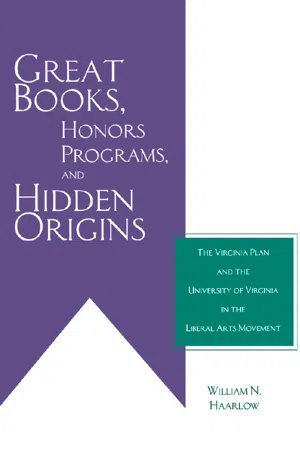
Great Books, Honors Programs, and Hidden Origins
The Virginia Plan and the University of Virginia in the Liberal Arts Movement
- 254 pages
- English
- ePUB (mobile friendly)
- Available on iOS & Android
eBook - ePub
Great Books, Honors Programs, and Hidden Origins
The Virginia Plan and the University of Virginia in the Liberal Arts Movement
About this book
This book argues a new and more complex interpretation of the development and manifestations of the liberal arts movement in American higher education during the 1930s, 40s and 50s. Specifically, the book elucidates the under-explored yet formative role that the University of Virginia and its 1935 'Virginia Plan' played, both in fostering the liberal arts movement, and as a representative institution of the broader interaction colleges and universities had with this movement.
Information
CHAPTER 1
Before the Virginia Plan
“It is impossible to think clearly about the curriculum of the American college or university without some sense of its past.”
—Clark Kerr
At the opposite end of the Lawn from the Rotunda at the University of Virginia stands Old Cabell Hall. Completed in 1898 under the auspices of the eminent architect Stanford White, Cabell Hall closed off the open end of Thomas Jefferson’s Academical Village and, in doing so, not only eliminated the prospect of the hills south of Charlottesville but also flipped the intended entry to the university from the south end to the north end of the Lawn. More than Jefferson’s physical design, however, had been dramatically altered at the university by the close of the nineteenth century. Virginia’s curriculum and the philosophy behind it had changed substantially during the 1800s. To understand these changes and how they precipitated the 1935 Virginia Plan, one must first place the University of Virginia in the larger context of American higher education history.
This chapter briefly discusses the evolution of certain aspects of American higher education from the founding of Harvard College in 1636 up to the 1935 Virginia Plan. Although primary emphasis is placed on curricular developments and philosophies during this three-hundred-year period, attention is also given to the place of the student in American colleges and universities, as the two are closely related topics. Indeed, both the curriculum and what is today referred to as “student life” were central to the philosophy of undergraduate education articulated in the Virginia Plan. While this chapter highlights significant historical points, influences, ideas, actors, and developments of this evolution, it is not intended to be exhaustive. Instead, it initially presents background for, and themes central to, the history of higher education relevant to the creation of the Virginia Plan.
The focus of the historical overview then shifts to the pre-Virginia Plan manifestations of the general education and liberal arts movements at Columbia University and the University of Chicago. Because accounts of the origins of general education at Columbia and Chicago have been told elsewhere by numerous capable historians, these overviews are relatively brief, intending not to be comprehensive institutional histories, but rather to provide a context in which to place the Virginia Plan.
The Curriculum and the Student in American Higher Education
The evolution of curriculum and college student development in American higher education is a long and telling story. Long because although the American history of curriculum and student development ostensibly starts with the founding of Harvard in 1636, its foundations are linked directly to the medieval university of the European High Middle Ages and stretch even further back to classical antiquity through what historian Bruce Kimball calls the oratorical and philosophical traditions of liberal education.1 The evolution of curriculum and student development in America is likewise telling because the forms they have taken over time in terms of their manifestations, pedagogical and theoretical assumptions, content, structure, and requirements say a great deal about the contemporaneous society. Understanding this history is essential if one is to grasp the significance of the Virginia Plan and the liberal arts movement.
There are four related and essential themes fundamental to any understanding of the college curriculum and student in America that are particularly germane to the Virginia Plan. First, since the beginning of its history in the seventeenth century, there has been a recurring fear of declension in American higher education. As a result, this concern has played a continuing role in approaches to the curriculum and the student. Second, there has been an ongoing debate about what constitutes a good college education, that is, what are its proper goals. Third, there has been a related battle between election and prescription, or more broadly, between freedom and restriction in the curriculum. Fourth, there has been an ongoing argument about whether higher education should groom a leadership elite, or emphasize the democratizing effects of mass education. As will be seen in the following historical overview, these four themes are fundamental to any understanding of the evolution of the curriculum and the student in American institutions of higher education in general, and to the formulation and implementation of the Virginia Plan in specific.
The Colonial College
Nine young men made up the first cohort of graduates in America, the Harvard Class of 1642.2 These first American bachelors of arts were inheritors of the “Oxbridge” academic tradition of England, yet they were also products of very colonial American concerns. Of course they did not think of themselves as “Americans,” but as Englishmen. Nevertheless, the colonists of Massachusetts Bay believed with great urgency that education was essential to the survival of their community in a way perhaps not envisioned in Europe, for in America the future of civilization was not to be taken for granted. The barbarism of the wilderness was literally all around them, and it threatened to overwhelm their holy compact at any time. Education was thus deemed essential to the very survival of the Puritan endeavor. Literate ministers were necessary not just because of the Protestant emphasis on reading the Word, but also because the small colony was responsible for providing its own Puritan clergy. Civilization was literally only one generation deep, so the younger generation had to be prepared to persevere and prosper. As conceived by the colonists, self-reliance was required, but only possible with higher education.
The Puritan concern about declension is a perennial concern in the story of the curriculum in America and the American student, a concern which has both indicted and motivated higher education and which continues literally up through the present day. The lurking danger has taken different forms over time: the Old Deluder, the wilderness, threatened English liberties, an uneducated republican citizenry, irrelevance, vocationalism, the elective system—the list goes on, up through contemporary concerns about declining morality, political correctness, and scholastic standards.
The early curriculum of the colonial colleges was thoroughly classical and prescribed. Emphasis was on the three Aristotelian philosophies: natural, moral, and mental (that is, physics, ethics, and metaphysics), ancient languages (Greek, Latin, and Hebrew), and especially divinity. These subjects were largely taught via the seven liberal arts as codified in the early Middle Ages: the trivium (logic, grammar, and rhetoric) and the quadrivium (arithmetic, geometry, astronomy, and music).3 In sum the colonial curriculum was part medieval with its scholastic concerns, part Renaissance with its interest in producing a governing class and gentlemanly refined culture, and part Reformation with its dedication to Protestant Christianity.4
Over the course of the eighteenth century, the original classical course of study was enlarged to include Enlightenment thought and subjects, including “more mathematics, greater specialization in the natural sciences, the study of literature and history, and a more prominent role for moral philosophy.”5 Moral philosophy, which developed as the capstone course for collegiate education, was broadly a course in ethics that “was wonderfully reassuring in its insistence on the unity of knowledge and the benevolence of God.”6 Although the colonial college curriculum was expanded, the trend could not continue unchecked. The introduction of belles lettres, modern languages, history, and especially the sciences increasingly crowded the classical curriculum so that by the early nineteenth century important choices had to be made. The antebellum college would be forced to deal with this inevitable eventuality.
During the seventeenth and eighteenth centuries it was believed that the classical course of study promoted morality and character because of its difficult content and the academic rigor required to master it. Although colonial educators believed that academic knowledge was important for students, their primary concern was the development of character and piety, whether they were training ministers or secular leaders. Accordingly, colonial schools invoked a strict discipline for students.
The schools also served in loco parentis, that is, as parental surrogates for students. With both their severe theology and their acute consciousness that the place of their civilization in the new world was tenuous, it is not surprising that a form of in loco parentis would be employed by colonial colleges, especially considering the relative youth of the college students in those years. Starting from the beginning of American higher education, reaching an apogee in the Antebellum era and then slowly declining, in loco parentis arguably existed up through the 1960s. The nature of that relationship changed over this long span of time, but the essential assumption that schools should in some form proscriptively direct student development—via rules or appeals to conscience, and manifested in characteristics such as compulsory chapel— was the modus operandi for most of the history of American higher education.
The second essential theme noted in the beginning of this chapter, the debate over the aims of higher education—between liberal/general education and practical/vocational education—came into sharper focus starting in the midnineteenth century, but can be linked to the ancient debates between the Sophists and Socrates in Greece during the fifth century B.C.Frederick Rudolph argues:
An exclusively cultural or nonutilitarian education is a concept contrary to experience. As Christopher Jenks and David Riesman put it, “The question has always been how an institution mixed the academic with the vocational, not whether it did so.” And the question has also been how much value society attached to the academic, the cultural, and supposedly nonutilitarian.7
The colonial college placed itself above this liberal/practical distinction. Trades would be mastered through apprenticeship, outside of formal higher education, while “classical erudition was believed to afford the sure guide for those destined to conduct the affairs of state and church.” Moreover, “Shared in common by all academicians, whatever their sectarian persuasion, was the presumption that classical learning was essential for success in the various learned professions of law, medicine, or theology.”8 These views would find a renewed voice in the twentieth-century liberal arts movement.
The Antebellum College
The antebellum college curriculum maintained a focus on the classical course of study, but, continuing the practice started in the eighteenth century, it also increasingly supplemented the traditional course with modern languages, mathematics, and more science. To cover these subjects, “parallel” or “partial” courses of study that often led to a B.S. degree were also introduced. These alternatives to the classical B.A. program gave students a choice between a classical and an arguably more practical course of study.9 In spite of these curricular additions, antebellum higher education curriculum is usually exemplified by the famous Yale Report of 1828 which claimed: “The two great points to be gained in intellectual culture, are the discipline and the furniture of the mind; expanding its powers, and storing it with knowledge. The former of these is, perhaps, the more important of the two.”10 As for the arguments that collegiate education should have greater orientation toward the practical concerns of the business and professional realms, the Report responded that, “our object is not to teach that which is peculiar to any one of the professions; but to lay the foundation which is common to them all.”11 In short, the mission of the liberal arts college was “to serve as a custodian of high culture; to nurture and preserve the legacy of the past; to foster a paideia, or ‘common learning,’ capable of enlarging and enriching people’s lives; and to impart the knowledge, skills, and sensibilities foundational to the arts of living themselves.”12
Although the Yale Report is often portrayed as a deeply conservative document, arresting the progress of higher education in America for decades, more recently this view has been challenged. Recent interpretation has suggested that the Yale Report was actually innovative in an important way. Instead of trying to cover the entirety of knowledge in a universal curriculum, as additions to the curriculum in the eighteenth century were designed to do, the Yale Report, acknowledging that such coverage was no longer possible, held that “the purpose of a college education was to train all the faculties of the human mind, rather than to teach all branches of knowledge.” In short, emphasis was being shifted from the furniture to the discipline of the mind.13
Whether or not the Yale Report represents innovation, there is little question that collegiate education too often remained a grim affair as an example from Princeton in 1846 demonstrates.
When word reached [Princeton Vice President John] Maclean that Professor [Evert M.] Topping was teaching Greek literature rather than the Greek language, he at once called him to account. Topping replied that he used literature as a means to an end, in order to interest the students in their work. After years of futile attempt in the familiar method of teaching, in which he was often interrupted “by groans and other wilful (sic) noises,” he began to intersperse the translation and parsing with such comments on the passages as had attracted his own attention. The effect was immediate. From being notoriously unruly and apathetic, the students became docile and studious. “We must succeed, it seems to me, by interesting the understanding of the students,” he concluded, “by rousing a manly interest of thought and then turning them back upon themselves.” That this was rank heresy we conclude from the fact that a few days later Topping’s resignation was accepted by the trustees.14
Cognizant of the content and pedagogy commonly employed in American colleges, Franklin, Jefferson, Jacksonians, and others criticized the classical curriculum to varying degrees as being insufficient if not irrelevant to the needs of the young Republic. Their criticisms notwithstanding, the spirit and content of the Yale Report largely encapsulates the stance taken by the colleges up through the Civil War.
It would be incorrect to assume, however, that there were no modifications to the classical curriculum during the Antebellum era. During the first decades of the 1800s, students, as they had always done, used ancient passages to study the classical languages. Generally they did not read classical texts in full. Instead, textbooks such as the Graeca Majora were used to study the learned classical languages. These textbooks were compilations of extracts, not classical works in their entirety. In short, “it was not classical literature, poetry, drama, archaeology, antiquities, biography, or history that occupied college boys in the classical classroom, but language.”15 This had been true since the founding of Harvard in 1636 and at its predecessors, Oxford and Cambridge. However, during the humanist revolution that occurred roughly between 1820 and 1860, a new philosophy of education emerged, one which sought to promote a virtuous citizenry, not just classical erudition. It was believed that the study of the classical world as a whole, and not just classical grammar and language, would help preserve the young American Republic from declension. Coinciding with the Greek Revival that developed after 1820, the college curriculum saw “the tragedies of Sophocles, Euripides, and Aeschylus; the comedies of Aristophanes; the orations of Demosthenes; the Illiad and Odyssey of Homer; and the dialogues of Plato all appear with increasing frequency after 1830 next to Cicero, Horace, Livy, and Tacitus.”16
This is an important point, for when the liberal artists of the twentieth century argued that their philosophy of education, based in part on the great books, was a re-introduction of what had always been the basis of Western education, they were only partly correct. True, classical texts were used before the rise of the research university in the latter half of the nineteenth century, but it would be incorrect to assume that American college students had generally followed something akin to a great books course of study. The liberal artists were on firmer ground when they sought precedence for their philosophy of education in the Antebellum era, rather than the Republican era of the late eighteenth century, or earlier.
Women’s Education and Curricular Innovation
Female higher education in the Antebellum era was similar in numerous respects to male education at the time, but it also introduced for the first time some of the subjects that would later b...
Table of contents
- Cover Page
- Title Page
- Copyright Page
- Series Preface
- Acknowledgments
- Introduction
- Chapter 1
- Chapter 2
- Chapter 3
- Chapter 4
- Chapter 5
- Chapter 6
- Conclusion An Unfinished Story
- Sources
- Notes
- Bibliography
Trusted by 375,005 students
Access to over 1.5 million titles for a fair monthly price.
Study more efficiently using our study tools.
Frequently asked questions
Yes, you can cancel anytime from the Subscription tab in your account settings on the Perlego website. Your subscription will stay active until the end of your current billing period. Learn how to cancel your subscription
No, books cannot be downloaded as external files, such as PDFs, for use outside of Perlego. However, you can download books within the Perlego app for offline reading on mobile or tablet. Learn how to download books offline
Perlego offers two plans: Essential and Complete
- Essential is ideal for learners and professionals who enjoy exploring a wide range of subjects. Access the Essential Library with 800,000+ trusted titles and best-sellers across business, personal growth, and the humanities. Includes unlimited reading time and Standard Read Aloud voice.
- Complete: Perfect for advanced learners and researchers needing full, unrestricted access. Unlock 1.5M+ books across hundreds of subjects, including academic and specialized titles. The Complete Plan also includes advanced features like Premium Read Aloud and Research Assistant.
We are an online textbook subscription service, where you can get access to an entire online library for less than the price of a single book per month. With over 1.5 million books across 990+ topics, we’ve got you covered! Learn about our mission
Look out for the read-aloud symbol on your next book to see if you can listen to it. The read-aloud tool reads text aloud for you, highlighting the text as it is being read. You can pause it, speed it up and slow it down. Learn more about Read Aloud
Yes! You can use the Perlego app on both iOS and Android devices to read anytime, anywhere — even offline. Perfect for commutes or when you’re on the go.
Please note we cannot support devices running on iOS 13 and Android 7 or earlier. Learn more about using the app
Please note we cannot support devices running on iOS 13 and Android 7 or earlier. Learn more about using the app
Yes, you can access Great Books, Honors Programs, and Hidden Origins by William Haarlow in PDF and/or ePUB format, as well as other popular books in Education & Education General. We have over 1.5 million books available in our catalogue for you to explore.