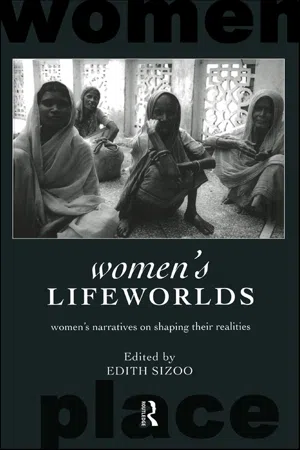
Women's Lifeworlds explores the diversity and complexity of women's perceptions and reactions to their own 'lifeworlds' in their own words. Examining the changing meaning of 'place' in women's lives over time and across space, this book questions how women face, negotiate and shape the social space of their environment. Engaging personal narratives are presented by fifteen women of various age groups, from different cultural, religious, social and geographical backgrounds, from Mexican politician, Muslim psychiatrist, Finnish housewife to Indian guru and African rural woman. Writing about the lives of their grandmothers, mothers, themselves, their daughters or other close female relatives, the authors of these life narratives cross generational and cultural divides and share perceptions with each other. This unique inter-generational approach provides an engaging challenge to the generalised assumptions of how women in various historical and cultural contexts feel about womanhood, life, society, culture and religion.
- 272 pages
- English
- ePUB (mobile friendly)
- Available on iOS & Android
eBook - ePub
About this book
Trusted by 375,005 students
Access to over 1.5 million titles for a fair monthly price.
Study more efficiently using our study tools.
Information
Part I
INTRODUCTION
1
A POLYLOGUE
Edith Sizoo
The Encounter turned into a real-life meeting. Having come with pen and paper, I found myself unable to write down the very secret of reciprocity that in my view characterized our exchanges, the secret that true dialogue between people and cultures depends upon.
(a participant)
EXPLORING SIMILARITIES AND DIFFERENCES
Adding stones to a historical path
Over the last few decades tremendous efforts have been made to reach a better understanding of the causes of women’s problems in society and to set out strategies to solve them. For many women the rising awareness of worldwide female solidarity was a vital spark in their personal life, igniting consciousness of their own specific reality.
Slowly but surely women started to speak out, publicly and privately, wanting to be heard openly and to be listened to on their own—possibly differing—terms. Although women’s feelings about being a woman within their own societies were perhaps voiced most eloquently through feminist movements, less formally organized and less articulate women also had their own perceptions of themselves and their societies.
Feminist thinking and acting, outspoken as it was, may have created the impression of dealing with one universal problem of submission to patriarchal models of society and of working on global, uniform strategies to empower women. However, a closer look at the emphases placed on the various aspects of the issue shows not only different waves in feminist thinking but also its inherent heterogeneity. We cannot speak of one feminism. There exists a variety of feminisms, each with its own angles and foci.1
At different times and at different places, one finds varying degrees of emphasis on such issues as women’s rights in society2, emancipatory politics and life politics.3 Many feminists focus particularly on gender equality and equal access to decision-making,4 or on the ‘relations of ruling’.5 Some, especially those from the southern hemisphere, feel that feminists should not be too preoccupied with sexuality. They challenge the hierarchies within the global feminist sphere and denounce Western feminist writing as ‘colonial discourse’ on ‘the Third World woman’, thus ignoring differences.6 At the same time, there are many Northern feminisms which acknowledge or advocate plurality.7 Sometimes they go even further by challenging the whole category of ‘woman’ as too fixed and too dichotomized, while life in fact is much more fluid.8 For some within this heterogeneous feminist movement, explicit political action through a well-organized movement is the main focus.9 For others, it is not even on the agenda.
Solidarity and differences
After the recent decades of worldwide discussion on ‘women’s issues’, we now seem to have entered a period of exploring the ways in which women respond to their immediate, and often very different, environments. The focus of attention is moving towards discovering the nature and quality of differences and the characteristics of their meaning.
Similarities and differences are explored within the categories of woman10 as well as the social construction of woman/man and the consequences of this for the dealings that each have with their environment.11,12 In this sense there is a shift towards defining and explaining differences in order to broaden our understanding of the contribution they can make. We could even speak of a move away from a focus on womanhood, towards an understanding of differences in general.
This tendency may bring feminist thinking closer to those—both women and men—who have been distanced in the past by a lack of subtlety and nuance. It may even bring it closer to feminists themselves, for even women who have been active in women’s movements recognize that in their own lives there are obvious differences between the public stands they take on feminism or gender issues, on the one hand, and shifts or compromises which they make in their own lives as women, friends, lovers and mothers on the other. As so often happens, in many realms of life, we may hesitate to reveal the discrepancies between what we say, do and write, and what we live—but they do exist.
The NGO International Forum on Women, in conjunction with the United Nations Conference on Women and Development in Beijing, China (1995), has clearly shown that feminist thinking has moved not only beyond thinking about universal ‘woman’ to perspectives on ‘difference’, but also developed the concern to see ways in which women can find common bases for action and collaboration while honouring their diversity in experiences and contexts.
In the plenary speeches during the NGO Forum in Beijing (compiled and edited by Eva Friedlander) new issues emerged:
identity and difference; human rights; responsibility and accountability of governments, non-governmental and international organizations; and questions of institutional transformation… The speeches reflect the ways in which identities are played off one another to create multiple levels of similarity and difference, unity and divisiveness. As differentiation and inequality bring benefits to some while marginalising others, the question of how to create unity while accommodating difference becomes a central problem for the future of the women’s movement.
(Friedlander, 1996)
The event in Beijing showed, again, how each participant (having come from a specific spot on the globe) was connecting her local web of social relations to the wider ones, and by doing so enabled the latter to connect with those in her place.
A parallel with the development idea
There is a parallel to be drawn here with the history of the idea of ‘development’ and its practice. For decades ‘development’ was defined in universal terms and thought of as a blueprint for the well-being of humankind. The ‘developed’ sat gloriously at the top of the Rostowian ladder, which was to be climbed by all human beings in order to attain ‘the good life’. ‘Development’ was supposed to be desirable and applicable anywhere, at any time, for anyone. Unfortunately, however, this heroic ascension did considerable damage to nature, cultures and people en route.13
The universalist, and therefore reductionist, approach in development thinking and practice ignored the historical and cultural diversity of the various local environments targeted as its ‘beneficiaries’. The many failures of large-scale development programmes, however, have slowly awakened a certain awareness of the need for a more culture-sensitive approach to problem resolution.14
The United Nations Decade for Cultural Development (1988–1997) which (significantly) followed the UN Decade for Women and Development and coincided with the UN Conference in Rio de Janeiro on Environment and Development, bears witness to the inevitable recognition that ‘development’ remains a myth as long as it is not tailored to fit Our Creative Diversity, the title given by the World Commission on Culture and Development, chaired by Pérez de Cuellar, to its final report.
Many development projects for women were initiated from outside by governmental or non-governmental agencies with a view to improving women’s socio-economic situation. Experiences with these projects have made it more and more evident that women in different parts of the world—belonging to different cultural contexts, social classes and religions—may perceive their womanhood and their life (partly) differently, may act on that perception (partly) differently, and may even resist ‘integration’ into a development model which does not respond to their own perception of their own aspirations. Key issues in such resistance are so-called ‘development’ programmes which violate natural resources. One example of an environmental movement initiated by a woman is the Green Belt Movement in Kenya.15
The trend towards further differentiation can be seen as characteristic of a new phase. Initially, the ‘women’s issue’ (like the ‘development issue’) tended to be stated in universal terms: it was thought to be the only way to make the point sufficiently powerfully. Now that the general analysis has to be applied to specific micro-levels, it is the diversity of situations which becomes more apparent, and—perhaps even more importantly—the differences in perceptions and appreciations of these situations. It is an attempt to explore this latter phenomenon and its implications that has led to the production of this book. This exploration has been conducted in a spirit of trying to understand rather than to explain.
The book project: purpose and expectations
The central idea behind the book project was a wish to highlight what women personally consider and appreciate as basic dimensions of their own lives, their sources of strength and the things that bring meaning to their lives. Rather than objectively addressing the socio-economic position of women in various cultural contexts, the book is concerned with women’s own-subjective-perceptions of their environment and the forces which drive them in shaping their lives the way they do.
These environments are not only linked to the physical places where women are born and those in which they subsequently live. They are also made up of historical and cultural settings which in turn are shaped by complex patterns of changing relationships. Wherever people are located, their ‘locus’ consists of shifting connections with their direct environment and the world beyond it. The question of how women face, negotiate and shape the social space of their environment clearly needed to be looked into from a time perspective as well as a cross-cultural place angle. In other words: what changes do we see over a certain period of time in a given geographical context (multigenerational or ‘vertical’ perspective): and how does a particular period in which a generation experiences a certain environment make a difference (intragenerational or ‘horizontal’ perspective)? How does moving between places influence a woman’s life: and how do changes in the place where she remains, perhaps all her life, affect her?
These questions were at the centre of the idea to combine the place and time dimensions by trying to find women from a variety of backgrounds (geographical, cultural, religious, socio-economic and age) who would agree to write about the lives of various generations of women in (or close to) their family.
The expectation was that these narratives would provide rich material for enhancing the understanding of similarities and differences in women’s lives over time and across space. For instance, the grandmothers’ generation was thought to have been more bound to its place of origin than the present-day generation of the authors and their daughters. It was expected that increased mobility might affect a sense of belonging, of rootedness.
Finally, it was hoped that what grandmothers, mothers and daughters in different parts of the world were going to say about their ways of shaping their own realities would not only bring out differences, but also make explicit the underlying driving forces which many women have always implicitly recognized in each other and which hopefully will continue to create a common base for shaping a more humane society—at home and elsewhere.
THE PROCESS: A POLYLOGUE
The choice of the authors
The composition of the group was based on the criterion of achieving diversity in geographical, socio-economic, cultural, religious and professional background, as well as age. The names of the candidates were suggested by the members of an intercultural Core Group which had been formed to monitor the process. At this point, information on the candidates was restricted to their activities outside the family circle: next to nothing was known about their personal background. The women who accepted to participate turned out to be not only quite diverse indeed, as was intended, but also to share a level of education which allowed them to take up the challenge of writing the life narratives, to communicate in English or Spanish and to travel outside their country Most (but not all) of them had followed some kind of higher education and are professional women now, even if their mothers were not.
It hardly needs to be stated that the group thus formed was not meant to be in any way representative of ‘women in the world’, nor of women in their own country, class, age or creed—not even of their family. Expectations did not go beyond the supposition that each of the invited participants would have her own specific frame of reference from which reality is observed and analysed, as well as her own personal approach to the common exercise. For instance, a Mexican politician, an Indian guru or an African rural woman would probably approach reality in a different way than a Finnish housewife, an Indigenous leader, a Muslim psychiatrist, or a European linguist. Not only might her perception be different, but also her conclusions. The combination of a variety of cultural, religious and professional angles might lead to a more comprehensive light being shed on ‘the ways’ of the women in the stories.
The fifteen authors were invited to meet for five days in order to share their perceptions of the life narratives. This Encou...
Table of contents
- COVER PAGE
- TITLE PAGE
- COPYRIGHT PAGE
- CONTRIBUTORS
- PREFACE: WOMEN'S WAYS OF SHAPING THIER REALITIES
- ACKNOWLEDGEMENTS
- PART I: INTRODUCTION
- PART II: THE LIFE NARRATIVES
- PART III: THE FINDINGS
Frequently asked questions
Yes, you can cancel anytime from the Subscription tab in your account settings on the Perlego website. Your subscription will stay active until the end of your current billing period. Learn how to cancel your subscription
No, books cannot be downloaded as external files, such as PDFs, for use outside of Perlego. However, you can download books within the Perlego app for offline reading on mobile or tablet. Learn how to download books offline
Perlego offers two plans: Essential and Complete
- Essential is ideal for learners and professionals who enjoy exploring a wide range of subjects. Access the Essential Library with 800,000+ trusted titles and best-sellers across business, personal growth, and the humanities. Includes unlimited reading time and Standard Read Aloud voice.
- Complete: Perfect for advanced learners and researchers needing full, unrestricted access. Unlock 1.5M+ books across hundreds of subjects, including academic and specialized titles. The Complete Plan also includes advanced features like Premium Read Aloud and Research Assistant.
We are an online textbook subscription service, where you can get access to an entire online library for less than the price of a single book per month. With over 1.5 million books across 990+ topics, we’ve got you covered! Learn about our mission
Look out for the read-aloud symbol on your next book to see if you can listen to it. The read-aloud tool reads text aloud for you, highlighting the text as it is being read. You can pause it, speed it up and slow it down. Learn more about Read Aloud
Yes! You can use the Perlego app on both iOS and Android devices to read anytime, anywhere — even offline. Perfect for commutes or when you’re on the go.
Please note we cannot support devices running on iOS 13 and Android 7 or earlier. Learn more about using the app
Please note we cannot support devices running on iOS 13 and Android 7 or earlier. Learn more about using the app
Yes, you can access Women's Lifeworlds by Edith Sizoo in PDF and/or ePUB format, as well as other popular books in Social Sciences & Social Science Biographies. We have over 1.5 million books available in our catalogue for you to explore.