eBook - ePub
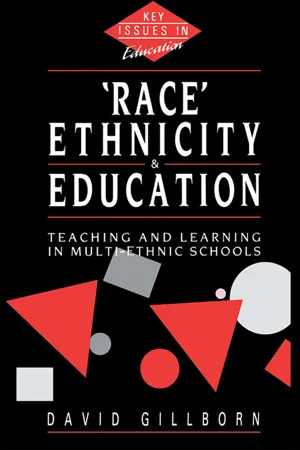
Race, Ethnicity and Education
Teaching and Learning in Multi-Ethnic Schools
- 272 pages
- English
- ePUB (mobile friendly)
- Available on iOS & Android
eBook - ePub
About this book
This book is a major new investigation into the issues of 'race', ethnicity and education, following the educational reforms during the late 1980s. It provides an up-to-date and critical introduction to current issues and major research findings in the field, exploring the teacher-pupil relationship through a detailed account of life in an inner-city comprehensive. It reveals the influence of different racist stereotypes and highlights the especially disadvantaged position of Afro- Caribbean pupils within a school. Features: * Draws on a wide variety of research projects in ethnic schools to examine: achievement; curriculum content; language use; assessment and testing under the National Curriculum * Uses material collected during two years of research to consider young people's school experiences and issues relating to classroom discipline.
Information
Chapter 1
‘Race’, ethnicity and education
Key concepts and ideas
Want it again, Paki?You stupid white Bastard.These are reportedly the words of two Manchester school-boys, one with a bloody knife, the other about to die from his wound. Half a year later, the mother of the Pakistani boy killed in a school playground is quoted as saying: ‘It might take 100 years to change the world. But the schools can change now…’ (Cohn, 1987, p. 8; emphasis added)
Questions of ‘racial’ equality, discrimination and harassment have become a familiar part of late twentieth century life. The ethnic diversity of society has consequences for every area of social policy, not least education. The ‘race issue’ cannot be adequately met by actions in any single area. Alone, the education system cannot provide all the answers, yet it does have the opportunity, and obligation, to make a significant contribution towards the creation of a more just society.
schools cannot ‘solve’ the problem of racism in our society. But they should surely not contribute to it, to the extent that they do. There is no simple or doctrinaire solution to the problem but the teaching profession can make a much larger contribution than they do at present. (Lacey, 1988, p. vii)
Race as an issue in contemporary education
‘Race’ issues frequently grab the headlines. When a Local Education Authority (LEA) designed a ‘Development Programme for Race Equality’, which included school-based evaluation and in-service training, national newspapers responded with banner headlines proclaiming a ‘Race Spies Shock’, involving the use of ‘race commissars’ in the classroom. When a Bradford headteacher published articles which offended many parents (both white and ethnic minority), the ensuing legal battle dominated media interest in education and led to a man whom many felt was ‘racist’ being hailed as a hero in the tabloid press.1 ‘Race’ is, therefore, a highly political matter, it is also a key educational issue. ‘Race’ is perhaps one of the most controversial areas of contemporary educational debate.
The area of ‘race’ and education is characterized by a lack of coherence and seemingly endless change and controversy. There are many different theories of race relations but very little agreement (cf. Rex and Mason, 1986). Scholars have argued over the relative importance of economic, gender and ethnic factors; the origins and mechanisms of group difference; even the validity of the very term ‘race’. In fact, terminology is one of the most frequently changing and disputed aspects of the whole field. Before going any further, therefore, it may be useful to outline briefly something of the main concepts which are used at present.
Defining and studying ‘race’
Key words and phrases have changed to reflect the variety of political and educational perspectives which have evolved over the last few decades. Consequently, words which were once quite proper are now scorned as insulting, and vice versa. In their struggle for political recognition and social equality, several groups have glorified previously derogatory terms—as has been the case with the Black Power and Chicano movements in the USA (Cashmore, 1988). During the early 1960s, the words ‘negro’ and ‘coloured’ were used by Civil Rights leaders such as Martin Luther King, yet by the end of the decade the same words were viewed as insulting (Demaine, 1989, p. 198). Similarly, social science researchers in the field of ‘race’ and ethnic relations have used a succession of words and phrases to describe different groups (cf. Bulmer, 1986).
Changes in the acceptability of different terms have important consequences for teachers. In Britain many teachers still refer to ‘coloured’ people without realizing the messages which they may be transmitting to pupils and parents. At the very least, such a phrase reveals a lack of sensitivity and understanding which cannot help communities’ confidence in their children’s schooling.
The following descriptions are, therefore, offered as a brief guide to some of the most frequently used concepts. The words reappear throughout this book—where other writers have used a term differently I will note this in the text.
Race
BIOLOGICAL RACE: During the nineteenth century, biologists used the term ‘race’ to place human beings in apparently distinct groups (types) thought to share a common biological ancestry. These races were primarily defined in terms of physical differences (known as phenotypes), such as skin colour. Consequently, geographical factors also became bound up in the competing racial categorizations proposed by different physical anthropologists. Assumptions about physical and mental differences were conflated so that supposed scientific ‘fact’ was used as ‘an explanation of and justification for the exploitation and subordination of blacks by whites’ (Mason, 1986, pp. 5–6)—what is sometimes known as ‘scientific racism’ (cf. Banton, 1988a).
Although such a view of ‘race’ still survives among some political and lay groups, in biological terms the notion of separate human races is now discredited. Quite apart from the fact that physical anthropologists could not agree ‘as to where the genetic boundaries between human groups were to be drawn, or even on how many such groups there were’ (van den Berghe, 1988, p. 238), advances in the biological sciences have established that all human beings are members of a single species, Homo sapiens, which has no meaningful sub-species.
[The human species] shares a largely common genetic structure in which minute variation controls differences in individual phenotypes (apparent characteristics).For example, skin colour in humans is thought to be controlled by just four out of about a hundred thousand genes. (Demaine, 1989, p. 199).
SOCIAL RACE: Although the idea of biologically distinct human races is now discredited, the term is still very widely used to refer to groups of people who are socially defined as sharing common characteristics. Again, physical characteristics play a major part in this. Such groupings are, therefore, socially constructed; they are not a biological fact, but are defined into existence.
In this sense, ‘race’ is no longer supposed to be a permanent, fixed genetic feature but is recognized as a variable, contested and changing social category. This is a crucial point, and can be illustrated with reference to the different conceptions of ‘race’ which have been constructed in different societies. In the United States, for example, any physical indication of even partial African ancestry might define someone as ‘black’, whereas the same person could well be be viewed as ‘white’ in Brazil (cf. Banton, 1983; van den Berghe, 1988).
The notion of ‘social race’ underlies almost all current use of the word ‘race’ in social science literature and research. Consequently, unless otherwise stated, this understanding is assumed wherever the term ‘race’ appears in the rest of this book.
Ethnic Group
Members of ethnic groups see themselves as culturally distinct from other groupings in a society, and are seen by those others to be so. Many different characteristics may serve to distinguish ethnic groups from one another, but the most usual are language, history or ancestry (real or imagined), religion, and styles of dress or adornment. Ethnic differences are wholly learned (Giddens, 1989, pp. 243–4; original emphasis)
There are several important points about this definition. Ethnic groups exist within larger cultural systems and are distinguished by their cultural distinctiveness (for example, language or history). Ethnic groups may, or may not, also be visibly distinct (for instance, through dress customs or physical characteristics). Where ethnic groups are visibly distinct this may reinforce the group’s separation from the wider society.
The notion of ethnic group is often confused with that of ‘ethnic minority’. It should be noted, however, that the latter is usually taken as implying minority status not only in numerical terms, but also in power terms. Consequently, although white South Africans account for a very small proportion of that state’s total population they are not an ethnic minority in the usual sense of the term: as a group, white South Africans have systematically exploited black Africans to a degree which is unprecedented elsewhere in the modern world.
In the UK the largest (and longest established) ethnic minority group is of Irish decent (Dickinson, 1982). Italians, Jews, Ukranians, and travellers are also important ethnic groups in Britain (cf. Jeffcoate, 1984; Swann, 1985). However, in political and everyday language, the terms ethnic group and ethnic minority are frequently equated with groups who are physically distinct from the ‘white’ (European) majority—an example of racist stereotyping.
The identification and naming of ethnic groups is a complex and political issue, as witnessed by the continuing controversies over an ‘ethnic question’ for the UK census (cf. Bulmer, 1986; Cross, 1989). In 1984 the Commission for Racial Equality (CRE) adopted the practice of distinguishing between ‘black’ and ‘white’ groups, with ‘further sub-divisions’ in terms of regional origins (for example, ‘Afro-Caribbean’, ‘Asian’, ‘European’, etc.). This classification was based on the belief that ‘discrimination on the basis of colour was the prime enemy to overcome’ (Cross, 1989; original emphasis). Similarly, many people use the term ‘black’ to refer to people of different national, ethnic and religious backgrounds who are believed to share a ‘common experience of white racism’ (Mukherjee, 1984, p. 8; Mac an Ghaill, 1988, p. 156). This use of the term is currently very popular; its strength lies in highlighting the shared experiences of different ethnic groups. However, such an interpretation is not without its problems; many people of South Asian descent, for example, do not describe themselves as ‘black’. Furthermore, by combining different ethnic groups together under crude general headings we may lose sight of important differences in opportunity and experience (Banton, 1977).
In this book I draw on the work of many different authors and, consequently, have to reproduce the changing use of a wide variety of terms. Wherever I quote from another study I will indicate which interpretations were used in the original. My own data were collected during a two-year study of life in an inner-city school which I call ‘City Road Comprehensive’.2 I have classified the City Road data according to the following distinctions:
AFRO-CARIBBEAN: This term is used where both parents were of black African or Caribbean origin. Within City Road and the surrounding community these pupils were known as, and referred to themselves as, ‘West Indian’ and/or ‘black’. I decided against adopting the term ‘black’ because (a) it is not used consistently in the literature, and (b) within the school the term was also used by, and about, some (but not all) pupils of mixed race (see below). Almost all the ‘West Indian’ pupils in City Road had parents who were born in the West Indies (usually Jamaica) and so I repeated the term when I first wrote about the school (Gillborn, 1987, 1988). As I have already noted, terminology changes rapidly and this label is now used much less frequently. Consequently, I have chosen to adopt the more common (and in some cases, more accurate) term, ‘Afro-Caribbean’ which ‘Somehow implies roots without denying Britishness’ (Gaine, 1984, p. 6).
SOUTH ASIAN: This phrase (often shortened to ‘Asian’ for the sake of convenience) is commonly used to denote pupils whose parents emigrated to this country from the Indian subcontinent. The term can obscure important historical, religious, linguistic, political and national differences; between people of Indian, Pakistani and Bangladeshi ethnic origin, for example. Within City Road, however, the term has some merit, since the majority of South Asian males shared the same religion and were linked by a common friendship network. Where differences of religion and experience were apparent these are identified in the text.
MIXED RACE: Within City Road pupils with one parent of Afro-Caribbean origin were usually referred to by teachers as ‘half-castes’—now widely viewed by the black community as a derogatory term. Within academic studies such pupils have sometimes been referred to as ‘mixed race’ (cf. Wilson, 1981, 1987). As I have noted, there is only one human race; the phrase mixed race is, therefore, potentially misleading. Unfortunately, no better term has yet been suggested and for the sake of continuity I have decided to follow Wilson’s example.
WHITE: Any pupils not included in the previous categories are understood to fall within this general grouping, which might more accurately be termed ‘white European’ (in City Road this group included pupils of UK, Irish, Scandinavian and Italian parentage).
These classifications are far from perfect and each group is heterogeneous, reflecting the sheer complexity of the field (and the basic problem of defining ethnic groups). As Malcolm Cross has observed, ‘The fact is that no one classification is likely to please all observers because the data are intended to reflect social constructions which are not held totally in common’ (Cross, 1989).
The situation is further complicated by the fact that, depending upon the circumstances, the same person might describe themselves as ‘black’ in one context (say on a census form) and as Jamaican or African in another (such as in a conversation relating to their sense of nationality or cultural heritage). Hence it cannot be assumed that one label is appropriate in all cases, even for the same person; the complexity of the situation reflects the dynamic and political nature of the issues at stake.
Ethnicity
Closely related to the concept of ethnic group, ‘ethnicity’ emphasizes the ‘sense of difference which can occur where members of a particular [ethnic] group interact with non-members. Real differences between groups of people are no more (and no less) than potential identity markers for the members of those groups’ (Wallman, 1979, p. x; original emphasis). Ethnicity concerns the sense and expression of ethnic difference. To acknowledge and glorify one’s ethnicity does not necessarily involve passing judgement on other ethnic groups. It is where such judgements are made that we begin to move into the realms of ‘racism’.
Racism
An increasingly widespread understanding of racism combines individual and group prejudice with a structural position whereby the individual or group has the power to influence others’ experiences and life-chances (cf. AMMA, 1987). Consequently,
PREJUDICE+POWER=RACISM
In its emphasis on power, this view deliberately recognizes the importance of wider social structures. Consequently, although an individual of Afro-Caribbean ethnic origin might, for example, hold stereotyped and negative images of white culture, s/he is unlikely to be in a position to put those views into effect because people of Afro-Caribbean ethnic origin are a relatively powerless minority in the UK. Hence racism becomes synonymous with ‘white racism’.
The simplicity and force of this definition make it particularly attractive to many prac...
Table of contents
- Cover Page
- Half Title page
- Key Issues in Education
- Title Page
- Copyright Page
- Contents
- List of Tables
- Dedication
- Key to transcripts
- Series Editor's Preface
- Preface
- Other Title Page
- Chapter 1 ‘Race', ethnicity and education Key concepts and ideas
- PART ONECity Road—Teaching and learning in a multi-ethnic comprehensive
- PART TWO Beyond City Road—Issues for education in a multi-ethnic society
- Notes
- Guide to further reading
- References
- Subject Index
- Name Index
Trusted by 375,005 students
Access to over 1.5 million titles for a fair monthly price.
Study more efficiently using our study tools.
Frequently asked questions
Yes, you can cancel anytime from the Subscription tab in your account settings on the Perlego website. Your subscription will stay active until the end of your current billing period. Learn how to cancel your subscription
No, books cannot be downloaded as external files, such as PDFs, for use outside of Perlego. However, you can download books within the Perlego app for offline reading on mobile or tablet. Learn how to download books offline
Perlego offers two plans: Essential and Complete
- Essential is ideal for learners and professionals who enjoy exploring a wide range of subjects. Access the Essential Library with 800,000+ trusted titles and best-sellers across business, personal growth, and the humanities. Includes unlimited reading time and Standard Read Aloud voice.
- Complete: Perfect for advanced learners and researchers needing full, unrestricted access. Unlock 1.5M+ books across hundreds of subjects, including academic and specialized titles. The Complete Plan also includes advanced features like Premium Read Aloud and Research Assistant.
We are an online textbook subscription service, where you can get access to an entire online library for less than the price of a single book per month. With over 1.5 million books across 990+ topics, we’ve got you covered! Learn about our mission
Look out for the read-aloud symbol on your next book to see if you can listen to it. The read-aloud tool reads text aloud for you, highlighting the text as it is being read. You can pause it, speed it up and slow it down. Learn more about Read Aloud
Yes! You can use the Perlego app on both iOS and Android devices to read anytime, anywhere — even offline. Perfect for commutes or when you’re on the go.
Please note we cannot support devices running on iOS 13 and Android 7 or earlier. Learn more about using the app
Please note we cannot support devices running on iOS 13 and Android 7 or earlier. Learn more about using the app
Yes, you can access Race, Ethnicity and Education by David Gillborn in PDF and/or ePUB format, as well as other popular books in Education & Education General. We have over 1.5 million books available in our catalogue for you to explore.