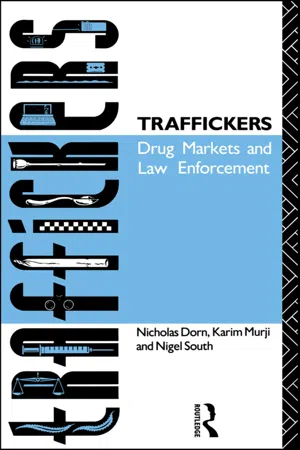
Traffickers presents new findings into the most mythologised and least understood area of crime and law enforcement. The chamelion reality of the world of drug trafficking is described in the words of traffickers and detectives. Drug enforcement combines the banal and spectacular in surveillance, covert operations and criminal intelligence. The war on drugs is a harbinger of wider changes in the organisation of policing and international cooperation. Traffickers explores the struggle that transforms policing and punishment as it stimulates the imagination.
- 272 pages
- English
- ePUB (mobile friendly)
- Available on iOS & Android
eBook - ePub
About this book
Information
Part I
Drug traffickers
Chapter 1
The good old days
Reciprocity and public service
In Part I we look at drug trafficking individuals and groups as they have evolved in Britain. We take a broadly chronological perspective, looking at the ways in which drug ‘dealing’ from the 1960s has mutated into drug ‘trafficking’ in the 1980s/90s. This chapter introduces what some nostalgic interviewees referred to as the good old days, when the supply of drugs was not so much a business, and not as nasty, as it has become.
TRADING CHARITIES
Dealing was different in those days: no violence, no rip-offs, people actually trusted each other. When you bought or sold, dealer and client invariably sat down and got stoned together – partly sampling the wares but partly social. Nowadays it all seems to be sell and run.
(Harry the cannabis dealer)
All I’ve ever done is sell to people who want to buy. They have the demand and I have the supply.
(Abby the Ecstasy dealer)
We use the term ‘trading charity’ to describe those traffickers who, initially at least, are not primarily (and definitely not solely) financially motivated. What financial ambitions they have tend to be thwarted by a lack of business skills and/or by their other, ‘social’ intentions.
The 1960s hippie passing on cannabis joints to people to turn them on and create peace, love and a better world provides a caricature of this type but, as we show below, this approach to trafficking can be adopted by a quite wide variety of people in differing times. For example, an Australian researcher found this kind of involvement in his study of ‘Drug entrepreneurs and dealing culture’ in Melbourne in the mid-1970s. This study concluded that dealing in psychedelics had
moved from a hang-loose ethic linked with the values of the counterculture to a specific attitude which sanctions the accumulation of profit for services rendered.
(Langer 1977: 384)
However, in Langer’s research, such dealers rarely made much profit. This, he argued,
may be partly explained by the fact that entrepreneurial practices related to marketing behaviour have not been entirely coordinated or systematised.… For example, there is much waste of their productthrough constant personal use, gift-giving or entertaining.
(Langer 1977: 384)
Lewis also identifies the significant distinction between those in the drug ‘business’ as trading charities with a ‘hippie’ ethic – and those with a more serious profit motive.
In the late 1960s and early 1970s, many ‘hippy’ traders and importers dealing in cannabis refused to do business with professional criminals. They did not view themselves as delinquent in an ethical sense and felt threatened by the potential complications of thoroughly criminal connections.
(Lewis 1989: 42)
We now turn to look at some of these individuals and their accounts of who they are prepared to do business with.
Case study: Harry the cannabis dealer
Harry is now in his early forties and was born and has lived for most of his life in a town on the southern coast. He is one of two children and comes from a ‘professional’ middle-class family. His education was normal and uneventful and with three ‘A’ levels he entered the local College of Art and Design. Here he quickly became involved in the ‘alternative’ culture of the 1960s. Looking back he offers the view that this was probably the most exciting period of his life, when friendships and interests were forged which have lasted to date. Drugs, in particular cannabis and LSD, were an important part of this lifestyle. In time, Harry became the ‘college dealer’, buying cannabis in London and dealing exclusively within his college peer group – he did not regard himself as a ‘dealer’.
I got the money together, hopped on the train to London and scored from any number of contacts in Kensington Market, the Gate [Notting Hill] or the Portobello Road.
Certainly there was no profit motive in this early enterprise,
I guess I just broke even – my dope was ‘free’ and it did give me some status.… [I was] doing a weight [1 lb. at that time] a week, sometimes more, sometimes less. When I sold out I just went and got more.
In the main, Harry supplied cannabis and he draws attention to the caution which many drug users displayed in the 1960s and which old-style users (whether of cannabis or heroin) today bemoan as frequently absent in a more commercialised and poly-drug using scene:
Even in those days among us students we did appreciate that some drugs weren’t that clever and there was a big distinction between cannabis users and other drug users. I would never deal in speed or anything else although I was sometimes offered it by the guys I was buying from in London. Acid of course was different, I did deal in tabs, mostly from Kensington Market, but when I saw bum trips, I was cautious even of that.
Harry carried on dealing throughout his three years at college, always purchasing in London and dealing in the relatively secure college environment.
I was never busted but I was careful. We all knew the drug squad officers. Sergeant Bloggs was especially known. He was really out to get the students and used to come to gigs at the college in a Bri-Nylon Beatles wig. It really was like that, cops and robbers stuff, or more like Keystone cops.2 The people who did get busted were the ones who did crazy things like walk past the police station smoking a joint. Some people almost seemed to want to get busted.
In a familiar move, after completing college, Harry and a group of friends drove a van to Morocco on a camping holiday.
Of course the real purpose was not camping – it was getting stoned on hash. A last fling before settling down to work and conforming. Anyway, the end result was that we decided to smuggle some hash back. If I’d known the risks involved I’d have never done it. We bought a couple of kilos, it was sand coloured resin with quite a high pollen content, it cost me about £90 but we were so green that I didn’t even haggle. Most we hid in sealed packets in the petrol tank, the rest taped inside the spare wheel. There were no problems coming back… I dealt it out to a number of friends at really good prices… I must have cleared over £250 profit from that one run, which paid for the holiday and left over enough to buy a suit and some shirts for my first job.
However, this period was not to last. After Harry’s run to north Africa,
he went through a period when I was buying on the streets, the odd ounce here and there. However, the drug scene was changing, getting harder and more commercial. People were into dealing for money and that’s when things became nasty – once the flower power ethos and era was over. I guess at heart I’m still a hippie, although like most of my contemporaries I look pretty straight. A lot of people got out of drugs then and moved on to other things. It makes me laugh when I look around and work out how many businesses have been established from the profits of one last cannabis run. Really healthy enterprises like [a well known local vegetarian restaurant] and [a silk screen printing outfit].
We shall return to this link between drug trafficking and legitimate business in Chapter 2.
Case study: Abby the Ecstasy dealer
It seemed that, what with paying for club admission, drinks and everything else, I cleared about £150 a week – not much really. The last couple of runs to town I did make more as he was selling me 100 tablets for £1,000. I spent most of the profit on clothes and records. I know that when I packed it in I had put an extra £200 in my Building Society account.
Abby is a single male in his early twenties. He has lived all his life in his home town, attended a local comprehensive school, then worked in a bank and then a fashion store. He lived for two years with Andy and now shares a house with three other gay men and works in a record shop. He started to use Ecstasy and a few other drugs as part of his involvement in the club scene.
When I met Andy we were both very much into the local club scene but at that time, late 1986, there wasn’t that much drugs around, at least in the sort of clubs we went to. Some cannabis, poppers – but mostly booze. AIDS was becoming high profile and most young gay men were into a health kick, body image was important, one didn’t want to look ill, so everyone was into gyms and sunbeds. I used a little cannabis which Andy didn’t like too much and that was it.
What changed Abby’s involvement was the link in the clubs between Acid House music and dancing and Ecstasy.
I was at the time going up to the West End clubs in London – and the one where Acid House started in the UK. It was originally a gay thing, a split off from energy dancing. It was there that I had my first Ecstasy tab, 1987. From then I was going up every weekend for allnighters. This was long before it had become a straight music and the Sun [newspaper] got involved. Everyone says Ecstasy is bad; however, when it was confined to the gay scene there didn’t seem to be any problems at all. People just took it and had a good time. They were all tightly interlinked, the clubs you went to, what one wore, the music one listened to and taking Ecstasy. At that time without the press involved it was discreet and very much a closed group doing it in very specific environments. I was going to the clubs all the time and got to know a lot of people so when Acid House came to the local club scene, I was in from the start.
When asked about how he became involved in ‘dealing’ Ecstasy, Abby’s immediate reaction was a dismissal of the term ‘dealing’.
I don’t like that word. It pictures a stereotype who is making money from others’ misfortune. Ecstasy, at least initially, wasn’t like that. When Acid House started locally, it did actually change things. Up until then, gays went to one sort of club and straights to another; there was no mixing, unless you count ‘queer bashing’ as such. [Then] Acid House led to a new club scene, young gays and straights in the same clubs without problems, since they were both there for the same reason – the music. It’s a bit like reggae, that brought together young blacks and skinheads with a common interest – music and cannabis. Ecstasy was – and here I do agree with the newspapers – essential to Acid House, everyone wanted to take Ecstasy. The group with the experience and who could get the drug were young gay men. So I got into supplying simply because I knew the contacts in London from my time spent up there at gay discos. It was quite easy.
With everything so easy and so pleasant, Abby explored the prospects for getting larger deals.
As I said, I had been buying in the London discos for nearly a year, most weekend nights, always from the same guy. It was always quite open in there [in a particular club], everyone knew him, you just went across and bought. I spoke to the man I had always bought from in London.… He told me – and I would emphasise that he did know me, I’d bought from him at least forty times – that he could sell me fifty tabs for £600. That’s just over £10 each and they sell from £16 to £20 each. I withdrew almost all my savings from the Building Society – I had been saving for a holiday. I should say that he gave me a number to ring when I had the money. It was a portaphone and he arranged to meet me at a pub in Swiss Cottage.… Anyway, I turned up sweating but he was there with another man. They didn’t have the tablets with them but asked for the money. I felt that he was hardly likely to cheat, since he was in the club every night so it’s not as if I couldn’t find him. Anyway, they took the money and went off. I was told to wait in the Underground station. After about half an hour, this second man came into the station and told me to buy a ticket to Baker Street. We got on the train together and he gave me the tablets during the journey. He got off at Baker Street and I saw him going across to catch a northbound train so I think they always used the underground for passing across bulk shipments. I bought from him about six times – at the end I was buying 100 tablets at a time and the method was always the same. Telephone him, go up on the train, meet him in the pub and pass across the money. Then be given the tablets at the Underground station. After the first time they didn’t pass the tablets across on the train, but on the platform as I was waiting for the train. It seemed to be a different person each time who passed across the tablets.
In Abby’s view this procedure was a secure one and he felt that added safety derived from these contacts also being gay.
They were all gay – sorry, I should have said that at the beginning. I think it’s much better buying from someone who’s the same as you. That’s safer.… I think that they must have been shifting a lot of tablets – they never had any problems in supplying me and the tablets were always the same – white with a groove. There’s not that much [more] to tell. I went to the local club with my tablets. At that time people were asking each other who had got and who sold Ecstasy. There was no trouble in getting rid of them. I’d pick up from London early on a Friday evening and be back in town by
8.30 p.m. Some I would sell that night and the remainder on the Saturday night. Most customers wanted one or two, but occasionally people would want more, say five if they were buying for friends as well. I used to leave most of the tablets with a friend and pick up from him when I needed more and also give him the money to hold. He was happy with £30 and a couple of free tablets for an evening.
Abby stopped supplying Ecstasy as he became disenchanted with the Acid House disco scene – ruined by a bad press and being taken up by
different people, real lager louts and ‘loadsamoney’. They weren’t in it for the music or dancing, just there since the papers said it was deviant and they thought it was trendy.… When it grew people saw a chance to make a lot of money – clothing, records, clubs and drugs. Most of the Ecstasy around in town now is a load of rubbish and that’s why you see so many bad reactions – Acid and Speed mixed together and sold in capsules for a fortune.… Once the entertainment industry saw that there was money to be made, Acid House died – and it’s the same with any music, once it’s taken up for profit there’s a lot lost.
Even given the recent nature of Acid House as a music form, it has passed and Abby’s account of his association with a particular drug that was homologous (fitted into) to the culture (cf Willis 1978) is already full of nostalgia and regret at the commercialisation and betrayal of the Acid House scene. He now goes to a number of different London clubs, no longer comfortable with the image that the local venues project and, perhaps more significantly, he no longer deals (or ‘supplies’) any drugs at all.
In the USA, the West Coast ex-hippie dealers and smugglers in Adler’s (1985) study represent a similar picture of the trading charity. The size and scale of their operations may become significant for a while, but their profits are diminished and their involvement often curtailed by ‘a residual hedonistic “hippy” ideology’ (Lewis 1989: 37; Adler 1985).
The Trading Charity dealer ties involvement in the supply of drugs to a particular facet of their social life and socialising within it. This may not amount to a full-blown ideology or world-view but it does mean that a goal of profit accumulation is subsidiary to, or strongly tempered by, a commitment to or enjoyment of the social and cultural aspects of using the drug and the context in which this is done. Such considerations are shared to some extent by the next type of trafficking network to be described.
MUTUAL SOCIETIES: RECIPROCAL SUPPLIERS
A mutual society is a friendship or acquaintance-based network of drug users, some of whom, some of the time, will supply drugs to others. Reciprocity is the name of the game (Auld 1981) – every user is potentially a supplier, and everyone is expected to help out everyone else. It is in this respect that they are unlike the trading charity dealers discussed above, since the latter supply their own needs from their trading stock, rather than trailing round their customers and trying to ‘score’ from them.
Members of mutual societies, or user-dealers as they are sometimes called, constitute a large population in relation to other types of traffickers. Where they have made links to help...
Table of contents
- Cover Page
- Title Page
- Copyright Page
- Acknowledgements
- Introduction
- Part I: Drug traffickers
- Part II: Enforcement strategies
- Part III: Key issues in drug enforcement
- Conclusion: A little knowledge. . .
- Appendix: Extracts from ACPO’s Broome Report
- Notes
- Bibliography
Trusted by 375,005 students
Access to over 1.5 million titles for a fair monthly price.
Study more efficiently using our study tools.
Frequently asked questions
Yes, you can cancel anytime from the Subscription tab in your account settings on the Perlego website. Your subscription will stay active until the end of your current billing period. Learn how to cancel your subscription
No, books cannot be downloaded as external files, such as PDFs, for use outside of Perlego. However, you can download books within the Perlego app for offline reading on mobile or tablet. Learn how to download books offline
Perlego offers two plans: Essential and Complete
- Essential is ideal for learners and professionals who enjoy exploring a wide range of subjects. Access the Essential Library with 800,000+ trusted titles and best-sellers across business, personal growth, and the humanities. Includes unlimited reading time and Standard Read Aloud voice.
- Complete: Perfect for advanced learners and researchers needing full, unrestricted access. Unlock 1.5M+ books across hundreds of subjects, including academic and specialized titles. The Complete Plan also includes advanced features like Premium Read Aloud and Research Assistant.
We are an online textbook subscription service, where you can get access to an entire online library for less than the price of a single book per month. With over 1.5 million books across 990+ topics, we’ve got you covered! Learn about our mission
Look out for the read-aloud symbol on your next book to see if you can listen to it. The read-aloud tool reads text aloud for you, highlighting the text as it is being read. You can pause it, speed it up and slow it down. Learn more about Read Aloud
Yes! You can use the Perlego app on both iOS and Android devices to read anytime, anywhere — even offline. Perfect for commutes or when you’re on the go.
Please note we cannot support devices running on iOS 13 and Android 7 or earlier. Learn more about using the app
Please note we cannot support devices running on iOS 13 and Android 7 or earlier. Learn more about using the app
Yes, you can access Traffickers by Nicholas Dorn,Karim Murji,Nigel South in PDF and/or ePUB format, as well as other popular books in Social Sciences & Health Care Delivery. We have over 1.5 million books available in our catalogue for you to explore.