eBook - ePub
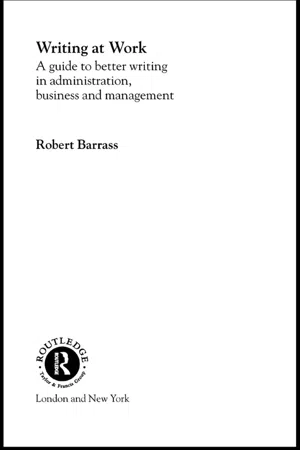
Writing at Work
A Guide to Better Writing in Administration, Business and Management
- 320 pages
- English
- ePUB (mobile friendly)
- Available on iOS & Android
eBook - ePub
About this book
Many employers complain about the poor communication skills of many young people seeking employment; and many people in employment are handicapped by the poor quality of their written work. While bad spelling, ineffective punctuation and faults in grammar create barriers between the writer and the reader, good English makes the reader feel at ease.
The benefits of being a good writer at work are:
Managers need to be able to communicate in order to get ideas across. If they cannot, they will be unable to make their viewpoint heard and they will be unable to influence customers, suppliers and colleagues as desired
If you can write well, you will find that your views are given prominence over those of others. Effective communication, and that includes writing, is the key to career success and advancement
This book is for those who have difficulty in getting thoughts into words or their ideas across, as well as those who are satisfied with their writing but are ready to consider the possibility of improving it. It is all about the ways in which writing at work is important - helping the reader to observe, remember, think, plan, organise and communicate.
1 Writing at work
Many people must be encouraged, by their success in school and college examinations, to think that their writing is satisfactory. Yet many students underachieve, and many employers complain about the poor communications skills of young people seeking employment.
Once in employment those who write badly create barriers between themselves and their readers, whereas those who write well make their readers feel at ease.
At work in administration, business or management, and in any profession, as when a student, you probably use a pen and a computer keyboard more than any other equipment. Writing is one thing that you must do every day, and success in your career depends largely on your ability to express your thoughts clearly, simply and persuasively. It follows that anything you can do to improve your use of words–so that your writing works for you–should help you to achieve your goals.
You probably think of writing primarily as a means of communication–and most of this book is concerned with communication–but consider first your other reasons for writing.
Writing for yourself
Many of the things you write are notes, personal memoranda and other records that you do not expect other people to see. They help you in many ways with your day-to-day work.
Writing helps you to observe
Preparing a description, like making a careful drawing or preparing a plan to scale, makes you concentrate on the object or event to be described and helps you to ensure that your record is both accurate and complete. Similarly, entering observations on a data sheet during any practical investigation or enquiry, using words or numbers, makes you concentrate on your work and helps you to ensure that each entry is inserted at the right time–so that all necessary data are recorded.
Writing helps you to remember
Making notes in lectures, seminars and tutorials is an aid to concentration that provides students with practice in listening for up to an hour, selecting the main points made by a lecturer or by different contributors to a discussion, and making a few concise notes. The notes made during a lecture should resemble the topic outline prepared by the lecturer when deciding what to say. They should suffice, as an aid to learning, to remind the student of much of what was said.
This ability to listen, select, and make concise notes relevant to one’s present or possible future needs is an important skill at work. In administration, business and management we make notes during conversations, interviews and meetings, so that we can remember: (a) the subject discussed (a heading), (b) with whom it was discussed, (c) when it was discussed (the date) and (d) the gist of what was said (a few words, phrases, numbers and dates, and where necessary complete sentences); and so that we have (e) a written record of any conclusions and of anything agreed (as carefully constructed, complete and unambiguous sentences).
Because such notes may be your only record of a discussion they should not be made on odd scraps of paper, your shirt cuff or the back of your hand. Instead, use A4 paper, personal memorandum forms or telephone message forms, and use one side of each sheet only–so that your notes can be stored in order in an appropriate file.
Most busy people keep a diary to help them remember both when they have to do things and what they have done. They also make notes of fleeting thoughts that might otherwise be forgotten (see Figure 1.1). By making a note, to help us remember, we can communicate even with ourselves.
A notebook used for records during an investigation or enquiry, like a diary, is a permanent record of what is done each day. Every note in it must be dated. Because we cannot remember when each observation was made, the date may assume great importance later–indicating not only when things were done but also the order in which they were done. For the same reason, each day the starting time should be noted, the time when each observation is recorded, and the time when the investigation ends (using a twenty-four-hour clock).
Similarly, because you need to know when it was written (and will not otherwise remember), every communication (every letter, memorandum, postcard, e-mail, fax message, form or other document) must be dated. A document may also be given a unique alphanumeric reference (a number, to distinguish it from other documents with the same date, and a letter or letters to indicate the department or section responsible for its production). Each time a document is revised this fact should be indicated (for example, by adding R1, R2, etc., and the date), so that anyone can see when it was written and when it was last revised.

Be ready to take a note
Figure 1.1 Always have a pen and at least a few sheets of notepaper available so that you can record fleeting thoughts that might otherwise be forgotten
As well as indicating when they were written, dates on documents enable you to keep them in order in a file–so that you can find a particular document if you need it and replace it in the file when you have finished with it. This, then, is the first and most important rule about writing in business: every personal record and every communication must be dated.
Writing helps you to think
We think in words, and in writing we capture our thoughts. Writing is therefore a creative process that helps us to sort our ideas and preserve them for later consideration. Preparing a memorandum, or a report, makes you set down what you know, and so leads you to a deeper understanding of your work. Similarly, preparing a progress report helps you to view an aspect of your work as a whole, to recognise gaps in your knowledge, to avoid time-wasting distractions, and to know when the work is complete.
Writing is an aid to thinking, and those who write quickly can record their thoughts quickly. They can write fast enough to maintain the momentum that gives coherence, unity and wholeness to a composition. So, teachers who do not provide hand-outs in every class, but do spell out key words and dictate important definitions, give their students opportunities to listen carefully, think for themselves, select and note important points, and develop the ability to write fast enough to maintain a train of thought.
Writing helps you to plan your work
Making a note of the things you expect to complete in the year ahead is helpful, even though new tasks are likely to arise that cause you to change your priorities. You will probably also find it helpful to work to some kind of weekly timetable, which may be a page in your diary, on which you can enter firm commitments and notes of things you hope to achieve at other times.
Even if you cannot plan each week in detail, it is essential to plan your day. This is best achieved by making a list of things you must do over the next few days. Such a personal memorandum or job list helps in establishing priorities and then in focusing attention as you concentrate on the tasks you expect to complete each day.
Writing helps you to be well organised
Your list of the things you plan to do each day is the basis of efficient organisation.
- Think. Prepare the list as you decide what needs to be done.
- Plan. Number the tasks as you decide your order of priority. The best time to prepare such a job list is probably towards the end of your day’s work, so that you can start the next day with the task you have given top priority.
- Write. Cross tasks off your list as they are completed, and add new tasks as they are brought to your attention.
- Revise. If necessary, as new tasks are added to the list, revise your order of priority.
Then before finishing work for the day spend a few minutes preparing a new job list ready for the start of your next day’s work.
Writing helps you to avoid stress at work
By making good use of a diary, and working to a job list each day, you provide a basis for effective time management. This not only makes for efficiency but also helps you to avoid stress by being in control: knowing that jobs will be completed in your order of priority and that any you are unable to complete one day can wait until the next. There is a saying ‘Never leave until tomorrow what can be done today’ but it is more important to avoid doing today those things that should be left until tomorrow.
Improving your writing
Recording interesting ideas as they come to mind
Ensure that you always have a pen and paper available so that you can make a note of fleeting thoughts that might otherwise be forgotten. These may be, for example, notes of things to do or of ideas for a report you are planning: additional topics, better examples to illustrate a point, or ideas for a better arrangement of material.
Using your diary
Always have a diary in your pocket or briefcase. Use it to remind you of the dates and times of engagements, to help you see when you are free to do other work, and to record those addresses, telephone numbers and other details you cannot remember but are likely to need when away from your home or office. There are advantages in using a pocket diary rather than a desk diary, because the pocket diary is available at all times. If you have both, it is important to ensure that additions or deletions in one are also made as soon as practicable in the other–so that both are kept up to date.
Dating everything you write
Resolve to include the date on every note you make in your own records, and on every communication. Unless everything you write is dated, you may find after days, weeks or months of work that you are unable to prepare an accurate and comprehensive report because you are not sure when a crucial entry was made in your personal records–or you do not know the date on which a communication to which you must refer was despatched.
Working to an up-to-date job list
Towards the end of each day’s work, list the things you plan to do on the next day. Then, to organise your work, number these tasks in order of priority. This will help to ensure that you complete the most urgent tasks first, avoid stress, and maintain control of your work and leisure time.
For most people an adequate job list can be made on the back of an envelope, and amended each time a job is completed or a new job is added. However, an alternative is to keep an up-to-date job list in a personal organiser. Personal organiser programs, for use with personal computers, are available in stand-alone versions that help one to organise one’s own time and in server versions that also allow one, for example, to view colleagues’ commitments and arrange meetings at mutually convenient times.
Writing good instructions
Instructions are used for many different purposes (for example, how to handle, assemble, operate, service or repair a product–or how to dispose of it safely when it is no longer required). A set of instructions may be a label on a product, a document or part of a document (as in a training manual, user guide or written procedure).
We all use instructions: how to fill in a form, how to find a book in a library, how to change the batteries in a radio, how to bake a cake, what to do in the event of fire. To emphasise how important writing is in thinking about your work, in planning what has to be done, and in organising a communication so as to achieve your objective, consider what is involved in writing instructions.
Many mistakes are made and many accidents caused by failures in communication attributable to ambiguous, incomplete or otherwise misleading instructions. When you have performed a task, following instructions, you may think, for example, ‘That was easy,’ or ‘Well, I don’t think much of those instructions.’ What, then, makes a good set of instructions?
Make notes as you consider what faults in a set of instructions are likely to annoy the user, cause accidents, or result in other perhaps costly mistakes being made. Then, as an exercise, write a set of instructions headed ‘How to write instructions’. Do this on one day, then reconsider it on the next. Keep your work and revise it each time you think of ways in which it could be improved.
If this task is used in a course on Business Communication or Writing at Work, participants can work alone for up to ten minutes, thinking and making notes. Then they can work in pairs for another ten minutes, comparing notes; and then in groups of about four–as small committees–for perhaps twenty minutes.
If two one-hour sessions are devoted to this exercise, in the second hour participants can: (a) agree as to what instructions are necessary and how best they should be presented, and then (b) either write instructions on how to perform a particular task or prepare a notice instructing employees what to do in the event of fire. Fire regulations, for example, should have all the characteristics you consider essential in good instructions.
Having completed this exercise, in one or two hours, depending on the time available, all present should be more critical of the instructions used in their own organisations. Some may decide they can improve the instructions used to standardise procedures for which they are responsible.
2 Do it this way
Your purpose in any communication is, first, to be understood. Depending on your audience and the occasion, you should also try, for example, to amuse, to convince, to inform, to instruct, to persuade, or to sympathise. That is to say, your intention should always be both to be understood and to affect other people in a chosen way.
Essential characteristics of business communications
As you prepare any letter, memorandum, or longer communication, in administration, business or management, consider the needs of your readers. Who are they? Why are you writing? What do you hope to achieve?
Many business communications are concerned with ensuring efficiency, quality, and cost effectiveness–with a view to making a profit so that those who devote time to the business (employees and owners) or invest money (owners or shareholders) can be paid. Such communications include not only letters and memoranda, and reports of various kinds, but also manuals, plans, specifications, guidelines, procedures–including instructions and drawings–and records of activities performed and results achieved.
Any communications that are, for example, inaccurate, inappropriate, unclear, verbose, inconsistent, incomplete or imprecise are likely to be ignored, or may confuse, or may result in inappropriate actions, wrong decisions, accidents, costly mistakes, and wasted effort.
Napley (1975), in The Technique of Persuasion, advised those advocates who would best serve their clients to present their case in order, with integrity, clarity, simplicity, brevity, interest, and with no trace of pomposity. To help you decide ho...
Table of contents
- Cover Page
- Title Page
- Copyright Page
- Preface
- Acknowledgements
- 1: Writing at work
- 2: Do it this way
- 3: Write a better letter
- 4: On form
- 5: Say it with words
- 6: Say it without flowers
- 7: Say it without words
- 8: Something to report
- 9: Helping your readers
- 10: Finding and using information
- 11: Just a minute
- 12: Talking at work
- Appendix 1: Punctuation
- Appendix 2: Spelling
- Appendix 3: Computer appreciation
- Bibliography
Trusted by 375,005 students
Access to over 1.5 million titles for a fair monthly price.
Study more efficiently using our study tools.
Frequently asked questions
Yes, you can cancel anytime from the Subscription tab in your account settings on the Perlego website. Your subscription will stay active until the end of your current billing period. Learn how to cancel your subscription
No, books cannot be downloaded as external files, such as PDFs, for use outside of Perlego. However, you can download books within the Perlego app for offline reading on mobile or tablet. Learn how to download books offline
Perlego offers two plans: Essential and Complete
- Essential is ideal for learners and professionals who enjoy exploring a wide range of subjects. Access the Essential Library with 800,000+ trusted titles and best-sellers across business, personal growth, and the humanities. Includes unlimited reading time and Standard Read Aloud voice.
- Complete: Perfect for advanced learners and researchers needing full, unrestricted access. Unlock 1.5M+ books across hundreds of subjects, including academic and specialized titles. The Complete Plan also includes advanced features like Premium Read Aloud and Research Assistant.
We are an online textbook subscription service, where you can get access to an entire online library for less than the price of a single book per month. With over 1.5 million books across 990+ topics, we’ve got you covered! Learn about our mission
Look out for the read-aloud symbol on your next book to see if you can listen to it. The read-aloud tool reads text aloud for you, highlighting the text as it is being read. You can pause it, speed it up and slow it down. Learn more about Read Aloud
Yes! You can use the Perlego app on both iOS and Android devices to read anytime, anywhere — even offline. Perfect for commutes or when you’re on the go.
Please note we cannot support devices running on iOS 13 and Android 7 or earlier. Learn more about using the app
Please note we cannot support devices running on iOS 13 and Android 7 or earlier. Learn more about using the app
Yes, you can access Writing at Work by Robert Barrass in PDF and/or ePUB format, as well as other popular books in Business & Business Communication. We have over 1.5 million books available in our catalogue for you to explore.