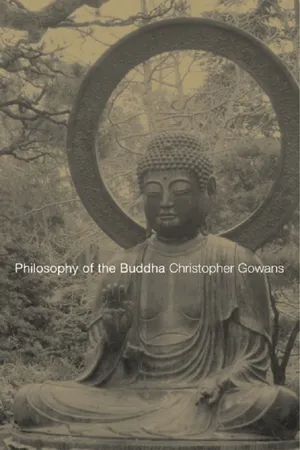
Philosophy of the Buddha is a philosophical introduction to the teaching of the Buddha. It carefully guides readers through the basic ideas and practices of the Buddha, including kamma (karma), rebirth, the not-self doctrine, the Four Noble Truths, the Eightfold Path, ethics, meditation, non-attachment, and Nibbâna (Nirvana).
The book includes an account of the life of the Buddha as well as comparisons of his teaching with practical and theoretical aspects of some Western philosophical outlooks, both ancient and modern. Most distinctively, Philosophy of the Buddha explores how Buddhist enlightenment could enable us to overcome suffering in our lives and reach our full potential for compassion and tranquillity.
This is one of the first books to introduce the philosophy of the Buddha to students of Western philosophy. Christopher W. Gowans' style is exceptionally clear and appropriate for anyone looking for a comprehensive introduction to this growing area of interest.
- 240 pages
- English
- ePUB (mobile friendly)
- Available on iOS & Android
eBook - ePub
About this book
Information
Part 1
The Buddha’s Teaching as a Philosophy
1
Observing the Stream
Followers of the Buddha are increasingly visible to people in Western societies. Most Buddhists live in Southeast Asia, China, Korea or Japan, but there are also significant Buddhist populations in countries such as Tibet, Nepal, and Sri Lanka. Though accurate measurement is difficult, there are perhaps some 500 million Buddhists in Asia. Western awareness of Buddhists is not entirely new: Christian missionaries and colonial forces entered much of Asia centuries ago. But today, on account of increased ease of communication and transportation, and the general phenomenon of globalization, we in the West now have the opportunity, and sometimes the necessity, of interacting with Buddhists to an extent unprecedented in our past.
In fact, due to immigration and (to a much lesser extent) conversion, many Buddhists now live in Western countries. For example, there are probably at least one to two million Buddhists in the United States of America and significant numbers in European countries such as the United Kingdom and France. This too is not altogether a recent development: there were Chinese Buddhists in California shortly after the Gold Rush of 1849, and Buddhist societies began to spring up in some Western countries in the late nineteenth century. Moreover, closer to our time, books such as Eugen Herrigel’s Zen in the Art of Archery (1953) and Hermann Hesse’s Siddhartha (1951), along with the writings of D.T. Suzuki and Alan W. Watts, inspired a good deal of popular interest in Buddhism in the period after the Second World War. But in recent years, immigration to the West by Buddhists has increased, and so has interest in Buddhism among persons in the West, such as myself, who were not raised as Buddhists.
An indication of the current interest, and part of its cause, is the prominence of His Holiness the Dalai Lama, Tibet’s spiritual head and political leader-in-exile. His efforts both on behalf of Tibetan independence from China and in support of inter-religious dialogue between Buddhism and Western religious traditions have attracted much attention. The Dalai Lama’s book The Art of Happiness was on the New York Times ‘best sellers’ list for well over a year. There is also a small movement of ‘Socially Engaged Buddhists’ in some Western countries led partly by Westerners with a serious commitment to Buddhism and partly by persons from traditional Buddhist countries such as Thich Nhat Hanh, the Vietnamese monk now living in France. Buddhism has even entered the arena of popular culture: in sports, advertising, television, movies, and rock music, occasional appearances of Buddhism may be found. Whether it is the golfer Tiger Woods, basketball coach Phil Jackson, actor Richard Gere, pop singer Tina Turner, or Adam Yauch of the rock group the Beastie Boys, it seems we have all heard of a celebrity who has proclaimed allegiance to some form of Buddhism.
In this context of increased awareness and interest, there are many reasons for persons in the West to inquire into Buddhism. One is to learn something about ourselves, to better understand our beliefs and values by comparing them with those of persons in cultures different from our own. A second is to understand something about those cultures, to comprehend how people in societies with Buddhist traditions live their lives. Related to this, a study of Buddhism may help us to interact better with Buddhists and Buddhist countries: it may enable us to approach these encounters in a more informed, responsible, and respectful way. Yet another reason is to see what we can learn from Buddhism, to ascertain whether an understanding of Buddhism might give us grounds for changing our own convictions and practices.
In some measure, this book may facilitate all these concerns, but its primary aim is the last, to reflect on what Buddhism can teach us. Specifically, the purpose is to help those with little or no knowledge of Buddhism to understand and evaluate the teaching of the Buddha from a philosophical perspective. Let us begin by reflecting on some key features of this approach.
1 The Nature of this Inquiry
We will focus on the teaching of Siddhattha Gotama, the person who became known as the Buddha (the enlightened one).1 There are many ways of studying Buddhism that do not emphasize or go well beyond this teaching. For example, we might investigate the long history of Buddhism, both in its theoretical and practical aspects, in the Asian countries it has influenced. Or we might examine contemporary Buddhist cultures in those countries from the perspective of anthropology, sociology, or religious studies. These are all valuable approaches. But there is also merit in concentrating attention on what the Buddha himself taught. Both the history of Buddhism and its contemporary manifestations are large, complex, and diverse subjects: an introductory survey of them could be informative, but its sheer breadth would not tend to encourage in-depth reflection about what Buddhism might teach us. Though there are various ways of narrowing the field, an obvious approach is to focus on the source common to all Buddhist traditions – the teaching of the Buddha himself.
The Buddha said he taught all human beings a path for achieving enlightenment and well-being. As he approached his death, he laid particular emphasis on the importance of this teaching. To his attendant, Ānanda, he said:
Ānanda, it may be that you will think: ‘The Teacher’s instruction has ceased, now we have no teacher!’ It should not be seen like this, Ānanda, for what I have taught and explained to you as Dhamma and discipline will, at my passing, be your teacher.
(L 269–70)
Buddhists everywhere revere as a source of wisdom and guidance the Dhamma of the Buddha, his teaching about the ultimate nature of reality and the way of life that accords with this. (‘Dhamma’ is the Pāli spelling followed here; the more familiar ‘Dharma’ is in Sanskrit.) By examining this teaching, we will be studying the heart of all Buddhist traditions. Of course, these traditions have interpreted and developed the Buddha’s teaching in strikingly different ways. For example, as we move from Sri Lanka to Tibet to Japan, the practice of Buddhism varies significantly. A full understanding of Buddhism would require investigation of these divergences, but they will not be our concern here. We will restrict ourselves to the teaching of the Buddha himself as we now know it.
Our aim is to understand and evaluate the Buddha’s teaching. Some may object that evaluation is not a proper concern of non-Buddhists living in the West, that this is the prerogative of persons in Buddhist cultures. The Buddha himself provided an answer to this contention. He offered his teaching to all human beings, and he invited us all to reflect on what he taught and to learn from it. The intended audience of his message was not restricted to persons of a particular culture or tradition. In fact, the Buddha meant to radically challenge many of the values of his own culture. Moreover, from the northeastern corner of India where he taught some 2,500 years ago, the Buddha’s teaching spread to societies such as China and Japan that were substantially different from his own. We accord the Buddha the highest tribute by accepting his invitation to seriously assess his teaching, not by flatly refusing to do so on the ground that it is the exclusive possession of another culture. By seeking to learn from the Buddha, we are not trying to tell others what they should believe: we are trying to ascertain what we should believe.
Finally, we will endeavor to grasp and appraise the Buddha’s teaching from a philosophical point of view. That is, we will focus mainly on the philosophical aspects of the teaching, and we will seek to render these intelligible and to consider their worth by reflecting on them as a philosopher would. We will bring some characteristic perspectives, concerns, and habits of mind of philosophy to this teaching in order to illuminate it and examine what may be learned from it. Though there are several worthwhile avenues by which persons in the West might engage the teaching of the Buddha, philosophy is a natural one. Philosophy has played a central role in Western traditions, and there is much in the Buddha’s teaching that is philosophical in nature – for example, his ideas concerning the self, impermanence, and dependent origination. Moreover, his teaching gave rise to much explicit philosophical reflection in Asian cultures. Nonetheless, some may object that Western philosophical orientations are not suitable to comprehending and assessing the Buddha’s teaching. The appropriateness and value of this approach will be explained at some length in chapters 4 and 5, but several preliminary points may be made here.
One form of the objection is the claim that, above all else, the Buddha taught a practice – an ensemble of dispositions, skills, and activities aimed at achieving ultimate well-being – and it is a distortion of his teaching to distill a theory from this practice and then consider the theory alone. Indeed, this would be a mistake. However, the practice taught by the Buddha does have theoretical dimensions, and there is much to be learned by focusing on these, so long as we do not lose sight of their practical context. A tradition developed early on in Buddhism that emphasized its theoretical elements (the Abhidhamma literature), and there is at least one important branch of Western philosophy (the Hellenistic tradition) that stressed its practical significance. This suggests that lines of communication are available by which persons with a Western philosophical perspective might constructively encounter the teaching of the Buddha.
Another form of this objection is the assertion that the Buddha taught a religion and not a philosophy. The first part of this contention presumably is correct, depending on what we mean by the term ‘religion’. The Buddha did not believe in God and hence did not regard his teaching as divine revelation. But in many respects it is appropriate to consider his teaching a religion – for example, it centrally involves a notion of transcendence. However, that the Buddha’s teaching is a religion in these respects does not entail that it is not, or does not include, a philosophy. The terms ‘Christian philosophy’ or ‘Jewish philosophy’ are not ordinarily considered oxymorons, and the existence of God is an important part of the theories of many canonical figures in Western philosophy. Though the purpose of our inquiry is not primarily comparative, we will see that there are numerous points of contact between the teaching of the Buddha and Western philosophical traditions.
A final challenge to a philosophical approach is the claim that the primary mode of understanding in Western philosophy is reason, whereas for the Buddha enlightenment is achieved not by reason, but by meditation. This is the most interesting objection, and it raises a serious issue that will be one of our principal concerns. Rational thought and discourse have been fundamental to much Western philosophy (though not all of it), and Buddhist meditation has played no role in its traditions. However, both the Buddha and many Western philosophers held that objective knowledge of reality and of how to live may be achieved by human beings. The teaching of the Buddha challenges the belief, so typical in Western philosophy, that rational reflection is the main means of attaining this knowledge. The Buddha thought reason was valuable but insufficient for enlightenment, and he thought meditation was crucial. The meditation techniques he taught were intended to develop our powers of concentration and, in a special sense, observation. They were meant to take us beyond ordinary modes of understanding, but not outside all understanding. The fundamental role of meditation in the Buddha’s teaching should be seen not as precluding an inquiry into this teaching from a Western philosophical perspective, but as providing a key issue for consideration in this inquiry. As we seek to make sense of the teaching of the Buddha, one of our concerns will be to determine if we have something to learn from meditation. Perhaps the primacy of reason commonly asserted by Western philosophers is ill-advised.
2 Guidelines for Learning from the Buddha
It will help to have some guidelines for comprehending and assessing the Buddha’s teaching in a philosophical way. These guidelines are not beyond controversy. We will need to consider one critique from the Buddha himself. Nonetheless, it is important to begin our inquiry with an awareness of some of the methodological issues involved in seeking to understand and evaluate his teaching. These two activities cannot be completely separated: evaluation obviously presupposes understanding, but we cannot fully understand something without recourse to evaluation. However, we will proceed by first discussing some principles of interpretation and then turning to some standards of assessment. In the next section (see pages 11–13), we will reconsider these in light of the Buddha’s own pronouncements apropos the comprehension and evaluation of his teaching.
Objectivity
Our first goal is an accurate and insightful understanding of the Buddha’s teaching. We should assume neither that a perfectly objective account is possible nor that any interpretation is as good as another. As we strive to understand, we are influenced by our own perspective, an ensemble of outlooks, interests, feelings, and capacities rooted in the particulars of our historical, social, and personal circumstances. This is inevitable and not entirely cause for regret. Without some perspective, we could not comprehend anything – for example, we could not understand without language, and whatever languages we know are the products of specific cultures and traditions. Since each of our perspectives differ in important ways, none of us can expect a fully objective account. On the other hand, we should not infer from this that all interpretations are on a par. We need not suppose there is a single correct interpretation to realize that some accounts may be better than others. Even if conflicting interpretations are sometimes equally or incommensurably good, our goal should be to seek an understanding that is well-founded and illuminating. One reason for being aware of our own perspective is to ascertain the ways it both enables and hinders us from achieving this goal. Though we cannot escape our perspective, we can gain some distance from it and perhaps modify it. This may enable us to overcome some of our limitations and to understand the Buddha in a more accurate and penetrating way.
Honesty
We should be careful not to presume either that the Buddha’s teaching must be pretty much the same as what we already believe or that it has to be radically different from what we think. Both mistakes have been made by some Western interpreters. For example, if we assume that all religions are really saying the same thing in the end, we may fail to see the deep differences between Buddhism and Christianity. Or if we suppose that the ‘Eastern mind’ is essentially different from the ‘Western mind,’ and that ‘never the twain shall meet,’ we may miss the fact that the Buddha addressed concerns of great importance to us. We need to be honest about what he did and did not say. Our aim should be to carefully determine the differences and similarities that actually exist between his teaching and our own beliefs. We may discover that there are real disagreements that m...
Table of contents
- Cover
- Half Title
- Title Page
- Copyright
- Dedication
- Contents
- Preface
- Abbreviations
- Part 1: The Buddha’s teaching as a philosophy
- Part 2: The not-self doctrine
- Part 3: The nature, origin, and cessation of suffering
- Part 4: The way to the cessation of suffering
- Buddhist resources on the Internet
- Glossary of important Pāli terms
- Bibliography
- Index
Trusted by 375,005 students
Access to over 1.5 million titles for a fair monthly price.
Study more efficiently using our study tools.
Frequently asked questions
Yes, you can cancel anytime from the Subscription tab in your account settings on the Perlego website. Your subscription will stay active until the end of your current billing period. Learn how to cancel your subscription
No, books cannot be downloaded as external files, such as PDFs, for use outside of Perlego. However, you can download books within the Perlego app for offline reading on mobile or tablet. Learn how to download books offline
Perlego offers two plans: Essential and Complete
- Essential is ideal for learners and professionals who enjoy exploring a wide range of subjects. Access the Essential Library with 800,000+ trusted titles and best-sellers across business, personal growth, and the humanities. Includes unlimited reading time and Standard Read Aloud voice.
- Complete: Perfect for advanced learners and researchers needing full, unrestricted access. Unlock 1.5M+ books across hundreds of subjects, including academic and specialized titles. The Complete Plan also includes advanced features like Premium Read Aloud and Research Assistant.
We are an online textbook subscription service, where you can get access to an entire online library for less than the price of a single book per month. With over 1.5 million books across 990+ topics, we’ve got you covered! Learn about our mission
Look out for the read-aloud symbol on your next book to see if you can listen to it. The read-aloud tool reads text aloud for you, highlighting the text as it is being read. You can pause it, speed it up and slow it down. Learn more about Read Aloud
Yes! You can use the Perlego app on both iOS and Android devices to read anytime, anywhere — even offline. Perfect for commutes or when you’re on the go.
Please note we cannot support devices running on iOS 13 and Android 7 or earlier. Learn more about using the app
Please note we cannot support devices running on iOS 13 and Android 7 or earlier. Learn more about using the app
Yes, you can access Philosophy of the Buddha by Christopher Gowans in PDF and/or ePUB format, as well as other popular books in Philosophy & Eastern Philosophy. We have over 1.5 million books available in our catalogue for you to explore.