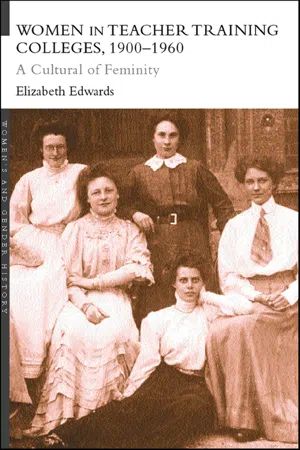
Women in Teacher Training Colleges, 1900-1960 is an intricate and fascinating investigation of the lives and experiences of women in these important educational institutions of the early twentieth century. The book provides an overview of the historical context of the development of the colleges, using detailed case studies of three colleges: Homerton, Avery Hill and Bishop Otter.
Drawing on a wealth of archival material, primary and secondary sources, and on the oral testimonies of former pupils and staff, the book examines the following key themes:
*the changing social class of women students
*the colleges culture of femininity drawn from the family organization and social practices of the middle-class home
*the conflicting public and private roles of the woman principal
*the role of the college staff and the residential context of college life
*women's sexuality
*the last days of the womens colleges.Women in Teacher Training Colleges, 1900-1960 is an essential contribution to women's history and gives a unique insight into this neglected aspect of women's experiences in the twentieth century.
- 224 pages
- English
- ePUB (mobile friendly)
- Available on iOS & Android
eBook - ePub
About this book
Information
Subtopic
History of EducationIndex
History1 The historical context1
The nineteenth century
Residential colleges, whose purpose was to train young women and men to teach, date back to the early years of the nineteenth century. There was, as yet, no state involvement in the provision of schools, and such provision that was made for the education of working-class boys and girls was in the hands of two religious societies – The National Society for Promoting the Education of the Poor, founded in 1811 by the Church of England, and the non-conformist British and Foreign School Society founded in 1814. The first training college as such was opened in 1805 by the British Society, at Borough Road in South London. At first only men students were admitted; but shortly after its foundation the college became co-educational. The first college for women only – Whitelands, also in London – was founded in 1841 by the National Society.2
In 1833, in the wake of the Reform Act of 1832, the state began, belatedly, to give indirect support to the education of the poor by giving capital grants to the National and British Societies for the building of schools. Six years later the state’s involvement became statutory with the establishment of a special committee of the Privy Council to be concerned with education. The committee appointed a dynamic secretary, James Kay
– later Sir James Kay-Shuttleworth – who succeeded both in increasing the amount of the government’s grants to the societies and in extending their remit to include the building of teacher training colleges. By 1846 some fifteen colleges had been built, all but one by the National Society. Seven of these colleges were for women.3
A big impetus was given to the training college building programme by the adoption in 1846 of Kay-Shuttleworth’s pupil–teacher scheme. This scheme, based on apprenticeship, was attractive to the mainly working-class pupils who attended elementary schools. Carefully selected pupils were to be apprenticed at the age of 13 to ‘equally carefully selected’4 head teachers for a period of five years. Pupil–teachers would teach in school during the day and receive instruction from the head teacher after school hours. Both pupil and head teacher would be remunerated by the state. On completion of their apprenticeship, pupil–teachers could sit an examination for the award of a ‘Queen’s Scholarship’ which would entitle them to a place in a training college. Training colleges would receive maintenance grants from the state for each student. Between 1846 and 1870 seventeen more colleges were built – ten of them for women. These included Homerton College in London, formerly an academy for training young men to be ministers in the Congregational Church, which re-opened as a co-educational, undenominational training college in 1852.5 In 1896, after its move to Cambridge in 1894, Homerton became a college for women only.6
The 1870 Education Act, which required all children between the ages of 5 and 13 to receive elementary education, greatly increased the demand for teachers. School Boards were set up for every Local Authority, but these Boards were not empowered to open training colleges. This put great strain on the resources of the two voluntary societies. Although the number of certificated teachers (i.e. those who had completed a two-year course at training college) increased from 12,467 to 31,422 between 1870 and 1880, and the number of pupil–teachers from 14,612 to 32,128, the fastest proportionate growth was of ‘Assistant’ teachers (i.e. ex-pupil–teachers who had not been to training college) who now compromised a quarter of all serving teachers.7 Increasing concern with the educational standards of pupil– teachers led to the setting up of Pupil–Teacher Centres by the larger local authorities. All academic teaching for pupil–teachers was now concentrated in these centres, where they existed, with a concomitant decrease in the number of hours students were required to teach in schools. The pupil– teacher system was a central concern of the Royal Commission, known as the Cross Commission, which was appointed in 1886 ‘to enquire into the working of the elementary Education Acts’. The members of the Commission were divided on the subject of pupil–teachers. The Majority report recommended continuing the existing system, but the Minority report was severely critical of it. Among the scheme’s critics was Fanny Trevor, principal of Bishop Otter College, whose evidence to the Commission I shall discuss further in Chapter 3.
Bishop Otter had originally been opened by the Church of England in 1839 as a training college for men, but it had been forced to close in 1867 through lack of support. Six years later it re-opened, this time as a college for the training of women teachers.8 The re-opening of Bishop Otter as a college for women was in the context of the developing contemporary debate on the desirability of attracting more middle-class girls into elementary teaching rather than relying on working-class pupil–teachers. I shall be discussing the class origins of women teachers later in this chapter.
The Cross Commission had also recommended a new experiment for the training of teachers. This was the establishment of Day Training Colleges, to be attached to universities or university colleges. These colleges rapidly became highly popular, and by 1900 were catering for nearly a quarter of all trainee teachers.9 Crucially, day college’s attachment to universities, and their non-residential status,10 made them more attractive to women from the middle class. Residential colleges, which were still provided by the voluntary colleges rather than the state, were challenged by this new type of teacher training; and women’s colleges began that improvement in practice and precept which was to develop into the culture of femininity. Day colleges were later to become fully integrated departments of universities, offering a one-year teaching diploma for graduates.
1900–44
Criticism of the inadequacies of the pupil–teacher system had hardened by 1896 when a government committee was set up to enquire specifically into the system. While commending the efforts of many Pupil–teacher Centres, it was realized that the only way to improve the education of pupil–teachers as a whole was for the state to provide proper secondary schools for their instruction. This reform was set in train under the provisions of the Education Act of 1902. School Boards were now empowered not only to build secondary schools, but to provide and maintain teacher training colleges. By 1920 nineteen ‘council’ training colleges had been opened: thirteen for women and four co-educational. All but three were residential.11 The residential colleges for women included Avery Hill, opened by the London County Council in 1906 on an 84-acre parkland site at Eltham.12 The religious societies’ monopoly over the provision of training colleges had been broken but, importantly, the ‘belief that residence was an essential element in the training of an Elementary school teacher’13 was to persist. Moreover, as we shall see throughout this book, there was no essential difference in the ethos of women’s residential training colleges whatever the origin of their foundation.
In 1903, the Board of Education (as the Committee of the Privy Council had now become) appointed a dynamic new secretary, Robert Morant. In 1907 Morant proposed an alternative to the much criticized pupil–teacher system which was to prove its death knell:
From August 1907 selected pupils at Secondary schools could be awarded ‘Bursaries’, that is, grants to enable them to stay an additional year at school between the ages of sixteen and eighteen. On completing this year they could enter training college straight away, or alternatively, could serve in schools as ‘Student Teachers’ for up to one year and then enter college.14
In practice, most ‘bursars’ served as student teachers for a year before entering college. No special examination was now needed for entry into training college although most students had taken one of the Local or Higher national examinations, administered by the universities and, unlike the Queen’s Scholarship, not confined to students intending to teach.15 The attraction of the ‘bursar’ scheme was that it ensured that students at training college had not only an adequate secondary education, but had also a year’s supervised teaching experience. Importantly, the award of a ‘bursary’ was more acceptable to middle-class parents than the apprenticeship status of a pupil–teachership.
Nevertheless in the early years of the twentieth century, residential training colleges were negatively perceived both by the educational establishment and by the outside world. Criticisms centred on the isolation of the colleges, the inferior social class of students, the difficult balance between academic education and vocational training, and importantly ‘the overcrowded character of the curriculum’.16 Ironically, it was the increased freedom given by the Board of Education’s own regulations in 1901 which had exacerbated this overcrowding. Training colleges were now instructed to draw up their own academic syllabuses and this allowed students to study certain subjects at an advanced level. Furthermore, a few students could now undertake a third year of academic study after the completion of their teaching diploma. Already by 1905 Homerton had established three advanced options in mathematics, science and French.17 The college historian drew attention to the pressures on the timetable:
The addition of a number of courses leading to a variety of examinations put great pressure on (the) timetable… The College, in effect, had to devise nine programmes to cater for students in the first and second years taking the Board of Education Certificate, some of whom would be undertaking additional work in the optional subjects, and for those taking the Matriculation and Intermediate Examinations of London University.18
At Avery Hill the original syllabus, drawn up by the LCC’s Education Committee in 1904, gave priority to an academic course which was geared not only to the requirements of the elementary school but to students’ own academic needs:
Students should take a two-year course in which the first year was given over entirely to academic subjects including English Language and Literature and also ‘masterpieces of world literature’, Mathematics, Geography. a modern language, English history ‘with a very general treatment of world history’, and Science. Though the second year would be largely devoted to professional training, it would also contain some Nature Study.19
Science fell casualty to poor teaching in secondary schools until the 1930s.20 During the inter-war years ‘professional’ subjects like Educational Psychology had a larger share of the formal curriculum; and, importantly (see Chapter 4), ‘practical’ subjects like Needlework and Music were given equal status to the ‘academic’ for advanced study.21 After the Second World War the curriculum remained essentially unchanged. Students spent five hours a week on educational studies and five on curriculum studies and chose one ‘main’ and one ‘subsidiary’ subject for special study. Moreover, and of crucial importance, two periods of teaching practice (four weeks and six weeks) had to be fitted into the timetable. The principal, Dr. Consitt, ‘aired her misgivings publicly in the Avery Hill Reporter in 1951’: ‘We try to improve… we merely overcrowd… Lecturers and students find the course too diffuse and full.’22
At Homerton the timetable in 1904, like that at Avery Hill, bore witness to ‘the full and fragmented occupation of the students’. Students attended classes for 26 hours each week with Wednesday afternoons free. Instruction took the form of hour-long lectures. Four hours each was devoted to English and Mathematics. Music, General Science and History took two hours each, the Theory of Education four. The rest of the timetable comprised the practice of education and included school management and discipline, blackboard technique and other practical matters including needlework. Teaching practice accounted for three weeks in each of the two years. In their second year students were able to ‘specialize’ in one or two subjects. Unlike Avery Hill, professional and vocational courses at Homerton were concentrated into the first year, allowing the second year to be devoted to academic and optional courses.23 In spite of its many critics (see below) and its seemingly prescriptive nature, the formal curriculum at training college together with the colleges’ cultural ethos did in fact allow students considerable freedom to pursue their own interests, as one student at Homerton in the 1930s discovered:
The subject which brought a new dimension into my life at this time was psychology, including the theory and practice of education. Dr. [sic] Waterhouse, lecturer in psychology, stood out with distinction. I found her immensely stimulating, if rather intimidating… her lectures were erudite and probing, and she encouraged any real interest in the working of the mind… I was able to join a small group to study Plato’s Republic with her, and found her very patient and illuminating.24
In 1932 the training colleges were severely and intemperately criticized by a Cambridge University academic, L. C. Knights, in the first issue of the highly influential journal Scrutiny.25 It is not without interest that Knights’ future wife, Elizabeth, was thirty years later to become a part-time lecturer in English at Homerton College.26 The source of the author’s venom is not entirely clear. Acting on behalf of the editorial board, his article claimed to be the first of a general critique of the educational system to be carried out by the journal: ‘We must begin somewhere.’27 The examination system and the teaching of English were planned targets for the future.28 More cogently, in view of the journal’s subsequent seminal influence both on the teaching of English and on the works to be included in the English literary canon, the article reminds readers of its central concern with ‘the cultural conditions that make the educational scandal possible’.29
The article claimed to have derived its information from the replies to ‘a widely distributed questionnaire’. In a characteristic passage the author, while admitting that he has failed to distinguish between the different types of training college, nevertheless treated criticisms of both the validity of his research and his qualifications to carry it out, with lofty disdain:
Even in publishing these notes we shall incur animadversion and objection. We have not had replies from every Training College in England and Scotland; we have not discriminated sufficiently between elementary and post-graduate Training Colleges, between Training Colleges for men and those for women; we have not mentioned the one or two decent exceptions to the general rule; and so on. In short, we presume. Our reply is that we presume to make a start, since no one else seems likely to do so.30
Criticisms of the training colle...
Table of contents
- Cover Page
- Title Page
- Copyright Page
- Figures
- Acknowledgements
- Introduction
- 1: The historical context
- 2: The culture of femininity
- 3: The role of woman principal
- 4: The staff Academic and cultural enhancement
- 5: Sexuality
- 6: The last days of the women’s college The 1950s
- 7: Conclusion
- Notes
- Bibliography
Trusted by 375,005 students
Access to over 1.5 million titles for a fair monthly price.
Study more efficiently using our study tools.
Frequently asked questions
Yes, you can cancel anytime from the Subscription tab in your account settings on the Perlego website. Your subscription will stay active until the end of your current billing period. Learn how to cancel your subscription
No, books cannot be downloaded as external files, such as PDFs, for use outside of Perlego. However, you can download books within the Perlego app for offline reading on mobile or tablet. Learn how to download books offline
Perlego offers two plans: Essential and Complete
- Essential is ideal for learners and professionals who enjoy exploring a wide range of subjects. Access the Essential Library with 800,000+ trusted titles and best-sellers across business, personal growth, and the humanities. Includes unlimited reading time and Standard Read Aloud voice.
- Complete: Perfect for advanced learners and researchers needing full, unrestricted access. Unlock 1.5M+ books across hundreds of subjects, including academic and specialized titles. The Complete Plan also includes advanced features like Premium Read Aloud and Research Assistant.
We are an online textbook subscription service, where you can get access to an entire online library for less than the price of a single book per month. With over 1.5 million books across 990+ topics, we’ve got you covered! Learn about our mission
Look out for the read-aloud symbol on your next book to see if you can listen to it. The read-aloud tool reads text aloud for you, highlighting the text as it is being read. You can pause it, speed it up and slow it down. Learn more about Read Aloud
Yes! You can use the Perlego app on both iOS and Android devices to read anytime, anywhere — even offline. Perfect for commutes or when you’re on the go.
Please note we cannot support devices running on iOS 13 and Android 7 or earlier. Learn more about using the app
Please note we cannot support devices running on iOS 13 and Android 7 or earlier. Learn more about using the app
Yes, you can access Women in Teacher Training Colleges, 1900-1960 by Elizabeth Edwards in PDF and/or ePUB format, as well as other popular books in History & History of Education. We have over 1.5 million books available in our catalogue for you to explore.