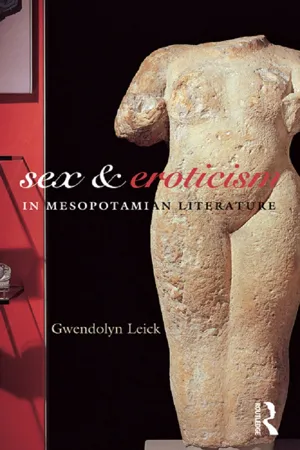
Sex and Eroticism in Mesopotamian Literature is a new contribution to current debates about sex and eroticism. It gives an insight into Mesopotamian attitudes to sexuality by examining the oldest preserved written evidence on the subject - the Sumero-Akkadian cuneiform sources - which were written between the 21st and the 5th centuries B.C. Using these long-neglected and often astonishing data, Gwendolyn Leick is able to anlayse Mesopotamian views of prostitution, love magic and deviant sexual behaviour as well as more general issues of sexuality and gender.
This fascinating book sheds light on the sexual culture of one of the earliest literate civilisations.
- 336 pages
- English
- ePUB (mobile friendly)
- Available on iOS & Android
eBook - ePub
Sex and Eroticism in Mesopotamian Literature
About this book
Part I
The Sumero-Akkadian Tradition of the Third and Early Second Millennia
1
The Cosmological Articulation of Sexuality
At some point every culture formulates beliefs about the origin of the familiar world. Sometimes, especially in literate societies, these concepts are worked into a coherent theory to account for the primary dynamics of the universe, the earth and ‘all that is therein’. But even when only certain aspects of life or society are traced to a primary stage, the patterns of thought involved reflect specific cultural conditions as well as experience common to all humanity that are projected into a primordial Other Time or Past.
Unlike the Greeks, Mesopotamian writers did not describe some of their literary works as ‘myths’ and they did not set out to compose ‘cosmogonies’. But many texts that concern the function and the deeds of deities or the origin of institutions have a mythological and cosmological framework. By beginning this examination of eroticism and sexuality with a section on cosmology I am honouring a hallowed Mesopotamian scribal tradition.
Scribes employed by a temple tended to focus on the god/dess they served and their cosmogonic speculations were related to the prevalent theological thought associated with these deities. The relative currency of their cosmological pattern varied with the rise and fall in the political fortunes of the gods’ cities and temples. There were also regional differences. All this is common to literary production in polytheistic systems. We need only think of the various creation myths in ancient Egypt, Greece or India.
In this chapter I shall not attempt to offer a comprehensive survey of all relevant cuneiform texts,1 but concentrate on the use of the sexual metaphor as it occurs in the various cosmogonic models.
In some aetiological narratives or ‘myths of origin’ the texts begin with the phrase ‘when so-and-so did not yet exist’ or ‘when so-and-so did not have a name’. The consequences of this absence are then described. For instance, before the appearance of cattle and grain, the gods had only grass to eat. We are then told of how an institution or commodity to remedy this situation was introduced. By elaboration this process can be taken further back to arrive at a primary stage of creation. This is generally characterized as undifferentiated and formless, but not Nothing. Mesopotamian cosmogonies, like those of most traditional cultures, do not invisage a creatio ex nihilo, but stress the inert potentiality of some prima materia. The beginning of creation is the beginning of a process of division and subdivision, the setting in motion of a dynamic principle. While in Egypt or India we find several analogies for this unfolding divergence, from the biological to the abstract, the Cosmic Egg to the Word of the Demiurge, the Mesopotamian systems have a strong anthropomorphic component and within this conceptual framework the most persistent pattern is that of sexual reproduction. The descent of generations of human beings has its equivalent in the sphere of divine beings and the forces of nature. Many ancient Near Eastern texts are therefore structured as retrogressive genealogies. The Book of Genesis, for instance, begins with the creation of Heaven and Earth, and then the organization of the world progresses to the first human couple, Adam and Eve, and their descendants down to the twelve sons of Joseph, who in turn are the ancestors of the Twelve Tribes of Israel.
But one must not take the strictly patrilinear structure of the Hebrew composition as the only possible model for integrating sexual metaphor in the cosmogonic process. The following models demonstrate that there was much more variation in the constituents of the primal scenario and the function and nature of reproduction and sexual roles.
The Southern or Eridu Model
Without trying to submit Mesopotamian mythology to a geographical reductionism it is worth considering that the natural features of a landscape do at times inform the imagery of mythical language. This is very obviously the case in much of the Australian or Native American material, but the impact of mountain peaks, rivers, lakes and springs, etc. is almost ubiquitous.
My division of the Mesopotamian system into a ‘southern’ and ‘northern’ model tries to correlate the terms ‘Eridu’ and ‘Nippur’ theology2 with their geographical situation. But it should not be taken as the basis of a binary orientation affecting Mesopotamian thought. Sumerian tradition held that ‘after kingship had descended from Heaven, Eridu became the first seat of kingship’.3
Eridu (the modern name of the site is Abu Shahrein) was situated at the edge of the great marshes. With their characteristic reed thickets and wide lagoons, they survive precariously in southern Iraq.4 The marshes have water in abundance but little stable land which can be used for large-scale growing of crops. Survival depends on a careful adaptation to the peculiar ecological conditions, and is not conducive to significant increase of population. The classical Mesopotamian civilization, however, was based on surplus production of cereals, made possible by putting normally arid zones under the plough and irrigating the land by an intricate system of canals, dikes and ditches. In these basically desert conditions, water was of fundamental importance to the economy. It became one of the most significant symbols for representing well-being, fertility and creation. The marshes of the South may well have actually been one of the oldest habitats of Mesopotamia (Green 1975:47–50), as the native tradition always maintained. Their proximity to the wide lagoons contributed to the formulation of the so-called Eridu theology. The basic symbol associated with Eridu is ENGUR (Labat No. 484); its main temple was called E.engura. The same sign preceded by the symbol for ‘water’ was used as a determinative for waterways, river, canal, lake, etc. The realm of the divine in this context is not the sky or the earth, but water. The sign ENGUR can also be read as nammu. This is a synonym of abzu, which is usually translated as the ‘watery deep’ or ‘sweet water ocean’ and defined as the subterranean source of water that emerges from the ground, from wells and springs, not rain-water. The importance of the abzu was recognized in the ritual. Temples throughout Mesopotamia and throughout history had basins or pools to symbolize and represent the abzu. Sumerian texts describe the abzu as lying below the surface of the earth, where the water deity lives. In later mythological texts, most notably in the Babylonian Enuma eliš (see below pp. 14–15), Apsû (the Akkadian form of abzu) is personified as male.
The Sumerian personification of ENGUR was female and called Nammu. God-lists and other texts describe her as ‘the mother who gave birth to Heaven and Earth’, ‘mother, first one, who gave birth to the gods of the universe’5 or as ‘Mother of Everything’. She is a goddess without a spouse, the self-procreating womb, the primal matter, the inherently fertile and fertilizing waters of the abzu. Nammu stands for the female sex as the one apparently able to create spontaneously, as expressed in a hymn to the temple of Eridu; ‘E. engura, womb of abundance’.6 Nammu does not play a significant role in the corpus of texts that has survived, nor was she much of a mythological personality. She may either belong to an older stratum of Sumerian or pre-Sumerian deities who did not become subjects of literary compositions, or owe her appearance in the hymns and god-lists to a tendency to anthropomorphize general concepts such as abzu or ENGUR and thereby integrate it into the Sumerian pantheon but without really becoming a ‘character’.
In Eridu itself, the archaeologists discovered a long series of shrines and temples.7 The first solid structure, a little room made of mud-brick, dates from the late sixth millennium. We do not know who was worshipped there, since the earliest cuneiform records date from the first quarter of the third millennium, and they associate Eridu with a male deity, Enki. Enki’s name bears no obvious connection with water, unless one concedes that ki can also stand for ‘below’. He is known as the son of Nammu and there has been some argument that Nammu’s divine functions had at some stage been transferred to her son,8 as he is never considered to be at the origin of creation himself. Enki always remains the Son. His mythological personality is very complex, partly because of the many associations with water: he became a god of wisdom, crafts and magic, also of fertility; and we shall see that he even achieved some status as a phallic and creator god. At any rate, he sometimes appears as a Trickster.
In the Babylonian tradition, ENGUR, the self-contained prima materia, is split into two components, Apsû and Tiāmat. Grammatically speaking, Apsû is masculine and Tiāmat (etymologically related to the Semitic word for ‘sea’) is feminine. The ‘Single Mother’ matrix is hereby replaced by a couple to represent the primary constituents of the universe. The important Babylonian text from the late second millenium, called Enuma eliš after its initial words, describes the beginning of the universe:
When on high heaven had not (yet) been created,
Earth below had not (yet) been brought into being,
When Apsû primeval, their begetter,
Primal Tiāmat, their progenitress,
(Still) mingled their waters together,
When no grassland had been formed, no reed thicket laid out,
When no gods whatever been brought into being,
Were not yet existent, their destinies undetermined,
(At that time) the gods were created within them.
(Held 1976:231)
The Assyrian version specifies that Ea (the Sumerian equivalent of Enki) and his wife Damkina were the first pair of gods created, while the Babylonian text has the sequence Lahmû-Lahāmu, Anšar-Kišar, followed by Ea. The text explicitly states that the Apsû and Tiāmat ‘mingled their waters’. This might mean that they constitute de facto one element (though, as often explained, probably as a mixture of sweet and salty waters). On the other hand, this mingling has been interpreted as a metaphor for sexual procreation (Lambert 1981:220), although this text generally avoids sexual metaphors. The first generations of gods were torn within the undifferentiated body of water, and even the later deities just emerge, complete, with their respective spouses. For the sake of symmetry and perhaps for the benefit of an audience no longer familiar with matrilinear references, the primal matter was artificially divided into complementary, male-female elements. But the older model of a singular source of life is still easily recognizable. It is also interesting that, in the course of the narrative, it is the female of the original couple, Tiāmat, who poses the most serious threat to the younger generation of gods, after her husband, Apsû, had been vanquished by his own ‘grandson’, Ea-Enki. The ensuing events, especially the ideas that the ordering of the universe could only take place after the violent overthrow of Tiāmat, is quite another subject and cannot concern us here.
The Eridu model assumes the primacy of the watery element, represented by the symbol of ENGUR=Abzu=Nammu, the sweet-salty, mud-marsh lagoon, teeming with life. The mythological signifier of the dynamic creative aspect is Nammu, while Apsû stands for the inert, permeable ubiquity that characterizes the physical element. Subsequent differentiation within creation occurs spontaneously and randomly. It is important to note that reproduction depending on heterosexual mating is not a primary metaphor in this model. However, this does not exclude erotic connotations: the marshes were the proverbial locus for sexual encounters (see later) and the connotations of abundance, seeping moisture, soft mud, etc. have sensuous overtones of a feminine and/or autoerotic kind. There is an interesting parallel in the ancient Lower Egyptian cosmogony of Heliopolis, which was also situated in ...
Table of contents
- Cover
- Half Title
- Title Page
- Copyright
- Dedication
- Contents
- List of plates
- Preface
- Acknowledgements
- Notes for non-Assyriologist readers
- Abbreviations
- Chronological chart
- Introduction
- Part I: The Sumero-Akkadian tradition of the third and early second millennia
- Part II: Sources from the later second and first millennia
- Glossary
- Notes
- Bibliography
- Index
Trusted by 375,005 students
Access to over 1.5 million titles for a fair monthly price.
Study more efficiently using our study tools.
Frequently asked questions
Yes, you can cancel anytime from the Subscription tab in your account settings on the Perlego website. Your subscription will stay active until the end of your current billing period. Learn how to cancel your subscription
No, books cannot be downloaded as external files, such as PDFs, for use outside of Perlego. However, you can download books within the Perlego app for offline reading on mobile or tablet. Learn how to download books offline
Perlego offers two plans: Essential and Complete
- Essential is ideal for learners and professionals who enjoy exploring a wide range of subjects. Access the Essential Library with 800,000+ trusted titles and best-sellers across business, personal growth, and the humanities. Includes unlimited reading time and Standard Read Aloud voice.
- Complete: Perfect for advanced learners and researchers needing full, unrestricted access. Unlock 1.5M+ books across hundreds of subjects, including academic and specialized titles. The Complete Plan also includes advanced features like Premium Read Aloud and Research Assistant.
We are an online textbook subscription service, where you can get access to an entire online library for less than the price of a single book per month. With over 1.5 million books across 990+ topics, we’ve got you covered! Learn about our mission
Look out for the read-aloud symbol on your next book to see if you can listen to it. The read-aloud tool reads text aloud for you, highlighting the text as it is being read. You can pause it, speed it up and slow it down. Learn more about Read Aloud
Yes! You can use the Perlego app on both iOS and Android devices to read anytime, anywhere — even offline. Perfect for commutes or when you’re on the go.
Please note we cannot support devices running on iOS 13 and Android 7 or earlier. Learn more about using the app
Please note we cannot support devices running on iOS 13 and Android 7 or earlier. Learn more about using the app
Yes, you can access Sex and Eroticism in Mesopotamian Literature by Dr Gwendolyn Leick,Gwendolyn Leick in PDF and/or ePUB format, as well as other popular books in History & Ancient History. We have over 1.5 million books available in our catalogue for you to explore.