- 512 pages
- English
- ePUB (mobile friendly)
- Available on iOS & Android
eBook - ePub
About this book
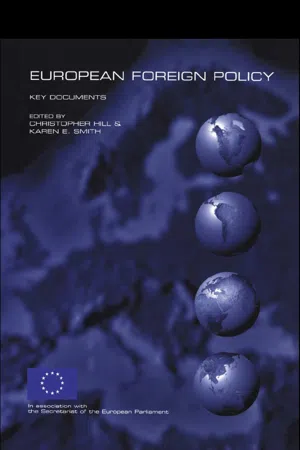
This book is the very first to collect together the key official documents tracing the development of European foreign policy from the end of the Second World War to the present day. It contains:
*all important documents on European foreign policy from 1948 to the Kosovo crisis
*material from major treaties such as The North Atlantic treaty, the treaty of Rome and the treaty of Amsterdam
*European responses to major world events such as the Middle East peace process, the Falklands war and the Balkans crisis
*detailed commentary and analysis of the documents providing a valuable political and historical context
*many documents which are extremely difficult to obtain elsewhere.
The unparalleled coverage makes this book an essential primary source for all those interested in European politics and International Relations.
Information
Section 1 The beginnings
The origins of change often turn out to have been working away by stealth with hardly anyone noticing, even those who will ultimately be awarded the historical credit. In the case of European foreign policy, or the collective diplomacy of the European Union, there are roots to be traced back well beyond the formal act of creation in 1970, when the Luxembourg Report gave birth to European Political Cooperation. Right from the beginning of the post-war period it had been evident to the leaders of the democratic states of western Europe, albeit in very different ways, that the traditional emphasis on flexible national diplomacy, and no permanent entanglements, was not going to be sufficient to cope with a world in which the two emerging superpowers were taking a close interest in Europe’s fate, and where national defence seemed likely to be forever compromised by the arrival of nuclear weapons. Looking back, the broad historical conditions were in place for the eventual emergence of a form of foreign policy cooperation among some European states, and the emergence of these conditions can be traced back over the period 1945–70.
At first, however, the vision was much more myopic and specific: how to deal with Germany. France, emerging from four years of Nazi occupation, felt itself intensely vulnerable to a German revival, while Britain, once again exhausted by the effort of victory, was sent into shock by the rapidity with which the United States distanced itself from its erstwhile ally, ending both lend-lease and nuclear cooperation in 1946, and forcing sterling into a damaging convertibility in 1947. It was, then, hardly surprising that Paris and London, which had engaged in early forms of military integration from 1905 to 1918, and had considered even political union amid the hysteria of May–June 1940, should turn again to the possibility of an alliance.
Alliances are not, in fact, at all the same thing as foreign policy cooperation. Their traditional concern is to establish a casus foederis in the event of a military attack. However, such a commitment always implies a diplomatic alignment, and in modern conditions of detailed contingency planning and transnational bureaucracies, it produces pressures for the harmonization of policies across a much wider range than that deriving from the mutual defence obligation. Thus the alliances formed in the aftermath of the Second World War turned out to have great significance for the overall pattern of international politics, not least in terms of the permanent division between the states of eastern and western Europe.
The latter group was primarily organized around the powerful outside force of the United States, which certainly acted as Europe’s external pacifier. But this did not rule out the development of a foreign policy system among the West Europeans themselves which was in large part the product of a need to cope with the consequences of American world power. Nor did the United States itself shrink from promoting a phenomenon which theoretically at least could have produced a serious rival to its own dominance. It fostered the European Defence Community (EDC) initiative of 1952 (document 1/6) and the Political Community of 1953 (document 1/7). Even American support was not sufficient to prevent the failure of these over-ambitious schemes, but the very attempt helped to prepare the ground for future, more practical developments. Furthermore smaller building blocks were also being put in place, such as the Anglo-French Dunkirk Treaty of 1947, and the Treaty of Brussels of 1948 (document 1/1).
The shipwreck of the EDC was salvaged by the British-inspired WEU deal of 1954. This built on the Brussels Treaty between Britain and what were soon to become the Six of the European Economic Community (EEC) to create a mutual defence pact which contained (in Article V) the automatic assistance clause that the North Atlantic Treaty Organization (NATO) lacked (its own Article V provides only for an individual member to take ‘such action as it deems necessary’ in the event of an armed attack on a partner) and the means for Germany to rearm within the context of a ‘normal’ alliance not solely aimed at protecting its partners from itself, even if their troops were increasingly to be based on German soil (document 1/8). Thus the Atlanticism of NATO (document 1/2) began to be paralleled by more discrete European arrangements.
On the West European front, however, foreign policy cooperation would have to wait for the foundations of functional cooperation to be laid down and consolidated. Extracts from the Schuman Plan (document 1/4) are included here both because they represent the beginnings of European integration and because they show the whole integration process was launched for reasons of international relations—to prevent a recurrence of the Franco-German conflicts which had brought Europe and the world to catastrophe twice in a generation. The same applies to the Treaty of Rome in 1957 (document 1/9) which gave birth to the European Economic Community, with its own consequential external economic relations—perhaps the sine qua non of the eventual development of European Political Cooperation. The relevant sections of the treaty are included—that is, those on the common commercial policy (CCP) and agreements with third countries, as the possibility of a common foreign policy is not mentioned—together with those articles from the Single European Act of 1987 (document 2/15), the Treaty of European Union (the Treaty of Maastricht) of 1993 (document 2/20) and the Treaty of Amsterdam of 1997 (document 2/22 which have modified the CCP. These relate, in particular, to Articles 113, 228 (the Commission’s negotiating powers), 235 (sanctions), 237 (membership) and 238 (association agreements).
The creation of a system of diplomatic coordination did not, however, depend on linear progress in the supranational realm. It could, indeed, be proposed as an alternative to supranationalism, as General de Gaulle did with the Fouchet Plans of 1961–2 (documents 1/10 and 1/11). This attempt to refashion the whole EEC in the image of an inter-state, foreign policy-led association foundered on the opposition of the other five, but it undoubtedly provided an impetus and a blueprint for the eventual emergence of EPC. There were other important foundations being laid for foreign policy coordination, too, in the 1960s. The 1963 Elysée Treaty between France and Germany (document 1/12) began the system of bilateral consultations which has turned out to be one of the key locomotive forces in European integration, while the Harmel Report of 1967 on the Atlantic Alliance (document 1/13) was most influential in its insistence that relations with the eastern bloc had to be based on detente as well as deterrence. This concern for balance was increasingly a distinguishing mark of an emerging European perspective on the Cold War, and it was, in a very short time, to take on an institutional form.
The Brussels Treaty
Reflecting the increasing western preoccupation with the Soviet Union over 1947–8, the Brussels Treaty, committing Britain, France and the Benelux countries to each others’ defence, had a more universal orientation than the Treaty of Dunkirk, of 1947 although it too referred explicitly to a possible German threat. Article IV provided for automatic assistance in the event of attack and was therefore a much stronger commitment than the NATO Treaty (see document 1/2) which was to follow a year later. The Brussels Treaty, due to expire in 1998, but with the same possibilities of renewal as that of Dunkirk, was the basis of the Paris Agreements of 1954, which set up the WEU and the eventual moving together of the EU and the WEU via the treaties of Maastricht and Amsterdam (see documents 1/8, 2/18 and 2/22).
Document 1/1 Treaty of Economic, Social and Cultural Collaboration and Collective Self-Defence between the United Kingdom of Great Britain and Northern Ireland, Belgium, France, Luxembourg and the Netherlands (The Brussels Treaty), Brussels, 17 March 1948
[The Signatories]
Resolved
To reaffirm their faith in fundamental human rights, in the dignity and worth of the human person and in the other ideals proclaimed in the Charter of the United Nations;
To fortify and preserve the principles of democracy, personal freedom and political liberty, the constitutional traditions and the rule of law, which are their common heritage;
To strengthen, with these aims in view, the economic, social and cultural ties by which they are already united;
To co-operate loyally and to co-ordinate their efforts to create in Western Europe a firm basis for European economic recovery;
To afford assistance to each other, in accordance with the Charter of the United Nations, in maintaining international peace and security and in resisting any policy of aggression;
To take such steps as may be held to be necessary in the event of a renewal by Germany of a policy of aggression;
To associate progressively in the pursuance of these aims other States inspired by the same ideals and animated by the like determination;
Desiring for these purposes to conclude a treaty for collaboration in economic, social and cultural matters and for collective self-defence;
• • •
have agreed as follows:—
ARTICLE I
Convinced of the close community of their interests and of the necessity of uniting in order to promote the economic recovery of Europe, the High Contracting Parties will so organise and co-ordinate their economic activities as to produce the best possible results, by the elimination of conflict in their economic policies, the co-ordination of production and the development of commercial exchanges.
The co-operation provided for in the preceding paragraph, which will be effected through the Consultative Council referred to in Article VII as well as through other bodies, shall not involve any duplication of, or prejudice to, the work of other economic organisations in which the High Contracting Parties are or may be represented but shall on the contrary assist the work of those organisations.
ARTICLE II
The High Contracting Parties will make every effort in common, both by direct consultation and in specialised agencies, to promote the attainment of a higher standard of living by their peoples and to develop on corresponding lines the social and other related services of their countries.
The High Contracting Parties will consult with the object of achieving the earliest possible application of recommendations of immediate practical interest, relating to social matters, adopted with their approval in the specialised agencies.
They will endeavour to conclude as soon as possible conventions with each other in the sphere of social security.
ARTICLE III
The High Contracting Parties will make every effort in common to lead their peoples towards a better understanding of the principles which form the basis of their common civilisation and to promote cultural exchanges by conventions between themselves or by other means.
ARTICLE IV
If any of the High Contracting Parties should be the object of an armed attack in Europe, the other High Contracting Parties will, in accordance with the provisions of Article 51 of the Charter of the United Nations, afford the Party so attacked all the military and other aid and assistance in their power.
ARTICLE V
All measures taken as a result of the preceding Article shall be immediately reported to the Security Council. They shall be terminated as soon as the Security Council has taken the measures necessary to maintain or restore international peace and security.
The present Treaty does not prejudice in any way the obligations of the High Contracting Parties under the provisions of the Charter of the United Nations. It shall not be interpreted as affecting in any way the authority and responsibility of the Security Council under the Charter to take at any time such action as it deems necessary in order to maintain or restore international peace and security.
ARTICLE VI
The High Contracting Parties declare, each so far as he is concerned, that none of the international engagements now in force between him and any other of the High Contracting Parties or any third State is in conflict with the provisions of the present Treaty.
None of the High Contracting Parties will conclude any alliance or participate in any coalition directed against any other of the High Contracting Parties.
ARTICLE VII
For the purpose of consulting together on all the questions dealt with in the present Treaty, the High Contracting Parties will create a Consultative Council, which shall be so organised as to be able to exercise its functions continuously. The Council shall meet at such times as it shall deem fit.
At the request of any of the High Contracting Parties, the Council shall be immediately convened in order to permit the High Contracting Parties to consult with regard to any situation which may constitute a threat to peace, in whatever area this threat should arise; with regard to the attitude to be adopted and the steps to be taken in case of a renewal by Germany of an aggressive policy; or with regard to any situation constituting a danger to economic stability.
ARTICLE VIII
In pursuance of their determinati...
Table of contents
- Cover Page
- Title Page
- Copyright Page
- Preface
- Section 1 The beginnings
- Section 2 EPC/CFSP—institutional developments
- Section 3 The revival of the WEU and the evolution of a European security identity
- Section 4 Major policy developments
- Appendix
Trusted by 375,005 students
Access to over 1.5 million titles for a fair monthly price.
Study more efficiently using our study tools.
Frequently asked questions
Yes, you can cancel anytime from the Subscription tab in your account settings on the Perlego website. Your subscription will stay active until the end of your current billing period. Learn how to cancel your subscription
No, books cannot be downloaded as external files, such as PDFs, for use outside of Perlego. However, you can download books within the Perlego app for offline reading on mobile or tablet. Learn how to download books offline
Perlego offers two plans: Essential and Complete
- Essential is ideal for learners and professionals who enjoy exploring a wide range of subjects. Access the Essential Library with 800,000+ trusted titles and best-sellers across business, personal growth, and the humanities. Includes unlimited reading time and Standard Read Aloud voice.
- Complete: Perfect for advanced learners and researchers needing full, unrestricted access. Unlock 1.5M+ books across hundreds of subjects, including academic and specialized titles. The Complete Plan also includes advanced features like Premium Read Aloud and Research Assistant.
We are an online textbook subscription service, where you can get access to an entire online library for less than the price of a single book per month. With over 1.5 million books across 990+ topics, we’ve got you covered! Learn about our mission
Look out for the read-aloud symbol on your next book to see if you can listen to it. The read-aloud tool reads text aloud for you, highlighting the text as it is being read. You can pause it, speed it up and slow it down. Learn more about Read Aloud
Yes! You can use the Perlego app on both iOS and Android devices to read anytime, anywhere — even offline. Perfect for commutes or when you’re on the go.
Please note we cannot support devices running on iOS 13 and Android 7 or earlier. Learn more about using the app
Please note we cannot support devices running on iOS 13 and Android 7 or earlier. Learn more about using the app
Yes, you can access European Foreign Policy by Christopher Hill,Karen E. Smith in PDF and/or ePUB format, as well as other popular books in Politics & International Relations & Diplomacy & Treaties. We have over 1.5 million books available in our catalogue for you to explore.