- 152 pages
- English
- ePUB (mobile friendly)
- Available on iOS & Android
eBook - ePub
About this book
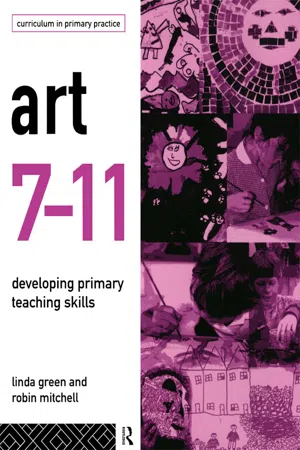
Aimed at non-specialist primary teachers, this book offers support for the two attainment targets of the national cuuriculum in art: investigating and making, and knowledge and understanding. It uses examples and materials to explore various areas of children's development in art making and understanding, and also aims to equip teachers with strategies for developing their own understanding and appreciation of the subject. Units included cover such areas as:
* children's motivation to make art
* developing co-operative work with artists in schools
* learning about art from other cultures
* learning about art from different historical periods
* 2D and 3D art
* assessing children's art
Information
Topic
EducationSubtopic
Education General Unit 1
What counts as art? Developing an understanding of the subject
In early November 1992 Julian Champkin, writing in the Daily Mail, reported:

Quite a question, if you are not expecting it. Who comes to mind? Maybe Van Gogh? Would Monet get a look in, or if not, surely Rembrandt would? Not at all. The result was very unexpected:
Shock!! Horror!! More people have heard of Rolf Harris than Rembrandt. What a terrible indictment against the effectiveness of English art education, that it failed to instil in the memory of the average London pedestrian any knowledge of art and artists. This may be so, but more importantly we need to know why the majority of respondents thought of Harris. He is a picture maker, a performer, a person who can demonstrate the ability to conjure up an image with a few deft brushstrokes. There is an element of magic about his artistic TV performances—his brushstrokes initially give the viewer few clues to the image, but before the viewer’s very eyes the magic works and the picture falls into place like some miraculous vision. The wizard has performed his trick and behold, the result.
The artist as magician has a very ancient lineage, from the cave paintings of Lascaux, mask-making and tribal dancing from all cultures, to the multi-media and sometimes exploding kinetic sculpture of Tinguely. Somehow an element of this magic still survives. No matter how much of a cliché the pictorial image may be, the result still stirs in the spectator a sense of wonder at the demonstration of skill which is beyond that of the spectator. To be really successful for present-day onlookers, whatever image or picture is being constructed, it must strike a chord of recognition, identification and understanding.
TRADITIONS, IMAGES AND SYMBOLS
The philosopher David Best proposes, ‘in the most fundamental sense, the meaning of the arts, as of language, is rooted in human actions and responses and cultural practices’ (Best 1992:16).
All works of art draw on human actions and cultural practices. They are a particular kind of response made by an artist working within a set of cultural traditions. The art work subsequently becomes a new addition to that culture. In order to identify with a work of art the spectator must be able to place it within his or her own previous experience of what they understand as art. This art may be within a genre—for example many of Rolf Harris’ illustrations will correspond to the spectator’s memory of Walt Disney’s images. Both sets of images are easy to understand, and they carry a straightforward emotional charge. They are often sentimental and relate to a world that exists within the imagination but also refer to some touchstones of human experience, for example the complexity of feeling which surrounds our relationship with the natural and animal worlds.
However, other easily recognisable symbols signify meanings and associations beyond the simple form of their illustration. For example, the crucifix and the Coca-Cola bottle are icons which are readily understood by the population at large, albeit at different levels. Consider the crucifix. The manner and range of its use is extensive. It may appear as a decorative and superficial adjunct to fashion, but in contrast denotes the whole complexity of Christian thought and faith. Similarly, the Coca-Cola bottle may illustrate the product itself but can also represent or symbolise the content and style of modern American capitalist culture. These cultural icons are part of the childhood and everyday lives of many people. Commercial advertising regularly uses simple, commonly recognisable images to convey more complex messages and stimulate emotional responses in their recipients. This is the stuff of everyday life, but it also indicates a central concern of art education.
The result of the survey mentioned earlier, and similar evidence, gives rise to much anxiety on the part of many art educators. Rod Taylor, in the introduction to his seminal work Educating for Art, lists a number of major anxieties which were being increasingly expressed about art education. Two principle issues were:
2 The majority of art teachers had rejected the art history lecture as a means of giving pupils an understanding of the visual arts and of art and craft objects.
(Taylor 1986:xi)
Can the Daily Mail survey be seen as further evidence to suggest that our efforts to educate the population about the visual arts and the world’s greatest artists has come to nothing? This may be the case, but it is possible to take a less pessimistic view. When asked to name a ‘well-known artist’ what the people in the survey may have had in their minds was the practical processes and craft skills of making art, not necessarily the quality of the ‘artist’s’ picture. We suspect that a different question, asking people to identify a picture rather than an artist, would have elicited The Hay Wain, the Mona Lisa, David Shepherd’s paintings of charging elephants, or various paintings by Renoir and Monet. We may therefore speculate that most people’s knowledge of art relates to two separate but related things, artefacts and artists. We recognise certain artefacts as being ‘art’, for example a painting in a friend’s sitting room or a marble sculpture of a reclining figure in an art gallery. We recognise the ceramics, woven hangings and prints on sale at craft fairs as ‘art’ and acknowledge the graphic design of posters as art work. Secondly, we acknowledge that artists make these objects.
There is another interesting factor at work here that may have influenced the respondents. Some artists, by the very nature of their work, are innovative and produce novel, original ideas which challenge our view of the world and ways of looking at things. This challenge presents problems for us as onlookers and often our understanding of contemporary artefacts is severely limited. It seems to take society a while to develop the understanding necessary to relate to the work. An example of this is the way in which the work of the Impressionists was initially received. In the late nineteenth century the work outraged the critics and aroused derision and scorn; yet now we delight in the works of Monet and Renoir and recognise their worth.
The fact that some new art is difficult to understand may explain why for most people modernist twentieth century art in almost any form is suspect—hence the choice of Rolf Harris rather than, say, Francis Bacon.
A further factor that can ‘distance’ art from everyday life is the prevailing view that artists behave in unusual ways and do not live in the ‘real’ world. This stems partly from nineteenth century legend, constructed around artists like Van Gogh and Gauguin, but mostly it is based on a deeper and more ancient myth, that of the artist as magician and priest. Gombrich speculates about the artist in this role when discussing the cave paintings at Lascaux:
(Gombrich 1972:22)
One of the purposes of art education is to start with popular opinion and develop from that a raft of understandings about art, through considering the nature of art and the lives of artists. This will bring about increased awareness, and, combined with practical art making, may create a deeper understanding of the subject in its cultural and historical context. It will enable the learner to make personal, meaningful art work and also to employ ways of representing significant events and feelings which share a common language with great artists.
In order to explore this notion and to help you make connections between your everyday life experiences and the world of art, find a colleague to do the following activity with you.
TEACHER ACTIVITY 1.1
‘Reading’ a picture
Plates 1 and 2 show two works by famous artists, A dance at the Moulin de la Galette by Renoir and The raft of the Medusa by Géricault.
- Regarding the subject matter, what do you think the picture is about?
- What are the main artistic devices that the artist has used (such as line, colour, shape, form, texture, pattern, tone)? Think also about the predominant colour scheme, types of brushstrokes, use of light and shade, and composition.
- What atmosphere does the picture convey?
- How does the picture make you feel?
After responding to these two pictures you may conclude that one is about happiness and the other about disaster. Judging by most pictures on display in high street stores, it could be concluded that all pictures are about happy events, pleasant atmosphere and harmonious colour. These reproduction prints reflect the contemporary preference for lighthearted paintings. Other art forms, especially novels and ...
Table of contents
- COVER PAGE
- TITLE PAGE
- COPYRIGHT PAGE
- ILLUSTRATIONS
- ACKNOWLEDGEMENTS
- INTRODUCTION
- UNIT 1: WHAT COUNTS AS ART? DEVELOPING AN UNDERSTANDING OF THE SUBJECT
- UNIT 2: A KNOWLEDGE BASE FOR THE SUBJECT
- UNIT 3: MODELS FOR CHILDREN’S PROCESS OF LEARNING IN ART, AND TEACHING STRATEGIES TO SUPPORT LEARNING
- UNIT 4: CHILDREN AND THEIR ART
- UNIT 5: PLANNING A PROGRAMME—PRINCIPLES AND PRACTICE
- UNIT 6: PLANNING CLASSROOM ACTIVITIES WITH ASSESSMENT IN MIND
- UNIT 7: ON REFLECTION
- RESOURCES SECTION
- GLOSSARY OF TERMS USED
- REFERENCES
Trusted by 375,005 students
Access to over 1.5 million titles for a fair monthly price.
Study more efficiently using our study tools.
Frequently asked questions
Yes, you can cancel anytime from the Subscription tab in your account settings on the Perlego website. Your subscription will stay active until the end of your current billing period. Learn how to cancel your subscription
No, books cannot be downloaded as external files, such as PDFs, for use outside of Perlego. However, you can download books within the Perlego app for offline reading on mobile or tablet. Learn how to download books offline
Perlego offers two plans: Essential and Complete
- Essential is ideal for learners and professionals who enjoy exploring a wide range of subjects. Access the Essential Library with 800,000+ trusted titles and best-sellers across business, personal growth, and the humanities. Includes unlimited reading time and Standard Read Aloud voice.
- Complete: Perfect for advanced learners and researchers needing full, unrestricted access. Unlock 1.5M+ books across hundreds of subjects, including academic and specialized titles. The Complete Plan also includes advanced features like Premium Read Aloud and Research Assistant.
We are an online textbook subscription service, where you can get access to an entire online library for less than the price of a single book per month. With over 1.5 million books across 990+ topics, we’ve got you covered! Learn about our mission
Look out for the read-aloud symbol on your next book to see if you can listen to it. The read-aloud tool reads text aloud for you, highlighting the text as it is being read. You can pause it, speed it up and slow it down. Learn more about Read Aloud
Yes! You can use the Perlego app on both iOS and Android devices to read anytime, anywhere — even offline. Perfect for commutes or when you’re on the go.
Please note we cannot support devices running on iOS 13 and Android 7 or earlier. Learn more about using the app
Please note we cannot support devices running on iOS 13 and Android 7 or earlier. Learn more about using the app
Yes, you can access Art 7-11 by Linda Green,Robin Mitchell in PDF and/or ePUB format, as well as other popular books in Education & Education General. We have over 1.5 million books available in our catalogue for you to explore.